a senior dev at my last startup quit after being denied a 10% raise.
management actually told him: "we're using cursor and ai devs now anyway, your role is mostly maintenance."
two weeks later:
the entire database architecture started lagging by 400ms out of nowhere.
turns out he had a custom cron job running that silently patched memory leaks every single night at 3 am.
management tried dumping the codebase into LLMs to find the bug, but the models obviously couldn't trace a silent leak buried in undocumented legacy infra.
he never documented it because leadership always screamed that refactoring was a "waste of shipping time."
the biggest mistake founders are making right now is thinking ai code generation replaces actual system knowledge.
generating text isn't the same thing as understanding why a complex system fails.
the most expensive engineers aren't the ones asking for a raise, they're the invisible ones keeping your product from melting down.
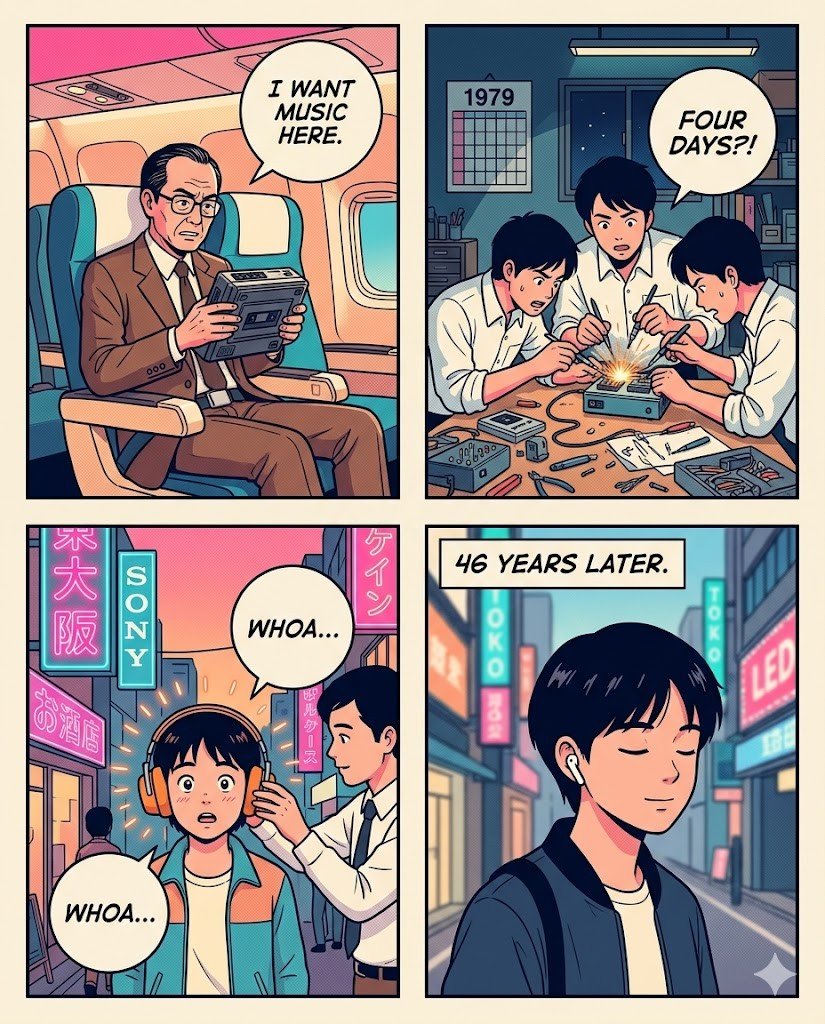
1979.
A 71-year-old Japanese man wanted to listen to music
on a plane.
So he asked his company's engineers to build something.
In 4 days, they ripped the recorder out of an old
cassette machine, added headphones, and handed it to him.
Nobody believed it would sell.
"A cassette player that can't even record? Who needs that?"
Even Sony's own marketing team had doubts.
First month: 3,000 units. A flop.
Then Sony did something insane.
They went to Tokyo's busiest streets,
walked up to strangers,
and put the headphones on their ears.
That's when it happened.
People stood there. Frozen.
Hearing music nobody else around them could hear.
Walking through the city with their own soundtrack.
By August, 27,000 units. Sold out.
By 1989, 50 million sold.
The man was Masaru Ibuka, co-founder of Sony.
The product was called the Walkman.
It didn't just sell music.
It invented a new way of being alone in public.
46 years later, you're wearing his invention right now.
One thing I was unprepared for in the professional world was how loyalty is rewarded.
There was this one employee who had worked at the company for 8 years.
He had moved closer to the office more than most of his co-workers.
He was always hardworking, committed, and never missed a day at work. Going overtime without pay never bothered him.
One afternoon, he accidentally saw his co-worker’s paycheck — a colleague who had been there barely six months and was being trained by him.
He couldn’t believe his eyes. The new hire was earning twice his salary, yet they had the same title, responsibilities, and level.
He arranged a meeting with his boss.
“Market rates have changed. We can’t adjust for everyone,” his boss said, defending the new hire.
He replied, “So loyalty is penalized?”
“That’s not how I’d phrase it.” The boss was getting cornered.
He insisted, “How would you phrase it?”
Boss was getting uneasy, “We value your contributions.”
He continued to push his boss: “But not enough to pay me fairly?”
The boss answered, “Our hands are tied,” and closed the meeting.
After that meeting, he realized his hands weren’t tied and began applying and interviewing for multiple roles in his profession.
Two months later, he landed a new role with three times his previous salary.
His old company posted his replacement role at the salary he had asked for.
The money is there. It’s just not there for people who don’t ask — or don’t leave.
Your loyalty won’t be rewarded. Your leverage will.
Biggest lesson EMPLOYMENT has taught me:
1. HR is not your friend. They are there to protect both the employee and the company.
2. Document EVERYTHING.
3.Train and develop yourself to be relevant in that place of work
4. Everyone is replaceable.
5. Your family and mental health is more important than any job.
6. Some of your coworkers secretly hate you.
7. Never stay at one job longer than 4 years unless the pay increase is substantial.
8. Don’t let them promote you in title but not in compensation.
9. Keep your personal life private. Do not overshare.
The damage is done.
When you terminate an employee due to performance issues, office politics, or force them to resign by creating a toxic environment — remember this:
They will move on.
In a few months, they’ll find better opportunities, rebuild their confidence, and thrive elsewhere.
But they’ll never forget how you treated them —
How you shouted, humiliated, and misunderstood them, simply because your ego got in the way of basic empathy.
They might never speak about it.
But they’ll carry the scars — silently.
Power should never come at the cost of someone’s dignity.
Boss: “You arrived 10 minutes late.”
Employee: “Yesterday I stayed late finishing that last-minute report.”
Boss: “I understand… but rules are rules.”
The next day, the employee arrived exactly on time.
And at 6:00 p.m. sharp, shut down the computer.
No extra emails. No work taken home.
If punctuality is non-negotiable, then effort must have boundaries too.
Recognition cannot be one-sided.
When mistakes are highlighted but dedication is ignored, the real message becomes clear:
“Do only what’s required. Nothing more.”
Empathy costs nothing.
The absence of it? That can cost you everything—especially your best people
Boss: “You arrived 10 minutes late.”
Employee: “Yesterday I stayed late finishing that last-minute report.”
Boss: “I understand… but rules are rules.”
The next day, the employee arrived exactly on time.
And at 6:00 p.m. sharp, shut down the computer.
No extra emails. No work taken home.
If punctuality is non-negotiable, then effort must have boundaries too.
Recognition cannot be one-sided.
When mistakes are highlighted but dedication is ignored, the real message becomes clear:
“Do only what’s required. Nothing more.”
Empathy costs nothing.
The absence of it? That can cost you everything—especially your best people.
The greatest treason ANC ever committed was to kill education worse than apartheid has ever done. As a result unemployment of youth is 60% north.
They should have ensured the mass production of skills but instead have abandoned the few vocational schools.
For housing we rely on Zimbos.