When Trump says the Ukraine does not want to end the war, what he is really saying is that Ukraine does not want to surrender to a deal that he has worked out with Putin which would see the Ukrainians hand over more of their land and people.
Speaking the truth is important.
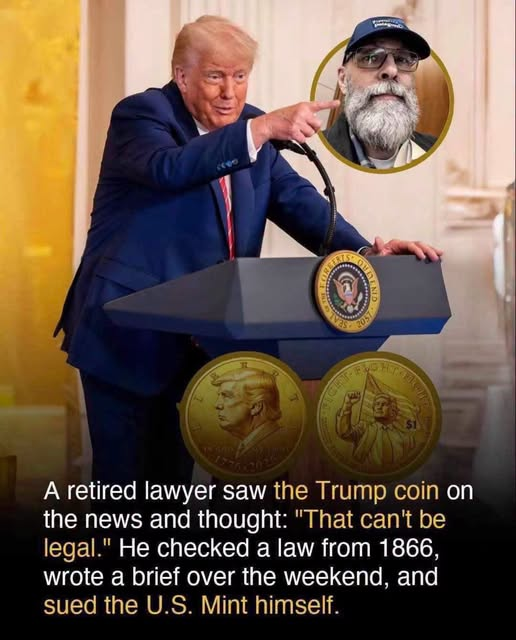
A retired lawyer saw a news story about Trump putting himself on a US coin. “This can’t be legal,” he thought.
So he looked up the law.
In 1866, Congress passed a federal statute banning the portraits of living individuals from appearing on U.S. currency. The law was created after a Treasury official put his own face on money during the Civil War.
The Trump administration recently approved a 24-karat gold coin featuring the president's face — intended for America's 250th anniversary on July 4, 2026. The U.S. Mint was prepared to begin production immediately.
So James Rickher — a retired federal employee and lawyer — spent a weekend writing a legal brief. On March 24, he filed a federal lawsuit to stop it.
"It's not just 'Hey, I don't like this,'" Rickher told reporters. "It's against the law."
The Trump administration argues that Treasury Secretary Scott Bessent has the authority to approve coin designs and that commemorative coins follow different rules than regular currency.
Rickher disagrees. He says the Secretary's discretion doesn't override the statute.
Here's what makes this more interesting — the bipartisan Citizens Coinage Advisory Committee, which normally reviews all new coin designs, declined to review this one. They raised concerns that putting a sitting president on currency could break with democratic norms.
The ONLY time a living president appeared on a U.S. coin was Calvin Coolidge in 1926. That coin was “congressionally authorized” and remains controversial to this day.
A federal judge will now decide. If no injunction is issued, minting begins.
Thank you to James for doing his part
As US Secretary of the Treasury @SecScottBessent clearly has absolutely no idea what he is talking about and asks “Where is Germany?” when it comes to the supply of Patriot fire units and missiles to Ukraine, I thought this might be a good time for an educational tweet.
Let's first talk about the supply of fire units and afterwards about the supply of missiles. Germany, Mr. Secretary, has in fact supplied more MIM-104 Patriot fire units to Ukraine than the US has, despite owning and operating only a fraction of what the US owns and operates. About half of Ukraine's MIM-104 Patriot fire units came from Bundeswehr stocks.
A total of five fully equipped MIM-104 Patriot fire units were supplied from Bundeswehr stocks between 2023 and 2025 alongside a few extra launchers and most likely a spare radar unit. Germany began donating Patriot related equipment to Ukraine at the same time the US has and still does it until this day while the US has long stopped donating this to Ukraine.
Let's now talk about missiles. Together with every fire unit, Germany also donated a missile package. Known donations included for example 100 missiles and 64 missiles. That's substantial, but of course, this only guaranteed the immediate operational readiness of said fire units, nothing else. We didn’t have our own production facilities and our stocks weren’t even remotely as well-stocked as those in the US. The US (led by Biden) actually kept those fire units alive.
In February 2025, before the delivery of the last two MIM-104 Patriot fire units took place, before various donations via PURL and JUMPSTART took place and before Germany made several smaller missile deliveries from its own stocks, the German MoD confirmed to have delivered 328 Patriot missiles of various versions. By now the number of Patriot missiles already financed and delivered should exceed 500 easily.
But what about what's happening now? Germany has shown multiple times since President Trump took office that it is leading in the organisation, funding and delivery of new ammunition for Ukraine's MIM-104 Patriot fire units.
The German government has multiple times organized or tried to organize new deliveries for Ukraine. For example, in February 2026, Germany was in talks with multiple nations to find a total of 35 PAC-3 missiles for Ukraine. After weeks-long negotiations, 30+ were actually donated as a result of the German initiative. Germany was also — on the highest levels — in talks with Spain and Greece for the delivery of additional missiles.
But of course, we are doing things beyond. A lot of things. As already mentioned, Germany is actively funding Patriot missiles from the US both via JUMPSTART and via PURL. You shouldn't forget @SecScottBessent, that we are paying you for this. As recently as June 2026, Germany spent a total of $200 million on PAC-3 missiles via JUMPSTART and another $200 million on various missiles via PURL. Total donations already exceed $1 billion.
And now to the final and biggest part: In April 2026, Germany announced an enormous missile package for Ukraine. Over the following years, Germany will spend €3.2 billion to finance 600 PAC-2 GEM-T missiles for Ukraine's MIM-104 Patriot fire units — made in Germany by the way.
So please don't ask what Germany is doing for Ukraine. We do more for Ukraine then anybody else, including the US. All you do now is getting paid billions for the bare minimum.
PS: For full transparency it must be noted that multiple nations like Denmark, Lithuania and Norway above all have supported Germany financially in the delivery or re-procurement of MIM-104 Patriot fire units and missiles.
Virginia, May 1862.
Before Little Bighorn. Before the legend. Before the disastrous final stand.
There was a young George Armstrong Custer, reclining beside a dog, staring into the camera with a look that almost seems to say he already knew he was destined for greatness.
Custer was a fascinating contradiction.
Charming, charismatic, courageous, and ambitious. But also impulsive, hot-tempered, and possessed of an ego that would become nearly as famous as the man himself.
He graduated last in his West Point class in 1861, yet rose to become one of the Union Army's youngest generals during the Civil War. He earned a reputation as a daring cavalry commander, willing to charge into danger when others hesitated.
He survived the Civil War and emerged a celebrated officer.
Fourteen years after this photograph, Custer and more than 200 men under his immediate command would perish at Little Bighorn, fighting Lakota, Northern Cheyenne, and Arapaho warriors in June 1876.
The young lieutenant in this photograph had no idea what awaited him.
There's a lesson buried in Custer's remarkable, deeply flawed life.
Confidence can inspire men to follow you into battle. Courage can carry you through impossible circumstances.
But confidence without humility can become arrogance. And arrogance, especially in command, can carry a terrible price.
Ego is the enemy.
Custer's story remains one of American history's most compelling reminders of that truth.
In 2000, miners working 300 metres (980 ft) beneath the Mexican desert broke into a cave. When inside, the scene looked almost impossible. Enormous transparent crystals were everywhere, some reaching 11 metres (36 ft) long.
This is Mexico’s Cave of the Crystals.
1/n
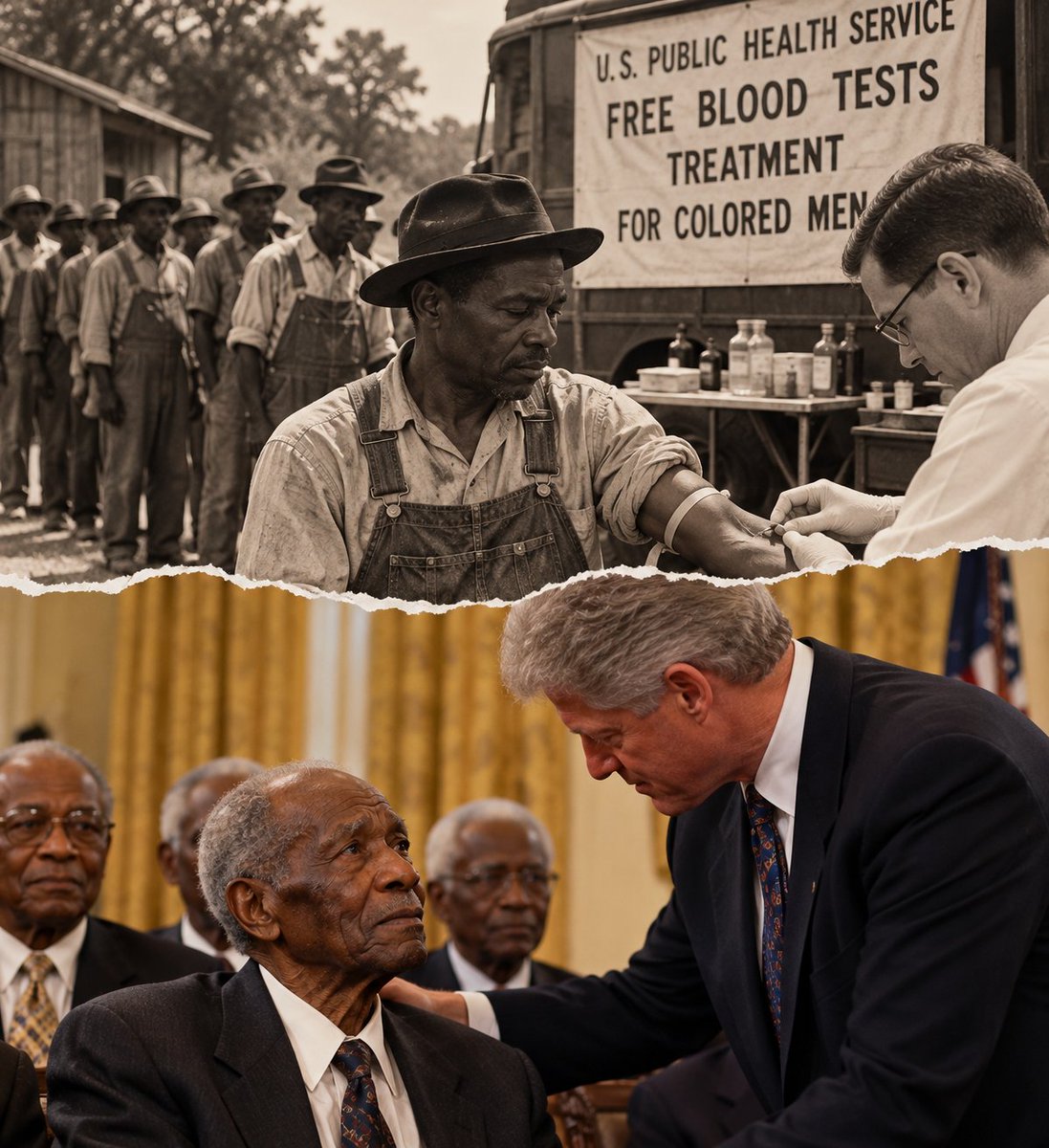
Charlie Pollard was a farmer in Macon County, Alabama. In the early 1930s he was in a crowd where government doctors were offering free blood tests, so he had one. He was told he had bad blood and should come back.
For four decades he came back. He got rides to the clinic. He got hot meals on clinic days. He got aspirin, tonics, and spinal taps that were described to him as treatment and were actually diagnostic procedures for the study. He was promised burial money.
What he was never given was penicillin, which became the standard cure in the late 1940s and which the study's doctors deliberately kept from him and from about four hundred other Black men, in order to watch untreated syphilis run its full course in the human body.
Nobody ever told him he had syphilis. He said so afterwards, plainly: he did not know what he had.
In July 1972 the Associated Press reporter Jean Heller broke the story, based on information from a public health worker named Peter Buxtun who had spent years trying to get someone to stop it.
Pollard got a phone call from a reporter. That is how he found out.
He went to a lawyer in Tuskegee named Fred Gray — the same Fred Gray who had represented Rosa Parks and Martin Luther King — and Pollard v. United States became the class action. It settled in 1974 for around $10 million and medical care for survivors and their families.
The study had run for forty years. It was stopped by a journalist, not by a doctor, not by a court, not by Congress.
In 1997 the survivors who were still alive were invited to the White House, and President Clinton apologised to them in person. Pollard was among the men in that room. He was in his nineties.
He had walked into a free clinic in the 1930s because somebody offered him a blood test.
19 October 1933 | Dutch Jewish boy, Herman Rudolf Odewald, was born in Amstedam.
He was deported to #Auschwitz from #Westerbork in February 1944. He was murdered in a gas chamber after arrival selection.
Vance: "I think Ukrainians should stop bombing Russian energy... I don't think that Ukraine should be in NATO."
NO ONE WAS TOUCHING THEIR PRECIOUS ENERGY UNTIL THEY INVADED US!
And maybe, just maybe, Russia should stop murdering Ukrainian civilians on a daily basis, JD? Maybe they shouldn't be murdering babies in their strollers in the park like they did today?
Maybe they should stop an almost 5-year-long bombing campaign against Ukrainian infrastructure designed to plunge us into a humanitarian disaster and force us to surrender? How about that?
Or, hear me out, maybe they should fuck off back across the border, and then no one will bomb them again?
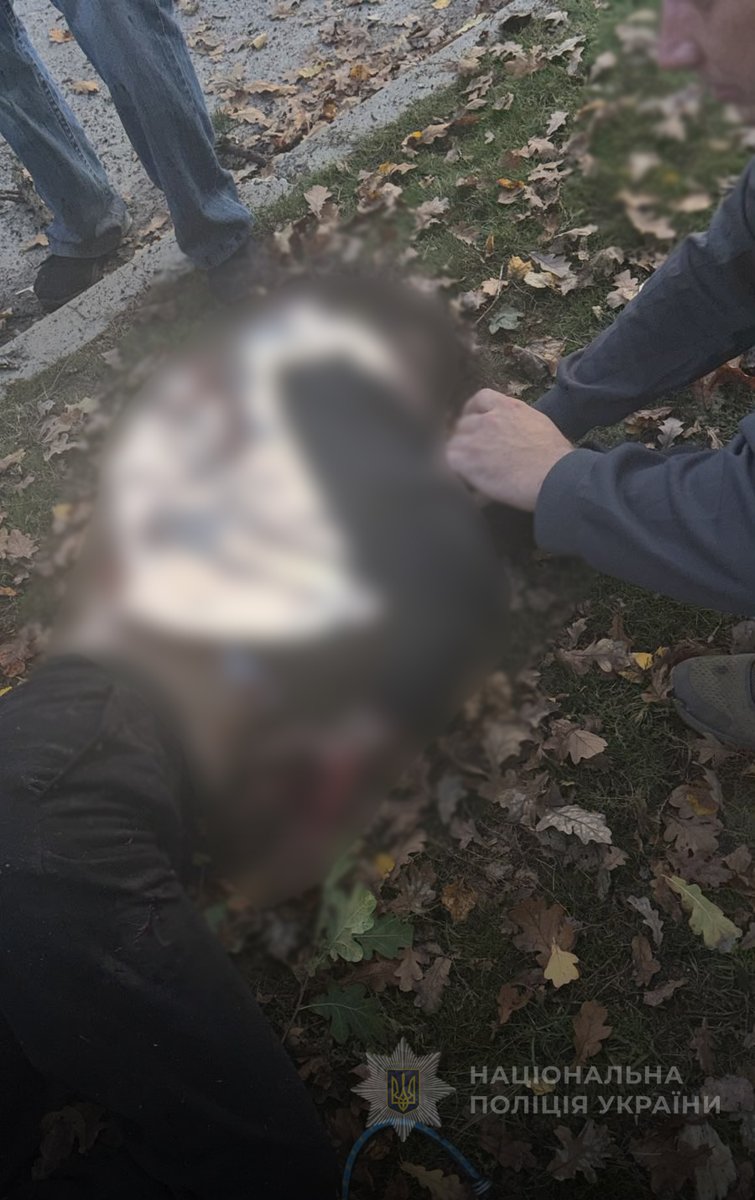
A horrific Russian strike in the Kharkiv region. A “shahed” struck people directly – in a park near an ordinary café. Pure atrocity. Six people were killed, including children. A little girl was killed in a stroller – her name was Angelina, she was just over a year old, born in August 2025… Her mother’s name was Inna. She died in the hospital… Another girl who was killed was 11 years old. My condolences to their families and loved ones. Another 14 people were injured, including six more children.
I am grateful to everyone who supports Ukraine under these circumstances and helps us shoot down “shaheds,” shoot down missiles, and stop Russian assaults. These are horrific photos, but behind them are shattered lives and the truth about this war. Lives must be protected. Ukraine needs air defense. You can't think about making money with Russia as long as it continues its asinine war. We ask that sanctions on Russia stay in place as long as the killings continue. We ask America to be strong, and we ask it to apply the Lindsey Graham law. We ask Europe to continue its support. We ask that everything possible be done to bring peace and guarantee security. Ukraine wants peace. It is Russia that has insisted on continuing the killing all this time. The world has enough strength to stop the war. That strength must finally be used – against the murderers.
Wickenburg, Arizona Territory, 1890s.
The white horse. The dust beneath their feet. Those intense, weathered looks.
Four Hispanic vaqueros staring straight into the camera. Jesus Olea, Francisco Macias, Juan Grijalva, and Clemente Macias.
Just imagine the miles these men traveled. The desert heat, the long cattle drives, the lonely nights beneath an endless Arizona sky.
Long before the American cowboy became a Hollywood legend, generations of Mexican vaqueros had already mastered the saddle, the rope, and the unforgiving demands of ranch life.
Their horsemanship helped shape the cowboy traditions of the American West.
These weren't men playing cowboy. They were the real thing.
And perhaps the most remarkable part of this photograph is that their legacy didn't disappear with the passing frontier. Their descendants helped preserve the history of Wickenburg and the Hispanic families who helped build it.
Four men. Four horses. One remarkable glimpse into the real American West.
@The_FJC The war would be over. Russia will re-group and in time they start invading Ukraine again. No stop until whole Ukraine is conquered. It started with Crimea, remember?
A 2300 year-old Pazyryk culture woman's boot from the Scythian world, preserved in the frozen ground of the Altai Mountains in southern Siberia...
High in the Altai Mountains of southern Siberia, a nomadic people buried their dead in timber chambers beneath great earth and stone mounds. These people belonged to the Pazyryk culture, part of the wider Scythian world. Soon after the burials, water seeped into many of the tombs and froze into permanent ice, sealing everything inside. When Soviet archaeologists led by Sergei Rudenko excavated the Pazyryk mounds in the mid-20th century, they found things that almost never survive: textiles, felt, fur, wood, and even tattooed skin. Among the finds was a woman’s leather boot about 2,300 years old, now in the State Hermitage Museum in St. Petersburg. Its red leather upper is covered in swirling designs, but the real surprise is underneath. The sole is decorated with a lattice of pyrite crystals and tiny beads.
Why would anyone decorate the bottom of a shoe? The most common explanation is how the Scythians lived. Much of their time was spent sitting cross-legged on felt rugs inside tents and around fires, so the soles of their boots were often on full view. Some researchers also note that the sole shows almost no wear, which suggests the boot may have been made mainly for burial, or worn by someone who spent more time on horseback than on foot. Either way, this small object shows how much these horse-riding nomads valued beauty and display. It also shows how the Siberian ice kept a moment of personal style intact for more than two thousand years.
#archaeohistories
"I've never seen anything like this in my life"
Amid Ukraine's massive drone barrage on St. Petersburg, locals complain that war was something that was supposed to happen in Ukraine, not back home.
In 1942 a Dutch warship escaped the Japanese Navy by pretending to be an island. It worked.
By early March 1942, the Dutch East Indies were falling. The Japanese had crushed the Allied fleet at the Battle of the Java Sea. Java was about to be overrun. The last Dutch ships still afloat were ordered to run for Australia.
One of them was HNLMS Abraham Crijnssen, a small, slow minesweeper about 180 feet long. She had almost no guns that could stop an airplane, and she couldn't outrun a Japanese destroyer if her life depended on it. Which it did.
She was supposed to make the escape with three other Dutch warships. Those ships were caught and sunk. Abraham Crijnssen was on her own.
Her captain, Lieutenant Commander Anton van Miert, came up with a plan that sounds insane.
The waters between Java and Australia are scattered with thousands of islands. Many of them are just tiny specks of land with a few trees on top. So the crew went ashore and cut down trees and jungle plants. They covered the entire ship in them, from bow to stern, until she looked like a small jungle-covered island. They painted the exposed parts of the hull gray and brown to look like rock and cliffs.
There was one catch. Islands don't move.
So during the day, the ship anchored right up against real islands and sat completely still. The crew refreshed the wilting leaves and stayed out of sight. Japanese planes flew overhead. They saw nothing but one more island.
At night, the "island" pulled up anchor and crept south toward Australia.
Night after night, day after day, she slipped through waters crawling with Japanese ships and aircraft.
After about eight days, the coast of Australia came into view. On March 20, 1942, Abraham Crijnssen sailed into Fremantle.
She was the last Allied ship to escape Java, and the only one of her class in the region to survive.
She went on to serve the rest of the war with the Royal Australian Navy hunting submarines.
And she's still around today. Abraham Crijnssen is preserved as a museum ship at the Dutch Navy Museum in Den Helder, in the Netherlands.
🍺🍾🍷💊💊The Morning After: Trump’s 50-Hour Geopolitical Hangover
Zelensky confirms that American intelligence sharing with Ukraine has resumed. Meanwhile, Donald Trump appears to be waking up inside a nightmare entirely of his own making.
Imagine the scene. It is Monday morning. After nearly 50 hours of international chaos, resembling the aftermath of swallowing an entire packet of brightly coloured pills on Thursday evening, the president finally opens his eyes.
The room is full of deeply worried people. His Republican colleagues look as though they have just discovered the consequences of their own careers.
One adviser wants to know whether America has actually surrendered its foreign policy to Moscow. Another is trying to explain why European governments are reconsidering American contracts. Canada is looking elsewhere for partners. Former allies are delivering what amounts to a collective, diplomatic fuck you.
Someone from the Pentagon wants answers. Someone from Wall Street wants reassurance. Someone from the State Department would simply like to know whether the United States still has any friends.
And Trump, surveying the wreckage of decades of American influence, has just one question.
“Did I make any great deals?”
No, Donald. You spent the weekend turning the world’s most powerful alliance into a customer complaints department.
And the customers have finally discovered they can shop elsewhere.