Since we just crossed 1,000 followers, figured I should probably introduce myself.
I’m James — the voice behind Chronicles of History.
I started this account because I’ve always loved American history, especially the West, the frontier, explorers, Native nations, soldiers, settlers, outlaws and the ordinary people who lived through extraordinary times.
Somewhere along the way, I became convinced that history shouldn’t just be a collection of dates we memorize.
It should make us think.
About courage. Sacrifice. Failure. Faith. Family. Resilience. Freedom. And what people were capable of when life demanded more from them.
My beliefs are pretty simple:
God. Freedom. Family. Legacy.
When I look at this country today, I think one of our greatest problems is that we’ve forgotten where we came from.
We’ve forgotten what happened to shape the world we inherited.
The life we benefit from today didn’t just appear.
It took real grit. Hardship. Sacrifice. Leadership. Faith. Community. And generations of people willing to do very difficult things without knowing how the story would end.
That history deserves to be protected.
It deserves to be understood.
And it deserves to be brought back into the light.
Chronicles of History is my very small way of doing that.
I believe in God, strong families, community engagement, servant leadership and doing hard things.
Those things still matter.
And history gives us countless examples of what ordinary people are capable of when they accept responsibility, endure hardship and live for something bigger than themselves.
I’m also a husband, dad, history writer and admittedly the kind of guy who can stare at an 1880s photograph for twenty minutes wondering who everyone was, what they were thinking and what happened to them after the shutter clicked.
That curiosity is really the heart of this account.
Not to romanticize the past.
Not to pretend it was simpler or perfect.
But to preserve it, understand it and carry forward the lessons that still matter.
Today we crossed 1,000 followers organically.
And somehow between 3,000–5,000 people a month are now reading my little history blog too.
That genuinely means a lot to me.
Thank you to everyone who reads, shares, argues, corrects me, teaches me something and adds to the conversation.
We’re just getting started.
Let’s make history cool again.
Count the deer.
They hang all along the front of the cabin, from the roof beam and the poles. More than you can count at a glance.
A low log shanty with a brush roof. A few men standing around the door. A pony waiting off to the side, ready to pack meat.
The card calls it "Deer hunters at home."
Truman Ingersoll was a photographer from St. Paul, Minnesota, who sold views of the northern woods: logging camps, fishing, and hunting camps like this one. The card doesn't say where this camp was.
For a lot of families in the north woods in 1890, deer season wasn't a sport. It was the meat for the winter. Men went to camp in the fall, built or patched a shanty, and hunted until the poles were full. Then they cut it, salted it, smoked it, or let it freeze, and hauled it home.
That pony was going to work hard.
And so were they. The hunt was the easy part. Taking care of the meat was the real job.
Put up enough for the winter. Then put up a little more.
Near Woods Park, Custer County, Nebraska. 1886.
There's an empty chair in the middle of the yard.
Somebody carried it out of the sod house and set it in the grass for the picture. Little George stands right next to it instead of sitting in it.
His mother, Lillie Semler, holds baby Daisy on her hip. His father, J.D., holds the donkey. Behind them is a long house built out of the ground itself. Big leafy vines spread out across the garden.
People brought out what they were proud of. For the Semlers, that was a chair, a donkey and two kids.
Show people what you've built, even if it's just a chair in the grass. Be proud of what you're building, one day it might just leave a legacy.
The shoebox.
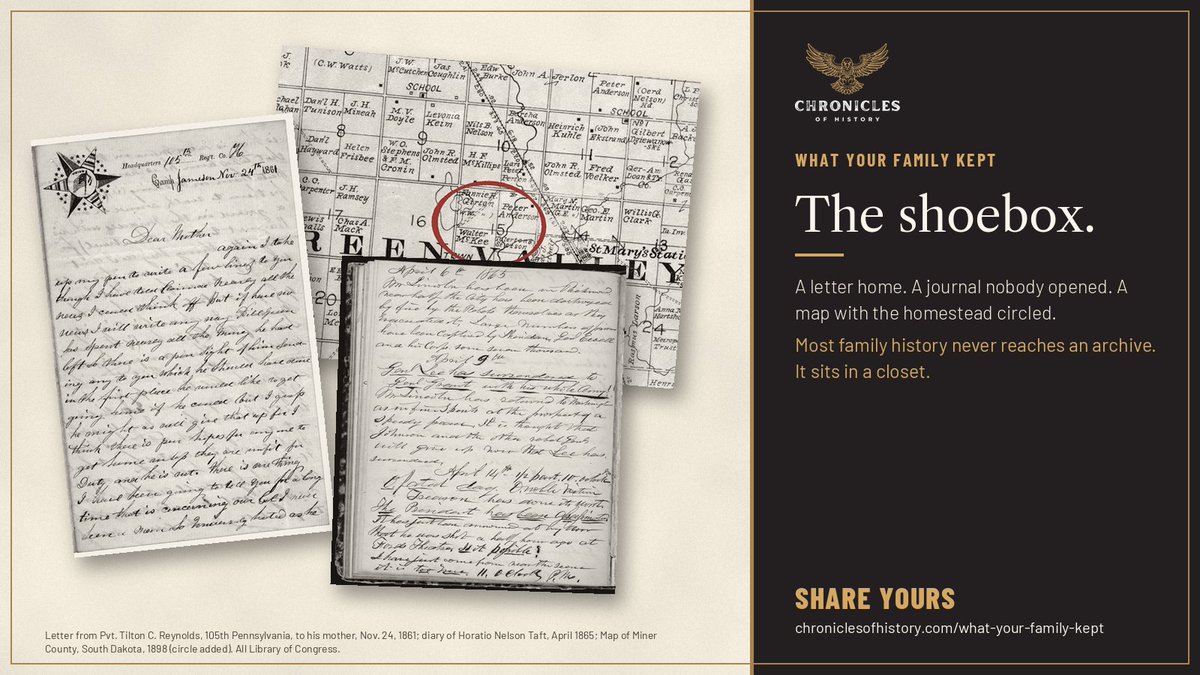
On November 24, 1861, a private in the 105th Pennsylvania sat down at Camp Jameson, Virginia, and wrote home.
"Dear Mother, again I take up my pen to write a few lines to you."
His name was Tilton C. Reynolds. He had turned 18 a month earlier. His family kept his letters, and today they are at the Library of Congress.
Most family history never makes it that far. It sits in a closet. A letter home. A journal nobody opened. A map with the homestead circled.
The lesson: we hardly write letters anymore, so what we choose to keep matters more than ever. Someone saved a young soldier's letter for 160 years. What will our grandchildren be able to read about us?
Every week, families in the Chronicles community share what they kept with me.
I'd love to see yours: the letters, photos, journals and maps. The link is in the first reply.
September 17, 1877.
Three hundred and fifty people arrived in Graham County, Kansas, looking for a town called Nicodemus. The ads had promised timber and "the finest country we ever saw."
What they found was a row of dugouts in the prairie.
Some turned around. The ones who stayed moved into those holes and went to work. The First Baptist Church started in a dugout that year. It still holds services today.
This photograph is from about 1885. Washington Street. A stone church. Williams General Merchandise. Horses, wagons, and a town they built out of those dugouts.
By 1899, Nicodemus homesteaders held 114 patents on 18,126 acres.
Freedom on paper isn't the same as freedom on the ground. The Exodusters went and got the ground.
Nicodemus is still there.
I wrote about all of it here: https://t.co/aoCOueb64d
Savage Station, Virginia. June 1862.
Looking at the ground is what got me.
It's covered in men.
Sitting.
Lying down.
Propped up on one elbow.
Blankets on the ground.
Hats on almost every head.
This is a Union field hospital. James F. Gibson photographed it after the Battle of Gaines' Mill on June 27, 1862.
No hospital ward. Just a few tents, a ladder leaning against a house, a picket fence, and a yard full of wounded.
Look for the straw hats. Many of them belonged to the 16th New York Infantry, who fought at Gaines' Mill.
Here's what the photograph can't show you.
Two days later, on June 29, the fighting came to Savage Station. The Union army kept falling back. And most of the men in this yard were captured when the Confederates overtook the area.
The army had to keep moving.
The wounded couldn't.
When we picture the Civil War, we usually picture the charge.
This was what came after.