We can now correlate all this institutional adoption of Chainlink directly to $LINK token usage:
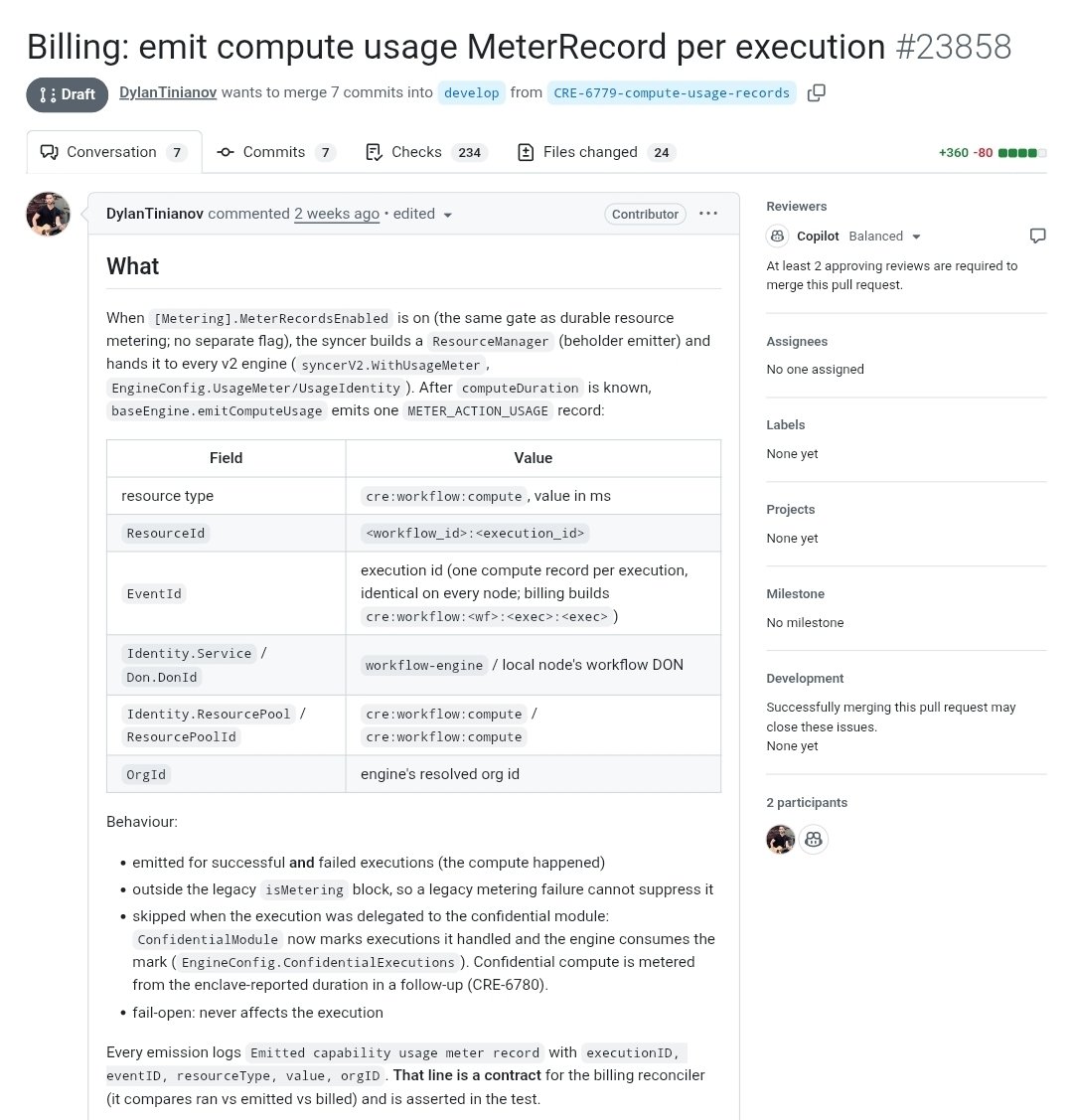
From the public GitHub PRs (first two screenshots attached):
🔹 "cre:workflow:compute (ms)": compute is its own billable resource.
🔹 "emitted for successful and failed executions": every run is billed.
🔹 "bills them from the enclave's own measurement": confidential workflows are billed too, by time inside the enclave (trusted execution environment for private/confidential computations).
From the DTCC Demo we can see that those CRE Orchestration fees are paid in LINK (screenshots 3 and 4 attached as examples).
So:
- Institutions adopt Chainlink through CRE.
- Each workflow, as seen in the DTCC AppChain demo, consists of multiple orchestration fees (+ CCIP fees), each paid in LINK.
- In the DTCC demo, there were 4 separate orchestration fees and 1 CCIP fee - that's 5 separate LINK fees in total.
- If there were any margin calls or collateral swaps, more thorough compliance checks, or any Confidential Compute required in that demo, that would likely require further Orchestration/CCIP fees.
- The Chainlink Github shows that CRE billing for each execution is proportional to the compute time in milliseconds required. Therefore:
- The more separate workflow steps where the user signs, the more orchestration fees incurred.
- The more computations in a workflow, the more orchestration fees incurred.
- The more complex those computations, the more orchestration incurred.
- Data Feeds/Streams also required in DTCC Demo for continuous collateral pricing, which is another Chainlink service used (usually subscription-based, per-use based if AI Agents using CRE.
In summary:
Institutional adoption up > LINK fees up
$LINK token absolutely needed
We’re encouraged by the @CFTC’s work towards clear rules for digital asset markets, including its consideration of oracles and proof of reserve.
We look forward to working with @ChairmanSelig & the Commission to strengthen U.S. leadership as markets rapidly move onchain.
JUST IN: Sergey Nazarov speaks at the White House on tokenization's impact on the American economy
“There’s a very real and tangible outcome that’s benefiting the adoption of U.S.-issued assets and the U.S. dollar”
LINK Everything
Chainlink might have had the best Q2 of any crypto platform...
Between April and June of 2026 @Chainlink saw some serious growth:
- Reached $110 billion in total value secured.
- $7+ billion in crypto migrated to using $LINK's cross-chain interoperability protocol (CCIP).
- Chainlink Reserve grew to more than 4.5 million $LINK.
- Chainlink oracles reached over $32 billion in transaction value enabled.
... and this is before you get to one-off collaborations like the one with @The_DTCC.
7 years ago today, Chainlink launched on mainnet with a single price feed.
Now, Chainlink's unified oracle platform powers 70%+ of DeFi and is bringing the world's largest institutions onchain.
LINK THE WORLD 🔗
NEW: The Chainlink data standard is now live on @amazon’s AWS Marketplace.
Now, millions of @awscloud developers & hundreds of thousands of businesses have access to the secure data infrastructure required to build institutional-grade blockchain apps.
What to expect? $LINK
🏛️ Regulation (Clarity) unlocks institutions, but adoption scales step by step, not overnight.
💸 Value comes from real transactions.
Not announcements, not partnerships.
Production is what matters.
🔁 Payment Abstraction means everything settles into $LINK, even if users pay in stablecoins.
The frontend may change… the backend demand does not.
🏦 The Reserve + staking are being built deliberately.
This isn’t rushed. It’s designed for long-term, sustainable value flow.
🧠 Institutions already know Chainlink.
Now it’s about prioritization and integration, not awareness.
🌍 Adoption won’t wait for one region.
If the US slows down, Europe, Asia, and others will move.
⚙️ The economic model is being built in real time.
Because nothing like this has ever existed before.
$LINK $GLNK $CLNK Vlad nailed it, the CLARITY Act needs to pass so stablecoins can finally deliver real yields to users instead of banks keeping everything. Tokenized MMFs are already showing the model works safely with reserves staying in the banking system. The U.S. either leads this or watches everyone else take it.
Most people will read Vlad's thread and think $ETH Ethereum is the big winner because it's still the main settlement layer for the majority of RWAs right now.But look closer: Ethereum can absolutely get diluted or partially replaced in a multi-chain world. $SOL Solana and others are already taking meaningful share in volume and speed.
The REAL MONOPOLY here, the piece that's truly irreplaceable and sits underneath everything @vladtenev is describing, is Chainlink. Oracles and CCIP provide the verifiable reserves, real-time yield data, NAV pricing, and secure cross-chain movement that institutions actually trust for compliance and scale. Coinbase made CCIP their exclusive bridge for wrapped assets.
Proof of reserves on major tokenized Treasuries? Chainlink. Institutional work with Swift, DTCC, UBS, Euroclear?
Chainlink is embedded across the board.Current stats: over $60 billion in TVS, more than $28 trillion in transaction value enabled. This is the middleware powering the path to the multi-trillion tokenized asset opportunity everyone keeps forecasting.L1s can compete and evolve.
This layer doesn't get swapped without massive regulatory re-approvals, audits, and rebuilding institutional trust. It's locked in deep.
If CLARITY Act passes and yielding stablecoins plus mainstream tokenized MMFs take off, Chainlink becomes the default plumbing of the next financial system.
Triple digits on LINK isn't aggressive speculation at that point. It's conservative if this narrative plays out.This is the infrastructure play that's been hiding in plain sight.
BIGGEST ASSYMETRIC OPPORTUNITY IN THE HISTORY OF CAPITAL MARKETS
MANSIONS, ROLLS ROYCES WILL BE BOUGHT....YACHT PARTIES WILL BE THROWN
EPOCH partners with Chainlink & Synthesys to launch TreasuryPlus (TPLUS), the first institutionally-managed tokenized private credit fund across 6 global markets.
Only Chainlink provides the data, interop & orchestration standards unlocking the full potential of tokenized funds.
Chainlink has become one of the most deeply embedded pieces of infrastructure in crypto.
It controls the majority of the oracle market by TVS and connects over 75 blockchains through CCIP.
Many major TradFi tokenization pilots from UBS to Swift is running through it. Lido migrated its entire cross-chain infrastructure to CCIP.
The question has been whether that translates into revenue. Smart Value Recapture and the Chainlink Reserve are the first real mechanisms that tie network usage to value capture.
Both are live and showing early traction, but they still need to continue scaling beyond where they are today.
Chainlink's value depends on institutional tokenization happening at scale. For those who believe that's coming, it's hard to find infrastructure that's better positioned.
The Wall Street firm that made BILLIONS in 3 months while your portfolio was bleeding
Jane Street is one of the biggest trading firms on Wall Street
They made $24 billion in a single quarter in 2025
They're also a key partner for BlackRock's Bitcoin ETF, helping create and cash out shares
For months, Bitcoin has been getting dumped at exactly 10 AM Eastern every single day right at market open
Bitcoin was dropping $2,000 in minutes, wiping out hundreds of millions in longs, then bouncing back
People accused Jane Street
No proof
Just a pattern that kept repeating
Then yesterday a lawsuit dropped and everything changed
Terraform Labs sued Jane Street for insider trading tied to the $40 billion Terra Luna crash in 2022
A former Terraform intern named Bryce Pratt later joined Jane Street as a trader
He set up a private group chat called "Bryce's Secret" with Terraform's team
On May 7, 2022, Terraform quietly pulled $150 million in UST from Curve
Within 10 minutes, before anyone knew, a wallet linked to Jane Street dumped $85 million in UST
That helped push UST off its dollar peg
Luna went from $80 to zero
$40 billion gone in days
The lawsuit says Jane Street dodged over $200 million in losses while regular people lost everything
Jane Street called it "desperate" and "baseless"
The same firm accused of dumping BTC every morning at 10 AM is now accused of front running the biggest crypto crash in history
One day after the lawsuit dropped, the 10 AM dump didn't happen
Bitcoin pumped 7%
Do whatever you want with this information
Das Chainlink Endgame ist offiziell. Vergesst alles, was ihr bisher über "Oracles" wusstet. Wir reden hier nicht mehr über Preisdaten, wir reden über das Betriebssystem für 800 Billionen Dollar. 😲
Der neue Chainlink Report bestätigt, was "Smart Money" längst vermutet hat: Chainlink ist das "Windows" für die Blockchain Welt.
Das Problem ist offensichtlich: Die größten Institutionen der Welt (Swift, UBS, J.P. Morgan) haben realisiert, dass sie nicht 100 verschiedene Blockchains, 50 Bridges und dutzende Compliance Tools manuell verwalten können. Das ist ein Integrations Albtraum, der nicht skaliert. "Patchwork" funktioniert im Hochfinanz Sektor nicht.
Die Lösung ist da: Chainlink Runtime Environment (CRE). Ähnlich wie die JRE (Java) damals das Internet für Apps nutzbar machte, abstrahiert Chainlink jetzt die Komplexität der Blockchains weg. Es ist die eine Unified Platform, die alles verbindet:
• Daten: Nicht nur Preise, sondern NAV & Proof of Reserve (Smart Data).
• Interoperabilität: CCIP als globaler Standard für Cross Chain Transfers.
• Compliance & Privacy: Identitäts Management und Zero Knowledge Proofs, damit Banken überhaupt on-chain dürfen.
Aber das wirkliche Alpha für Investoren steckt in den Tokenomics: Die Chainlink Reserve ist bestätigt. Durch "Payment Abstraction" können Institutionen Gebühren in Fiat oder Stablecoins zahlen. Doch das System konvertiert diese Einnahmen, um LINK zu akkumulieren und in die strategische Chainlink Reserve zu leiten. Das bedeutet: Jede Bank Transaktion, jeder RWA Transfer stärkt direkt die ökonomische Basis des Netzwerks.
Das ist keine Zukunftsmusik mehr. Swift, Fidelity, ANZ Bank und Euroclear nutzen diese Standards bereits für echte "Delivery vs. Payment" (DvP) Transaktionen. Chainlink baut nicht an einer App. Sie bauen die Schienen, auf denen das globale Vermögen in die On Chain Welt rollen sollen.
If you are new to chainlink after this @NYSE news the chainlink token $link is getting pulled off exchanges really hard! Look at the blue line last year. Get in now there are a few left.
Supply on all exchanges on a
ALL TIME LOW !!!
Chainlink $link
THE REAL $100T BRIDGE IS FORMING
The Chainlink, Swift, and UBS collaboration is pure compatibility.
Banks keep using ISO 20022, the messaging they already trust, while Chainlink quietly connects those flows to on-chain fund actions like subscriptions and redemptions.
This is how institutional capital actually stays on-chain.
Nothing breaks.
Systems stay familiar.
And compliance stays intact.
🔥 @jpmorgan 🤝 @chainlink
For those who don’t understand why I’m tagging Chainlink instead of Ethereum, it’s because NONE of this works at scale without Chainlink.
Consider the following:
For JPM tokenized deposits to be scalable, reliable, compliant, and auditable, they need ALL of the following simultaneously:
✔️ Decentralized, threshold-signed attestations (not a single vendor)
✔️ Proof of off-chain reserves tied to regulated custodians
✔️ Secure off-chain computation + API ingestion
✔️ Automation with deterministic execution
✔️ MEV protection for large-value institutional flows
✔️ Cross-chain / permissioned ↔ public chain messaging
✔️ Audit trails regulators already recognize
✔️ Enterprise SLAs + professionally operated node infrastructure
💎 ONLY Chainlink provides this entire stack today. Not partially. Not theoretically. In production AND ready.
☝️ There is NO competing system (Pyth, API3, UMA, custom oracles, EigenLayer AVSs, native ETH solutions) that can deliver all of that right now, period.
More so:
💎 JPM already uses Chainlink — that is not speculative.
Chainlink Proof of Reserve is the only PoR system regulators, auditors, and counterparties already accept on public chains.
✅ No PoR → no credible on-chain mint logic → no institutional adoption.
There simply is no workaround here!
ETH L1 MEV alone forces Chainlink usage. This is massively under appreciated.
Large mint/burn/redemption events on ETH L1:
•Will be front-run
•Will leak value
•Will expose client flows
JPM 💯% cannot and will not accept this.
Chainlink’s Fair Sequencing / private execution / CCIP private paths are currently the only oracle-native mitigation stack designed for institutional value flows.
CCIP is the only viable permissioned ↔ public bridge
If JPM:
• Keeps core accounting on Kinexys (permissioned)
• Issues representations on ETH
• Needs atomic burn/mint, settlement finality, or message passing
Then they absolutely need:
• Rate-limited
• Programmable
• Auditable
• Kill-switch-enabled
• Institution-grade cross-chain messaging
That is exactly CCIP’s design target. There is NO credible alternative.
Based on all currently available information, JPM tokenized deposits on Ethereum L1 simply cannot be deployed at scale, with regulatory credibility, security, automation, and composability, without Chainlink.
Not “unlikely.”
Not “preferred.”
Structurally and compiantly required.
$LINK the 🌎
CHAINLINK: THE ORACLE OF 2026
Chainlink is transitioning from a DeFi tool to the backbone of global finance.
The tech is evolving. The Chainlink Runtime Environment (CRE) is the game-changer for early 2026.
It brings "Confidential Compute"—allowing banks to trade on-chain without exposing private data.
While others play with unproven tech, 50+ chains already use CCIP to move billions safely.
The "Institutional Era" isn't coming. It’s here.
$LINK is the key.