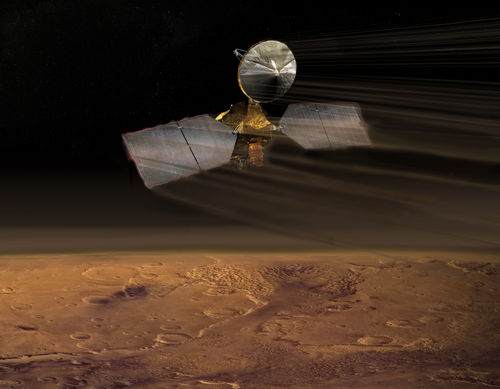
Before the desert that stands today, liquid water flowed on the surface of Mars longer a lot more recently than previously thought — by about a billion years! Data from @NASAJPL’s Mars Reconnaissance Orbiter tells us more. Dip into the details: https://t.co/HT4l5UYBN4
OMG, that’s a wrap! @NASA’s Oceans Melting Greenland mission completes 6 years surveying Greenland’s entire coastline.
The findings? Ocean water is melting Greenland’s glaciers at least as much as warm air is melting them from above.
Our #IXPE mission will study some of the most violent and extreme phenomena in the universe in a whole new way. How?
Watch this episode of #EZScience as @Dr_ThomasZ and @EllenStofan dive into IXPE, set to launch Dec. 9: https://t.co/Cx6HCb5rFS
🚀 Go #IXPE! Our newest X-ray observatory blasted off at 1:00am EST.
This begins a new quest to unlock the secrets of some of the most energetic objects in our universe, from black holes to neutron stars. https://t.co/Cx6HCb5rFS
Nicknamed the “river horse,” by the Greeks, a hippopotamus spends up to 16 hours a day submerged in rivers and lakes to keep their massive bodies cool in the harsh African heat.
#NatGeoWild
A school of juvenile striped eel catfish huddle closely together as protection from predators as they take turns feeding on the ocean floor.
Credit: Abyss Dive Center Bali https://t.co/rBO0DTKQnp
These “unicorns of the sea” seem to be everywhere: on T-shirts, mugs, and more. But in their native Arctic waters, they’re hard to spot https://t.co/izV1O5qnsg