@MereSophistry Over a century of research shows that massing/cramming is not good for durable long-term learning; spacing/distribution across longer time periods is, & this holds for just about every type of learning you can think of (developing expert skill, remembering, problem-solving etc)
“In fact, there is surprisingly little hard evidence that any of these approaches, on their own, are effective in shrinking academic disparities. To do that, teachers should consider augmenting their equity initiatives with explicit instruction, regular feedback, and lots of retrieval practice, all of which have been shown to help struggling learners.”
Bingo! This is the core issue. It’s the opportunity cost of investing time, resources, and money on what has yet been proven to work and not what has been proven: explicit instruction, retrieval practice, and formative assessment with feedback.
Teachers, schools, and districts only have so much bandwidth and frequently it is not spent on what decades of research show work to help all students learn.
“Draw or write.” “This or That.” Choice sounds and looks student-centered. It really isn’t.
When we let novices choose the format, we’re often asking them to make expert decisions and lowering the cognitive demand in the process.
Choice isn’t personalization. It’s often a learning styles dog whistle which allows students to opt out of essential thinking processes needed to effectively develop and show their understanding. 🐕😗
New post on why integration is the correct “choice” for our students instead of selection. 👇
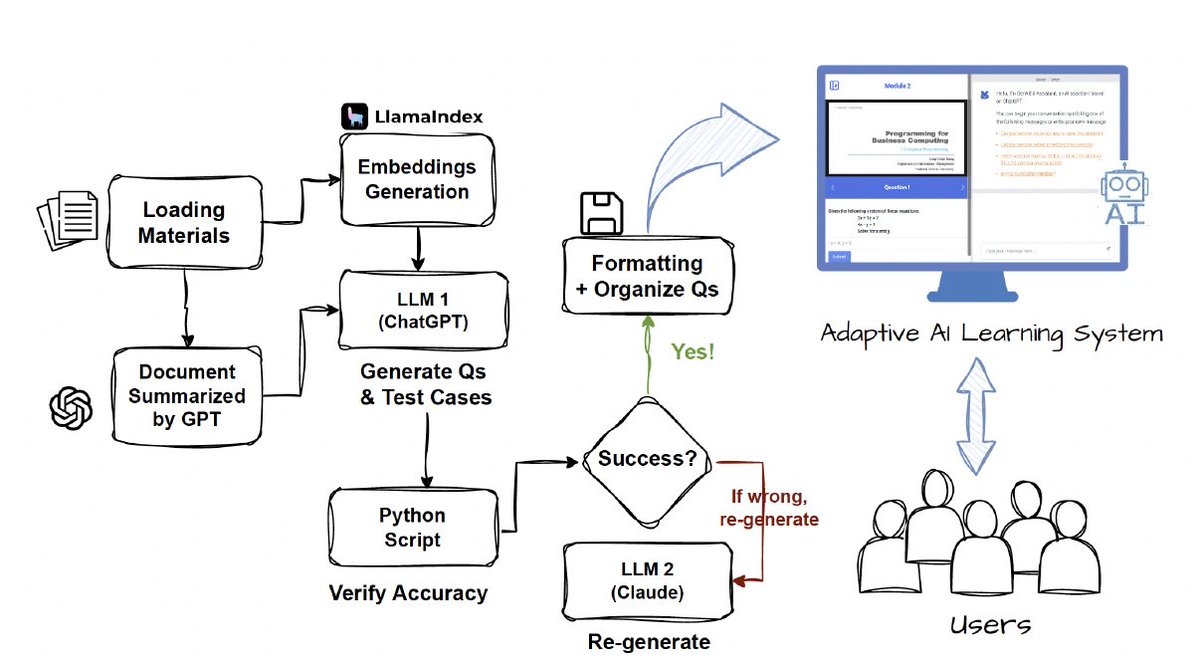
New study involving 770 high school students over 5 months across 10 schools. All students got the same lectures, course material, and GenAI tutor. The only difference: half received a fixed sequence of practice problems (easy to hard, standard practice), while the other half had their problem sequence dynamically personalized by a reinforcement learning (RL) algorithm.
The result: students with adaptive sequencing scored 0.15 standard deviations higher on an in-person, handwritten final exam: no devices, no AI assistance.
By some estimates, that's equivalent to 6–9 months of additional schooling. No extra instruction time or additional teacher workload. Beginners with no prior experience saw the largest gains (0.215 SD). Students at lower-tier schools benefited more than those at elite schools.
https://t.co/BkVyBMHyyh
Natural learning is brutal. Evolution's method: those who fail to learn, perish. The knowledge we transmit in a single sentence ("don't eat that berry") took generations of fatal errors to acquire. Schools exist precisely because natural learning is slow, cruel, and inefficient.
The artificial classroom isn’t a falling away from a natural ideal; it’s an improvement on natural indifference.
Learning is a compounding game. It’s about steady growth over time not momentary performance.
This is why retrieval practice, daily review, and spacing are so powerful. They convert momentary effort into lasting advantage.
We often judge students by where they are now. Their test scores, their reading level, their grade placement etc. But often we are testing the illusory gains of cramming not learning. What really matters is the trajectory: the rate at which they are learning.
And learning is not additive, it’s synergistic. Knowledge doesn’t simply stack piece upon piece; it interacts. Vocabulary unlocks comprehension, comprehension fuels background knowledge, and background knowledge accelerates the acquisition of more vocabulary. The cycle feeds itself.
Changing long term outcomes means designing for growth rates, not snapshots. That means prioritizing daily reading, retrieval practice, cumulative review, and structured vocabulary instruction. activities that produce small but steady gains but often don’t feel like it.
It also means intervening early, because once a compounding gap opens, it is brutally hard to close. Interventions often fail when they treat outcomes, not growth rates.
Daily reading habits exemplify the Matthew Effect in education where small behavioral differences compound into dramatic learning disparities. Students who read consistently encounter vastly more words than sporadic readers, creating cascading benefits in vocabulary, comprehension, and cognitive processing that extend far beyond the reading itself.
Like compound interest, these modest daily choices accumulate into substantial gaps in academic achievement, transforming seemingly minor habits into powerful predictors of lifelong educational success.
Thrilled to share CAP: The Creativity Assessment Platform. CAP is a free web-app with creativity tests and automated scoring.
App: https://t.co/vg8SSSFaQY
Paper: https://t.co/lLsCX2gBOB
We built CAP to make creativity testing easier and more reliable. Here's a quick tour.🧵
Unit 0: Learning How to Learn is done! I’m sharing the booklet with a few disclaimers. The booklet includes the following sections:
✔️Part 1: Memory
✔️Part 2: Retrieval Practice
✔️Part 3: Learning Myths
✔️Part 4: Metacognition
✔️Part 5: How Our Brains Learn
✔️Exam Revision Guide
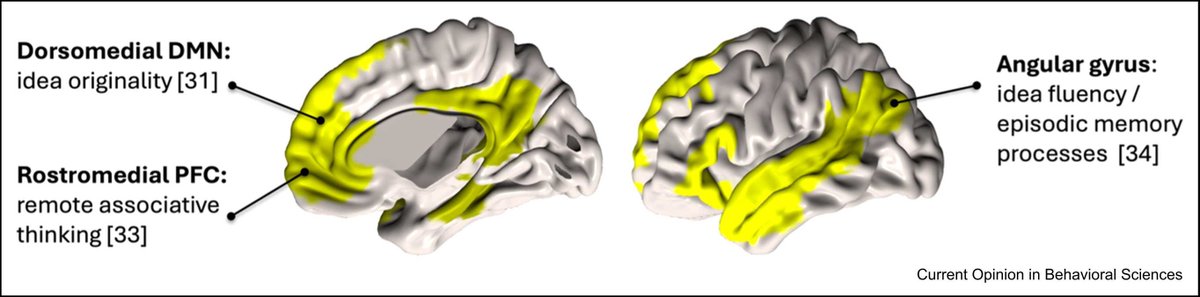
How does the DMN contribute to creativity?
Our new review with @Roger_Beaty and Emmanuelle Volle explores 4 novel trends in research: (1) causal links to creative abilities, (2) associative thinking, (3) idea evaluation, and (4) diverse functional integration.
Enhancing creativity through neurofeedback:
Check out our recent paper where we use covert neurofeedback to entrain default-executive coupling during creative thinking!
Xinbing (Jack) Zhang, Jack White, @Michael_Luehrs, @MichalRamot, & @Roger_Beaty
https://t.co/glnpPNmJ6R
Simone trained people to increase default mode and executive brain network coupling using neurofeedback, which boosted creative thinking—showing a double dissociation.
A big technical undertaking and his first-first author brain paper 👏
NSF will award ~1,000 instead of their usual ~2,000 Graduate Research Fellowships this year.
NSF slashes prestigious PhD fellowship awards by half https://t.co/HnrJbzEsa4