🧠 Charcot–Marie–Tooth Disease (CMT)
The most common inherited peripheral neuropathy.
🔹 Progressive distal muscle weakness
🔹 Foot drop
🔹 Pes cavus (high-arched feet)
🔹 Hammer toes
🔹 Reduced reflexes
Early recognition and rehabilitation can significantly improve quality of life.
#MedTwitter #Neurology #MedicalEducation #CMT
As a Senior Consultant, the reason I haven't raised my voice is simple:
When the interns are gone, I will gladly show up at 5AM, clerk 80 patients, draw the blood, and run the night calls myself.
I am superhuman. Obviously.
As a Senior Nursing Officer, the reason I am silent is obvious:
I have no problem running three wards alone, fixing lines, tracking vitals, delivering babies, doing the paperwork.
I don't need hands. I have dedication.
As a Policymaker, the reason I haven't spoken is elegant:
The interns are a budget problem I solved by terming the students.
My children are not doing internship in Uganda, after all.
As a Patient, the reason I haven't complained is clear:
Even if the doctor cutting me open has worked 36 hours without food, just cut me open and take the baby out.
Hunger sharpens the hands. Everyone knows this.
As a Citizen, the reason I am unbothered is rational:
None of my children is a medic.
I have my pastor.
The system runs on miracles. Always has.
This policy is brilliant.
Let's all stay quiet and watch the magic happen.
Not every patient with cirrhosis and shortness of breath has a lung disease 👀
📌 Chronic liver disease
📌 Platypnea (worse when sitting)
📌 Orthodeoxia (oxygen drops when upright)
📌 Digital clubbing
📌 Increased A–a gradient
Think Hepatopulmonary Syndrome.
The diagnosis is often missed, but the clue is simple:
Liver disease + unexplained hypoxemia = investigate for HPS 🫁🩺
A practical review covering pathophysiology, diagnosis, severity grading, and transplant outcomes 📚
https://t.co/1dSdJ0pv1C
June is Men's Mental Health Awareness Month.
Today or this week, call a man in your life and ask:
"How are you really doing?"
Listen without judgement. Men need support too.
#MOHatWork | #MentalkUG26
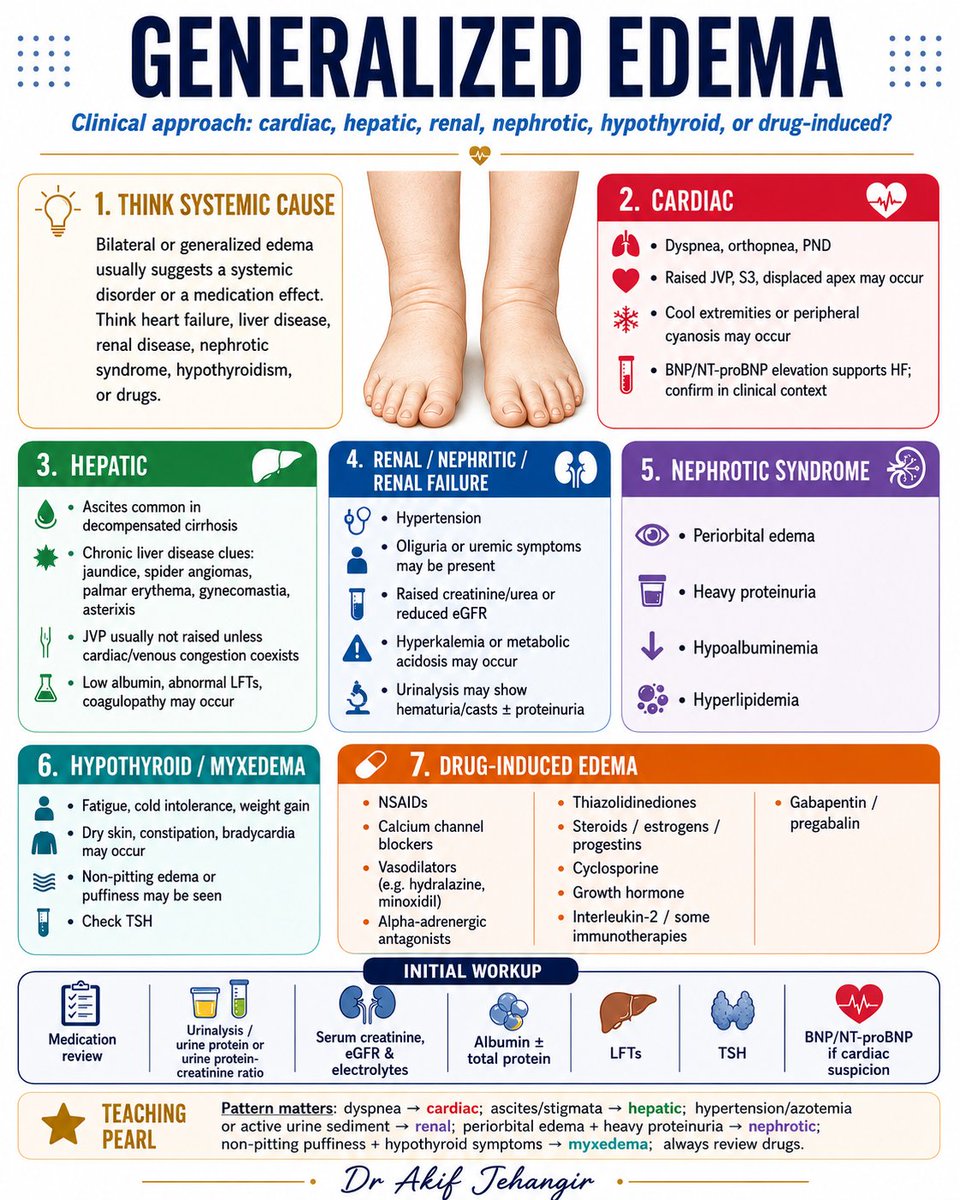
Generalized edema is a clinical clue—pattern recognition helps localize the cause: cardiac, hepatic, renal, nephrotic, hypothyroid, or drug-induced.
Like, repost, and follow for more high-yield internal medicine teaching.
#InternalMedicine#MedicalEducation#Edema
A sickle cell anaemia patient in severe vaso-occlusive crisis.
What is the rationale behind multiple analgesics?
About pentazocine, what is more common in sickle cell disease: addiction or tolerance?
Never ignore the pupils.
In critically ill patients, pupils often speak before the patient does.
A quick look into the eyes can reveal hypoxia, raised ICP, drug overdose, brain herniation, poisoning, stroke, or impending neurological collapse, sometimes within seconds.
Pupils are not just a routine examination finding.
They are a real time window into the brainstem and autonomic nervous system.
Some important clinical truths every doctor should remember 👇
My internship experience:
The previous night, I was on call and had worked until 4am. I was also in my periods and my whole body felt like it had been pounced. By 8:30am again, I was on table for a C/section. I thought it would be just one case and I would forcefully go and rest.
However, emergencies kept coming and Before I knew it, I was on the second, third and fourth C/section. My head started spinning. I wasn’t sure if I were getting finger pricks in the process or not. Then I couldn’t feel my legs anymore.
The Next sequence of events that followed, I have no clue. I just woke up and found myself in the nurses room with I.V dextrose running in my vein.
Now, imagine undergoing this kind of stress for one year without pay!
By the time I was finishing my internship, my whole being was screaming ‘ophthalmology, where are you?’ I can’t continue like this!
Bobi Wine once said:
"Atamanyi bw'aba ngamanyi nti tamanyi, oyo abera muyizi mumuyigirize."
So, I will assume that you do not know, and that you know you do not know. So let me teach you.
Who is a Medical Intern?
Medical interns are fully qualified health professionals who have completed university and been awarded degrees. They include:
Medical Doctors
Nurses
Midwives
Pharmacists
Dental Surgeons
After graduation, they have two possible paths:
1. Non-Clinical Path
A graduate may choose not to practice medicine directly. They can:
Join research
Pursue a Master's degree in a non-clinical field
Work in public health
Join administration, policy, academia, or other non-clinical careers and be working.
2. Clinical Path
A graduate who wishes to treat patients in hospitals must first complete one year of supervised internship.
Uganda follows a British-style training model where a graduate works under supervision for one year before being granted full independent practice.
The purpose of internship was originally simple:
Learn under supervision
Gain practical experience
Transition safely into independent practice
The Problem:
Over the years, Uganda has faced a severe shortage of healthcare workers.
Many hospitals operate with:
Too few doctors
Too few nurses and midwives
Too few pharmacists
Limited budgets for hiring staff
Hiring a fully employed health worker is expensive. Government must pay salaries, benefits, study leave, pensions, housing allowances, and other costs.
As the shortage grew, government needed a cheaper solution.
The Solution Government Chose:
Instead of hiring enough healthcare workers, Uganda increasingly relied on medical interns to fill staffing gaps.
The were turned into a source of extremely cheap labour and went from being supervised to gain experience but doing real employable work.
For many years, interns received only about UGX 750,000 per month, with no food, housing, or other benefits. This arrangement saved government billions of shillings that would otherwise have been spent hiring fully employed health workers.
What Internship Became:
On paper, internship was supposed to be supervised training.
In reality, it gradually became service delivery.
Medical interns routinely:
1. Work Extremely Long Hours
Many intern doctors perform 36-hour shifts at least twice a week.
2. Provide Cheap Labour
Hospitals depend heavily on interns to keep services running, some hospitals can go days without seniors but interns doing the job (They're not being supervised but are providing a service, which the government is supposed to hire someone to do it)
3. Work With Minimal Supervision
Any medical intern will tell you that supervision is often limited. In many rotations, supervision happens mainly during the first few weeks. After that, interns largely report to seniors while independently handling patients and making decisions.
Personally, during internship, I performed over 100 Caesarean Sections without a senior doctor physically present.
That is not what most people imagine when they hear the phrase "supervised training."
The Impact:
This system achieved several things:
- Hospitals continued functioning despite staff shortages.
- Patient complaints reduced because healthcare workers were available.
- Government avoided hiring large numbers of senior staff and thus budget saved.
- Health budgets remained lower than they otherwise would have been.
The result:
Government saves an estimated:
UGX 12–15 billion per month
UGX 145–180 billion per year
compared to the cost of hiring enough fully employed health workers to replace the work currently performed by interns (This isn't gap of being supervised to learn, it is a real healthcare staffing gap being filled by medical interns).
Meanwhile, government spends approximately:
UGX 4.55 billion per month
UGX 54.6 billion per year
on intern allowances.
How the Fight Started:
Over time, interns increasingly felt that they were no longer being treated as trainees. They were functioning as employees while being paid trainee allowances.
Interns raised these concerns to President Museveni.
In 2021, the President agreed that intern allowances should be increased to approximately UGX 2.5 million per month.
The increase was implemented because government recognized that interns were providing critical services to the healthcare system and dumpenning the deficit.
What Happened Next:
One year later, discussions emerged about reducing the cost of internship even further.
The argument was simple:
Government wanted the services interns provided but did not want the financial burden that came with paying them.
As a result, ministry of health, which is supposed to fight the well-being of its people decided to raise a proposal to revise medical training and extend the duration of medical school from five years to six years, just because they want to take exploitation to another level and have it completely free.
The practical effect would be that the same work currently done by paid interns would instead be done by students during an additional year of training, labelling medical interns as students failed and thus, they decided to add a full year to medical practive just to have free labor.
Why Many Consider This Unfair
This change affects more than future interns.
It affects every medical student, including those who may never want to practice clinically.
Someone who wants to:
- Work in research
- Join public health
- Enter administration
- Pursue non-clinical careers
would still be forced to spend an extra year in medical school because government wants clinical services without paying internship allowances.
Many see this not as an educational reform, but as a financial decision designed to reduce government expenditure while overworking its citizens.
The Real Issue:
This debate is often framed as:
"Why should interns be paid to learn?"
That is the wrong question.
The real question is:
"Should interns be paid for the substantial work they perform beyond the original purpose of supervised training?"
If internship truly consisted of observation, teaching, mentorship, and closely supervised practice, the discussion would be very different.
But that is not the reality experienced by many interns.
A Simple Analogy
Imagine joining a company as a cleaner.
Because you are a cleaner, your employer begins assigning you additional responsibilities.
You become:
The gatekeeper
The gardener
The cook
The electrician
The driver
Eventually, several other employees are removed because you are performing their duties.
On paper, you remain a cleaner.
In reality, you are doing the work of an entire department.
That is how many medical interns feel.
Officially, they are trainees.
In practice, they always function as a critical workforce keeping hospitals running.
And unlike the cleaner in this example, the intern cannot simply refuse, because completing internship is mandatory for obtaining a license to practice.
"Stop using Medical Interns"
Approach to PUO (Pyrexia of Unknown Origin)👇
A patient has been febrile for weeks. Multiple antibiotics have failed. Cultures are negative. What next?
The biggest mistake is ordering random investigations without a diagnostic framework.
Think of PUO in 5 major categories:
1. Infections
Still the most common cause in many developing countries.
Never miss:
Tuberculosis (pulmonary or extrapulmonary)
Infective endocarditis
Deep-seated abscess
Brucellosis
HIV-related infections
Osteomyelitis
Clues:
✔ Weight loss
✔ Night sweats
✔ Travel history
✔ Animal exposure
✔ Prosthetic valves or cardiac murmurs
2. Malignancy
Especially when fever is associated with constitutional symptoms.
Think:
Lymphoma
Leukemia
Renal cell carcinoma
Metastatic cancers
Clues:
✔ Lymphadenopathy
✔ Splenomegaly
✔ Unexplained anemia
✔ Elevated LDH
✔ Significant weight loss
3. Autoimmune / Inflammatory Diseases
Important differentials:
SLE
Vasculitis
Adult-onset Still disease
Rheumatoid arthritis
Giant cell arteritis
Clues:
✔ Rash
✔ Arthritis
✔ Oral ulcers
✔ Very high ESR/CRP
✔ Multisystem involvement
4. Drug Fever
Always review medications before ordering expensive tests.
Common offenders:
Beta-lactam antibiotics
Sulfonamides
Anticonvulsants
Allopurinol
Clue:
Patient looks surprisingly well despite persistent fever.
5. Miscellaneous Causes
Don’t forget:
Pulmonary embolism
Sarcoidosis
Thyroiditis
Inflammatory bowel disease
Factitious fever👇
This is most consistent with miliaria rubra (heat rash/prickly heat), caused by blockage of sweat ducts leading to tiny, uniform papules on the back in hot or humid conditions with excessive sweating or occlusive clothing.
It is a benign, self-limiting condition that typically improves with cooling, loose clothing, and avoidance of heat and sweat buildup.
🍓 Strawberry Tongue ≠ One Diagnosis
Both Kawasaki Disease and Scarlet Fever can present with a strawberry tongue, but the underlying pathology, complications, and treatment are completely different.
👁️ Conjunctivitis + Hand/Foot changes → Think Kawasaki
🧻 Sandpaper rash + Sore throat → Think Scarlet Fever
The best clinicians don’t memorize findings—they learn to differentiate them.
#MedTwitter #MedicalEducation #NEETPG #INICET #USMLE #Pediatrics #Medicine #ClinicalPearls
🫀🚨 Aortic Stenosis: The Murmur That Can Predict Sudden Death
Remember the classic triad:
⚠️ Angina
⚠️ Syncope
⚠️ Dyspnea
When these symptoms appear in a patient with aortic stenosis, the clock is ticking.
🎧 Clinical clue:
A harsh ejection systolic murmur radiating to the carotids + pulsus parvus et tardus = Severe Aortic Stenosis until proven otherwise.
📌 Most common cause in the elderly:
➡️ Calcific degeneration
📌 Best diagnostic test:
➡️ Echocardiography
📌 Definitive treatment:
➡️ Aortic Valve Replacement (SAVR/TAVR)
One murmur. One triad. One life-saving diagnosis.
#MedTwitter #Cardiology #HeartDisease #MedicalEducation #FOAMed #InternalMedicine #NEETPG #INICET #USMLE #ECG #ClinicalPearls 🫀📚🚑