Today we share updates on our progress, highlighting ways Torins are delivering on the promises of miniproteins. We see miniproteins as the next step change in the long lineage of binding-based drugs, moving beyond the capabilities of the last 100+ years of small molecules and 40+ years of antibodies.
https://t.co/t4IhJCWeI6
The protein drugging playbook is broken for RNA. This is how to fix it.
https://t.co/mNycwOt1yX
mRNA is a message, not a machine. Its structures shift inside cells, it has no active site to block, and binding in a test tube doesn't predict function in cells.
Covalent chemistry changes the equation. It cracked KRAS after 40 years. Now over 50 approved drugs use covalent mechanisms, from aspirin to Paxlovid.
I became a scientist watching DNA sequencing reshape biology. Saw the same pattern every time: turn your question into a sequencing readout, and the data drives a revolution.
I built a company to bring that to drug discovery, alongside the sharpest people I know. Meet @EnduraTx!
I think most people should consider becoming scientists.
While there is a real risk AI will eliminate jobs, conversely the need for models to understand the world around us through more and better data will increase exponentially.
AlphaFold, for example, would not have been possible if not for the work of thousands of grad students and postdocs painstakingly depositing well-curated datasets over decades of meticulous experimental work.
We still only understand a fraction of the physical world and beyond, and we’ll only be able to do so if we collect more data and put it into context.
Maybe this is a bit naive or utopian thinking, but humans are not designed to look through pages of receipts, read 100-page legal documents, or write reports and POCs no one will ever read. They are wired to explore, driven by curiosity, and have an innate desire to understand the world.
Many who are bored or feel a lack of purpose -- with the overhanging (and maybe exaggerated) doom and gloom of AI replacement -- should think about this.
Every few months traditional media runs another hit piece on "tech billionaires" funding science…then complains about politicized public funding.
A look at private funding's historical role in breakthroughs and what we stand to gain by encouraging it again. Link below:
Excited to announce Preventive, a PBC dedicated to rigorous research into the safety of embryo editing for preventing disease.
We've raised ~$30M and believe that if proven safe, this could be one of the most important health technologies of our lifetimes🧵
Second epic speaker is @mattkrisiloff of @SciFounders. Interviewed by @GusDomel
We connected originally over twitter. So thank you X for this great networked site.
Matt is driving home the point of storytelling in Bio and differentiated vision. LFG!
I've been reflecting on how this great article by @deenamousa applies to surgery.
Similar to radiology, AI & automation will have transformational effect on surgery. We want to turn more clinicians into expert surgeons. And at the same time we want to make more curative surgeries possible and more efficient for more patients—thus growing the number of patients and clinicians (i.e. Javons paradox in surgery).
Another takeaway: It's not surprising that the approved models in radiology are struggling in real clinical settings as the data is not broad enough. This is where I believe 'native-ai' tech will win out in healthcare. Training on generic data sets has its limitations.
I am fascinated by animal toxins and I think now is the best time to build and dig through massive venom biobanks to discover the next wave of billion dollar blockbuster drug classes. 🐍🧵
The ultrasound paradox: devices are inexpensive but development requires talent and capital.
You have to solve issues of signal processing, electrical engineering, mechanical design, and physics simultaneously.
It’s like designing a smartphone and a medical procedure at the same time. It requires diverse skill sets and ingenuity. Proud of our team for pushing through these challenges.
For all you gene editing scientists out there, I highly encourage you to join this conversation.
We've buried our head in the sand for too long on heritable editing, paving the way for reckless individuals to pave their own path
Interesting: the big swings in biotech funding have largely been driven by generalist funds -- many leaned heavily into biotech in 2018–2019 and now seem to be pulling back.
Specialist funds have continued deploying at a steadier pace.
Partnerships are becoming more important than ever for biotech startups.
@SciFounders is hosting a free, open workshop on how to land partnerships and how to make them work.
350+ sign-ups, but there’s still time to join.
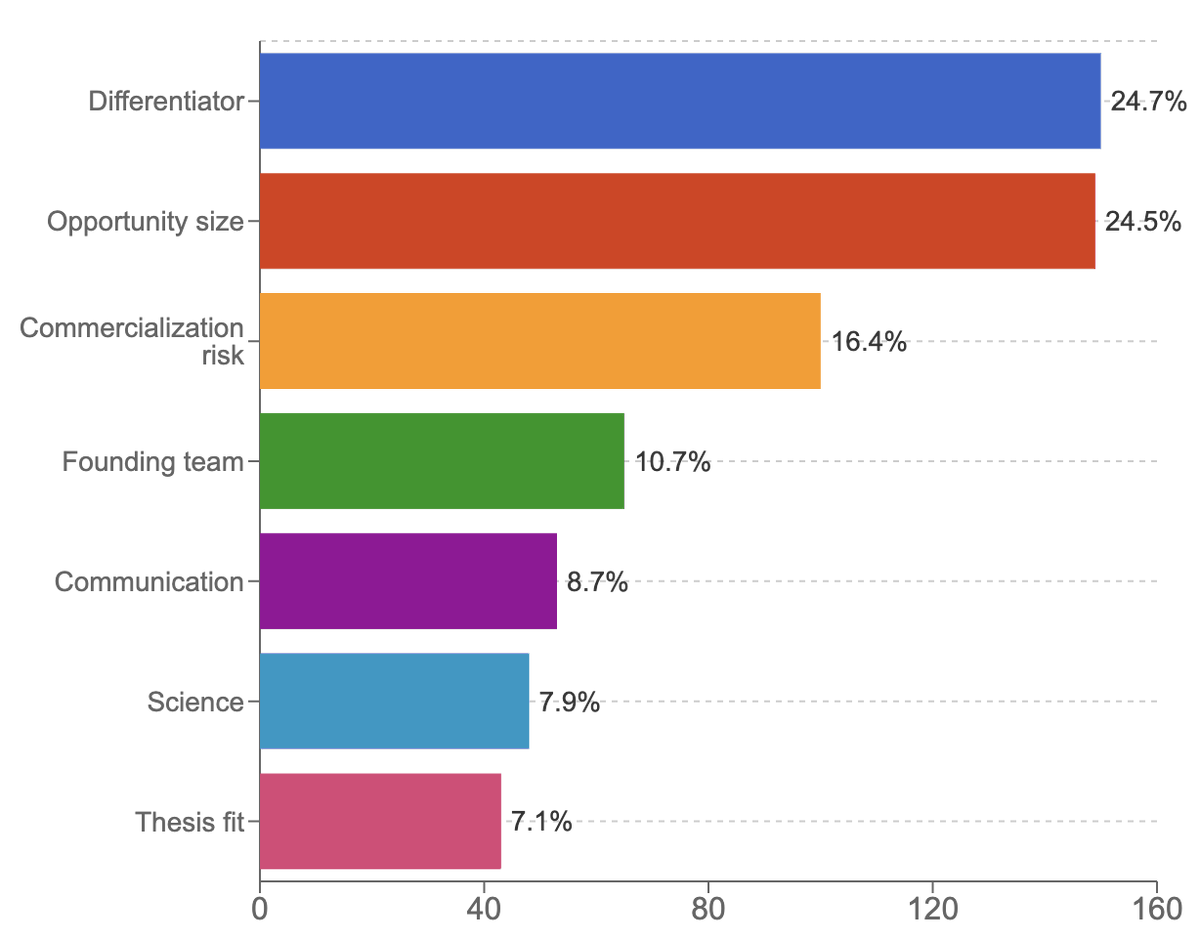
The crummiest part of venture capital is having to tell people no. We at @SciFounders often need to make tough decisions. I went back to our notes on the last ~500 startups we met and could boil down our feedback to 7 main factors that I think are critical.
📅 Save the date for our Biotech Partnerships workshop: June 11 | 9–10 AM PT
Partnerships are more important than ever in today’s financial environment. That’s why our next session will focus on how to make them work.
Lucas Harrington has built partnerships at Mammoth that have generated $200M in upfront payments. He’ll share insights, lessons learned, and the advice he wishes he had on day 1.
👉 We’ll cover:
• Whether to partner or go solo
• How to identify and evaluate the right partners
• Which contract terms actually matter
• Tactics to close deals efficiently
• What to focus on in the first 90 days after signing
🕜 20-minute presentation + extended Q&A
🎟️ Open to everyone!
https://t.co/dhhLX2V9e1
Excited to share details of what we are working on @nudge for the first time today.
Our mission is to improve everyday life by developing the best technologies for interfacing with the brain.