@RobertoBalbinoX Agree, the cap chart misleads. Same outside the dollar - the non-USD stablecoins I track moved ~$6.8B in 30 days, and nearly half was one token, A7A5, a ruble stablecoin under sanctions. Activity and concentration say more than supply
@harshamv Good roundup.
A non-USD angle from our data across the non-usd denominated stables which we track shows that BRL stablecoins moved ~$115M on Nov 3–9 vs ~$87M the week before, while tracked MXN tokens are still near zero. The BRL leg is where local-currency volume shows up first
@Securitize, the platform behind @BlackRock's tokenized funds, is buying @RiverOneHQ.
Why it matter in my eyes -
When a fintech lends to small businesses, it doesn't use its own money. It borrows from a bank on a short-term credit line, makes the loans, bundles them, sells the bundle, and repays the bank. River One wants stablecoin holders to provide that line instead of the bank.
Until now, stablecoins mostly bought finished products: like a token of a fund that already holds loans. This moves them to the start of the chain, where credit is actually created.
The gap is reak. Of the ~$30B in "tokenized private credit", 90% are home loans recorded on a blockchain. Stablecoin capital actually funding credit is ~$5.8B. The market for asset-backed lending is estimated at ~$6T.
The open question is control. Because a bank sees every loan and can shut the line when something goes wrong. Of the bank is removed, then visibility has to be rebuilt as data anyone can check.
That's the real work ahead. Not another token, but credit a user can see
#Stablecoins #PrivateCredit #RWA
@HookedExchange GYEN is a good case of issuance without adoption. On Stellar chain it still logged ~15K transfers in October as we track it the data. But total value was around $1K
@TBariach@trondao USDT on Tron is not under control of Tether, they cannot freeze it there. On a smart contract level there is no opputunity to make it, the logic is hard and cannot be change. That's why people prefer to use it inspite of a huge fee even for a small transaction amount
@candowa_au Absolutely right, distribution decides a lot of tasks
On Stellar, the only AUDD chain our platform tracks so far, October transfer volume was ~$17M over 36K transfers, about half of September
That Tron gap shows in platform data too. The only non-USD stablecoin we track on Tron is A7A5, the ruble pegged stablecoin, which is under sanctions
Indeed, a compliant local-currency liquidity sits elsewhere, so routing USDT0 into cNGN pairs is a practical fix. How deep is the cNGN book today?
@joinrepublic Access is the right question, and the next is settlment. We track Solana non-USD stablecoins, EURC made $1.7B transfers there in October. Private credit priced and repaid in euros on the same chain is a short step
@io_enthusiast@StartaleGroup Yield and settlement on one rail is the right direction for japanese yen. The gap is usage, as JPYC on Polygon did ~$44K across 910 transfers in October in the tracked by our platform data, and Coinbase is winding down GYEN
@industryspread The 30% unremunerated floor is the real design choice, as it caps float income and pushes issuers toward payments volume. For scale, the GBP denominated stablecoin we track on Arc blockchain moved ~$1.25M in October. Long way to go before a £40bn cap matters
@AfricaWeb3_Inst@gftn_official@AIRinnovate I'd ask how the ₦10bn bar treats issuers already live. On Stellar blockchain NGNC logged ~7,100 transfers in October but only about $2K in value in the tracked data. The capital rules will decide if that turns into real flow or stays a pilot
@Pankujasrotia11 The licensing filter point is the strongest part. Supply lagged, but usage didn't, The euro pegged stablecoins we track moved ~$2.4B onchain in October, mostly EURC on Solana. Small float, high turnover. Our coverage is partial, but the euro looks used, just not hoarded
@CharmanderX81 BRL is the interesting test case right now. BRLA supply went from about R$209M to R$316M between Nov 6 and Nov 9 per DefiLlama, roughly 95% of it on Celo. The rails exist, the open question is where the two-sided flow comes from
@CharmanderX81 Good timing for this series! The gap I keep seeing is that non-USD stablecoin supply is still tiny next to the FX market it wants to serve, so liquidity depth per pair matters more than the number of pairs listed. Curious how you'll treat that
@YouApp_AI Merchant gets local, and user tops up in MYRT, XSGD, JPYC or IDRT. That's onchain FX hidden behind a QR code, which is how it should feel. Who holds the FX leg and the spread on the conversion?
Redemption is what holds the peg, and MiCA has largely settled that side for euro tokens. The harder part now is distribution. All euro stablecoins together are still around $849M per @DefiLlama, which is why new issuers sell instant SEPA exits rather than the token itself I believe
@TBariach Happy to join. Stablecoin regulation makes big moves around the globe.
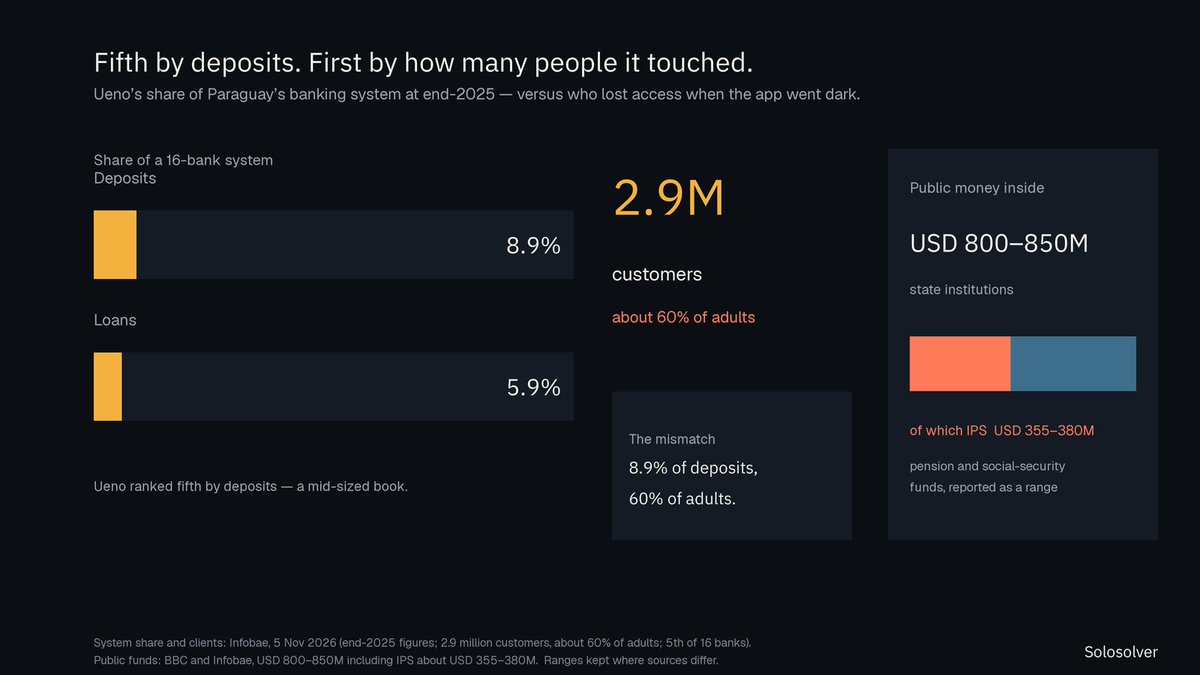
Local currency onchain can mitigate risks, which Paraguay had last week
7/7 What it would have changed is access.
Daily money would no longer be one bank's IOU.
A dollar stablecoin would have protected purchasing power, by dollarizing wages and prices further.
The harder rail is local-currency cash that still moves when a bank goes dark.
https://t.co/CAEvUZQVL9
1/7 A resolution is not a rescue
Early on 3 November, Paraguay's central bank said it had the day before taken Ueno, the country's largest digital bank, out of ordinary management.
Restatements left solvency below half the legal minimum, so the app, cards and ATMs went dark.
6/7 An onchain guaraní, fully reserved, with published proof of reserves, a public check that tokens match assets, would not have cured those related-party loans, and it would not have held the currency
Reserves still sit somewhere, and a PYG token still falls when PYG does