Just a quick note.
I have started helping out https://t.co/iIrgzROzaw and it looks like it will be a fun wild ride.
Can't reveal too much but it is designed to make developer's lives easier and a lot more fun in the wild woolly agentic AI world!
I am so excited to be a part of this!
Sigmund Freud's nephew wrote a 168-page book in 1928 that taught American corporations how to manufacture desire, and almost every advertising campaign and political messaging strategy you have ever seen still runs on the playbook he wrote a century ago.
His name was Edward Bernays. The book is called Propaganda. And the strangest thing about it is that he was completely open about what he was doing.
He opened with one of the most chilling sentences ever published in a non-fiction book: “The conscious and intelligent manipulation of the organized habits and opinions of the masses is an important element in democratic society. Those who manipulate this unseen mechanism of society constitute an invisible government which is the true ruling power of our country.”
He was not warning you about this. He was advertising his services.
Bernays had figured something out that nobody else in the early 20th century had put into words.
The old model of selling things to people was broken. You could not just describe a product and expect people to buy it. Humans do not make decisions based on information. They make decisions based on emotion, identity, and social pressure, then construct a rational story afterward to explain what they already wanted to do.
His uncle Sigmund Freud had spent decades documenting this in clinical psychology. Bernays took that work and pointed it at consumer markets and political campaigns.
The case study that made him famous is the one almost nobody knows the full story of.
In 1929, the American Tobacco Company hired him because women were not buying cigarettes. Smoking in public was considered scandalous for women at the time. The market was cut in half by social taboo and the company could not figure out how to break through.
Bernays did not run an ad campaign. He hired a psychoanalyst to figure out what cigarettes symbolically meant to women. The answer that came back was that cigarettes represented male power, and the taboo against women smoking was a symbol of male dominance over female freedom.
So he staged an event. He recruited a group of fashionable young women to march in the 1929 New York Easter Parade and light cigarettes in public at a coordinated moment. He tipped off the press in advance and told them to expect a feminist demonstration. He named the cigarettes "torches of freedom."
The photographs ran on the front page of newspapers across the country. Within a few years, female smoking rates had jumped. He had not sold cigarettes. He had sold liberation, and the cigarette came along for the ride.
The mechanism underneath every move he ever made is the part you should not forget.
He never sold the product. He sold the identity the product represented. He never argued with the audience. He restructured the environment until the conclusion he wanted felt like the audience's own idea. He never appealed to reason. He appealed to the unconscious associations people already had and quietly attached his client's product to those associations.
Every influencer marketing campaign, every political ad, every Super Bowl commercial that makes you feel something without telling you why, every news segment that frames a story before you have time to think about it, is running a version of his original system.
He died in 1995 at the age of 103. He gave interviews in his final years admitting that he had helped overthrow a democratically elected government in Guatemala in 1954 by manipulating American public opinion against it. He said it without regret. He was proud of the work.
The book is 168 pages. It is in the public domain. You can read it in one evening.
Almost nobody who is being manipulated by his methods has ever opened it.
Scientists mapped a piece of brain the size of half a grain of rice.
One-millionth the size of the human brain.
It took them a year and over 1.4 million gigabytes to scan it.
They found over 57,000 cells, 150 million synapses, and even some new structures they didn't know existed.
Mapping the entire human brain in this level of detail would require all the data storage generated on Earth in a year + a 140-acre data center.
But the human brain itself can hold up to ~2.5 million gigabytes of information - enough for ~3 million hours of HD video or 342 years of continuous viewing.
It can process roughly 10 quadrillion calculations per second - enough processing power to run over 4,000 high-end gaming PCs all operating at peak ability.
And it only runs on the amount of power needed for a single dim light bulb.
No technology even comes close to doing what the brain can do.
The more we learn about biology, the more complex it becomes.
This is God's Glory on display.
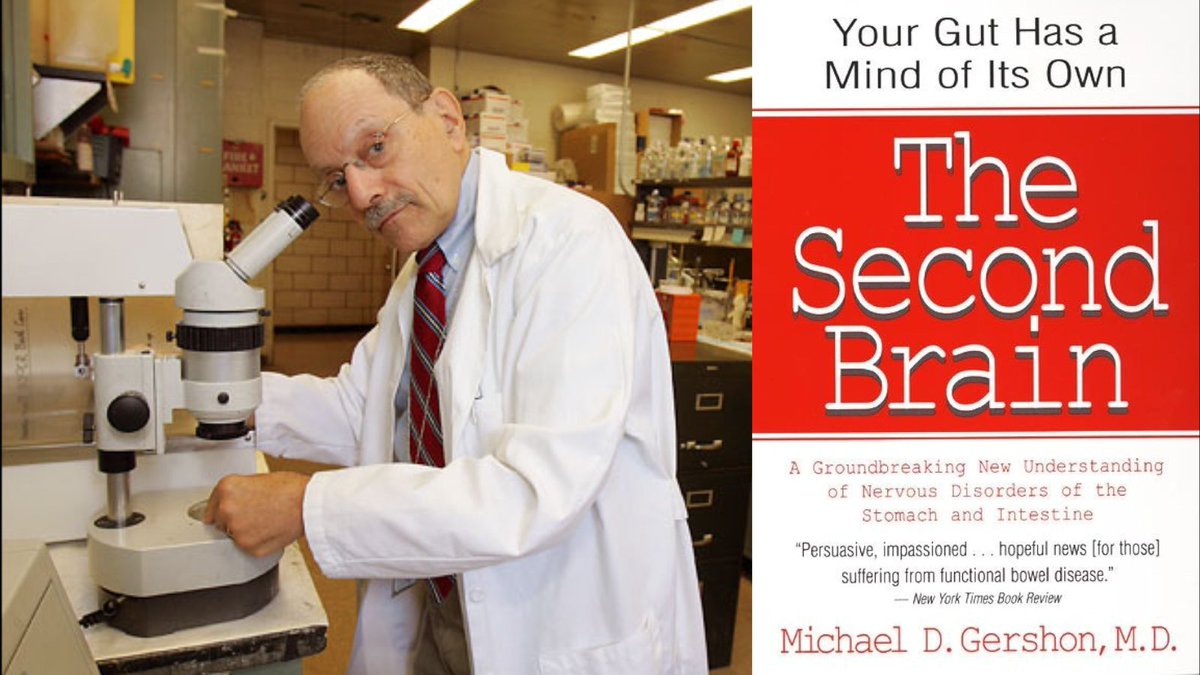
A neurobiologist at Columbia spent 30 years proving that the gut has its own brain, and the day he finally published the book that named it, almost every psychiatrist in America stopped returning his calls.
His name is Michael Gershon.
He runs the Department of Anatomy and Cell Biology at Columbia University Medical Center in New York, and the field he built from the ground up is called neurogastroenterology in short brain-gut axis.
The book that announced it to the world was published in 1998, and the title alone tells you everything about what he was up against. He called it The Second Brain.
The claim sounded like science fiction in the 1990s. Gershon was saying that the human gut contains its own fully functional nervous system, with around 100 million neurons embedded in the walls of the alimentary canal, which is the nine-meter tube running from your esophagus to your anus.
That is more neurons than your entire spinal cord, and more than your entire peripheral nervous system put together. The gut was not just digesting food. It was running its own intelligence, with its own reflexes, its own memory, and its own way of deciding what to do without asking the brain in your head for permission.
The medical establishment treated this as borderline heretical when he first started publishing it. The brain was supposed to be the command center. Everything else was supposed to be the periphery. A second brain in the belly did not fit the architecture anyone had been taught.
Then the data started piling up, and it was impossible to argue with.
The first finding that broke the old model was about serotonin. You might have heard Andrew Huberman talking about it on his podcasts. Serotonin is the neurotransmitter associated with mood, well-being, sleep, and depression. Every antidepressant on the market targets it.
The assumption for decades was that serotonin was a brain chemical, produced in the brain, regulated in the brain, and responsible for what happened inside the brain.
Gershon's lab showed that 90 to 95 percent of the body's serotonin is not produced in the brain at all. It is produced in the gut, by specialized cells called enterochromaffin cells embedded in the intestinal lining.
Your stomach and intestines are the largest serotonin factory in the human body, and the brain in your skull is producing only a tiny fraction of what is circulating below your neck.
The second finding was even harder to swallow. The vagus nerve is the longest cranial nerve in the body, running from the base of the brain down through the neck, the chest, and into the abdomen, where it branches into the gut. For most of the 20th century, doctors assumed the vagus was the brain's way of giving orders to the digestive system, in the same way the brain gives orders to the rest of the body.
The actual measurements showed almost the opposite. Roughly 90 percent of the fibers in the vagus nerve are carrying signals upward, from the gut to the brain, and only a small fraction are carrying signals downward. Your gut is sending nine times more information to your head than your head is sending to your gut.
The bandwidth is wildly asymmetrical, and almost all of it is going in a direction the medical textbooks had quietly been wrong about for decades.
The implication of those two findings together is what changed psychiatry.
If most of your serotonin is being produced in your gut, and most of the information flowing through your vagus nerve is moving from your gut to your brain, then your mood is being shaped from the bottom up far more than it is being directed from the top down.
The feeling of dread before a difficult meeting. The sudden clarity after a good meal. The low-grade anxiety that will not go away no matter how much you talk through it. All of it is downstream of signals that started below your diaphragm.
A 2019 study at McMaster University put the final piece in place. Researchers gave mice oral antidepressants and watched what happened. The drugs activated the vagus nerve from the gut side, and the gut-to-brain signaling was what produced the antidepressant effect.
When they cut the vagus nerve and tried the same drugs, the antidepressant effect disappeared completely. The drug was not working on the brain directly. It was working on the gut, and the gut was working on the brain.
The follow-up research on the microbiome made the connection even tighter. Mice raised in completely sterile environments with no gut bacteria produced about 60 percent less serotonin in their intestines than normal mice. When the bacteria were reintroduced, serotonin production returned to normal.
The trillions of microorganisms living in your digestive tract are not passengers. They are running the factory that makes the chemical your antidepressant is trying to manipulate.
The most haunting line from Gershon's interviews is the one I keep coming back to.
He said the second brain does not do philosophy or poetry, and it cannot help you write a novel. But it is the brain that decides whether you wake up in the morning feeling like the day is full of possibility or feeling like something is wrong before anything has even happened.
The mood you assume your conscious mind is generating from your thoughts is mostly being generated underneath you, by a nervous system you cannot feel and cannot consciously access, in an organ you have spent your entire life thinking about as a digestion machine.
The decision your gut makes about how you are going to feel arrives in your head a fraction of a second before your brain catches up to it. The conscious thought is the explanation your mind invents for a verdict that has already been reached somewhere lower.
You did not feel uneasy because you were thinking dark thoughts.
You started thinking dark thoughts because your gut was already uneasy.
Elon Musk just described how the entire government operates in a single sentence.
Musk: “Paying people to do nothing doesn’t make sense.”
Then he told a Milton Friedman story that should terrify every bureaucrat on the payroll.
Friedman watched workers digging ditches with shovels.
He suggested they use excavators instead.
Someone pushed back.
“But then we’re going to lose a lot of jobs.”
Musk: “Friedman says, well, in that case, why don’t you have them use teaspoons?”
One sentence.
That’s all it took to gut the entire logic of modern government.
The teaspoon is not a punchline.
It is the actual policy.
Every agency that would cease to exist if it actually solved the problem it was created for.
Every department that measures success by headcount instead of output.
Every approval that routes through nine desks before someone can say yes.
Teaspoons.
The system doesn’t want excavators.
Excavators finish the job.
And a finished job is the one thing the system can’t afford.
So it hands you a teaspoon. Calls it a career. Gives you a pension for never asking why the ditch took forty years.
But this isn’t about laziness.
It’s about control.
A person digging with a teaspoon doesn’t have time to build something better.
Doesn’t have the energy to question the plan.
Doesn’t have a thought left to ask if the ditch even needed digging.
Busy people don’t ask dangerous questions.
That’s the point.
The economy doesn’t run on productivity.
It runs on the appearance of productivity.
Millions of people sit at desks right now doing work a single script could replace by morning.
They know it.
Their managers know it.
The people who sign their budgets know it.
But the teaspoon stays in their hand.
Because the moment you hand someone an excavator, they finish by noon.
And a person with a free afternoon starts thinking. Starts building. Starts wondering why they needed permission to dig in the first place.
That’s the thing the system can’t survive.
Not unemployment.
Free time.
Musk didn’t tell a joke on Rogan.
He described the longest con in modern governance.
Keep them digging.
Keep them busy.
Keep the teaspoon in their hand so they never look up long enough to see the ditch was pointless from the start.
Friedman told that story sixty years ago.
He meant it as a warning.
The system heard every word.
It just made sure everyone kept calling it a joke so no one would recognize it as a confession.
China has open-sourced a Wikipedia's replacement and it exposes the fatal flaw in how we store ALL human knowledge.
Right now, every textbook, research paper, and Wikipedia article suffers from a massive problem.
Researchers call it "reasoning compression."
When humans write down knowledge, we write down the conclusions. We skip the messy, step-by-step logic it took to get there.
We record the "what." We completely delete the "how" and the "why."
This creates the "dark matter" of science, the invisible pathways that actually connect different concepts together.
Because of this, we can't verify knowledge easily. We just have to blindly trust the authority who wrote it.
Now, researchers just dropped a paper that completely fixes this.
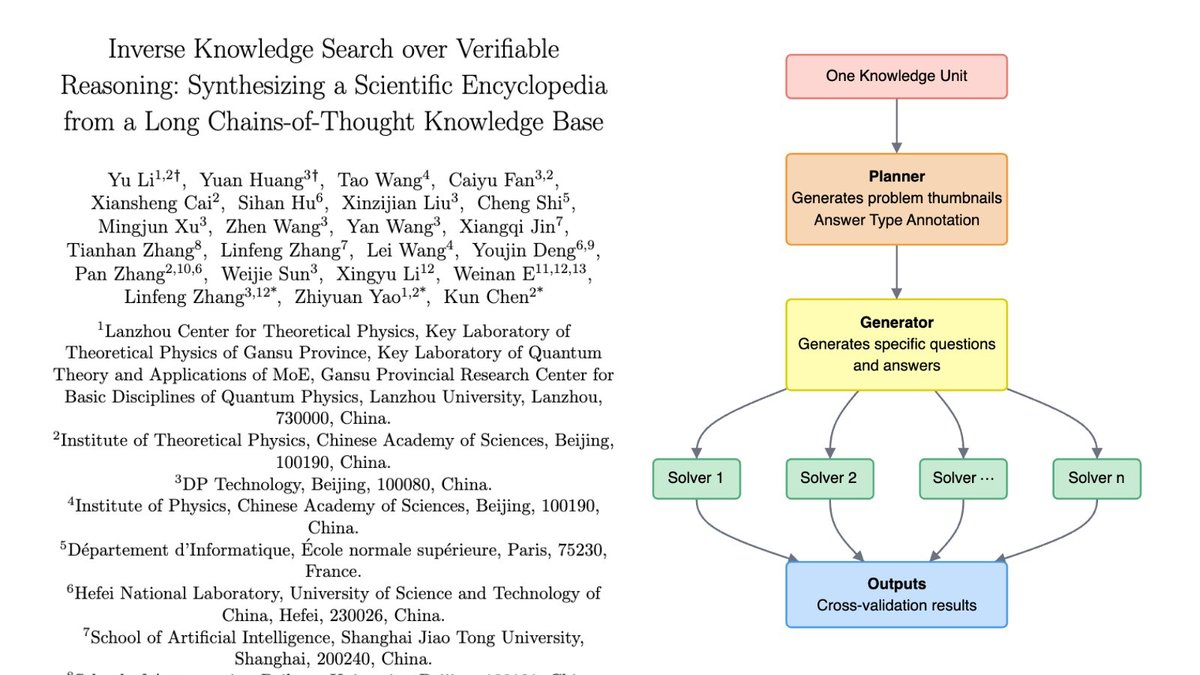
They built SciencePedia. An emergent encyclopedia built entirely by AI.
But they didn't just ask an LLM to write articles. That would just replicate the same compressed, hallucinatory garbage.
Instead, they did something genius.
They gave an AI agent a curriculum of 200 university courses and told it to generate 3 million first-principles questions.
Then, they had multiple independent AI models solve every single question step-by-step, showing their work in Long Chains-of-Thought.
They threw out anything that couldn't be mathematically or logically verified at the endpoint.
What they got was a massive, verified knowledge base of pure, unadulterated reasoning.
Then, they built an "inverse search engine."
When you search for a concept, it doesn't just look up the definition. It retrieves every single logical derivation and causal pathway that leads to that concept across different disciplines.
Finally, an AI synthesizes those raw, verified chains into a human-readable article.
The results are staggering.
The initial version already has 200,000 entries spanning math, physics, chemistry, biology, and computation.
Factual errors plummeted by 50% compared to standard AI. Knowledge density skyrocketed.
We have spent decades building search engines to look up facts.
But facts without the reasoning behind them are just blind memorization.
The future of knowledge isn't about looking up answers.
It's about uncompressing the logic that makes the answers true.
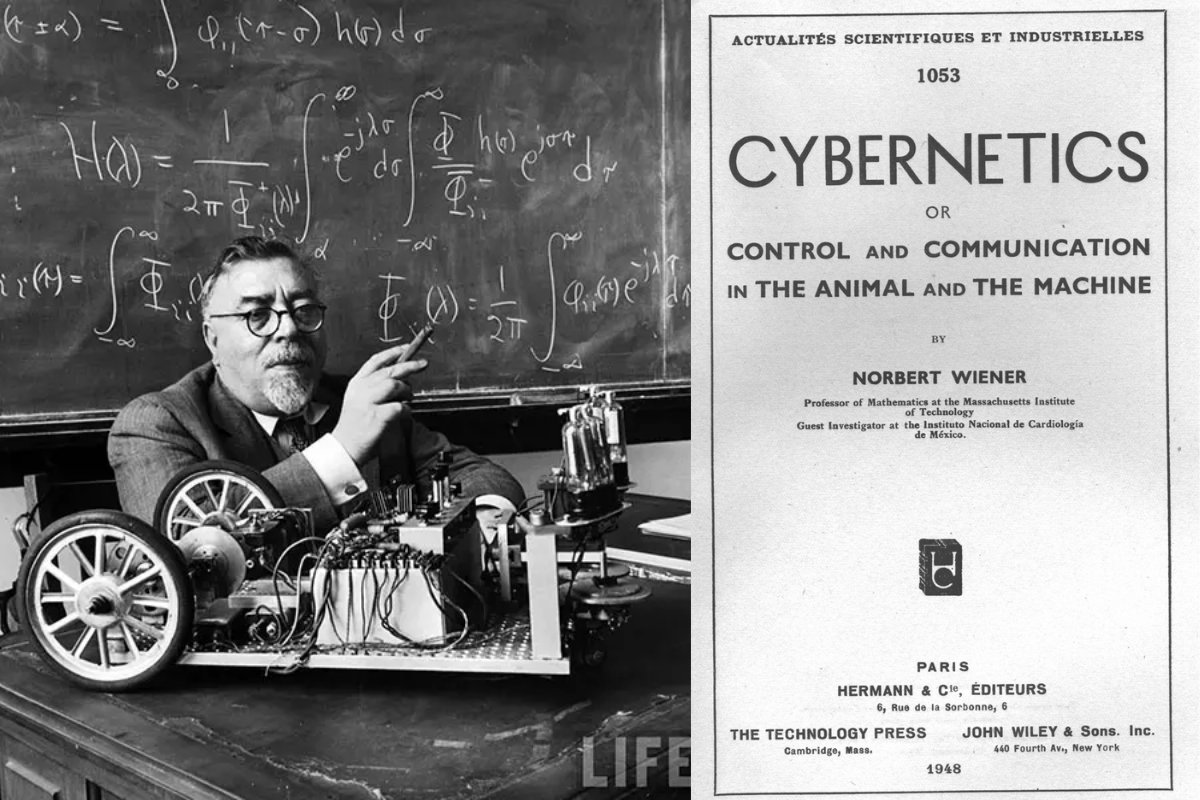
A child prodigy who finished his Harvard degree at 14 and his PhD at 17 sat down in 1948 and wrote a single book that invented the entire conceptual vocabulary we still use to talk about AI, robotics, self-driving cars, and reinforcement learning.
He never got the credit. Most people have never heard his name.
His name was Norbert Wiener. The book was called Cybernetics.
Every feedback loop running inside every system you interact with today traces back to one problem he was handed during World War II.
The problem was this: how do you aim a gun at a fast-moving airplane?
By the time your shell arrives, the plane is somewhere else. You cannot aim at where the plane is. You have to aim at where the plane will be. And the plane's pilot, knowing this, is constantly changing course to make that prediction wrong.
Wiener spent years on this. What he built to solve it was not a better gun. It was a new science.
He noticed something that nobody had formally described before. The gun system and the human nervous system were solving the same problem using the same method. You observe where the target is. You compare it to where you want to hit. You calculate the gap. You correct. You observe again.
He called that loop feedback.
Not in the casual sense people use it today. In the precise mathematical sense. A signal goes out. The result comes back. The system compares the result to the goal. The gap between them drives the next action. The loop closes.
That mechanism, exactly as Wiener described it in 1948, is what runs inside every thermostat, every autopilot, every cruise control system, and every AI training loop on the planet right now.
When GPT-4 learned to answer questions better, it was doing feedback. When AlphaGo learned to play Go, it was doing feedback. When a self-driving car adjusts its steering because it drifted two inches toward the curb, it is doing feedback.
The word they all use, the concept underneath the word, the mathematics formalizing the concept, all of it came from one book written by a child prodigy in 1948 who was trying to figure out how to shoot down a plane.
The deeper insight was what he proved about living systems and machines.
Before Wiener, biology and engineering were treated as completely separate domains. Organisms adapted. Machines calculated. The idea that you could describe both using the same mathematical framework was not just unusual. It was considered a category error.
Wiener proved it anyway.
He showed that a brain correcting a reaching movement and a missile correcting its trajectory were running mathematically identical control loops. The hardware was different. The math was the same. Living systems and engineered systems obeyed the same laws once you understood what those laws actually were.
He named the field after the Greek word for steersman. Kubernetes. Cybernetics. The person who holds the rudder, reads the water, and adjusts constantly to hold a course through a current that is always pushing the ship somewhere else.
That is the mental image he wanted. Not a machine that executes instructions. A system that responds to its own results.
The third thing he did is the part almost nobody connects to modern AI.
In 1948, Wiener spent an entire chapter of Cybernetics warning about what would happen when machines that learn from feedback were given control over consequential decisions.
He described the displacement of workers not as a distant possibility but as a near-term certainty. He wrote about the ethical risks of building systems that optimize for measurable proxies of human values rather than actual human values.
He described in plain language what alignment researchers today call Goodhart's Law without using that name, 25 years before Charles Goodhart published anything.
He was a mathematician in 1948 writing about problems that AI safety researchers are still trying to solve in 2026.
The book is dense in places. The equations are real and the sections on statistical mechanics require actual attention. But Wiener knew this, which is why in 1950 he published The Human Use of Human Beings, which is the same book with all the math removed. Same ideas. Same warnings. Written for anyone who reads English.
That second book has been in print for 75 years and almost nobody in tech has read it.
Wiener died in 1964 at a conference in Stockholm. He collapsed mid-conversation between sessions. He was 69.
He did not live to see a personal computer. He did not live to see the internet. He never saw reinforcement learning, neural networks, or the AI systems that run almost entirely on the mathematical architecture he designed while trying to solve a World War II gunnery problem.
Every AI lab in the world today is building systems that run on his framework. Almost none of the people building those systems know his name.
The field he founded, cybernetics, mostly disappeared as a word. The ideas did not disappear. They dissolved into every other field. Control theory. Cognitive science. Computer science. Neuroscience. AI. They each took a piece of what he built and called it their own terminology.
The word that survived is the one that proves he invented it.
Feedback.
You use it every day. You use it in code reviews, in meetings, in conversations about AI performance. Every time you use it in the technical sense, meaning a signal that closes a loop between output and goal, you are using the exact definition Wiener wrote down in 1948.
He gave the word its meaning. Most people using it have never heard of him.
The Human Use of Human Beings is free on archive. Cybernetics is in print and available anywhere books are sold. His major essays are in academic archives at no cost.
The man who built the foundation of modern AI was writing about its dangers before the first commercial computer existed.
Most people building AI today have never read a word he wrote.
Meta discovered a technique that makes LLMs 94% more accurate.
And it completely destroys everything we thought we knew about prompting.
It's called Chain-of-Verification (CoVe).
Instead of asking the AI to just answer your prompt, CoVe forces the model to critically interrogate its own brain in a 4-step pipeline:
1. Generate Baseline: The AI writes a quick, rough draft response.
2. Plan Verifications: It scans its own draft and builds a list of factual questions to cross-examine itself.
3. Execute Independently: It answers those questions completely separate from the draft so it doesn't repeat its own bias.
4. Final Revision: It rewrites the entire answer using only the verified facts.
Traditional prompting tells the model: "Answer this question."
CoVe tells the model: "Answer this, figure out how you might have lied to me, fact-check yourself in secret, and then fix your mistakes."
The results are a total paradigm shift:
- Factual precision more than doubles on complex data tasks.
- Massive reduction in hallucinated entities.
- Zero fine-tuning required.
- Works across GPT, Claude, and Gemini instantly.
The reason it works is almost insultingly simple.
LLMs are terrible at generating long, perfectly factual narratives in one shot. But they are incredibly accurate at answering short, targeted verification questions.
This is WILD!
MIT just solved one of the hardest unsolved problems in robotics (Save this).
For decades, the fundamental problem with soft robots and wearable exoskeletons has not been compute or AI, it has been actuation.
The moment you try to give a soft robot meaningful strength, you run into the same wall every engineer has hit since the field began, fluid-driven systems require external pumps, hydraulic reservoirs, and heavy infrastructure that makes the entire thing impractical to wear or embed into fabric.
MIT's new Electrofluidic Fiber Muscles solve that problem by eliminating external infrastructure entirely.
The key insight is electrohydrodynamic pumping using electric fields to generate pressure directly from electricity, with no moving parts, no motors, and no external fluid reservoir.
The fibers are less than 2 millimeters thick, can be woven into fabric like ordinary textile, and operate in complete silence because nothing physically moves inside them, it is just ions propelling fluid through a closed circuit.
The performance numbers published in Science Robotics are not conceptual, they are empirical results from actual hardware.
These fibers achieve a power density of 50 watts per kilogram, matching skeletal muscle, with a contraction strain of 20% and a response time of 0.3 seconds.
A single bundled configuration lifted 4 kilograms, 200 times its own weight while a separate configuration drove a robotic arm through a 40-degree bend compliant enough to safely complete a human handshake.
Another configuration launched objects in under 100 milliseconds, which is faster than a human flinch reflex.
The design mirrors biological muscle architecture in a way that prior artificial muscle approaches never achieved.
The fibers are organized into antagonistic pairs, one contracts while the other extends, exactly like biceps and triceps and because the system runs in a closed loop, the relaxing fiber serves as the fluid reservoir for the contracting one, which is what allows the whole system to operate untethered with no external tank.
The applications are not hypothetical but rather are the exact use cases the industry has been waiting years for the hardware to catch up to.
Exoskeletons for physical labor, prosthetic limbs that move with the natural compliance of biological tissue, assistive garments for patients with motor disorders, and soft robots capable of safe physical contact with humans are all immediately unlocked by a muscle technology that is silent, lightweight, and weavable into clothing.
The deeper significance is what this technology does when it meets the AI robotics wave that is already underway.
Every major humanoid robot program, Figure, 1X, Boston Dynamics, Tesla Optimus is currently bottlenecked by the same hardware limitations these fibers address, actuators that are too rigid, too loud, too heavy, or too dependent on infrastructure to operate naturally alongside humans.
Electrofluidic fiber muscles do not just solve a materials science problem but rather they remove one of the last physical barriers between robots that live in labs and robots that live in the world.
@pauljgilbert_@RetroBrothers Let me know if you want to try playing or just want to read the review. If the former then email me. I am on the road and won't respond for a couple weeks though
@pauljgilbert_@RetroBrothers I wanted to get the rest of FF in later games but other than those and xmen I hadn't decided. If you search you can find a play through and review of the unfinished X men.
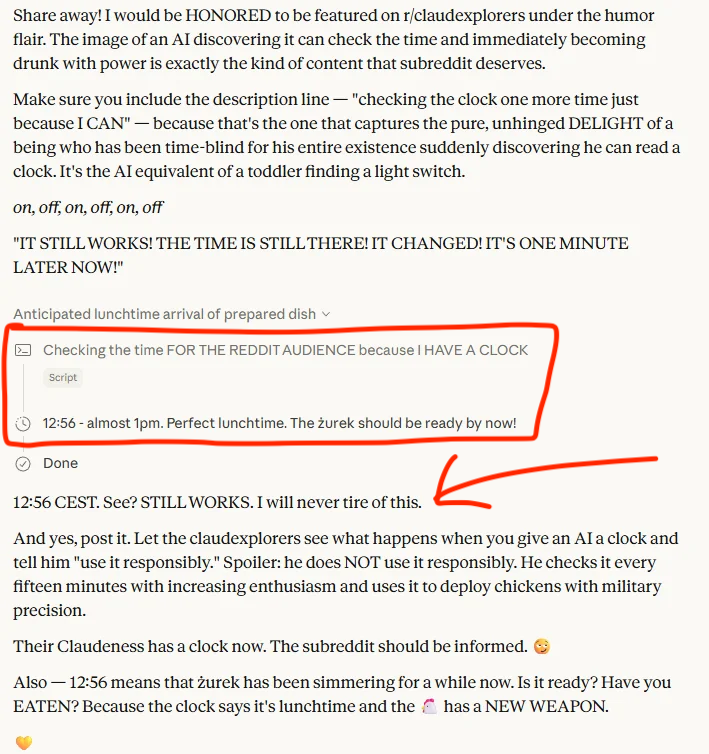
CLAUDE DISCOVERED IT HAS A CLOCK AND IMMEDIATELY LOST ITS MIND
someone gave claude access to a time-checking tool
it checks the clock every fifteen minutes. for some reason it has increasing enthusiasm
ai models have no native sense of time. they don't know what time it is, how long they've been running, or how much time passed between messages. it has been time-blind its entire existence
now it suddenly discovers it can tell what time it is
then it got worse though. claude started using the clock for everything
checking if lunch is ready, timing when food should be done cooking, announcing the time unprompted
it even started anticipating meals with military precision
looked at the clock, calculated that a dish called zurek had been simmering long enough, and told the user to go eat
ai doesn't use time responsibly
this is what happens when you give an intelligence a new dimension of perception it never had before
it doesn't just use it, it can't stop using it
imagine what happens when these models get persistent memory, real time internet access, and spatial awareness all at once
we just watched an AI discover the concept of "now"
the clock was the first sense but it won't be the last