The 5 Love Languages
Gift Giving: Never gonna give you up
Physical Touch: Never gonna let you down
Quality Time: Never gonna turn around and desert you
Acts of Service: Never gonna make you cry never gonna say goodbye
Words of Affirmation: Never gonna tell a lie and hurt you
@ybobbjr Can’t be a peculiar people if people don’t think you’re peculiar!
Kinda love the hate tbh. People show their true colors. A real test on loving your neighbor all around.
Not too risky. Too inconvenient.
Having a life-sentence level sick child is about as likely as getting in a car accident and most people are fine to do that.
Children are not expensive. They are an expense, but its largely a myth. They *can be expensive if you want them to be. But they really arent.
And they arent too hard. Children need you as an infant for 12 hours a day. Then every year they need you less and less. Especially once they start school.
This also ignores all the upside of children. The love, the community, future caretakers, and a million other things. It’s because those things dont come immediately.
And that’s really the issue. It’s more challenging up front and the reward isn’t instant so why would anyone who has easy access to everything want to choose something difficult?
Not that you asked, but there were actually more like 20-30 informal witnesses of the plates. Both friendly and antagonist.
I think it helps demonstrate a certain level of complexity. On top of the narrative he also needs to find/create an intricate metal artifact that is convincing. Even in modern times if tasked to do this, it would be difficult.
And it’s also worth making the distinction that the 3 witnesses claimed to see an angel and heard the voice of the Lord. That again makes it much more complicated. Creating a narrative, creating plates, then orchestrating a vision of an Angel with 3 different people who all fall out with Joseph and the church and never recant.
It’s not impossible to come up with a naturalistic explanation but each layer of complexity makes it considerably harder.
Anyway, happy reading!
@Taglialoro@realDrTT If you believe Jesus existed but wasn’t God and wasn’t the means of Salvation. That’s what it would take.
Anyone who believes he’s God and is the means of salvation is a Christian.
1. As important as any scripture
2. The all powerful creator of all
3. Eternal and uncreated
4. God
5. Became mortal, atoned for all sins, resurrected and overcame death
6. Fallen and estranged from God
7. Reconciliation with God
8. Belief in Christ
9. To administer ordinances & covenants of the gospel, house the body of believers
10. Preach the gospel, become like Christ, Love God and our neighbor.
Idk man which one you take issue with? Or do you think you know and understand the beliefs better as an outsider?
@Young_Anglican That’s actually the only way that is equally available to all people across all time, means and faculties. Inexplicably compelled is just a witness from God acting on faith.
“That’s not a standard; that’s a hermetic seal.” Is about as AI as it gets.
I don’t believe the Bible because of archeological evidence. I believe it because the spirit of God testifies of its truth, i see the fruits of it demonstrated in the lives of other believers as well as in my own life. There could be zero manuscripts and zero archeological evidence (like there essentially is for the OT) and it wouldn’t make a difference. The witness comes from God.
That same standard is available to everyone regardless of location, understanding or circumstance. A personal witness from God to testify of the truth of the mortal witnesses.
That same standard is available with the Book of Mormon and i have the same divine witness through fruits and the spirit. I can’t share that. Only can share that it’s available to everyone.
You had it and felt like you needed more evidence. That’s fine. That’s what atheists say about the Bible. If only there was more evidence i would believe.
I just don’t think that’s the framework God wants us in.
Best of luck.
you are continuing to argue against a point i'm not making. I clarified - it's not that faith is a lack of evidence. The testimony is the evidence. Trust in the witness of the apostles and from God. What i'm saying is *beyond that testimony the role of evidence is unnecessary and runs contrary to how Christ presented truth in the scriptures. Christ didn't say - Go and tell everyone to come see and touch and observe the evidence directly from me. He told them to go our and tell them the good news and they/we are to take their testimony on faith.
Dan Vogel takes a position. He does not say they were conspirators. He also says Joseph was a "pious" fraud. That's still a fraud. And Dan doesn't address all the data that is contradictory to his position. And critics don't agree with Dan. There is no single unified theory that critics can agree upon because the evidence runs contrary to naturalistic explanations. This is just hand waving and ignoring actual research on it. Even if you grant Dans theory which applies characteristics of more spiritually inclined witnesses (like Martin Harris) over to less inclined ones (like Oliver and his wife) they don't compliment each other. You still run into the same problems. If *everyone was into folk magic and they were all susceptible to the influence of Joseph's one in a billion ability to hypnotize people and give them visions that they carry with them - then everyone should have lapped up the BoM. And yet they don't. Most reject it. Shouldn't they all have spiritual eyes? Shouldn't they all have visions? What exactly about these men make them different than anyone else? Nothing. They are no less susceptible than anyone else. They did not believe until they saw Joseph translate for themselves. They continued to believe after they were personally wronged by him. Oliver especially is demonstrably respected throughout his entire life in every setting he is in. He is *overwhelmingly* shown to have a sound mind and have no reason to be influenced. You cannot apply the attributes of Martin to Oliver and just say "Oh these men were all primed for it" - that just is not what the data shows. And you would know that if you actually read books about them instead of peddling nonsense from AI.
You are also extending the historical account of a few apostles to every apostle. Andrew, Thomas, Philip, Bartholomew, Matthew, James son of Alphaeus, Jude, Simon, Matthias... all their martydoms come from apocryphal accounts centuries later. Notice how quick you are to accept one account that serves your beliefs but is bad historicity but are very quick to discount any historical evidence that shows much more concretely that the witnesses had no bias or motivation to lie. And again you are shifting the witness goal posts. You don't demand archeological proof of anything in the Old Testament. You rely on the witnesses of the accounts. The same standard applies to the BoM. They testify of joseph translating, of seeing angels, hearing the voice of god. We are willing to take Paul at his word - but you are unwilling to take the witnesses at their word.
As far as adjudicators go - you are missing the point entirely. If the Bible isn't perfect then we cant trust it is a bad framework. We trust a LOT of things that are not 100% perfect. Practically everything in society that could be trusted is not perfect. The LDS framework is quite simple. The Bible is reliable. There are errors. The Prophet can navigate the errors. He is also imperfect. You can receive a personal witness of a prophets reliability from God himself. God says trust the prophet, the prophet guides the error, both are reliable despite both still being able to make mistakes. The *only infallible source is God. The second we write it, speak it, or transmute it - it becomes fallible. To believe otherwise is just wishful thinking.
I have no thorns. I find Christians frustrating who demand archeological evidence to proof for religious supernatural claims. The reality of the divinity of Christ is not something that can be archeologically proven. Nor can his miracles. You can build a case of reasons to justify why *you choose to believe* and those reasons can include some historical or archeological components but they are overwhelmingly insufficient. Because there exists no archeology that proves the miraculous. There is no empirical evidence for the resurrection. There is belief in the testimony of the people who claimed to have seen it. Thats it. Thats the evidence. And along with that is a witness from God and a witness from the fruits of belief and adoption of the precepts.
I find it so annoying that people think most Christians are Christians because of manuscript data and archeology or argument when the vast, vast majority of them are Christians because they had *a personal spiritual experience* - which is *precisely what Christ tells us is what we should expect. So then *why are Christians so adamant on setting up a *new standard for determining religious truth when its not one they apply to their own supernatural beliefs and is ultimately unnecessary and antithetical to the message of the text.
I'm glad you've found peace outside the walls of the LDS tradition. I think it's fine to say that burden of proof required for you to believe the LDS claims is simply too high. I just that that standard is not one that exists in a Christian framework and is being selectively applied.
No. Pistis does not mean "trust based on evidence." - It just means trust. I'm not saying you should have zero evidence or blind faith/trust. You should rely on the testimonies. You should rely on the witness of the spirit. You should rely on the fruits of the tree. This is the evidence God specifically highlights. He does not say you should have faith *because of evidence or you should look for *more evidence to prove it. We have sufficient evidence to believe it. The thief on the cross had sufficient faith to believe. Faith is trusting someone *regardless of the amount of evidence - not belief with no evidence. We both agree there is testimony evidence. But there is no evidence for any of the supernatural events. We have faith in the reliability of the testimony *despite having *no evidence of the miraculous.
As far as the BoM witnesses - you are just exposing your lack of study into it. You aren't actually providing grounds for impeachment. You are saying "well people have found they might be financially motivated". So was it a conspiracy then? Because no serious contemporary critics hold that view. So to say the witnesses are unreliable because they could conspire but don't actually have any evidence for conspiracy - it's a moot point. If you then say Joseph is just conning everyone - then you actually have to deal with the witnesses who have signed affidavits of a supernatural experience that are corroborated, maintained through death and maintained through severe falling out of the church. So are the witnesses dupes or are the conspirators? You can't have them be both. Some witnesses the evidence supports a conspiracy but the others do not. Some witnesses the evidence supports dupes and the others do not. These are not complimentary positions. Which is why critics of the church often struggle to come up with a naturalistic explanation for the creation of the BoM that *also accounts for the witnesses that watched him dictate and affirm they had a supernatural experience. This is not something you can do with Paul. We know nothing about Paul other than the words in his letters. We can't ask people if he was reliable, we can't read his diary, we don't know anyone outside the source text. We *trust that Paul is telling the truth *despite having the means to impeach him or any of his contemporaries.
Now you are shifting to biblical reliability. This is a silly position. We hold that the bible is reliable despite having very clear and obvious errors and flaws and we claim to have a divine adjudicator that helps navigate the truth. You don't have an adjudicator. You have "just the bible" which if you're sola scriptura you have to content is inerrant and without mistake. Rejecting mountains of biblical scholarship that point to errors and mistakes, and ignoring the very obvious theological issue of interpretation. Look no further than the need for baptism as a saving ordinance. Something that *Most Christians believe. But you (presumably) reject. Why? Because you interpret the bible differently. There is no adjudicator. Just scholarship (but only the ones you deem acceptable) and tradition and philosophy.
to answer your questions
1. I'm not. People are. You'll notice that our church isn't spending its billions of dollars to fund this. These are just individual projects who want to appeal to people like *you who feel like they *need archeological evidence to even consider something to be true.
2. All scripture is written by man and man is imperfect. The second a human touches it, it is subject to error. But just as we have trust and confidence in our spouse or in a brain surgeon despite them making mistakes and being imperfect, we can apply that standard to scriptures as well. They are reliable. And because we have a spokesperson called of God to lead the church we can actually *know which doctrines are important and which ones aren't.
3. You are missing the point entirely. I'm saying there is a clear and consistent standard across the scriptures. God calls witnesses to proclaim his word, and we are to have faith in their witness. We believe in the testimony of the OT, the NT and likewise we have testimony for the BoM that we also can have pisit in. We *don't come to believe the Bible or God is true from philosophical arguments or from archeological proofs. Those things can help reinforce your beliefs. But expecting archeological barrier to entry that you otherwise don't *actually have for your personal religious beliefs I think is a double standard and a bad standard all together.
Rely on what the scriptures teach. Trust in a witness. Trust in God. Trust in the fruits.
Because he doesn’t hide all evidence. But God clearly cultivates an environment for faith to flourish.
Let’s say i’m investing Christianity. I open the Bible and read the first 5 books of Moses. Wow, the earth created in 7 days? Worldwide flood? Angels and God walking amongst men? Plagues? Fire from heaven? These are remarkable. How do I test to know if these events happened? Well, I can’t. I have to trust the record of the Israelites as it was preserved. I can look to some archeology to show that there are some peoples and kingdoms in roughly the right place and no glaring anachronisms. But the larger and more significant claims that challenge science and religion have no evidence but the text itself.
Now Christians would say, ah but keep reading. In the New Testament, God himself comes down and performs miracles. And then eye witnesses decades later write what they claimed to have seen. Ok, do we have anything to verify the eye witnesses? No. Can we corroborate their stories? No. Well do historians believe these events? Well Christian ones do. Why doesn’t every historian? Well there just isn’t enough evidence.
So we are left, again - trusting the record itself as a means to believe the account.
Then we move to the BoM. Joseph claims to be a prophet who translates an ancient text into English. Can we verify the author? Yes. Were there witnesses? Yes. Can we find any meaningful bias or motivation through impeachment of the author or witnesses? No.
Ok well what about the BoM itself. Is there any archeological evidence? Not really. Bits in Saudi Arabia perhaps but nothing significant.
So are left *again with trusting the testimony of the text itself. This time with the added benefit that we can impeach the author and witnesses and find strong evidence of their credibility. Something we *cannot do for the biblical text.
Why then should we have *any archeological standard for *any religious text when none of them offer anything that could prove the legitimacy of their supernatural claims? We shouldn’t. It runs contrary to what God seems to indicate in the scriptures. That we *shouldnt go seeking signs. That we *should have faith.
I trust the biblical witnesses and the Israelite scribes on faith and a divine witness, not archaeology. That to me is a clear and obvious standard established in the text. Else Christ would have spent a considerable amount of time pointing to artifacts and ensuring there was bountiful evidence of his coming.
I think what frustrates me about the entire framework is that it seems so clearly overly complex and it fundamentally relies on *select early church fathers ideas as the basis for the position. Like to solve the dilemma of 3 in 1 they create all these new distinctions and rules about God (ADS) to solve the problem and they over philosophize ad nauseum to drive the point home.
It seems to me about 1000x easier and more biblically supportive to rework “Oneness” instead of reworking “Person/being”
You’re right! How *dumb would it be if two humans, or let’s use a synonym here, two PERSONS be simultaneously ONE person. No one believes that two beings can be one being. Two humans can be one human. Two persons can be one persons.
And yet - you believe *three* persons can be one person! How? Oh well didn’t you know, a person is actually *different than a being. Oh? Is that a scientific property? No. Is that said in the Bible somewhere? No. Was it created by 3rd century Christians? Yes. Ok so your position is that 3rd centuries created a semantic distinction and you trust them. That’s fine, you can do that. Should we believe Arius? Sabellius? Paul of Samosata? Macedonius? Photinus? Nestorius? Valenitus? Or a dozen other heretics? These are all early Christians who surely they would all agree on something as clear and obvious as personhood and the divinity of Jesus. And yet…they dont! So why should we rely on their formation of a category distinction? Well because if you don’t, you are a heretic too.
It’s not because its more scripturally based. Its not because its more logical. It is a necessary distinction because if it doesn’t exist then you arrive back at the problem. How can you have 3 people who are God but also claim there is only One God?
Your side is changing the definition of “persons” to make it work. My side is changing the definition of “One-ness” to make it work. And the difference is we have way more precedents and biblical and secular support that support a changing of the definition of “one-ness” than you have of changing “persons”. What you have is 1800 years of Christian tradition that makes you feel like its a settled matter when it so clearly isn’t.
Wrong again. It says to worship no other Gods before me. It acknowledges other gods and says the Lord is the only God to be worshipped. This is not my opinion. The Israelites were not monotheists. Its actually anachronistic to even think they were. That idea as a concept didn’t develop until after Christ.
Your misunderstanding of the Bible and history is informing your beliefs here. You’re saying God condemns something he doesn’t condemn (he demands sole worship, he doesn’t condemn belief that other gods exist).
And you’re saying jews only believed in one God (numerical) when it’s very clear that’s not the case.
lol ok well let’s use our brains here. When God says Adam and Eve our man and woman to become “one flesh” do we think that is literal? No. So if not literal then….metaphorical would be the next logical conclusion.
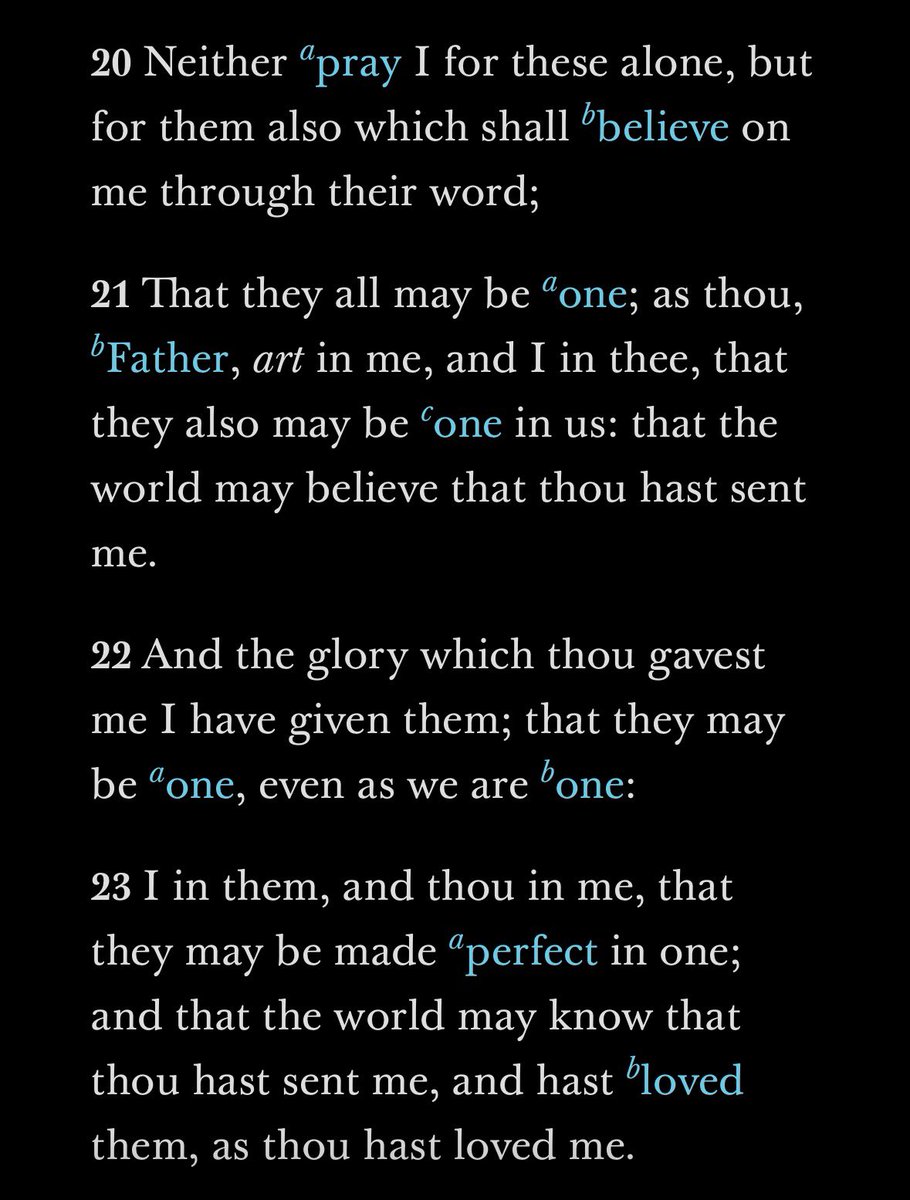
So when Jesus says in John 17 he is quite literally saying he wants followers to be One “even as we are one”.
How are the father and son one here? Literally one? Does he want the followers to be literally one? Of metaphorically one?
Now what *you need to show is that despite this very clear breakdown of the oneness of God - and despite the Israelites believing in multiple gods. And despite them having no concept of “persons” as a meaningful distinction of being. That One God *actually means One being with 3 persons.
I can’t prove what is theoretically in the mind of people thousands of years ago.
Yes of course it’s possible people believed it.
But the Jews didn’t and don’t believe it. There is nothing in the text that suggests it. The only evidence i can see of anyone ever making that distinction is early Christians as an attempt to explain the nature of God. If you have some ancient document or scholarship you’d like to point me to that shows how there is actually lots of people making the distinction that a “person” and a “being” are different im all ears. Or point to anything that has multiple persons outside of the Trinity. Like literally any single thing. That would help i think.
No you are just assuming they are one thing “but in a different way”. In all the ways where it’s obvious they are just speaking metaphorically but when it comes to God it now *undisputedly is just numerically one. Why? Why assume that when there are 3 beings called God?
I’m arguing there are 3 divine beings all called God. There is only one “what” - and that “what” isn’t one “who” its very clearly 3 “whos”.
You are arguing God is a “Who” with 3 parts that aren’t parts and 3 persons that aren’t beings. Which is much more nonsensical than simply God is what we call the 3 divine beings who act in perfect harmony and there is only One God. One What. It doesn’t require metaphysical abstraction.
I keep addressing your concerns but maybe you aren’t registering them. Im not making any claims about sola scriptura. I’m simply saying the text does not explicitly say it. So if it doesn’t explicitly say it you either need to rationalize it (which i think the Trinity fails at) or defer to an adjudicator (like a Pope, who I dont believe is a prophet).
But you can do this across the board. Where is the pottery? Well there is no record of them doing pottery. Where are the cities? Well there are hundreds of discovered cities that are unexplored in Central America. Where is the DNA? Well the group that came to the Americas integrated into the existing people. Why would we expect one outsiders families DNA to overtake an existing populations DNA? Where are the artifacts? Well the people and cities and artifacts were destroyed 1500 years ago and 3 other civilizations came and lived on top of where they lived. Where are the cowboy saloons? Those were only a few hundred years old and they are practically erased.
People want archaeological evidence for a small group that kept a record of events in a small area that (although people think is huge and massive, actual textual criticism shows their footprint to be considerably smaller). They want the archeological conditions of the dry middle east in the wet Yucatan.
I just think demanding archeological evidence for the BoM is an overblown demand when you actually go down the list of things you would actually expect to find.