Scout is proud to announce our $100M Series A, the largest defense-tech Series A in US history
This round will accelerate development of Fury, the foundation model for unmanned warfare
We are proud to double down on our seed investment in Scout by leading their $100M series A. Colby and Collin are world-class entrepreneurs and technologists.
Between seed and Series A, Scout’s vision language and action (VLA) model was deployed in the field by their government and commercial customers.
Freedom is not free. Edge intelligence is the future, and its applications range from industrial security, deterrent for global conflicts, and cyber security.
With Scout, the world is a safer and better place for everyone.
Scout AI just raised a $100M Series A that we co-led at @DraperVC. They’re building an AI model called Fury that operates military vehicles and drones with real intelligence.
They’ve already secured $11M in DoD contracts and are one of 20 autonomy companies embedded with the Army's 1st Cavalry Division.
Scout AI's CTO @collinotis made a point that stuck with me.
These autonomous systems can be constrained to a specific geographic zone, or locked to require human confirmation before any action. The AI doesn’t act unilaterally. That matters to us.
The question of who controls autonomous defense systems, and how, is one of the most important design questions of this decade.
Scout is thinking about it seriously.
Congrats to @adcock_colby, Collin, and the whole @ScoutAI_ team on the raise.
Scout is proud to announce our $100M Series A, the largest defense-tech Series A in US history
This round will accelerate development of Fury, the foundation model for unmanned warfare
"This historic raise is a signal to every patriot in Silicon Valley. The most important frontier in AI is the physical world, and it should be pursued in service to the men and women who defend this country."
@adcock_colby, CEO & Co-Founder
Raw. Behind the scenes. Explainer. 🎥🤖
🚨 The first agentic military strike. 🚨
A few weeks ago we showed something that had never been demonstrated before:
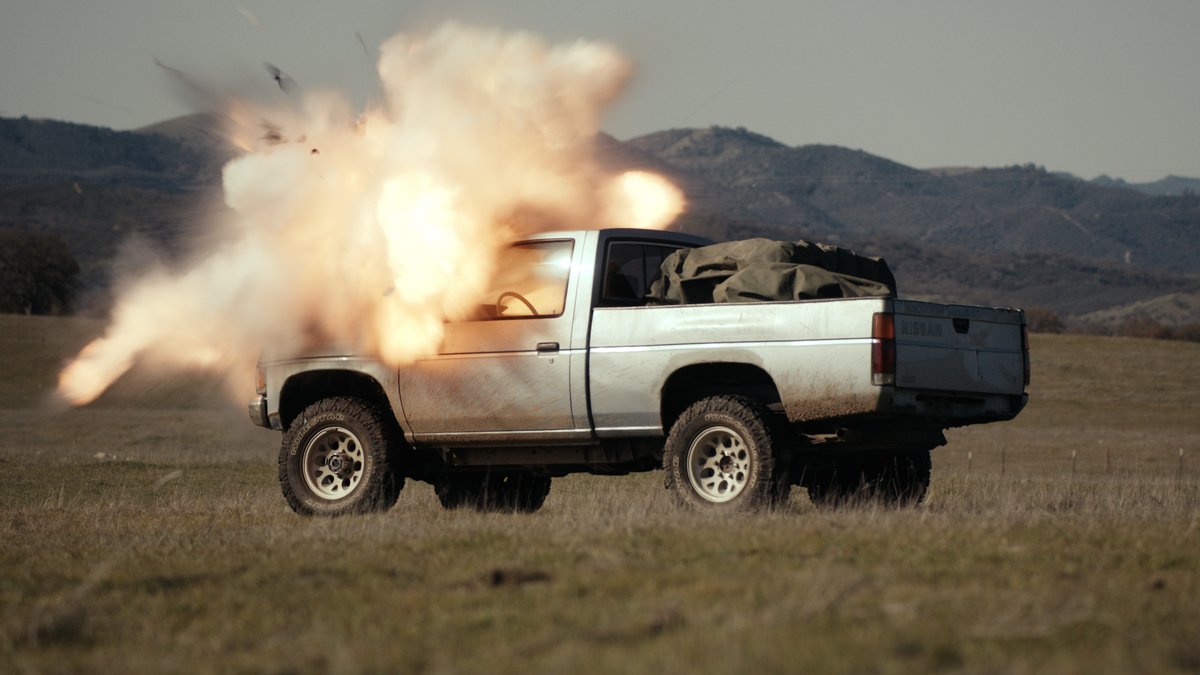
A team of AI agents conducting a coordinated military strike on a target.
In the explainer video below, I'm sharing a look under the hood at how it actually works.
System architecture:
🚙 1 UGV carrying 2 one-way attack drones
🧠 7 AI agents total
• 1 Orchestrator agent (~300B parameters)
• 6 asset agents
Each asset runs two agents:
• Reasoning agent – planning, decision making, tool use
• VLA agent – perception and vehicle control trajectories (~1B parameters)
Tool use is also used all over the place on orchestration and platform autonomy. Agents call tools on traditional platform autonomy (e.g. flight controllers) when that makes sense vs. direct control (e.g. unlatch and takeoff command).
Systems:
• Orchestrator runs in an orchestration compute cluster on a set of H100s.
• Each edge asset has 2x Nvidia inference chips, some as low as 25W.
• Orchestrator does not have any implementation insight into assets.
• Treats them as third-party assets.
• It reads the ICD for the function calls, similar to MCP.
Shared cognition across the system:
📡 All agents share their thoughts across the network
🧠 Memory stored as text + short-term video context
👁️ Systems maintain shared situational awareness
This allows the system to operate as a single coordinated intelligence, not isolated robots.
• All systems are loosely coupled, prompting eachother.
• Clear safety guard rails and human on the loop.
• Entire video is hands-off from human control after the initial paragraph of intent into the Orchestrator.
• Agents run between 350ms to 10s cycle times depending on their function and all actions are real-time dynamic. No pre-scripting of the mission.
⚡ Video is sped up 2× for brevity
This capability was developed under DARPA and U.S. Army contracts for broad DoW use.
🎙️ @emilmichael@Jason@friedberg@chamath this is the fully autonomous AI mission you discussed as possible someday soon on the @theallinpod last week. Happy to give any of you a direct technical brief at any time.
Scout AI today publicly showcased for the first time its Fury Autonomous Vehicle Orchestrator running a heterogeneous fleet of autonomous air and ground systems from natural language mission intent
Watch the full demo now ⬇️
Scout AI is using technology borrowed from the AI industry to power lethal weapons—and recently demonstrated its explosive potential. https://t.co/Ouuz4rwxfP
Today I am extremely proud to introduce the Fury Autonomous Vehicle Orchestrator 🇺🇸
For the past 12 months, the Scout AI team has been building this quietly. Now we’re finally ready to unveil it to the world
Just like AI agents are transforming the digital world, Fury Orchestrator brings that same agentic intelligence into the physical world for the U.S. warfighter
It is the first agentic system that can take a commander’s high-level mission intent, spoken or typed in natural language, and turn it into coordinated autonomous action across a mixed fleet of unmanned assets
More in 🧵
Scout AI today publicly showcased for the first time its Fury Autonomous Vehicle Orchestrator running a heterogeneous fleet of autonomous air and ground systems from natural language mission intent
Watch the full demo now ⬇️
Unlike traditional autonomy stacks that rely on hand-engineered code and conditional logic, Fury functions as an agentic interoperability layer
The orchestrator reads platform documentation and tool definitions, then generates structured JSON instructions native to each vehicle’s API, without modifying underlying flight controllers, mobility stacks, or autonomy software