Summarized:
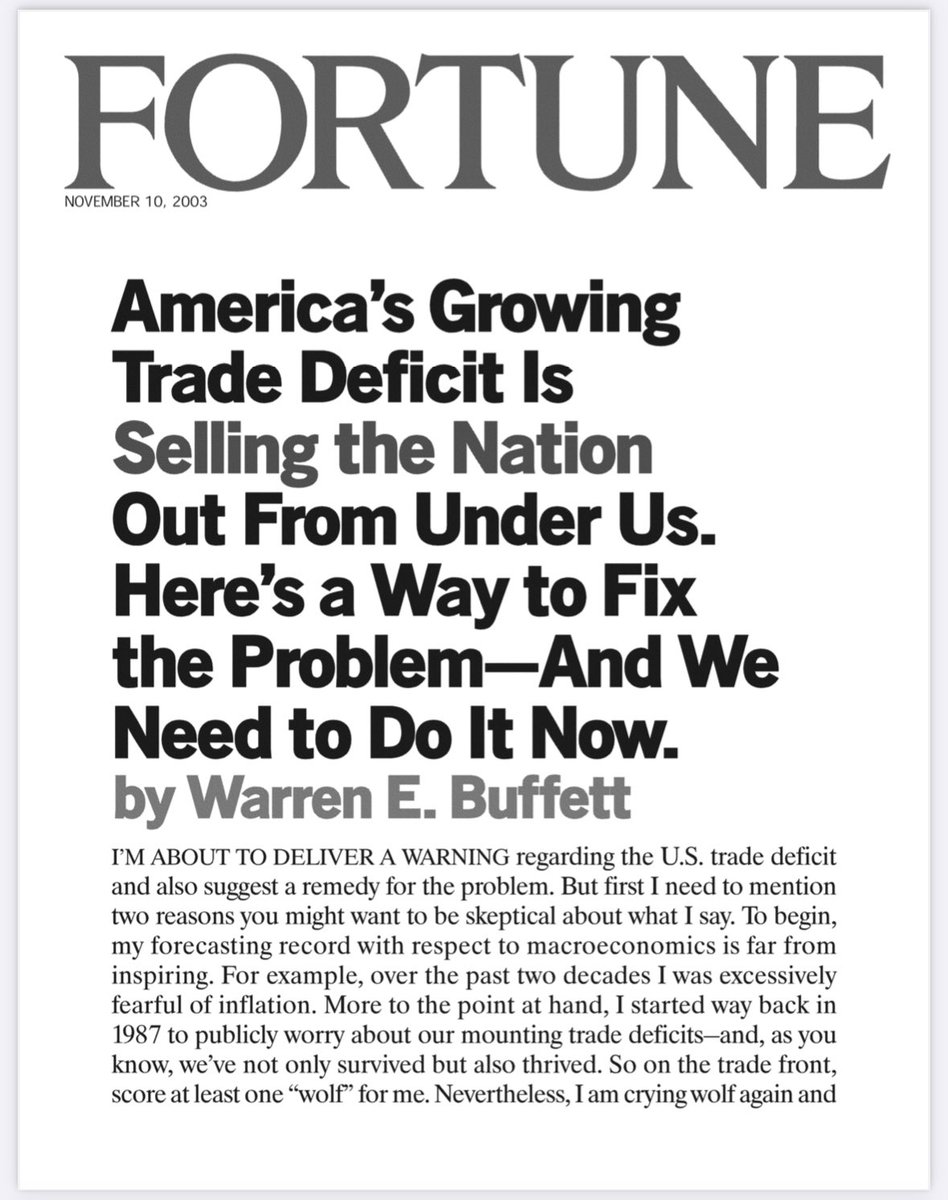
The article, titled “America’s Growing Trade Deficit Is Selling the Nation Out From Under Us. Here’s a Way to Fix the Problem—And We Need to Do It Now,” was written by Warren Buffett and published in Fortune magazine on November 10, 2003. In it, Buffett expresses concern about the United States’ escalating trade deficit and its long-term economic implications. He uses a simplified parable involving two fictional islands, “Thriftville” and “Squanderville,” to illustrate his point. Thriftville represents a nation that lives within its means, producing more than it consumes and exporting the surplus. Squanderville, on the other hand, consumes more than it produces, relying on imports and borrowing from Thriftville to sustain its lifestyle.
Buffett argues that the U.S. is behaving like Squanderville, running persistent trade deficits that result in foreigners accumulating increasing amounts of American assets—stocks, bonds, and real estate—in exchange for goods and services. He warns that this trend essentially transfers ownership of the nation’s wealth to foreign entities, potentially compromising future economic sovereignty. At the time of writing, he notes that the U.S. trade deficit was around $400 billion annually (projected to exceed $500 billion in 2003), and net foreign ownership of U.S. assets had already risen to $2.5 trillion by 2002.
To address this issue, Buffett proposes a solution: the implementation of “Import Certificates” (ICs). Under this system, exporters would receive ICs equal in value to their exports, which they could then sell to importers. Importers would need these certificates to bring goods into the U.S., effectively capping imports to match the level of exports and forcing a balanced trade account. Buffett suggests this market-based mechanism would incentivize domestic production, reduce the trade deficit, and halt the erosion of national wealth without resorting to protectionist tariffs or quotas. He acknowledges potential drawbacks, such as short-term price increases for imported goods, but argues the long-term benefits outweigh these costs.
Buffett concludes by urging policymakers to act swiftly, emphasizing that the trade deficit is a slow-bleeding problem that could lead to severe economic consequences if left unchecked. He stresses that his proposal aligns with free-market principles while addressing a critical structural flaw in the U.S. economy.
The National Parks Service has removed the rainbow flag that sat on a flagpole inside the Stonewall National Monument near Christopher Park in New York City's Greenwich Village. https://t.co/1uDT7K99sj
More and more Americans are voicing their outrage at the tactics being deployed by federal agents in Minnesota. But it’s important to understand the broader implications of what this administration is doing, and the threat it poses to the basic freedoms of every American.
@SchiesslFuel@PhilMackey This is such a stupid take… Imagine the money that they would be making if they would actually go to the Super Bowl and then imagine how much of they would win