Plateau crises: The cotton has fallen. The FALSE narrative has been unmasked
By: Zagazola Makama
There was a time when every violent incident in Plateau was quickly packaged, exported and presented to the international community as another chapter in a supposedly endless “Christian genocide.” And it worked. But something has changed.
For those following the crisis from outside Nigeria, videos like this may still sound convincing because they are often presented without the context that Nigerians living through the crisis already know. But within Nigeria, particularly among communities directly affected by the violence, the simplistic genocide narrative has increasingly collided with the messy reality on the ground. And that reality is inconvenient.
We have documented thousands of pieces of evidence showing attacks, killings, destruction of property, cattle rustling, reprisal attacks and displacement affecting different communities. In some locations, one community suffers an attack and retaliates; elsewhere, the pattern is reversed. Yet somehow, in certain advocacy circles, the first attack can disappear into the footnotes while the retaliation becomes the headline.
Take, for example, some organisations engineering narratives in Plateau. Their reporting has repeatedly been criticised for selective emphasis, particularly when violence involving Plateau natives is concerned. If the victim belongs to one preferred category, the incident receives international attention. If the same crisis produces victims from another community, particularly Fulani, the story suddenly becomes much more complicated or disappears altogether in the media space.
Nigeria’s security crisis is increasingly being fought on two fronts. There is the physical battlefield, where terrorists, bandits and other criminals attack communities. And there is the information battlefield, where competing groups fight to control the narrative about what happened, who is responsible and why.
The second battlefield can determine what happens on the first.
What they want to push to the international community is: “Hundreds and thousands of churches are being destroyed,” and “Christians are killed for wearing the Cross.” They use terrible headlines to amplify what is, in many instances, a complex farmer-herder and communal conflict.
But what is the business of herders whose livestock was stolen with attacking churches or planing to orchestrate Christians genocide? Even recently, we have seen how the bullet does not differentiate. This time, one Muhammed Abdullahi was shot, but some conflict reporters carefully omitted that part because it does not fit their preferred narrative.
Apparently, in this version of Plateau’s history, the first bullet does not matter nearly as much as the identity of the person who fires the second one. And then comes the familiar formula:
Attack → retaliation → mass burial ceremony → international statement → “Christian persecution” or “genocide” → fundraising, advocacy and another round of international attention. Meanwhile, the underlying cycle continues.
Zagazola has recently published evidence of Fulani victims from Berom and Mwaghavul communities receiving compensation. Just yesterday, another Fulani man paid ₦1 million as compensation for destroying a farm.
Now the question is: Are they paying the compensation for committing genocide against Christians? Because from the look of things, even farm destruction is sometimes described within the wider Plateau conflict narrative as “genocide.”
Unfortunately, the crisis entrepreneurs will never publicise such narratives because stories like these do not fit neatly into the fashionable narrative. They demonstrate something profoundly inconvenient: there are people on both sides suffering losses, and Fulani individuals, when found wanting, are also coming forward to pay compensation.
@DHQNigeria@HQNigerianArmy
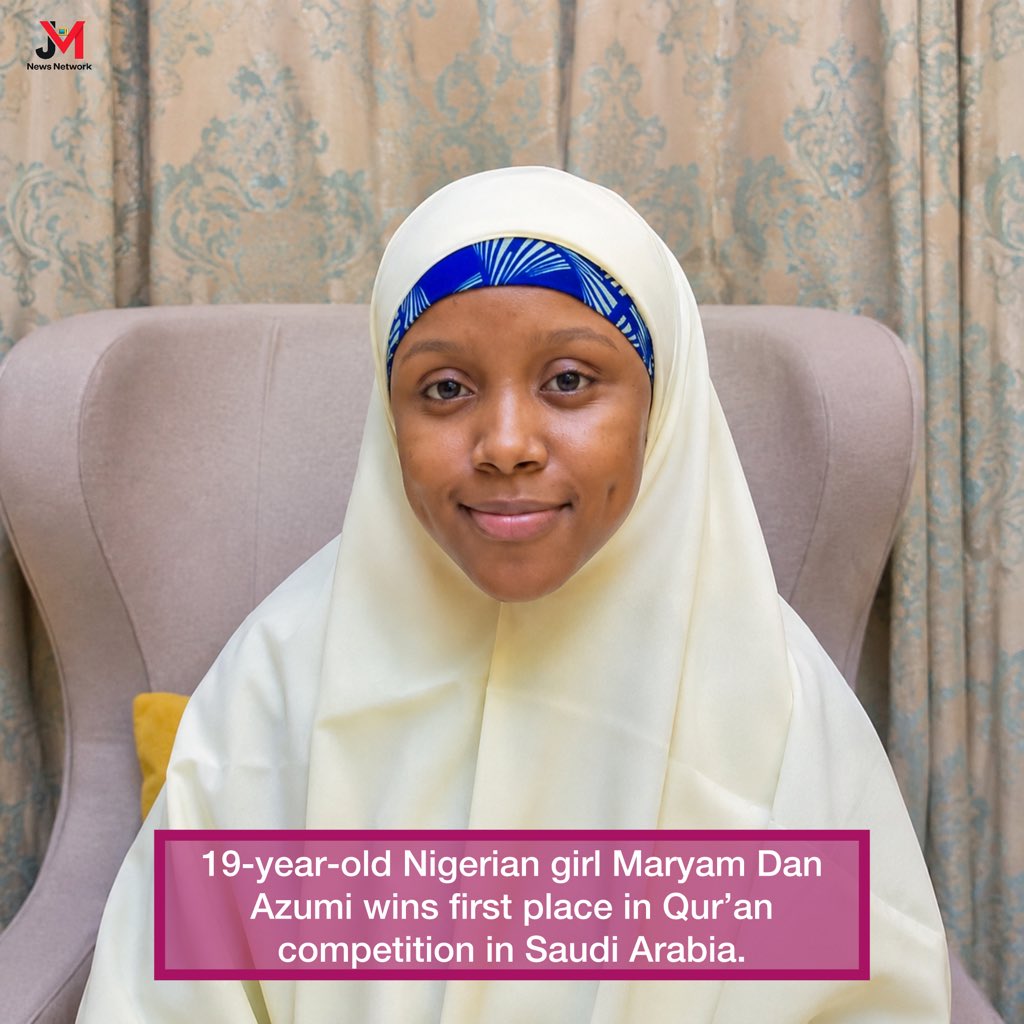
Maryam Ibrahim Dan-Azumi, a pupil from Nigeria, has secured a prize of 120 million naira, equivalent to approximately 80,000 dollars, at the 46th King Abdulaziz International Qur’an Recitation Competition held in Makkah, Saudi Arabia.
Originating from Gombe State, she obtained the leading position in the division devoted to the memorisation of 60 Hizb of the Qur’an together with Tajweed and Tafsir, achieving a score of 97.70.
She took part among 334 competitors representing 133 nations, and the event marked the inaugural occasion on which female participants were admitted in the competition’s forty-six-year existence.
Maryam attends the Abubakar Siddiq Community School for Qur’an Memorisation situated in Gombe.
Maryam Ibrahim Dan Axumi, the way you recite the Qur’an with such calmness, confidence, and beautiful composure is truly remarkable. 🤍📖
The people of Nigeria and the entire world are proud of you. 🇳🇬🌍
May Allah continue to increase you in knowledge, faith, and excellence. You are a true source of pride for Gombe and Nigeria. ❤️🤲
APPLAUSE FOR MARYAM IBRAHIM DAN’ AZUMI, NIGERIA’S QUR’ANIC CHAMPION
I heartily congratulate Maryam Ibrahim Dan’ Azumi on her remarkable victory at the 46th King Abdulaziz International Qur’anic Competition in the Kingdom of Saudi Arabia.
Emerging victorious in a competition featuring participants from 132 other countries is an extraordinary achievement. Her mastery of the Holy Qur’an, including memorisation, recitation, Tajweed and Tafsir, reflects years of discipline, sacrifice, dedication and an unwavering pursuit of excellence.
Maryam’s success is another powerful reminder of the enormous potential of young Nigerians to compete and excel on the global stage. Even more inspiring is the remarkable example of her family, with her elder sister, Hajara Ibrahim Dan Azumi, also having emerged first in an international Qur’anic competition in Jordan in 2024. Their achievements demonstrate what is possible when talent is nurtured through strong values, education, mentorship and family support.
I congratulate their parents, teachers and mentors whose sacrifices and guidance have contributed immensely to these outstanding accomplishments.
On behalf of the Federal Ministry of Youth Development, I celebrate Maryam for bringing honour to our country. May this achievement inspire millions of young Nigerians to pursue knowledge, discipline and excellence, and may Allah continue to increase her in knowledge and make the Holy Qur’an a source of guidance and blessing in her life.
Congratulations, Maryam. Nigeria is proud of you.
Those behind the attack on innocent people in Jos yesterday are pure terrorists and our enemies. The authorities must swiftly identify them, hold them accountable and ensure they face the full weight of the law.