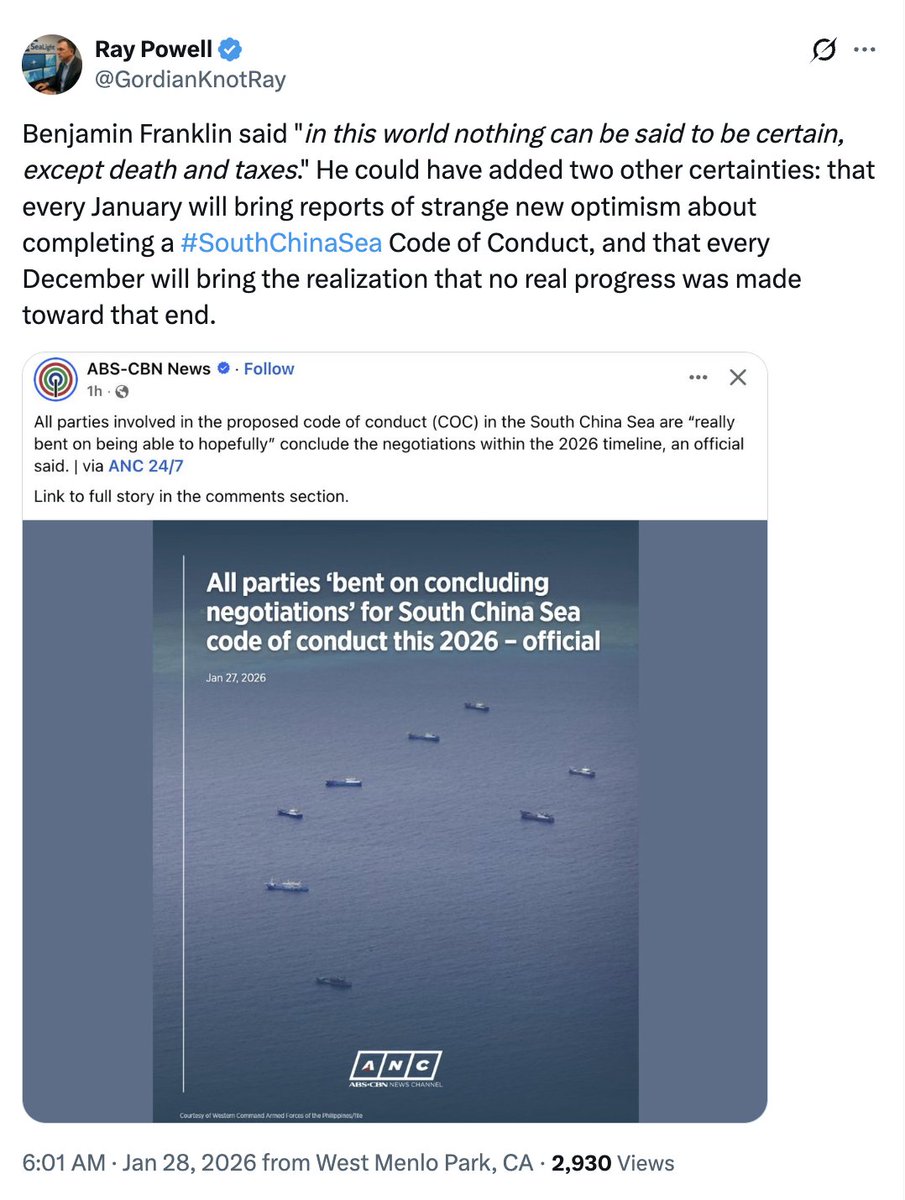
“It’s an annual ritual. The ASEAN Chair commits to completing the Code of Conduct in January, but by November is reporting that — although great progress has been made — they didn’t quite get there this year. Rinse, repeat,” Ray Powell, executive director at gray-zone activities tracker SeaLight Foundation told CNBC.
He described the 80% number as “a meaningless statistic,” given that the issue at hand was complex and contentious.
...
At the same time, a rushed or flawed Code would be worse than none at all, Powell said.
“In fact, the worst outcome is not a failure to agree, but rather a weak Code that would enable Beijing to undermine UNCLOS,” he said. The United Nations Convention on the Law of the Sea, which came into force in 1994, provides a comprehensive legal framework for oceans and seas globally.
“The narrative from China could then be ‘see, now we have this shiny new regional agreement that overrides that problematic law invented by outsiders who don’t understand East Asia and shouldn’t have a say here anyway,’” Powell added.
https://t.co/Fdfc6u1RE8
Who will enforce the #SouthChinaSea Code of Conduct?
The answer is: NOBODY.
Earlier today, Sealight Director @GordianKnotRay was interviewed by @onenewsph' Morning Matters regarding the South China Sea Code of Conduct negotiations.
Listen to the full interview here:
https://t.co/ekiCfnb9ng
”It’s international waters, we can do anything we want. Any problem with that?” The Chinese academic, Dr Hu Bo exclaimed, projecting the arrogance of a mighty and coercive power, that is —China.
He must have been very annoyed at Colonel Ray Powell during the heated exchange that he resorted to cutting him short whilst talking, in a disrespectful display of arrogance during the Manila Dialogue gathering, 17th November 2016. Ray is the founder and Executive Director of Sealight,
Ray pushed back, highlighting the bad behaviour of China through its grayzone operations of aggression and coercion against the Philippines and other neighbours.
The Chinese representative continues to blame the Philippines in the escalating tensions in the West Philippine Sea/ South China Sea despite its repeated misdemeanours and aggressions against the Philippines. China anchors its claims on the infamous “9-dash line”, something that has no basis in international law and in fact.
🇨🇳#China is the MOST SOPHISTICATED AND SUCCESSFUL Expansionist Power of this Century
Listen to our SeaLight Director Ray Powell (@GordianKnotRay) as he delivered his opening remarks at the #ManilaDialogue on the #SouthChinaSea
Source: WPS
🐮🐴@SCMPNews: Ray Powell, director of SeaLight ... referred to comments previously made by veteran Singaporean diplomat Bilahari Kausikan, who once compared Asean to “a cow” that could “never be a horse”.
At a conference in Singapore in 2015, Bilahari suggested that both animals were useful, but their level of usefulness was different.
Powell asked his fellow panellists: “What is the South China Sea security problem and what is Asean’s role in it? I’d ask you to consider, are we asking a cow to run in a horse race?”
HEATED EXCHANGE OVER CHINA'S MILITARY OPERATIONS IN PHILIPPINE SEA
WATCH: Chinese academic Dr. Hu Bo of the South China Sea Probing Initiative questioned whether there was a problem with China's Coast Guard and military operating in the Philippine Sea, arguing that the waters are international. SeaLight Foundation Executive Director Ray Powell pushed back, saying China's actions may be framed as legal under freedom of navigation but remain "aggressive and coercive" — a hallmark of gray-zone tactics.
The exchange comes amid heightened scrutiny of China's naval activities in Philippine waters. In October, the Chinese aircraft carrier Liaoning and three accompanying destroyers came as close as 15.2 nautical miles from Talulu Point in Siocon, Zamboanga del Norte, according to Philippine Navy monitoring reports obtained by BNC. | via Joash Malimban, https://t.co/9R0Mcay5im
China is an expansionist and aggressive power that steals resources and territory from its neighbors like Vietnam and the Philippines. They want to take the Batanes Islands next.
This was @GordianKnotRay's spirited and passionate presentation at the #ManilaDialogue organized by the @wps_ph here in Manila.
Ray asserts also that like any colonizing power, China uses suppression of dissent against its will by engaging in political warfare, subverting the media and political class of neighboring countries to parrot their talking points. Talking points like China is not bad, we're lucky China is only using water cannons and not shooting, and resistance against China is futile.
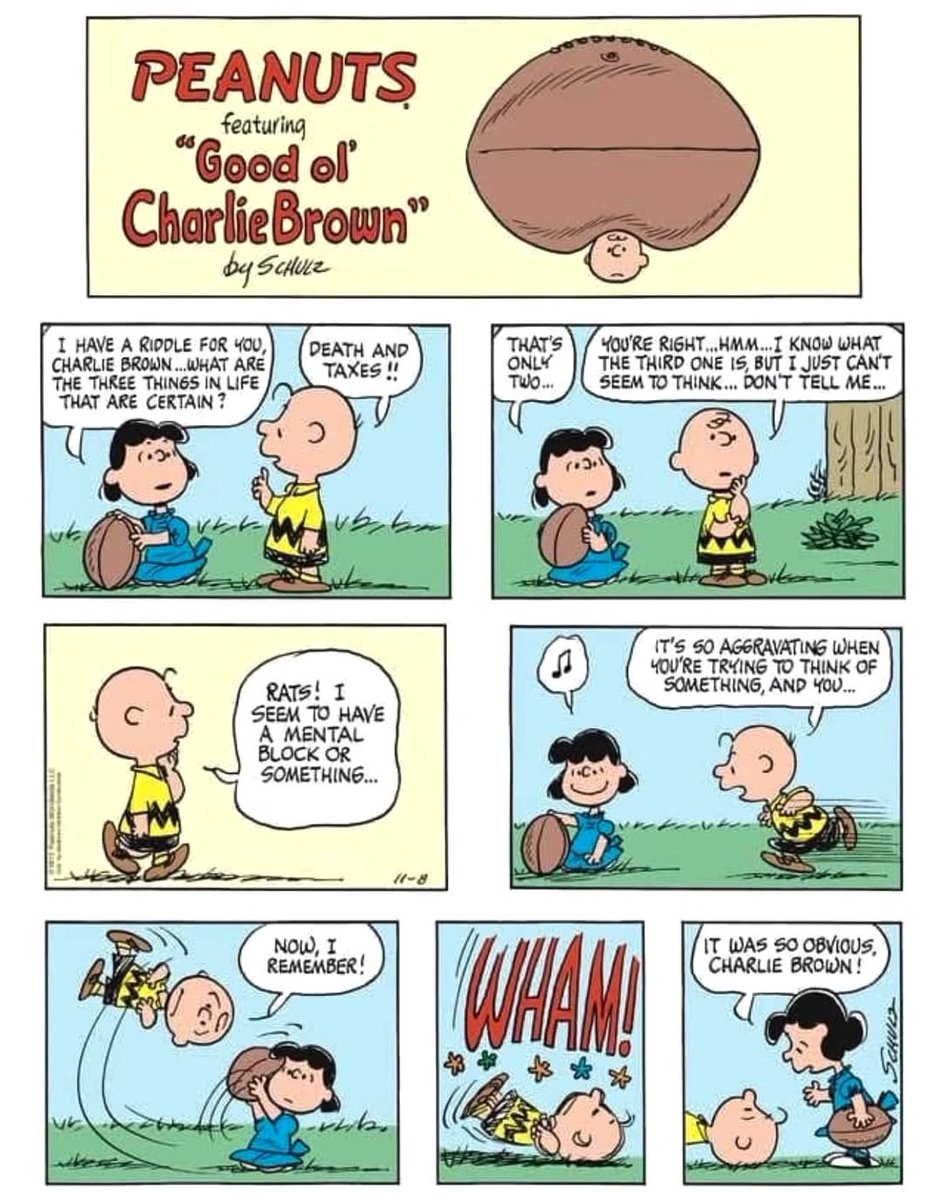
This was me in January👇.
Of course we had to play make-believe for the whole year anyway. But it's okay, we have *ahem* "70%" ... or maybe "80%" ... or something.
And we'll do it all again next year. It's the #ASEAN way.
The #SouthChinaSea#CodeofConduct version has Lucy saying at the end, "It's okay, we got provisional agreement on 77% of the paragraphs this year!"
Cast:
- Charlie Brown played by #ASEAN
- 🏈 played by the Code of Conduct
- Lucy played by Reality Bites
‘Davidson Window’ Admiral Hopes He Was Wrong On China’s Ability To Take Taiwan By 2027
The time frame Adm. Philip Davidson famously declared China could be ready to invade Taiwan is about to arrive.
https://t.co/6jX7NkLgM8
Trump's Lack of Policy Explanation
In this video, @GordianKnotRay breaks down the unilateral decision-making style of the Trump administration, highlighting how major foreign policy actions, in particular its military operation in Iran, were executed without building a public consensus, securing congressional authorization, or laying the traditional diplomatic groundwork.
The Trump administration seems to have done what it wanted because it believed it knew what was best for the United States.
It’s Almost 2027… So Why Should We Care if Taiwan’s “Davidson Window” is Closing?
In 2021, Admiral Phil Davidson famously warned Congress that the threat of conflict over Taiwan could emerge within six years. With 2027 and the end of the “Davidson Window” approaching, he rejoins @IndoPacPodcast Host Jim Carouso and SeaLight Executive Director @GordianKnotRay in person to explain what the warning was all about and what has changed since.
Link to the episode below.
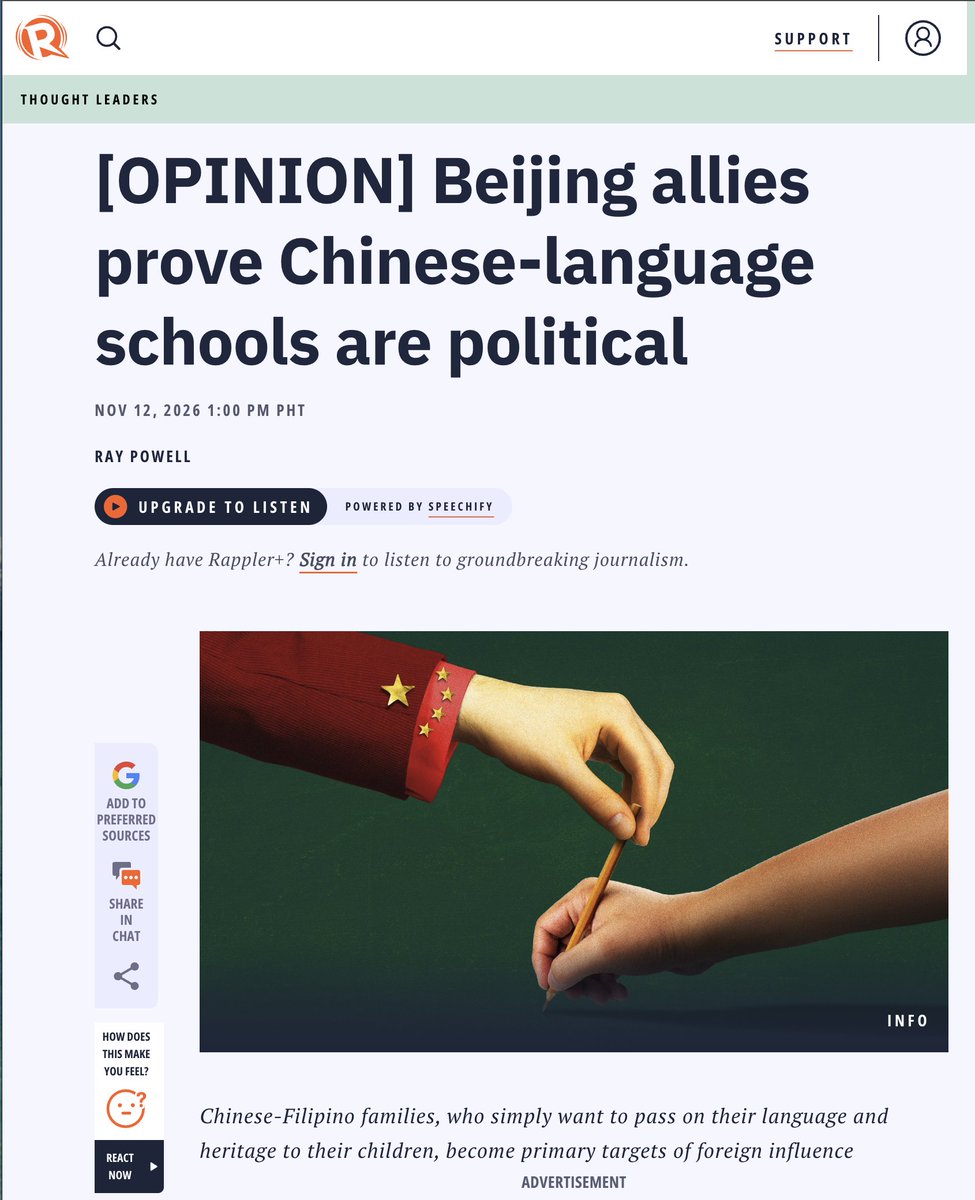
My latest for @rapplerdotcom: "Beijing can’t have it both ways. Its diplomats and allies can’t tell Chinese schools to advance the Communist Party’s political goals, then cry “smear” when someone translates their words into English and reads them aloud for all to hear.
"If the embassy truly wants geopolitics kept out of the classroom, it should start by instructing the PCERC to end its United Front political work in Chinese-language schools. I’m sure the first to thank them would be the students and their families."
Full article link below in comments 👇
The previous quote was 80%, but none of that matters. The fact is that the fundamental differences in the 20-30% remain as irreconcilable as they were when the year started.
It was never a question of whether smart & committed negotiators could find a way through, because there is no way through that doesn't involve surrendering sovereign rights to China.
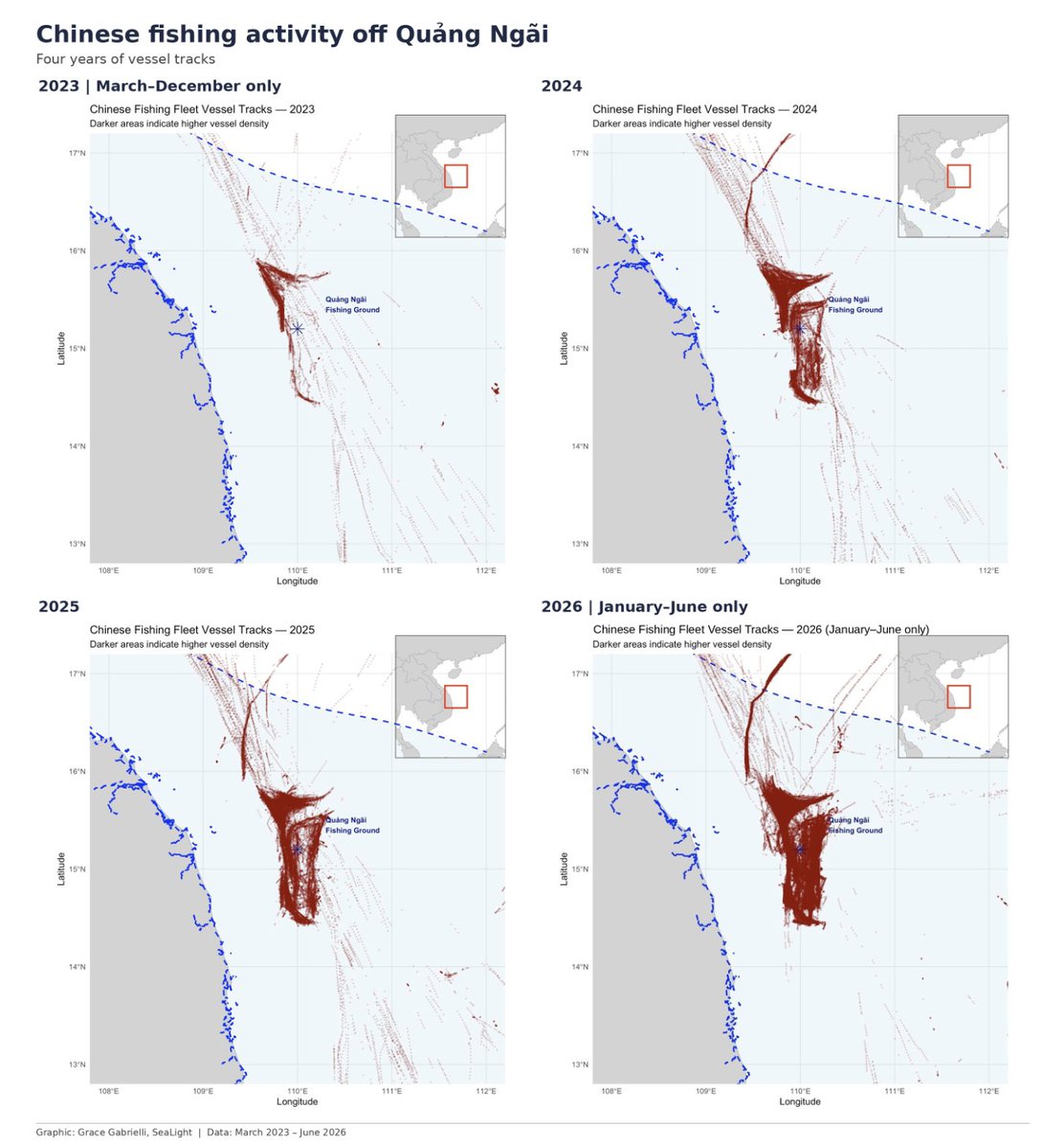
🇨🇳China’s Fishing Fleet Off 🇻🇳Vietnam: Commercial Activity, State-Backed Pressure 🐟
For the past four years a growing Chinese fishing fleet has been returning to waters just off Quảng Ngãi province, pushing out Vietnam's fishermen as Beijing extends its illegal maritime claims ever closer to Vietnam's central coast.
SeaLight tracking shows a fleet of about 100 Chinese fishing vessels making repeated deployments inside Vietnam's exclusive economic zone off Quảng Ngãi, operating within 28 nautical miles of Lý Sơn Island. On some days in 2026, more than 40 were in the area at once. Fishing peaked in March and April 2026, the highest levels in SeaLight's data so far.
A Chinese government vessel followed the fleet's seasonal movements. The fishing is commercial, but the message is clear: Beijing permits and protects it in waters it illegally claims as its own.
Vietnamese fishing communities are paying the price, losing access to traditional grounds and facing a real risk at sea. Hanoi, meanwhile, keeps the confrontation largely out of public view.
We first provided this information to the BBC's Vietnamese-language service last month, but this is the first English-language report on this activity.
Read our full report at the link in the comments below 👇