Distress signal from “shadow fleet” tanker Myra in the North Atlantic turns out to be false alarm
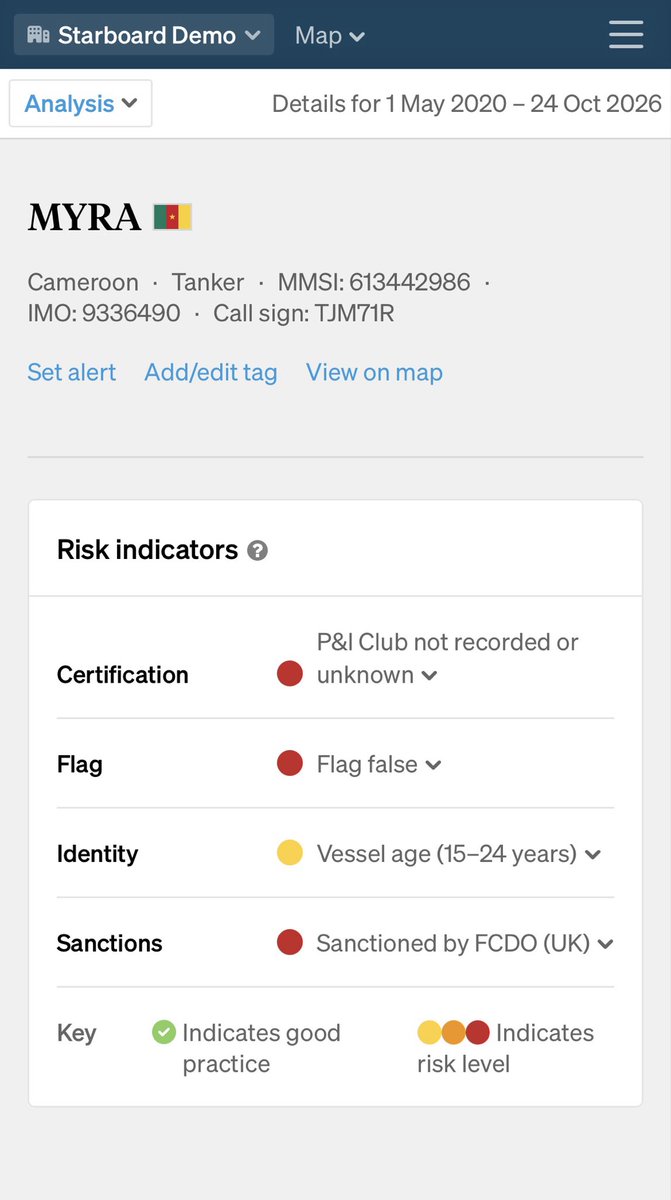
Myra remained in the North Atlantic west of Ireland as of the evening of Oct. 25, per @StarboardIntel. Its declared destination is Port Said, Egypt.
https://t.co/tpxyY5Iwnm
The Irish Coast Guard and British Royal Air Force have been monitoring a tanker linked to Russia that declared a false emergency off the west coast.
https://t.co/ldvLz9CUYL
MYRA (IMO 9336490) is false-flagged, with no recorded P&I insurance. She likely loaded in Ust Luga before leaving Russian waters around 15 October.
Link for Starboard users: https://t.co/7ns7AaiLJc
Russian “shadow fleet” tanker linked to Iranian leadership sends distress signal in the North Atlantic
The sanctioned Myra, part of a shipping network controlled by Mohammad Hossein Shamkhani, issued the alert west of Ireland amid rough seas on Oct. 24.
https://t.co/yC7Gpcx62M
New ship-tracking data shows China’s coast guard presence at Scarborough Shoal has doubled again in 2026 to reach all-time highs—leading to dangerous encounters with Philippine law enforcement: https://t.co/GirzBoAy0Y
First tanker carrying Russian diesel to U.S. heads for New York after Trump-Putin deal, set to arrive after midterm elections
The Agioi Fanendes loaded 40,000 metric tons of diesel in Primorsk on Oct. 22 and is due to arrive Nov. 7, per @StarboardIntel.
https://t.co/G27cdtYOsy
@InsiderEng Also from @United24media: “According to Starboard Maritime Intelligence data reviewed by @the_ins_ru, Ya Qing Hai Yang was spotted several kilometers from the Norwegian border on the Russian side earlier in October…”
https://t.co/qCQ4A1AigN
“The Starboard Maritime Intelligence analytics platform recorded that both vessels were traveling from Hong Kong along the Northern Sea Route, making several stops in the Far East.”
⚓ Norwegian authorities have detained two cargo vessels, at least one of which is involved in servicing the sanctioned Russian Arctic LNG 2 project.
https://t.co/ZdVPAGOqMW
Starboard Maritime Intelligence identified the tankers in this video. Our AIS data puts the crossing off Port Said at 10:39 UTC on 17 October 2026, with PASSAT an estimated 20 to 70 metres ahead of OPAL, which was alongside STORM PEARL. All three are under UK and EU sanctions.
Starboard Maritime Intelligence identified the tankers in this video. Our AIS data puts the crossing off Port Said at 10:39 UTC on 17 October 2026, with PASSAT an estimated 20 to 70 metres ahead of OPAL, which was alongside STORM PEARL. All three are under UK and EU sanctions.
The video shows two supertankers engaged
in mid-sea double-banking operation whilst underway. Another rogue tanker
is crossing from the port side (so is a give way vessel in a crossing situation besides the obligation for keeping clear of double-banking vessels being severely restricted in their manoeuvrability). I admire the coolness and presence of mind of the Loading Master who could be heard giving bold bridge orders and assists in avoiding an imminent collision and a catastrophic event.
#MarineTanks #MaritimeSafety #TankerOperations #SuperTankers #DoubleBanking #MarineEngineering #DeckOfficers #Seafarers #ShipNavigation #COLREGs #CollisionAvoidance #MaritimeIndustry #MerchantNavy #ShippingIndustry #SeafarerSafety #LoadingMaster #Seamanship #VoiceOfSea #CourtesySM
Courtesy: SM
New: Why Should We Care About if the Ocean Floor is Now a Battleground?
Nearly all global internet traffic quietly moves through fiber-optic undersea cables on the seabed, yet most people still think of the internet as “the cloud.” In this episode, @GordianKnotRay and Jim sit down with Trent Fulcher, CEO of @StarboardIntel, to explore what he calls “the end of the benign seabed.”
Drawing on real cases, from a suspicious cable cut off Taiwan to fishing fleets and shadow tankers across key maritime chokepoints, Trent explains how vessels can mask their identities, spoof locations, and drag anchors over critical infrastructure while hiding behind flags of convenience. He breaks down why around 95% of internet traffic still relies on subsea cables, why repair delays can stretch to 45 days, and how new data fusion and behavioral analytics are shifting the industry from reactive incident response to proactive prevention.
The conversation digs into who is most vulnerable (from Pacific Island states to cable-dependent hubs like New Zealand and Singapore), how governments and cable operators are building joint defenses, and what smaller Indo-Pacific nations can realistically do with limited navies and budgets.
Links to the full episode below.
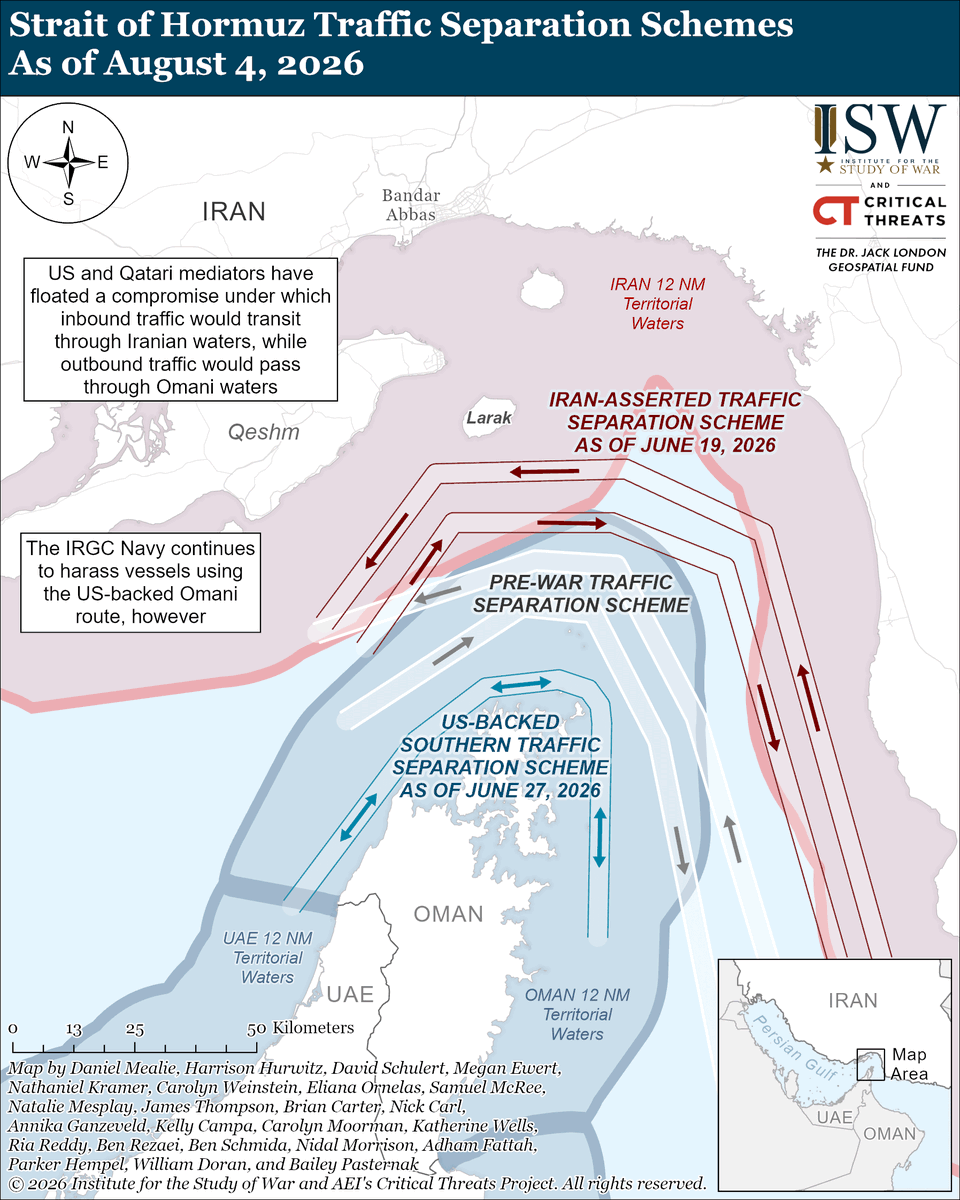
Iran Update Special Report, August 4, 2026: US officials and Iranian negotiators continue to present competing interpretations of the emerging arrangement on the Strait of Hormuz. The Iranians’ inconsistent messaging in these negotiations is likely a product of the competing Iranian regime factions’ approaches to control over the strait and negotiations with the United States writ large.
More Key Takeaways:
Iran’s broader military establishment, which appears to currently dominate regime decision-making, maintains its position against significant concessions over the Strait of Hormuz because they assess that Iran can outlast the United States in the war.
Iranian President Masoud Pezeshkian and other pro-negotiations officials continue to advocate for diplomacy to settle the conflict and prioritize Iran’s economic challenges, while facing mounting pressure from the other regime factions that oppose compromise and seek more maximalist regional objectives. This intra-regime divide will likely impede Iran’s ability to concretely come to an arrangement over the strait.
Supreme Leader Mojtaba Khamenei appears to be downplaying these intra-regime divisions to portray a unified front against the United States, however. The Supreme Leader’s Public Relations Office on August 4 rejected reports claiming to describe Mojtaba’s reaction to a letter from President Masoud Pezeshkian.
The Houthi military spokesperson Yahya Sarea claimed that a Houthi drone struck a “sensitive target” at Najran Regional Airport, southern Saudi Arabia, on August 4. An informed regional source told Agence France-Presse (AFP) on August 4 that the Houthis struck the Najran Regional Airport’s main radar installation, which has affected airport operations.
The Houthis likely sank an Indian-flagged cargo vessel with a one-way naval attack drone near the Bab al Mandeb Strait. Indian Minister of Ports, Shipping, and Waterways Sarbananda Sonowal announced on August 4 that an unspecified projectile struck and sank the Indian-flagged MSV FAIZE NOORE OLIYA “near Yemeni waters.” (1/2)
10 “shadow fleet” tankers awaiting icebreakers in the Kara Sea are likely carrying oil from Russia’s Arctic fields
@StarboardIntel data allowed The Insider to identify 8 additional ships drifting in the Kara Sea aside from those reported by @BarentsNews.
https://t.co/gY7kviaaH3
MORE: At least seven vessels have changed course to avoid transiting through the Bab al Mandeb Strait in light of the Houthi blockade on Saudi ports. The Houthis imposed the blockade against Saudi Arabia on July 20. Six commercial vessels altered their course away from Saudi ports on July 22, according to ship-tracking data cited by Reuters. Another oil tanker that was bound for Yanbu — Saudi Arabia’s main oil export terminal on the Red Sea — turned away from the Bab al Mandeb Strait while in the Gulf of Aden on July 22.
The European Union Naval Force warned commercial vessels with links to the United States, Israel, and Saudi Arabia on July 22 against sailing in the Red Sea and Gulf of Aden. Commercial ship traffic through the Bab al Mandeb Strait continued on July 22 despite the Houthis’ threats against commercial vessels, however.
Commercially available ship tracking data from July 22 shows that 30 commercial vessels have transited through the Bab al Mandab Strait since ISW-CTP’s last data cutoff on July 21. This is a notable decrease from the 64 commercial vessels that transited the strait between 2:00 PM ET on July 20 and 2:00 PM ET on July 21, however. At least one oil tanker transporting crude oil from Yanbu, the Xin Long Yang, initially changed course on July 21 to avoid crossing the Bab al Mandeb Strait but has begun to reapproach the strait on July 22.
Houthi officials have emphasized that the Houthis will maintain their blockade on Saudi ports until Saudi Arabia lifts its blockade on Yemeni ports and airports. ISW-CTP will provide further analysis about the Houthi blockade against Saudi Arabia in its July 23 Iran Update.