Just to clarify, this is not the fictious "KHAT SHEKAN" but another ship that challenged the US blockade line.
The U.S. policy regarding the blockade is to warn ships off. They give them the option to turn around and return to port. If they fail to turn around, the U.S. gives the ships warnings, up to three hours, to evacuate the aft portion of the ship before striking the ship. The aim has been to disable the ships, but there have been two actions where they ordered the crews to abandon ship and then sank the vessels.
Most of the ships targeted have been Dark Fleet vessels with suspected false registries. We will have to see what ship this is.
@NZ_Trav Nice job. BZ.
Check out the @UANI Iran Shipping Update reporting on BASHT (IMO 9346536) over past few months:
https://t.co/BM1xiUPg6N
Keen to find out new patterns that are emerging.
Up Next: the 15th Biennial General Conference of the Council for Security Cooperation in the Asia Pacific (CSCAP), the region's largest track II security summit.
Dec. 1-3. 2026 at the Grand Hyatt Manila
During the 63rd CSCAP Steering Committee Meeting held in Kuala Lumpur in December 2025, CSCAP Philippines prevailed in the vote to host the conference, securing the confidence of Member Committees to convene the network’s largest and most important gathering. Jointly chaired by the National Security Council of the Philippines and the WPS Foundation, CSCAP Philippines will welcome senior academics and think tank experts, retired military, former government officials, and other security experts from across the Asia-Pacific for discussions on the region’s most pressing strategic and security challenges.
Building on the achievements of previous General Conferences, the 15th edition aims to strengthen CSCAP’s relevance and contribution to regional policymaking and the evolving Asia-Pacific security architecture. At a time of intensifying geopolitical competition, growing strategic uncertainty, and mounting challenges to regional institutions, the conference will seek to bridge Track II research and dialogue with practical policy recommendations. Particular emphasis will be placed on strengthening engagement between the policy and academic communities, fostering cooperation among Member Committees, and ensuring that CSCAP continues to serve as an influential platform for regional confidence-building, preventive diplomacy, and cooperative security.
For more information, visit https://t.co/WGfwhMlbiz
Previous CSCAP General Conferences
14th (2024)
Kuala Lumpur, Malaysia
13th (2022)
Jakarta, Indonesia
12th (2019)
Hanoi, Vietnam
11th (2017)
Chiang Mai, Thailand
10th (2015)
Ulaanbaatar, Mongolia
9th (2013)
Beijing, China
8th (2011)
Hanoi, Vietnam
7th (2009)
Jakarta, Indonesia
6th (2007)
Jakarta, Indonesia
5th (2005)
Jakarta, Indonesia
4th (2003)
Jakarta, Indonesia
3rd (2001)
Canberra, Australia
2nd (1999)
Seoul, Republic of Korea
1st (1997)
Singapore
#MNLDialogue
SPARTA II is not a regular cargo ship. It exclusively works for Russian government, Armed Forces & paramilitary groups, delivering military cargo where Russia is involved. Lately, it carried cargo delivered by Iranian vessels to Bronka. World is a safer place without Sparta II.
I have just completed a three-day swim through the Strait of Hormuz. I went there to bring attention to the devastating environmental cost of war.
Associated Press has published the first account of the swim. Please read it, and help share it.
https://t.co/qfxN1qLPZ3
Photos: Kelvin Trautman / Lewis Pugh Foundation
#HormuzSwim
I thought this was the most interesting part of the 1st Seminar.
Perhaps first time this issue has been so plainly and openly discussed at this type of high profile event? (Please correct me if not)
Looking fwd to the 2nd for his comments on ASEAN.
Wonder if he will have to make any edits following the APEC, Trilateral 🇺🇸🇨🇳🇷🇺 & Bilateral 🇸🇬🇨🇳 meetings in Shenzen, or does his draft still stand as written before those meetings?
Can a small state stay neutral if great power rivalry boils over into war?
--
In his @IPS_sg Nathan Lecture, former permanent secretary Ng Chee Khern (director of @ISEAS) delivered a stark reality check on Singapore’s military facilities in a US-China clash.
In peacetime, Singapore allows U.S. forces access to its ports and airfields to keep Washington constructively engaged. But if war breaks out, this access becomes an immediate flashpoint: Washington would demand continued use of naval repair and air bases, while Beijing would demand Singapore deny it entirely.
--
International law explicitly forbids belligerents from using neutral ports as a base of operations. As Ng warned, peacetime precedent cannot simply continue:
“If we allow in war what we allow in peace, we could lose our standing as a neutral. In effect, we would have chosen a side.”
Even strictly observing the law offers no guarantee. China could view legally permissible services like refuelling or basic repairs as direct enemy aid:
“Who receives fuel, repairs, credit, or equipment will matter more than any description of our own policy.”
--
Diplomatic buffers like ambiguity, delay, and case-by-case talks evaporate in a crisis. Ng cited 1941, when Britain and the USSR invaded an officially neutral Iran simply because they needed its rail network:
“In war, neutrality protects a country only as far as those at war choose to respect it.”
The ultimate takeaway: small-state neutrality is not an abstract legal shield.
“Sovereignty is the right to choose, and statecraft makes the choice real.”
Preserving that choice won't be decided when war starts, but by the tangible deterrence and national resilience built long beforehand.
--
Aboard an aircraft carrier fighting the Iran war, I kept hearing sailors RAVE about Uncrustables.
Pilots won't go on missions without them. Supply officers can't stop thinking about them. Sailors can't eat enough of them.
Now, my first A-hed:
https://t.co/T6zWc8QjCA @GW_CVN73
I'm seeing a lot of people criticizing the Economist cover. But the fact of the matter is that today Russia, China, North Korea, and Iran are much more integrated industrially, including and especially their defense industries than the WWII axis ever was. They also coordinate their diplomacy and support one another’s strategic ambitions more consistently than the Axis powers ever did, despite lacking a formal four-way alliance.
So, just because George W. Bush made a dumb speech 24 years ago, must the term "axis" forever be mocked and dismissed?
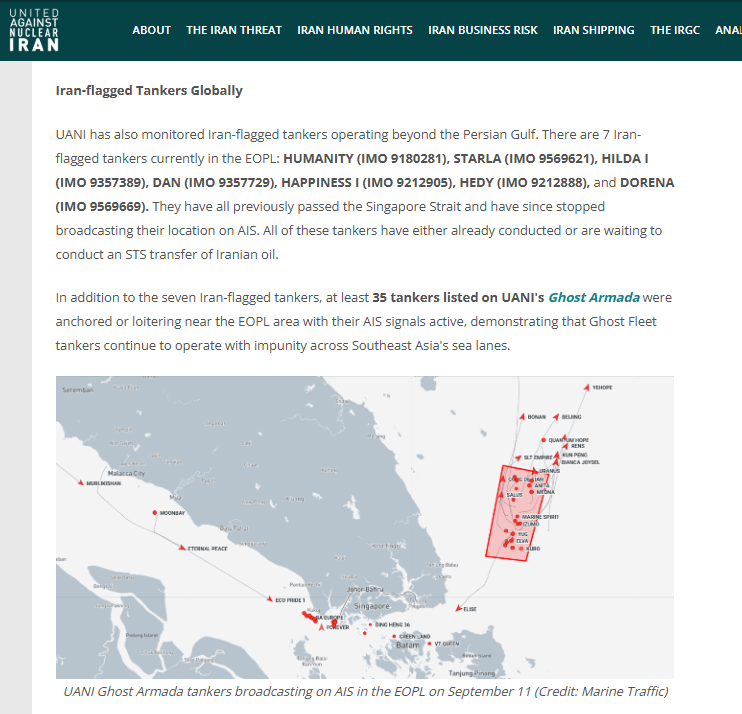
Near Sri Lanka, the 🇮🇷-flagged, OFAC-sanctioned container ship RAMA 3 (IMO 9303754) appeared abruptly on AIS transiting eastbound into the Bay of Bengal.
Its destination is Port Klang, Malaysia, with an estimated arrival on November 25.
RAMA 3 appears to have departed the anchorage near Qeshm in Iranian waters and headed toward Fujairah on November 12, before ceasing to be detected on AIS for a possible dark transit across the Gulf of Oman & Arabian Sea.
Ship identity/MMSI swapping near Sri Lanka occurs regularly by transiting 🇮🇷-flagged or 🇮🇷-linked cargo ships.
--
US Treasury presses Singapore and Malaysia on Iran sanctions compliance
https://t.co/CIJNYDiwjg
Will the recent meeting of US Treasury officials with government authorities in Singapore and Malaysia, lead to any response by local companies that support 🇮🇷 vessels during port visits or at anchor? Will commercial port operators and shipping agents face secondary sanctions?
🇮🇷VELON 1 (IMO 9122473)
🇮🇷KASHAN (IMO 9270696)
🇮🇷SHIBA (IMO 9270646)
🇮🇷FLORA (IMO 9349576)
Are all at Port Klang anchorage now, with 🇮🇷RAMA 3 inbound.
Port Klang is likely used for transhipment of cargo.
What is the nature of the cargo?
Is any of this cargo war-sustaining material listed as contraband by the US blockade announcements?
Many questions and sanctions & risk mitigation considerations for Port Klang.
--
More info at @UANI Iran Shipping Update:
https://t.co/xQrujS1hV4
--
Map & AIS data: @MarineTraffic
--
@JemimaShelley@mercoglianos@brentdsadler@ChongJaIan@DzirhanDefence@MarcusHand1@captsingh
Ha! I suspect (and hope) they don't need me to tell them.
I just like to point these out for everyone else as an interesting tidbit reflecting the nature of maritime chokepoints, especially the Malacca Strait & Singapore Strait, where these noteworthy coincidences occur regularly.
MV-22 Osprey has visited India, Maldives, and Sri Lanka recently. As an extraregional power, the US gains key access in the Indian Ocean from its partners.
@DzirhanDefence Wouldn't be the first time that a US Aircraft Carrier has sailed near OFAC sanctioned 🇮🇷-flagged Cargo ships in these waters: nor the second, nor third or fourth.
Today, as part of Operation Economic Outcast, Treasury is targeting key “oil trustees” the Iranian regime relies on to facilitate the sale of oil abroad. With no oil on the water outside of the U.S. military blockade and no oil loaded onto vessels since the start of Operation Economic Outcast, the regime is attempting to recoup billions of dollars from its oil trustees. In many cases, these corrupt trustees have kept the oil revenue for personal gain.
https://t.co/dbEIPJD0E1
@johnkonrad I liked the first season. It was entertaining. Nice Christmasy feeling
Major suspension of disbelief, especially about how they always found a perfect, available parking spot everytime in London.
Near Borough Market, near the US Embassy, etc, no problem.