investing enough time to learn math in the earliest age possible will give you insane ROI. first step of learning AI isn’t reading “attention is all you need.
it’s MATH.
Most people will waste this weekend.
Don’t be one of them.
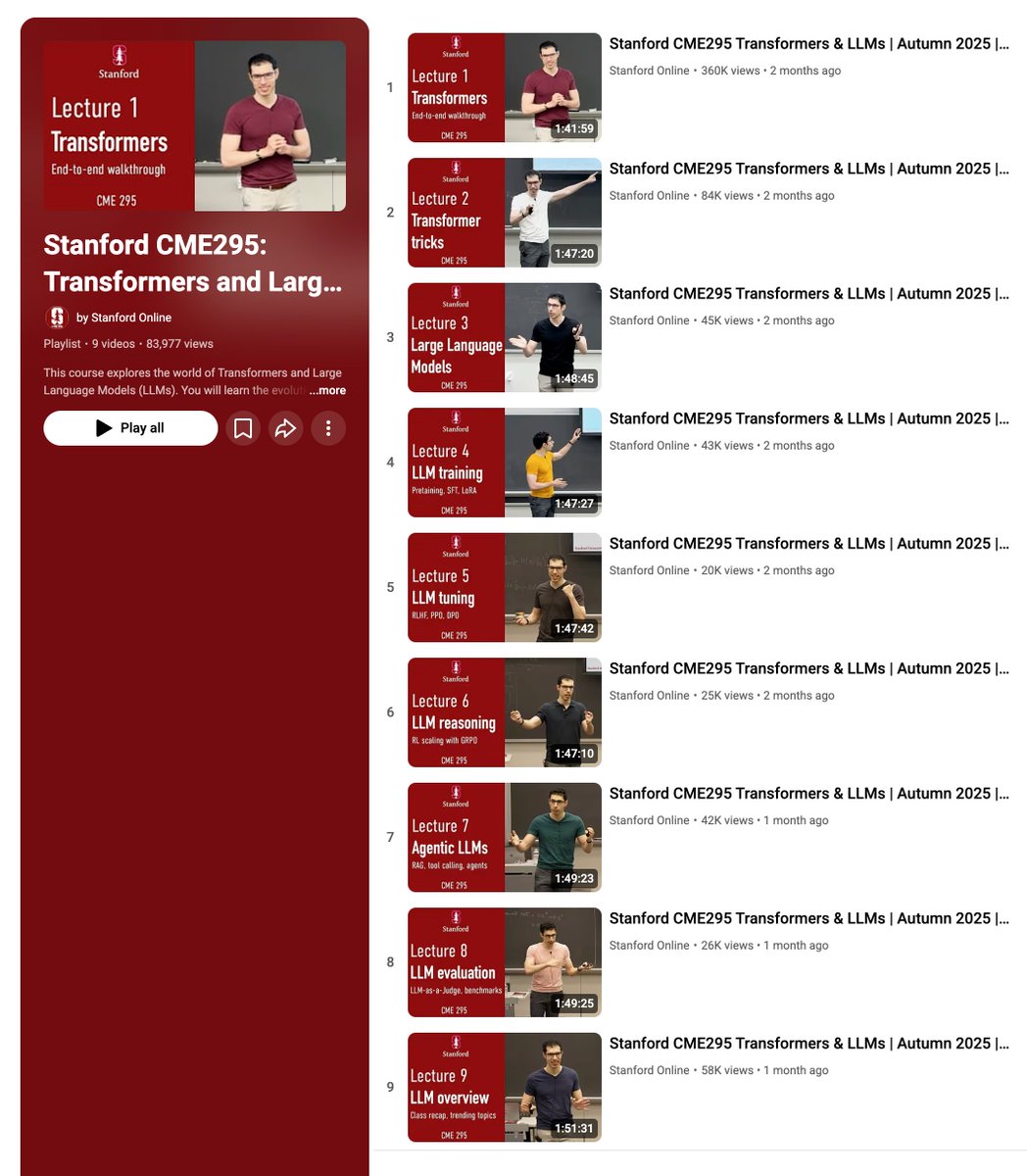
Stanford's Autumn 2025 Transformers & LLMs course. 9 lectures. Free.
While others scroll, you could understand how Flash Attention achieves 3x speedup, how LoRA cuts fine-tuning costs by 90%, and how MoE makes models efficient.
➕ What's covered:
➡️ Lecture 1: Transformer Fundamentals
→ Tokenization and word representation
→ Self-attention mechanism explained
→ Complete transformer architecture
→ Detailed implementation example
➡️ Lecture 2: Advanced Transformer Techniques
→ Position embeddings (RoPE, ALiBi, T5 bias)
→ Layer normalization and sparse attention
→ BERT deep dive and finetuning
→ Extensions of BERT
➡️ Lecture 3: LLMs & Inference Optimization
→ Mixture of Experts (MoE) explained
→ Decoding strategies (greedy, beam search, sampling) → Prompting and in-context learning
→ Chain-of-thought reasoning
→ Inference optimizations (KV cache, PagedAttention)
➡️ Lecture 4: LLM Training & Fine-tuning
→ Pretraining and scaling laws (Chinchilla law)
→ Training optimizations (ZeRO, model parallelism)
→ Flash Attention for 3x speedup
→ Quantization and mixed precision
→ Parameter-efficient finetuning (LoRA, QLoRA)
➡️ Lecture 5: LLM Tuning
→ Preference tuning
→ RLHF overview
→ Reward modeling
→ RL approaches (PPO and variants)
→ DPO
➡️ Lecture 6: LLM Reasoning
→ Reasoning models
→ RL for reasoning
→ GRPO
→ Scaling
➡️ Lecture 7: Agentic LLMs
→ Retrieval-augmented generation
→ Advanced RAG techniques
→ Function calling
→ Agents
→ ReAct framework
➡️ Lecture 8: LLM Evaluation
→ LLM-as-a-judge overview
→Best practices and benefits
→Biases and pitfalls
➡️ Lecture 9: Recap & Trending topics
From Stanford Online:
Rigorous instruction. Latest techniques. Free access.
Perfect for:
→ ML engineers building with LLMs
→ AI engineers understanding transformers
→ Researchers working on language models
→ Anyone learning beyond API calls
This weekend: learn the techniques that separate good engineers from great ones.
(I will put the playlist in the comments.)
♻️ Repost to save someone $$$ and a lot of confusion. ✔️ Follow @techNmak for more AI/ML insights.
i’ve never been more inspired to become a better SWE
i spend about ~45 mins a day coding with zero AI tools, learning documentation, browsing libraries
benefits:
> time to execution dropped by half, i have a sharper sense of what needs to get done, how it will look, and therefore get it done faster
> less time debugging, AI’s make more mistakes than you realize if you don’t know what it’s actually writing. i stopped treating it like a black box
> culturally inspired to contribute back to OSS. the amount of public libraries that hold up our world is fucking insane. contributions actually make the world a better place. still finding the repo that i feel alignment with
i “learned” to code in college about ~3 years ago, and until NOW do i feel like i’m actually getting started
In 2020, I solved a gnarly reverse engineering challenge in PlaidCTF. Only 9 teams solved.
It's a huge pile of Typescript. Everything is named after a fish.
The catch? There's no code, only types. How do they perform computation using just the type system?
(Spoiler: Circuits!)
@FeHa@musuhphp Permisi, saya besok akan magang sebagai IT auditor di salah satu KAP besar, kira-kira itu bisa dibilang cybersecurity ga ya? Job desc-nya kurang lengkap, tapi termasuk dalam departemen ITGC ktny
Kebetulan sukanya development (kuliah teknik informatika), tapi juga suka iseng CTF