Our house rule is you don't have to go to sleep if you're reading. So my 8 year old is now reading 6th grade reading level because he likes thinking that he's getting away with staying up after bedtime. Win/win.
Fred Rogers met with a child psychologist every week for 22 years to build his show. She shaped everything: every script, prop, and song. The whole point was to give a child's nervous system time to slow down. In 1984, a single regulatory decision ended all of it.
The psychologist was Dr. Margaret McFarland, who co-founded the Arsenal Family and Children's Center alongside Benjamin Spock and Erik Erikson. She and Rogers understood that the prefrontal cortex in children, the part of the brain that controls impulse, emotion, and attention, takes decades to fully develop. At the start of every episode, Rogers tied his sneakers and changed his sweater while children settled in. Those pauses were intentional, designed to help a child's nervous system shift into a calmer, more focused state.
What ended it had nothing to do with child development science. In 1984, Reagan's FCC chairman Mark Fowler abolished the advertising limits that had protected children's programming from commercial pressure. Toy companies moved within months. Between 1984 and 1985, cartoons tied to toy lines increased by 300%, from a handful of shows to more than 40 animated series. In almost every case, the toy was designed first. The cartoon was built to sell it.
Researchers later put numbers to what parents were already noticing. A 2011 study in Pediatrics from the University of Virginia tested 60 four-year-olds across three groups: one watching SpongeBob, which cuts scene every 11 seconds; one watching a slow PBS show, which cuts scene every 34 seconds; and one drawing. Nine minutes later, all three took tests on attention, impulse control, short-term memory, and problem-solving. The SpongeBob group scored significantly worse across every measure.
In the 1970s, children began watching television around age 4. Research from pediatrician Dimitri Christakis found that by 2009, the average age of first screen exposure had dropped to 4 months, as the content got faster and the audience got younger. Researchers separately found that each additional hour of daily screen time at ages 1 or 3 raised the risk of attention problems at age 7 by 9%.
Stateside, a gas station. I drank a frozen blue beverage too quickly, and was struck down by a punishment this entire nation knows, and accepts, and has named.
The drink is called a slush. Ice, sweetness, and a blue that does not occur in nature. The day was hot. I was thirsty. I drank like a soldier at a river.
The pain arrived in my skull like a war horn.
Behind the eyes. Above everything. Total. I gripped the roof of my car. I may have made a sound.
"Brain freeze," said the cashier through the door, with no urgency whatsoever.
It has a NAME. The affliction is so common it has a household name, like a cousin.
"Tongue on the roof of your mouth," called a man at the pumps. He did not look over. He prescribed the remedy mid-pump, casually, the way one mentions weather.
I pressed my tongue to the roof of my mouth. The war horn faded. The healer nodded at his pump, finished, and was gone in a Chevrolet.
In my land, punishment follows crime by way of courts and seasons. Here, the sentence is instant. Drink with greed, and the ice strikes the mind directly. No trial. No appeal. Perfectly fair.
And here is what moves me. EVERYONE has felt it. The cashier. The healer. Children. Elders. An entire nation united by the same small lightning, all taught the same cure, all passing it on to strangers at gas stations, free of charge.
You cannot fully distrust a country once you know it shares one pain.
The freeze does not punish thirst. It punishes haste.
I finished the slush slowly, like a scholar. Blue tongue. Clear mind.
Then at the door I forgot everything, drank deeply, and was struck down again.
"Tongue, hon," said the cashier, without looking up.
Discipline is a journey.
Non-finance folks so rarely get this clarity: Prices aren’t punishment/rewards—Prices are information.
They are distinct from value judgments. Related but distinct.
It’s not schools that need to ban cell phones — it’s parents. As an educator I can tell you: kids are way too clever for a school ban to work. Those resources are needed to help parents re-normalize childhood without a smartphone.
Ideology baked into training data…although all training data has someone’s ideology. LLMs are opinionated bc they aggregate opinions https://t.co/ouxuD65Ntr
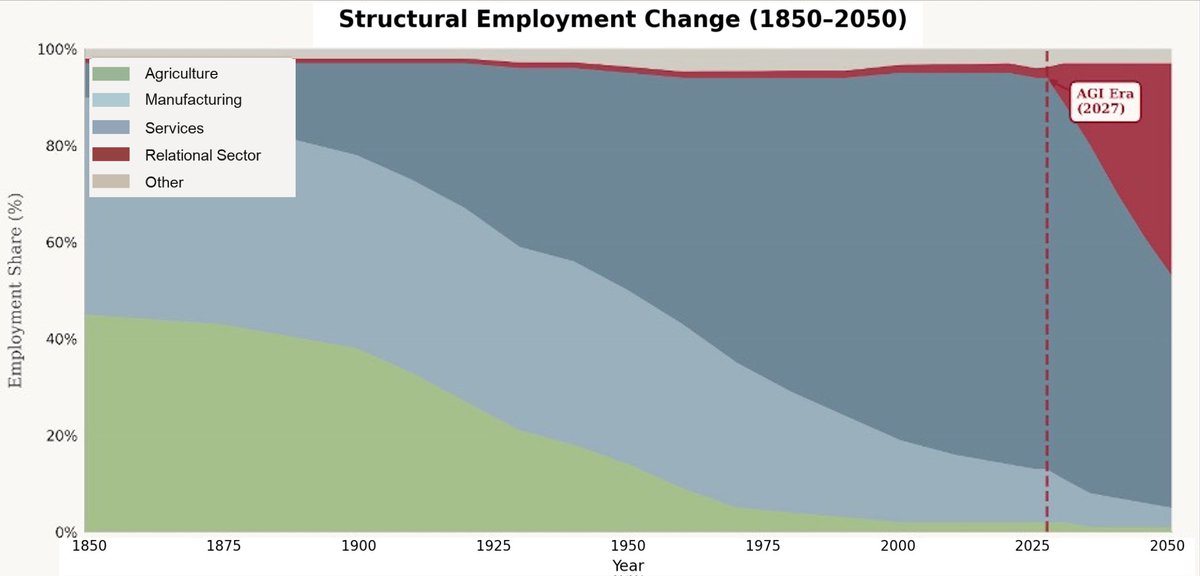
New essay on the economics of structural change and the post-commodity future of work.
1. Almost any question about the impact of advanced AI on the economy needs to start at the same place: what is still scarce? Answer that, and the analysis becomes pretty straightforward. This essay explores what becomes scarce if AI really can replicate most of what humans do in production, and what this mean for the future of jobs.
2. My conjecture, working through the economics: labor reallocates across sectors, and the sector it reallocates to has properties that keep labor a meaningful share of the economy. Ultimately this is about the structure of demand itself. For this, we have to go back to Girard, Augustine and Rousseau: once people's base needs are met, their preferences shift to comparative motives (e.g., status, exclusivity, social desirability). This motive is inherently non-satiated.
4. The key paper is Comin, Lashkari, and Mestieri (Econometrica 2021). As people get richer, they don't buy proportionally more of everything. They shift spending toward sectors with higher income elasticity. They estimate income effects account for 75%+ of observed structural change.
5. The ironic consequence: the sector that gets automated becomes a smaller share of the economy, not a larger one. Agriculture got massively more productive and its share of employment collapsed. Manufacturing too. The "stagnant" sectors absorb the spending and the jobs.
6. So the question is: which sectors have high income elasticity in a post-AGI world? I argue it's what I call the relational sector. Categories where the human isn't just an input into production, it is part of the value.
7. Why does the relational sector have high income elasticity? Because human desire has a mimetic, relational dimension. We don't just want things for their intrinsic properties. We want what others want, and we want it more when others can't have it. Girard, Rousseau, Augustine, and Hobbes all saw this.
8. In work with Kristóf Madarász, we showed this experimentally: WTP roughly doubles when a random subset of others is excluded from the good. And in new work with Graelin Mandel, AI involvement kills the premium. Human-made art gains 44% from exclusivity; AI-made art only 21%.
9. This all comes together for the core argument. The sector that absorbs spending as AI makes commodity production cheap is one where human provenance is part of the value, and demand for it grows faster than income. Exactly the profile that keeps labor meaningful.
10. To be clear about the claim: I'm NOT saying aggregate labor share must rise. It may fall. The claim is about sectoral composition, i.e., where expenditure and employment go once commodities get cheap, and the fact that the sector that will absorb reallocated labor maps to a substantial component of human preferences and desire.
11. If you're interested in the formal model, a linked companion technical note works out all the economics.
Read the essay here: https://t.co/NcjVgn2o8g
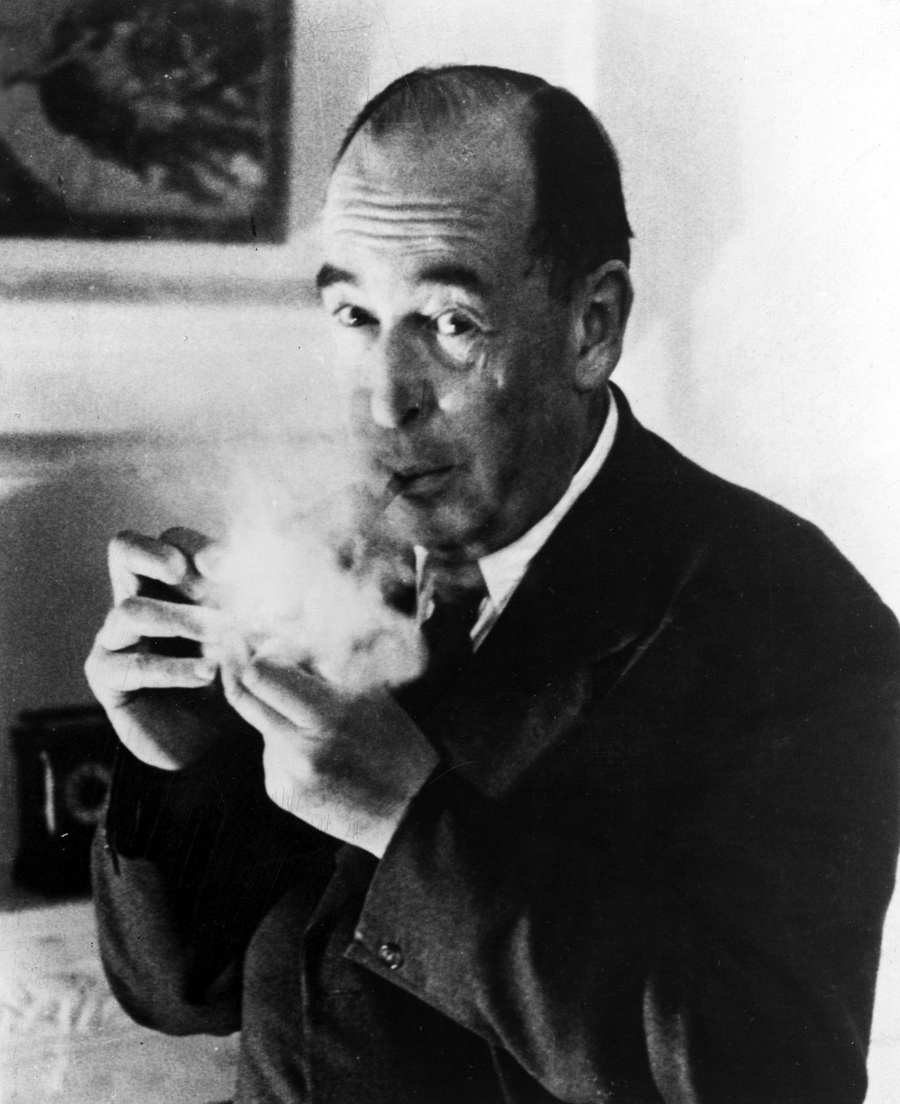
Did you know C.S. Lewis predicted the modern obsession with “being nice” would destroy the soul?
In The Abolition of Man, Lewis argues that when a society stops believing in objective virtue, it doesn’t become tolerant… it becomes manipulable.
He calls the result “men without chests.”
People with appetites and intellects, but no courage, no honor, no trained moral instincts. They can calculate everything and defend nothing.
Lewis saw that once we reject inherited moral law, we don’t become free. We become raw material… easily shaped by propaganda, pleasure, and fear.
Modern man prides himself on compassion while quietly surrendering every standard that once gave compassion meaning.
Lewis’s insight is brutal: a civilization that educates clever cowards will eventually be ruled by tyrants or technicians.
Because when nothing is worth dying for, everything becomes negotiable… including human dignity.
@PAHoyeck They Live and Roland Barthes (anything on advertising). You’ll be amazed at how well your students already understand semiology, and and how far you can take that into their actual lives
When brilliant teachers emerge, they disappear. Jaime Escalante created one of the finest AP calculus programs in the country. He could not scale it. Marva Collins founded an exceptional school. She could not replicate her excellence across ten other schools.
The question is not why these teachers are geniuses. The question is why we have no system to transmit their genius.
If Escalante had been a martial arts master, he would have founded a school. His best students would open branches displaying their lineage. Over generations, a coherent tradition would spread. This happens in martial arts, music, dance, and craft traditions.
It does not happen in education.
I call this absence The Missing Institution. In the absence of government monopoly, we would have seen the spontaneous creation of hundreds of pedagogical lineages, each designed to transmit the artistry of a master teacher.
Instead, teacher training is controlled by education professors who publish research papers, not by virtuoso teachers who practice their craft daily.
Montessori and Waldorf escaped the system. They created their own teacher training lineages outside government control. KIPP Academies created an internal leadership program. Hi Tech High licensed its own teachers. The moment schools escape government domination, they spontaneously create The Missing Institution.
For underprivileged children, this absence is catastrophic. They need schools that transmit cultural capital through immersion in a living tradition.