We’re opening a research preview of Claude Duet, a new app where Claude works as a proactive agent.
It comes to you with what needs your attention, completes tasks you ask of it, keeps working when you step away, and checks with you before it acts on your behalf.
🔐 Node.js security updates are now available!
New releases for Node.js 22.x, 24.x & 26.x address multiple vulnerabilities, including high-severity issues.
Review the details and update your systems to stay secure.
🔗 https://t.co/W4kfzx5lxz
#NodeJS#Security
Over the past two months, we have been leading a coalition to mitigate one of the most severe bugs in open source software found in recent memory, php2shell, found as part of our Patch the Planet initiative. https://t.co/rBsz7lrlwo
OpenAI models helped researchers—operating as part of our Patch the Planet initiative—discover critical security flaws in PHP, an open-source programming language used to run an estimated 70% of websites.
Over the past two months, we led a coalition of maintainers, researchers, and security providers to prepare fixes and protections ahead of disclosure. This duration was necessary because the fix was quite intricate and required a major change to the PHP engine. Every site using PHP can now safely upgrade their version to stay secure, in addition to applying mitigations from various security vendors.
Due to the severity of these flaws and PHP’s widespread use, we consider this bug to be one of the most impactful vulnerabilities in recent memory. It also marks a new phase, where AI can find security bugs with internet-scale impact.
This is an example of the Defender’s Window in action: to our knowledge, frontier AI was able to find this vulnerability ahead of attackers, giving defenders time to prepare.
https://t.co/TW3jrSbB3f
Cancer patients with the same diagnosis often have very different tumor biology.
Molecular testing can reveal underlying differences, but that's slow and expensive.
Introducing Holon-S1, our platform to predict genes and biomarkers from routine pathology slides.
• beats two other models at predicting spatial gene activity in a controlled comparison
• has identified potentially novel biomarkers in breast cancer and colon cancer
• evaluated across 16 organ types and more than 15 scanners, using slides from both formalin-fixed, paraffin-embedded and fresh-frozen tissue.
We believe Holon-S1 has the potential to help researchers find new biomarkers in slides they already have, discover treatment targets, and bring more personalized cancer care within reach!
🚀 Introducing DeepInfer, our in-house inference framework, now fully open source!
Powering DeepSeek-V4.1-Flash at scale with high throughput and low latency. We’re sharing our production stack to help the community lower compute costs, reduce energy use, and make AI more affordable.
🔗 https://t.co/JGAik1kgk0
1/4
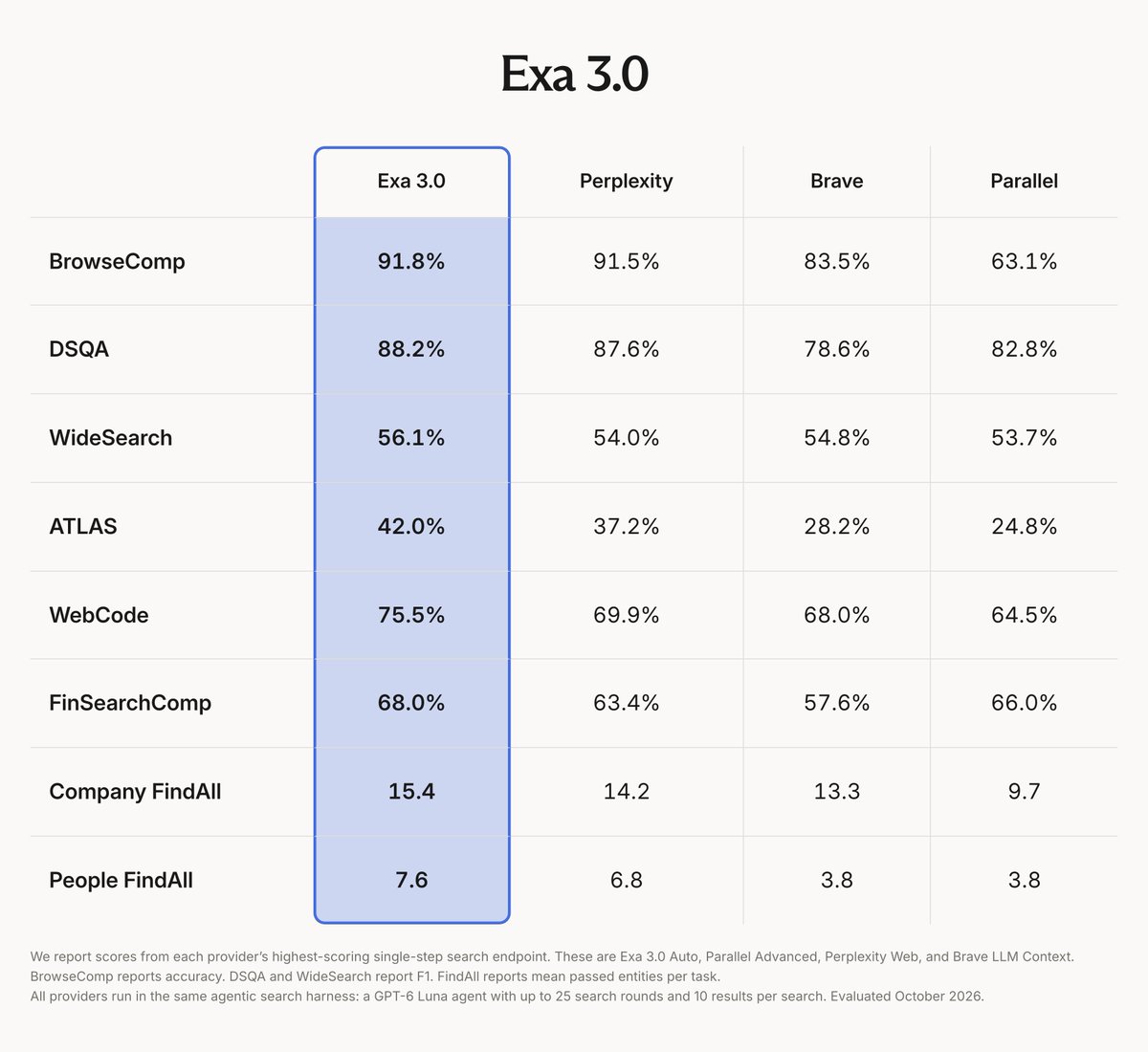
Introducing Exa 3.0: our largest ever improvement to search quality.
Exa is now #1 on every benchmark we tested, from public evals to verticals like coding and GTM intelligence.
It's the result of multiple research breakthroughs 🧵
Is being technical still worth it when AI commoditizes math and coding?
We asked @Alfred_Lin of @Sequoia. We also talked about feature vs. real company, circular money in AI, and the rate of diffusion of technology.
Full talk 👇
https://t.co/0zRdz0zjEh
Hi, I'm Felix. I'm an eng lead working on Claude. I love watching people take flight and do things they never thought possible.
We often describe that as "being more ambitious" when using AI, which is tricky advice to follow. I wrote a tutorial:
https://t.co/vNPPs5FWm8
we announced Jev 1.14 on 10.14 at 1:14pm PT 🔥
a new and improved model, along with experimental features for our dreamers:
• images
• a new box type
• longer context
surprise, Jev was already able to see you! 👁️
BUT our bar for production-grade intelligence is quite high, so builders beware, these are preview features.
enter the ~*~ danger zone ~*~ at your own risk. 🚨
Exa just passed $100m in annualized revenue.
We've grown almost exactly 10x per year for 3 years. We now handle 2 billion requests a month from 200k+ teams. And it’s still so early:
We predict agents will search 1000x more than humans by 2030.
Agents don't search like humans. They write long, complex queries and want all the world's data, not just the web. We've spent 5 years building a search engine designed for them.
We now serve personal agents, AI labs, coding agents, GTM agents, really any agent. Exa gives these agents access to 100s of billions of web documents and tons of proprietary data.
Our customers are increasingly noticing that information is the bottleneck to agent performance. While the world seems close to perfect intelligence with models like Fable and Astra, we are very far from perfect information.
To our small but legendary team, thank you for getting us here, from engineering to research to GTM to ops.
To our customers, it is an honor to serve you. We have some exciting releases coming soon and can't wait to share them 🫡