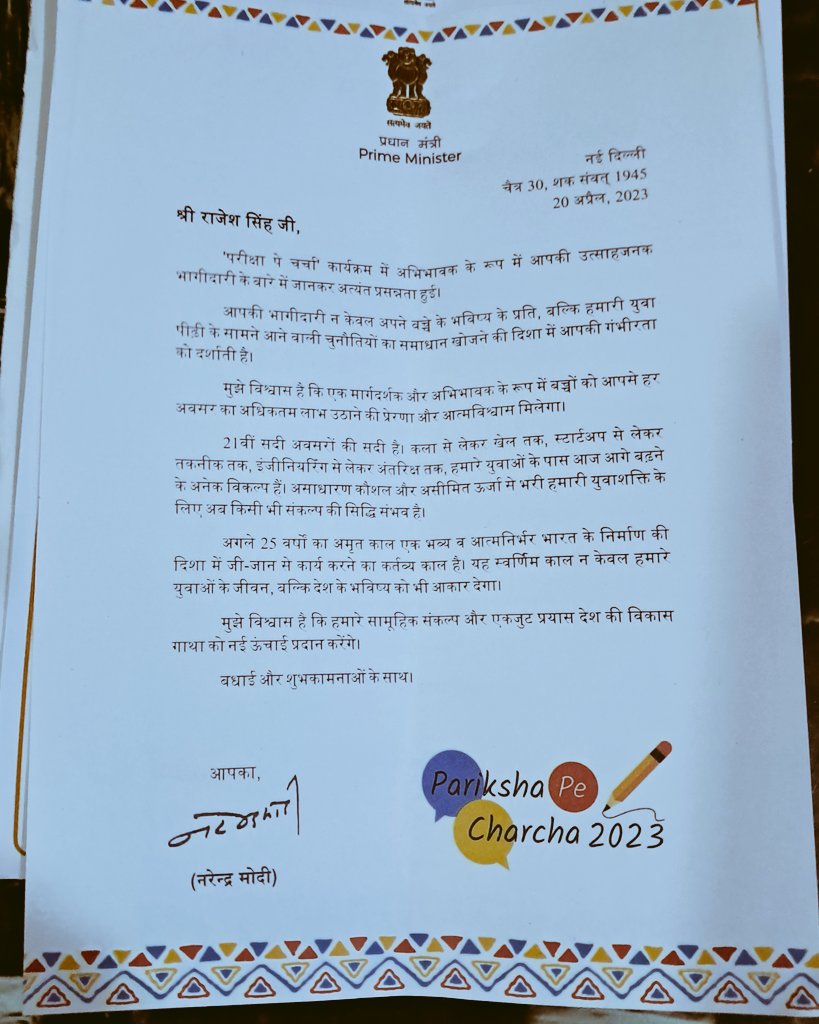
Received the appreciation latter from honourable prime minister shri @narendramodi ji for participating in pariksha pe charcha program along with daughter and shearing my views on the same.
How many people gets this honour in life.
It made my day. Thank you sir.
Eid of Horrors for Princesses and Noblewomen Who Missed Jauhar.
Ibn Battuta describes the Eid celebrations of Sultan Muhammad bin Tughluq, who ruled the Delhi Sultanate from 1325 to 1351. He says: “Then enter the musicians, the first batch being the daughters of the infidel rajas — Hindus — captured in war that year. They sing and dance, and the sultan gives them away to the amirs and a'izza. (The amirs are commanders or high-ranking nobles, and the a’izza are other powerful men in the sultanate).
Then come the other daughters of the infidels who sing and dance; and the Sultan gives them away to his brothers, his relations, his brothers-in-law and the maliks' sons.
This court is usually held in the afternoon; and on the following day also it is held at the same time and in the same order when female singers are brought in. They sing and dance, and the sultan gives them away to the chief slaves.
And on the third day the sultan gets his relatives married, and gifts are made to them. And on the fourth day the male slaves are manumitted; on the fifth day the female slaves are manumitted, and on the sixth day he makes the male slaves marry the female slaves. On the seventh day he gives away alms on a very large scale.”
Ibn Battuta was a 14th-century Moroccan Muslim explorer who travelled from Africa to India and the Middle East to China. He wrote a travelogue, The Rihla of Ibn Battuta. The Arabic word rihala or rehala means ‘journey’ or ‘voyage’, or ‘travelogue’. Rihalas often recorded a traveller’s experiences, local customs, politics, and historical events across the Islamic world and beyond. In his book, he describes the pitiable condition of Hindu princesses, noble women, and other girls.
Manumitted means released from slavery or servitude by an owner. This usually occurs when slaves convert to Islam, not otherwise. This was a part of jihad on Hindus. In these cases, the slaves were likely held in captivity for a while. Since males older than 12 were killed, it is quite certain that they were converted and circumcised. They could also be the children of slave men and women whose children were also born as slaves, as per Islamic law at the time. Perpetual slavery till eternity was allowed by their law.
The Islamic jihad on Hindus has been so brutal that many researchers call it ‘the largest genocide in human history.’ Koenraad Elst explains how the genocides were executed.
He says: “Apart from actual killing, millions of Hindus disappeared by way of enslavement. Slaves were likely to die of hardship; e.g. the mountain range Hindu Koh, ‘Indian mountain’, was renamed Hindu Kush, ‘Hindu-killer’, when one cold night in the reign of Timur Lenk (1398-99), a hundred thousand Hindu slaves died there while on transport to Central Asia.
Though Timur conquered Delhi from another Muslim ruler, he recorded in his journal that he made sure his pillaging soldiers spared the Muslim quarter, while in the Hindu areas, they took ‘twenty slaves each’. Hindu slaves were converted to Islam, and when their descendants gained their freedom, they swelled the numbers of the Muslim community. It is a cruel twist of history that the Muslims who forced Partition on India (1947) were partly the progeny of Hindus enslaved by Islam."
https://t.co/5kBidV5bfz
@KESCoHQ स्वर्ण जयंती विहार सेक्टर 1 में सुबह से आपूर्ति बाधित है। कृपया संज्ञान लेते हुए जल्द समस्या का समाधान करने का कष्ट करे। कब तक लाइट आएगी कृपया अवगत कराएं।
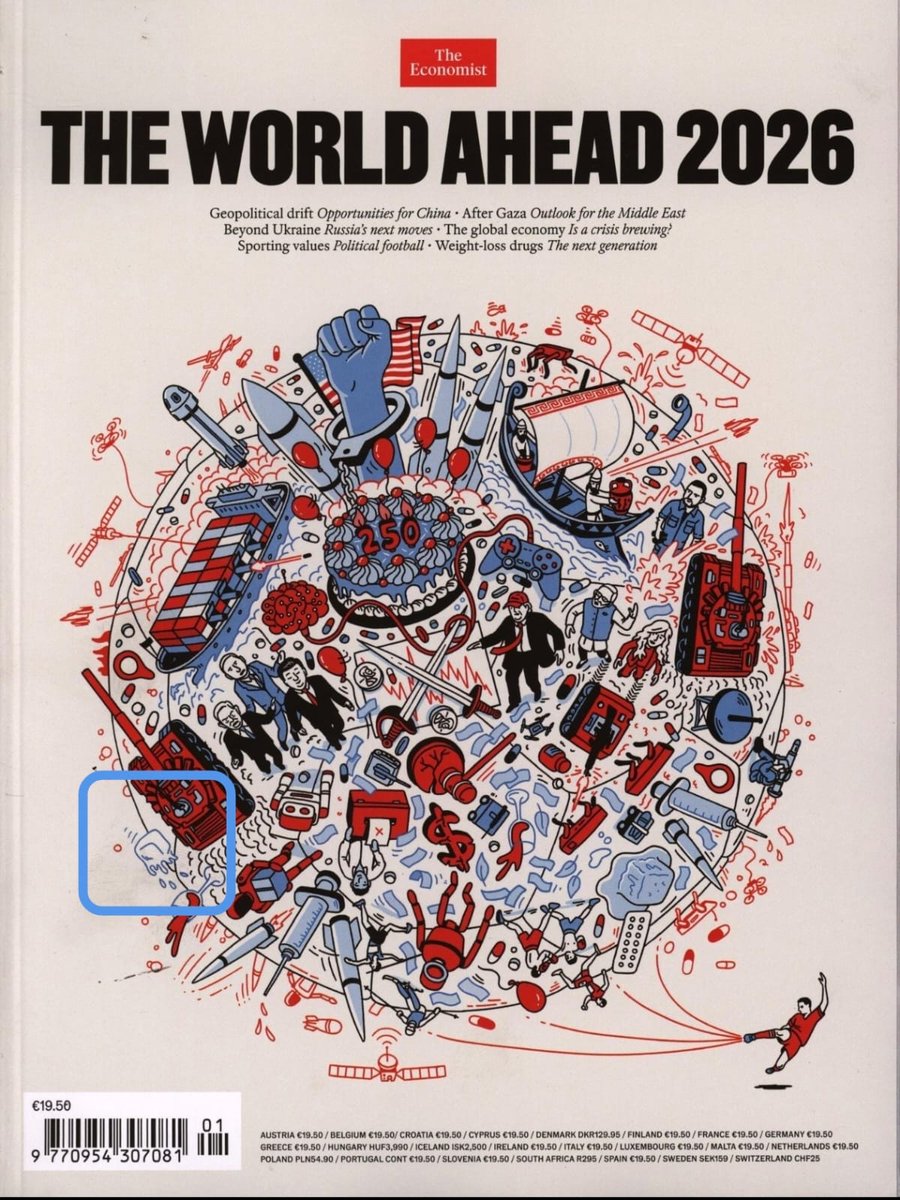
Rothschild family owned magazine The Economist published this cover image in its January 2026 edition
If you look carefully at first image, they have shown a melting glacier at bottom left
If you place this image on a clock, melting glacier aligns exactly with the end of August
@MukeshPathakji मुकेश जी को धन्यवाद
यह मेरेसाथ भी हो चुका है। मेरी गाड़ी महेंद्रा की थी। आपकी तरह निर्णय लेने की हिम्मत नही हुई। मैं सरकारी नौकरी में था।समय नही दे सकता था।इसलिए चुपचाप गाड़ी लेकर आ गया।
Next in who after the Ramanujan series?
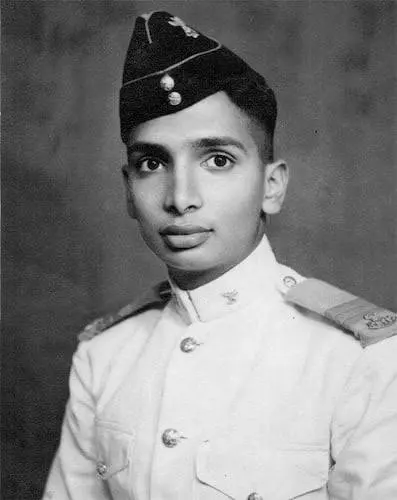
At a tender age of 16, a brilliant but completely unguided boy from Tamil Nadu joined the National Defence Academy & was commissioned into the Indian Navy's electrical branch . He did not have the luxury of a quiet university setting; he was trained in practical skills to maintain weapons systems on warships.
But Arogyaswami Paulraj possessed an insatiable, self-taught obsession with the advanced mathematics of signal processing, control theory & information theory. He studied advanced matrices & random variables by lamplight on naval ships.
By the late 1970s, India faced a serious strategic challenge. After the 1971 Indo-Pak War exposed weaknesses in imported sonars, the Navy needed an advanced anti-submarine warfare system but was blocked by international export restrictions. The Navy turned to Paulraj, then a rising officer with a PhD from IIT Delhi (earned while still in service). He was tasked with leading a major indigenous project to develop a world-class hull-mounted panoramic sonar from scratch.
Operating under intense resource scarcity, Paulraj’s mathematical genius took over. He designed complex signal-processing algos that could filter the chaotic, deafening acoustic noise of the ocean to pinpoint enemy submarines. The resulting system, APSOH (Advanced Panoramic Sonar Hull), inducted in 1983, completely stunned global military observers. It did not just work, it outperformed contemporary Western systems.
After setting up major defense labs in India, Paulraj retired from active naval service & arrived at Stanford University in 1991 as a research associate. This is where the story shifts from military history to modern legend. While working on signal separation experiments for airborne military reconnaissance, Paulraj noticed a strange, fleeting physical phenomenon.
When a radio signal is transmitted in a crowded area (like a city with buildings), it bounces off walls & scatters into 1000s of chaotic, distorted paths. Engineers treated this scattering as a nightmare, multipath interference that corrupted data.
Paulraj had a paradigm-shifting realization rooted in multi-variable calculus & spatial matrices: What if the scattering was not a bug, but a feature?
He realized that if we used multiple antennas at the transmitter & multiple antennas at the receiver, we could use advanced matrix mathematics to isolate those scattered paths & stream parallel, independent channels of data over the exact same frequency, at the exact same time.
He called it MIMO (Multiple Input, Multiple Output).
When he 1st proposed it, the academic world mocked him. Prominent profs & industry skeptics told him it violated the laws of physics & information theory. They claimed it was mathematically impossible to multiply data speeds w/o expanding bandwidth.
Paulraj did no back down. He built his own prototype, founded a startup & proved the mathematics in real-world silicon. He designed the microscopic architecture, the microchip algos that allowed small devices to execute these hyper-complex spatial matrix calculations in fractions of a microsecond.
If we look at the device we are using to read this right now, look at the top corners of our screen. We cannot see them, but embedded inside the frame of our phone are multiple microscopic antennas operating on Paulraj’s exact MIMO-OFDMA mathematics.
Every single modern 4G network, 5G network & high-speed Wi-Fi router on Earth is built entirely on the mathematical foundation invented by the self-taught Indian Navy officer who packed his bags for Stanford. He did not just solve a math problem; he built the invisible highway that carries nearly 100% of the world's mobile data traffic today.
@KESCoHQ महोदय, स्वर्ण जयंती विहार सेक्टर एक मे सुबह 6 बजे से विद्युत आपूर्ति नही हो रही। कृपया समाधान करने का कष्ट करें।बिजली न होने से पानी भी नही आया है।बहुत समस्या हो रही है।