I am happy to introduce AI co-clinician,
@GoogleDeepMind's research initiative to explore how AI could better amplify doctor's expertise and help deliver higher quality care to patients.
We’re excited about our early results, and are taking a phased approach to our research explorations with academic and research collaborators.
Read more in our blog: https://t.co/OVPDordxTw
Our FU Superchargers (Folding Unit) save 20%+ on cost, improve build quality, and deploy 2X faster.
The majority of cost savings are in civil, electrical and logistics cost. It's why we're spending so much time improving our pre-assembled Supercharger units.
With FU Superchargers, on-site work is further reduced, including no more DC busbar connection and no Tesla service technician needed for commissioning. We can ship 16 Supercharger posts per truck (previously 12), making the logistics cost of shipping pre-assembled Superchargers now cheaper than traditional construction 🤯.
This is just Rev1, we'll have Rev3 by next quarter. Every little improvement matters for the scale needed for 100% EV adoption.
This is incredible.
This machine is capable of cleaning up 100 million kg of plastic ocean waste, and as of 2025, it has already collected about 500,000 kg of plastic.
It aims to remove 90% of ocean plastic by 2040.
In 3 yrs this #solar installation at an Arkansas high school turned the district’s budget from a $250K deficit to a $1.8 million surplus. They're using the surplus to pay teachers more
We have the solutions. Implement them. #ActOnClimate#ClimateAction#climate#NoWarNoWarming
I’m going to tell you how much worse it was at the start of the PC Revolution for white collar workers trying to adapt, vs today with AI
Today, presumably every white collar worker has access to a smart phone and/or a PC/laptop.
Back then, a PC cost $4,995 , an off brand was $3,995. 5k in 1984 is about $16k today. It was really expensive.
The only reason I could learn how to code and support software is because my job let me take home a PC to learn. By reading the software manual. Literally. RTFM. Or pay to go to training. Classes that started at hundreds of dollars then. It was expensive. It absolutely limited who could get ahead.
Today, ANYONE can go to their browser, to the AI LLM website of their choice, and type in the words “I’m a novice with zero computer background, teach me how to create an agent that reads my email and …”
That concept applies to LEARNING ANYTHING
Think about what this means. Any employee of any company can say “ I need to learn how to xyz for my job , which is to do the following: Tell me what more information do you need to help me be more efficient, productive and promotable”. Or “ what new skills can you teach me that will help me reduce my chances of getting laid off “. Or “what suggestions do you have for me to communicate to my boss, who I barely know, to help my chances of staying employed “
These aren’t great prompts. But they are a start that anyone can take.
Think about how incredible that is.
Back in the day was so much harder for white collar workers. It was harder for new grads because unless they took comp sci, they probably had never used a PC.
Big Companies are going to cut jobs. No question about it. Small companies is are going to need more and more AI literate thinkers who can help them compete or get an edge
What I tell every entrepreneur, and it’s more crucial today. “ when you run with the elephants there are the quick and the dead. Adopt tech quickly , you can out maneuver big companies. “
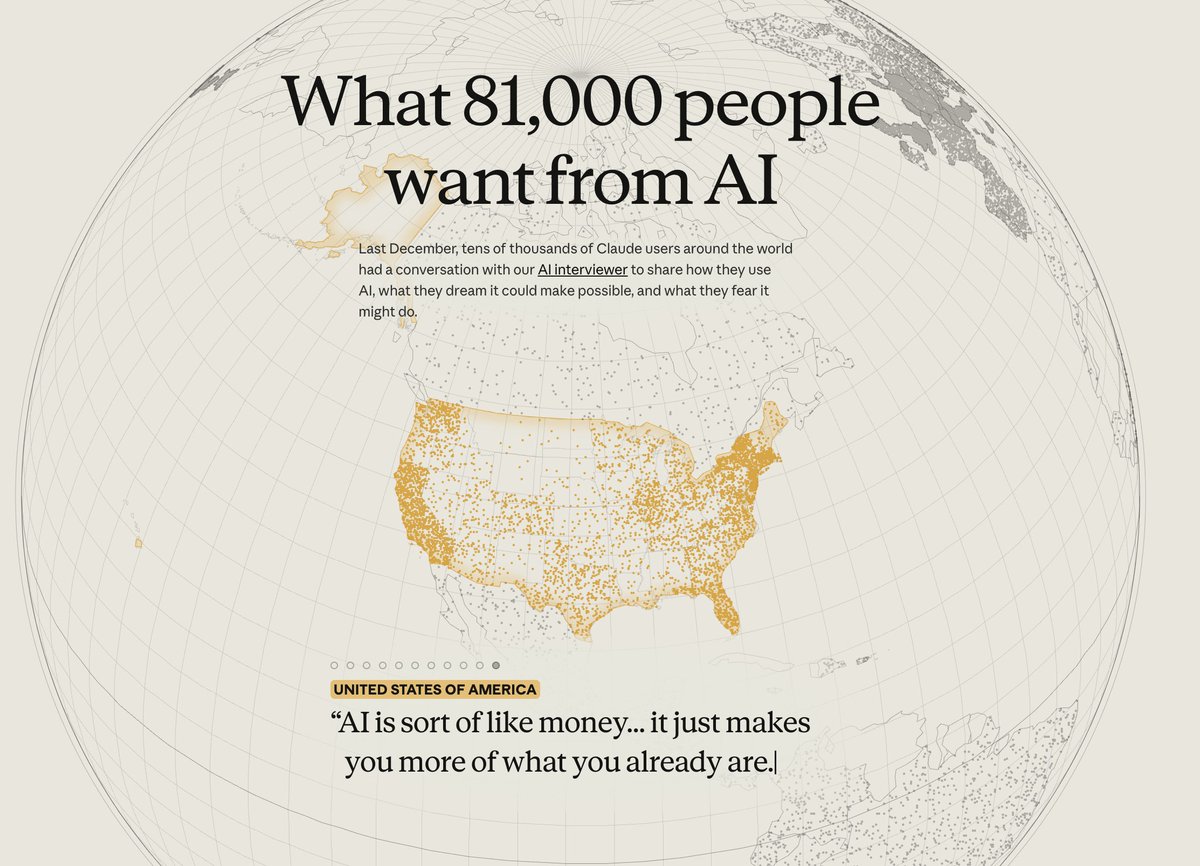
Wow this new Anthropic post is a GREAT read
Everyone's "worried" about job loss but Anthropic just asked 81,000 people the more honest question: do we even want them?
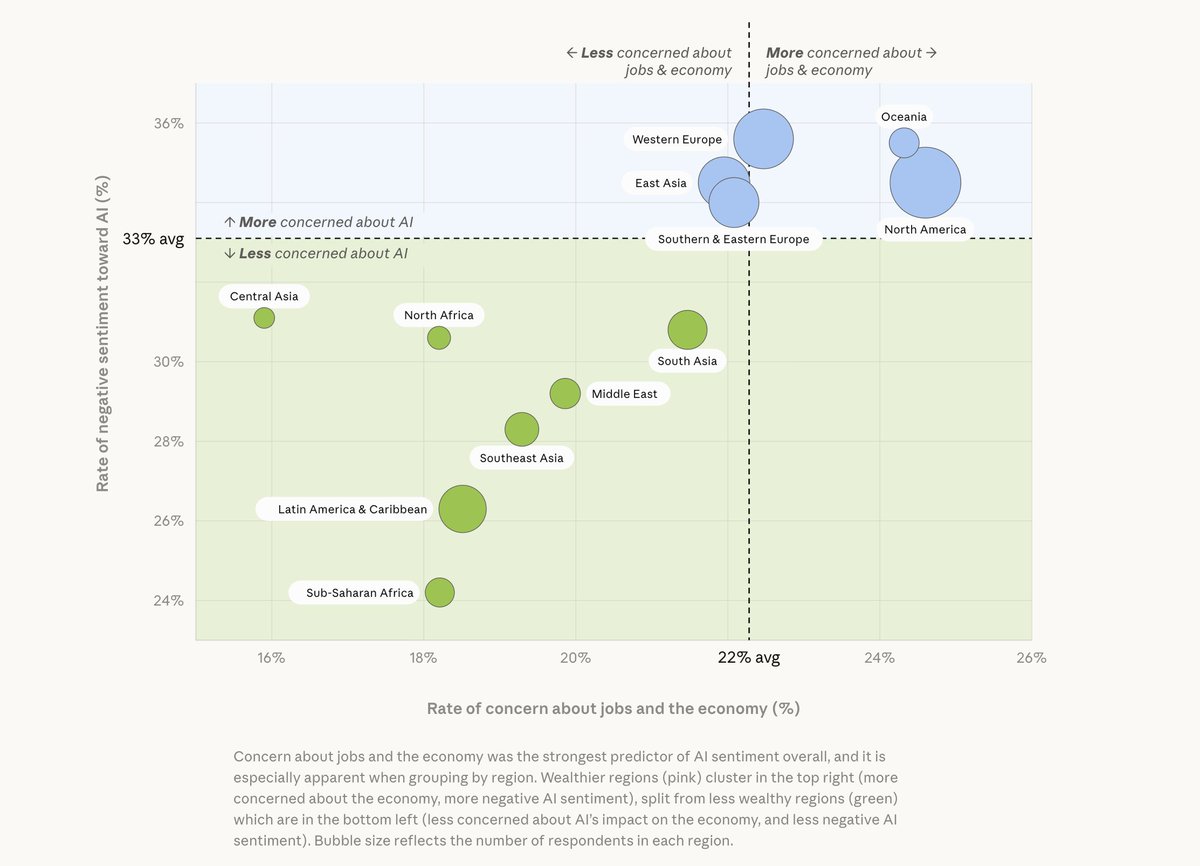
On the surface, yes. 22% of respondents listed job displacement as a top fear. It was the strongest predictor of negative AI sentiment in the entire study.
But when Anthropic asked people to describe their ideal vision for AI the answers told a different story:
- A software engineer in Mexico wants to leave work on time to pick up his kids from school.
- A worker in Colombia wants to cook with her mother instead of finishing tasks.
- A freelancer in Japan wants less brainpower spent on clients so he can read more books.
- A manager in Denmark said if AI handled the mental load, it would give her back something priceless: undivided attention.
19% said professional excellence. But 11% said time freedom. 14% said life management. 10% said financial independence. Across all these groups, the unifying ask was the same: help me live better.
A third of all 81,000 responses, when you pull on the thread, are people describing a life where work takes up less of who they are.
We say productivity. We mean liberation.
We say we're scared of losing our jobs. But what we're actually scared of is losing our income without gaining our freedom. The economic freefall without the parachute.
The real conversation is more about what replaces the jobs. If the answer is nothing, no safety net, no new path to purpose. Then displacement is terrifying.
If the answer is time, autonomy, and the space to do what actually matters to you, then it's the thing people have been quietly wishing for all along.
81,000 people just told us what they want. We should listen.
The biggest-selling drug on the planet last year was a peptide. Semaglutide, the molecule inside Ozempic and Wegovy, is a chain of just 31 amino acids. It generated roughly $33 billion in revenue for Novo Nordisk in 2025. One molecule. The entire peptide drug market crossed the $50 billion mark.
Finding the right peptide is where all the money burns. For each disease protein, you need to design a peptide that binds tightly enough actually to work. Think of it like making a custom key for a lock, except each position on the key can take 20 possible shapes, and even a short 10-position peptide can have over 10 trillion possible combinations per target.
The two best AI tools for this, BindCraft and BoltzGen, work by first predicting a peptide's 3D shape, then checking whether it sticks. That two-step process generates one candidate every few seconds to a few minutes. A whole day might get you a few hundred designs.
LigandForge skips the shape-prediction step entirely. It learns the physics of molecular interactions and generates sequences directly from the shape of the target protein’s docking site. No iteration, no structure prediction during generation. Over 700 peptide sequences per second on a single GPU. That’s 10,000x faster than BoltzGen, over 1,000,000x faster than BindCraft.
Speed means nothing if the peptides are garbage, though. So they tested it on five targets that have historically been difficult to bind: TNF-alpha, the target behind the rheumatoid arthritis blockbuster Humira. PD-L1 is the immune checkpoint that cancer immunotherapy drugs like Tecentriq block. VEGF-A, the target for cancer drug Avastin. HER2, breast cancer drug Herceptin’s target. And IL-7R-alpha.
LigandForge generated 150,000 candidates across all five in 3.4 minutes and produced tightly binding candidates (predicted binding strength in the low nanomolar range, where real drugs operate) against all five. BoltzGen hit 1 out of 5. BindCraft hit 0.
A 2020 JAMA study pegged the median cost of bringing a single drug to market at $985 million. The early discovery phase, where you’re searching for molecules that bind to your target, can take 1 to 6 years. A tool that searches the same space a million times faster changes how many disease targets a lab can afford to go after at once.
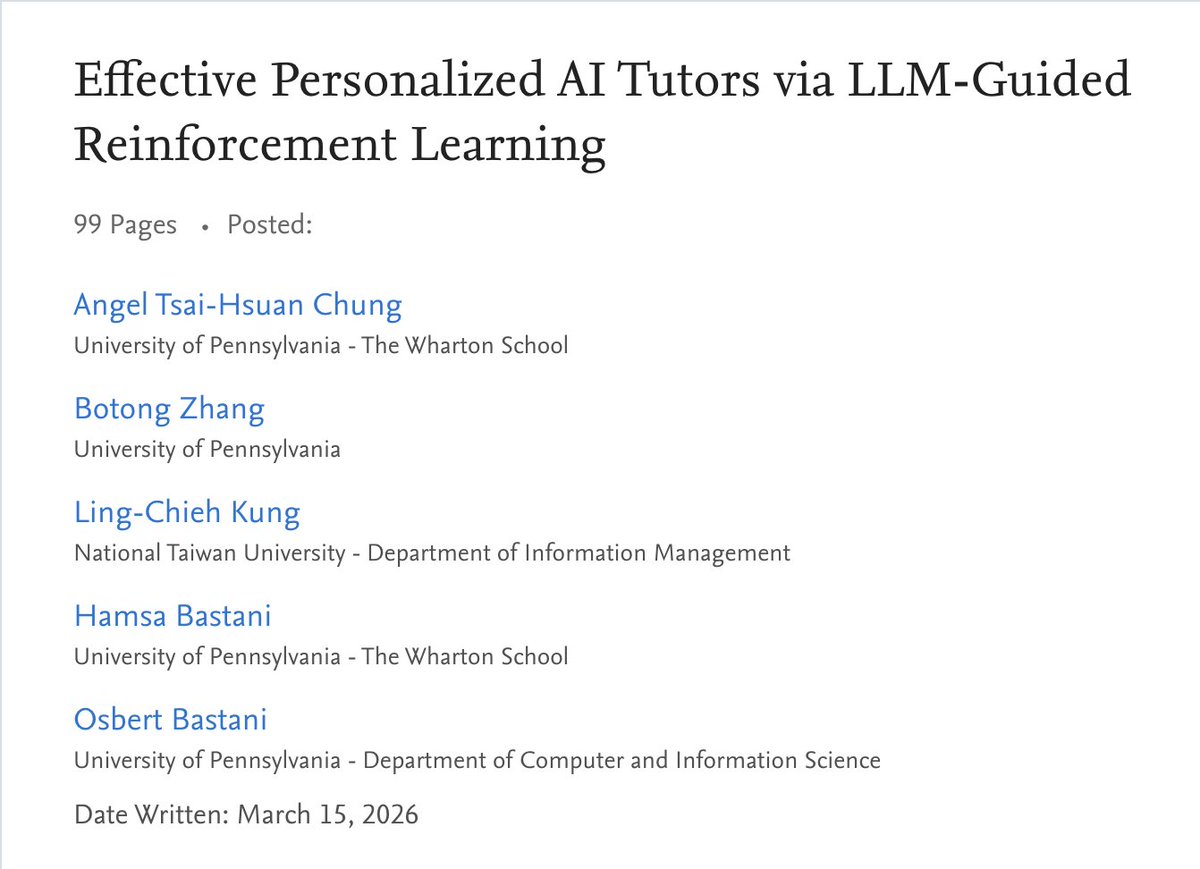
🚨🚨 Excited to share our first *positive* results on AI in education!
Most AI tutor work focuses on making the chatbot better. We suggest another lever: deciding what students should practice next to improve learning.
We combine an LLM tutor with reinforcement learning to personalize problem sequencing using signals from student-chatbot interactions and solution attempts.
We tested this in a 5-month randomized field experiment in a Python course across 10 high schools in Taipei. All students had the same course material and the same AI tutor. The only difference was adaptive vs. fixed problem sequencing.
Result: across 770 students, adaptive sequencing improved performance on an in-person final exam taken without AI assistance by 0.15 SD, with larger effects for beginners. Our evidence suggests the gains came from stronger engagement and more productive AI use.
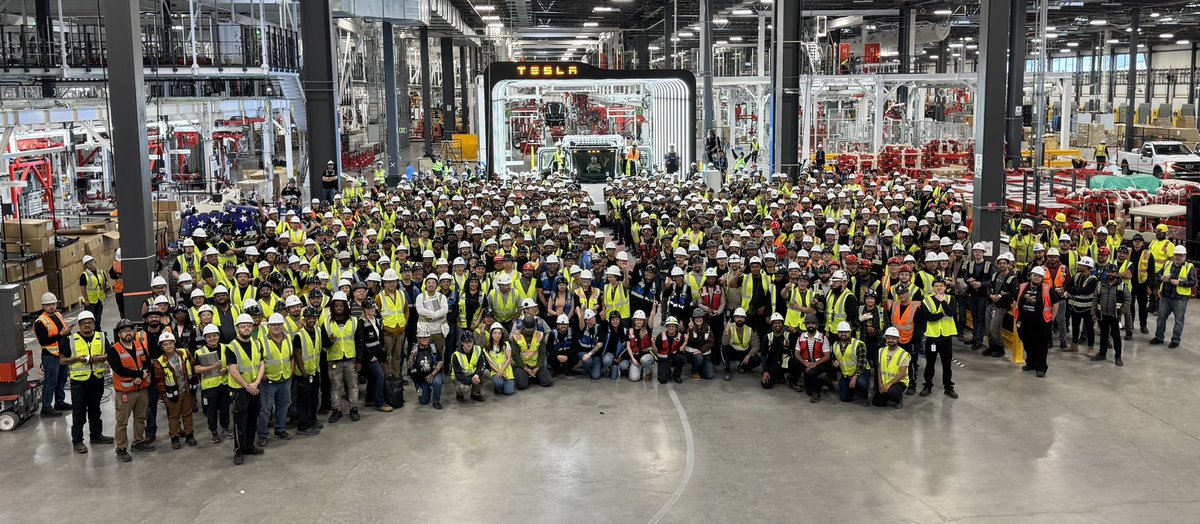
Tesla cut its Gigacasting processing time from 180 seconds to 75 seconds - nearly 60% faster 💡
The Model Y Juniper rear casting weighs approximately 60 kg, down from 67 kg on the previous generation - a 7 kg reduction through incremental design improvements.
But the processing time improvement is the real story.
How?
Conformal cooling. Complex water channels drilled or 3D-printed inside the die steel cool hot spots rapidly and evenly across the entire casting. This accelerates solidification, improves microstructure, and improves mechanical properties.
The result is a casting that is lighter, stronger, and produced in less than half the time.
Add to that:
-> Close collaboration between casting designers, die designers, production team and safety team
-> Engineering teams from 3 continents, all running Gigacasting in very high volume
-> Advanced software controlling every injection parameter
-> Optimized runner and gate design refined through five years of iteration since 2020
Tesla's manufacturing advantage isn't the Giga Press itself. It's knowing how to run it - and having five years of compounding process knowledge that no competitor can shortcut.
🎞️ Credit: Atomic Industries - Aaron Slodov
❌ Don't leave your insights to chance with the X algorithm
✅ Subscribe for free to my weekly newsletter about all things Gigacasting and magnesium Thixomolding: https://t.co/dNqB8sgbXo 📬
📊 The Gigacasting Database: https://t.co/rfetcMQP5Y
Australian tech entrepreneur Paul Conyngham explains how he used ChatGPT/AlphaFold (spent $3,000 with no biology background) to create a custom MRNA vaccine to treat his dog’s cancer tumors. Unreal.
For anyone wondering how a third-grader can complete six years' worth of math in a single year.
This knowledge graph spans 3,000 math topics, from 4th grade to the university level, providing the perfect basis for mastery learning.
Students can go as fast or far as they want! There are no restrictions whatsoever. The only requirement is that they must demonstrate mastery of each topic before moving on to the next.
Kids are capable of incredible things when given that kind of freedom and support.
Whoop has 800 employees today and just announced plans to grow headcount +600 this year. Investing in talent AND ai tools not mutually exclusive.
Many of these “AI layoffs” are just companies under performing or lacking a bigger market opportunity.
Everyone treats dwell time and heatmaps as insight, but they’re really just surface-level outputs that miss the point. What retailers actually want are actionable insights to improve space design, run smarter operations, and provide meaningful human support in the moments that matter.
You close that gap by understanding behavior more granularly: when attention turns into pickup, pickup into basket, and how quickly decisions happen between those steps.
If you’re curious how we approach this at AiFi, the link is in the comments.