@_erika_dona@gsxej@biorxivpreprint With this atlas in place, we mapped sex differences in the atlas and adult connectomes, identifying female-specific apoptosis and transcriptional divergence as drivers of sexually dimorphic development. 7/8
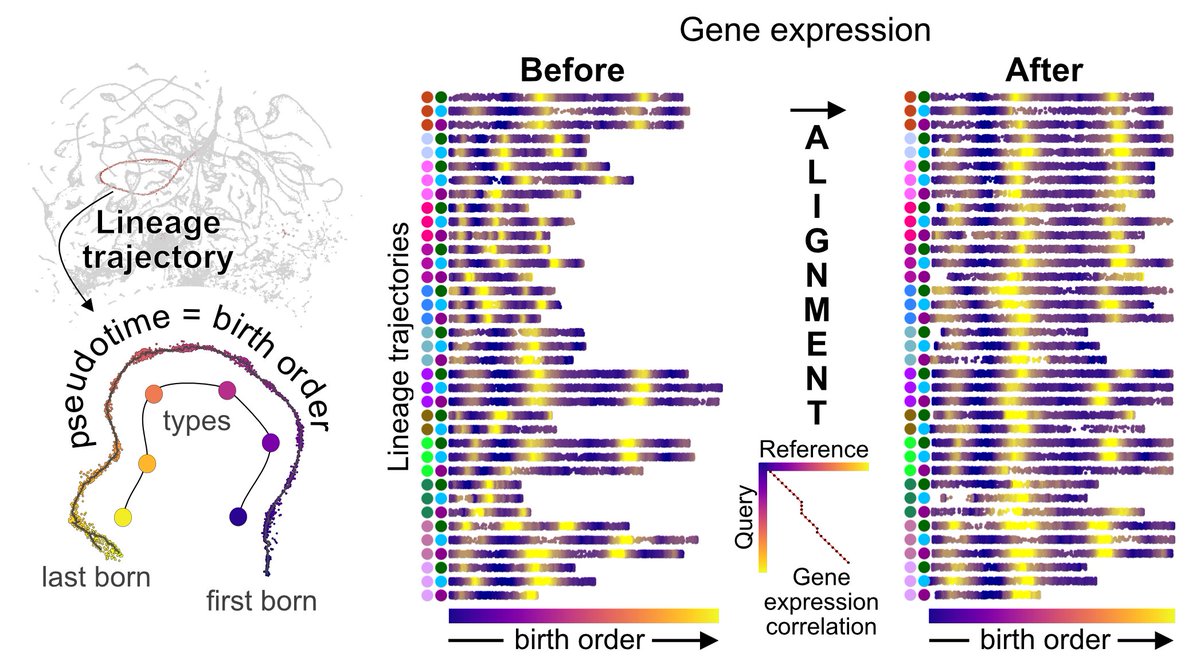
@_erika_dona@gsxej@biorxivpreprint Late born neurons from each lineage form trajectories, with consecutively born neuron types arranged by birth order. By aligning 83 such trajectories, we directly compared how expression dynamics unfold across lineages. 5/8
@gsxej@_erika_dona@biorxivpreprint With unprecedented 38× coverage, our atlas resolves single neuron clusters and shows that separate waves of neurogenesis use different modes of molecular identity encoding: discrete in early born and continuous in late born. 3/8
So proud of @istvan_taisz and @GaliliDana for this elegant and rich scientific story that finally links sex pheromone circuits to dimorphic behaviour in #Drosophila. And a lovely 🧵 to boot. Read and enjoy!
@sfrechter@as_bates@gsxej After almost 10y #BAcTrace works well, but 1) you need a LexA driver for your receiver (upstream) neurons 2) high sensitivity means you will get a BAcTrace signal in neurons that express both the receiver and donor constructs – even if the overlap is at very low levels. 8/11
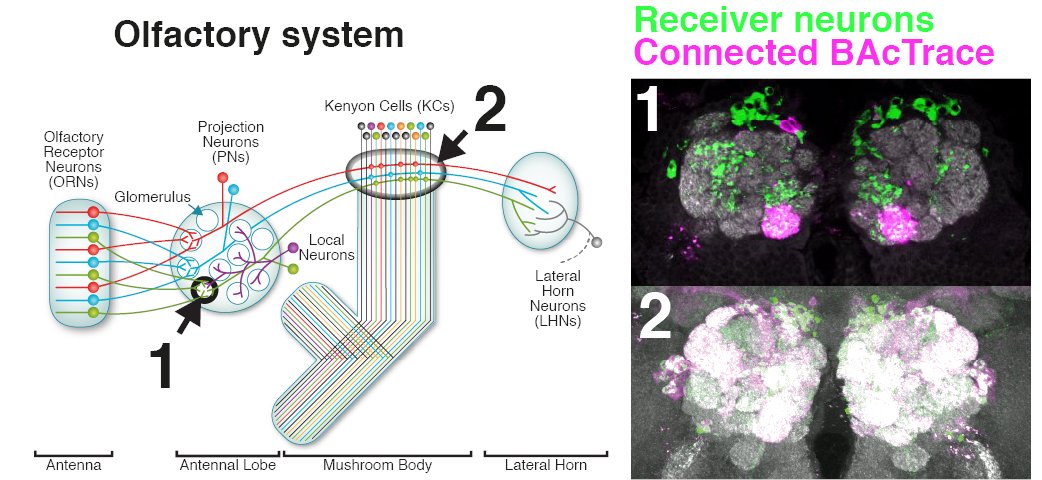
@gsxej We first validated #BAcTrace in two well characterised connections in the fly olfactory system. One was weak but stereotyped and highly selective (ORN-PN), the other is strong but characterised by random convergence of multiple cell types onto downstream neurons (PN-KC). 5/11
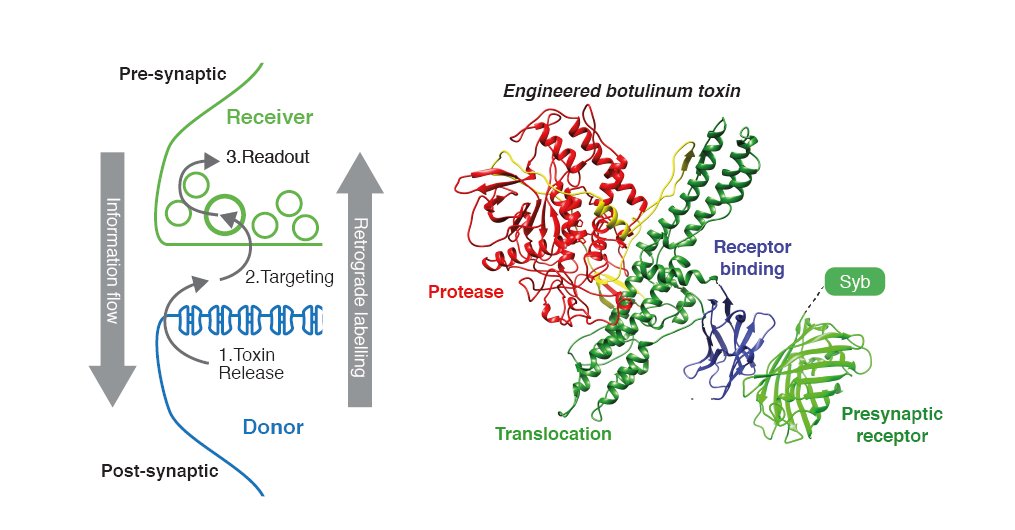
@gsxej In #BAcTrace one genetic driver defines a *donor* population expressing an engineered C. botulinum neurotoxin (aka #botox!). This jumps backwards across the synapse to *receiver* neurons. The botox then releases a tethered transcription factor in the connected cells. 4/11