One reason why so many high achievers are unhappy: their expectations rise faster than their accomplishments.
Success is most satisfying when you have high aspirations but modest expectations.
You can set ambitious goals without taking it for granted that you'll attain them.
Garantizar los derechos básicos tiene un costo.
Un ajuste hecho solo por el lado del gasto, recaerá tarde o temprano sobre cosas que necesitamos.
Lamento que el país siga sacrificando recursos preciosos por mantener exenciones que benefician a quienes tienen la mayor capacidad de aportar y por negarse a pilotear esquemas de devolución o exclusión de pago para las personas de menores ingresos.
Les dejo mi columna de hoy en @ELTIEMPO
https://t.co/sxlcGKa1gW
🎙️👖 ¡Arrancamos la segunda temporada de LíderJeans y se viene buenísima!
Estrenamos nuestro primer episodio con Alejandra Botero Barco @aleboterob , con quien tuvimos una conversación muy interesante sobre los retos de construir un Estado más capaz y una mejor gestión pública en Colombia.
Hablamos de capacidad institucional, catastro multipropósito, los desafíos de transformar las organizaciones públicas y de cómo, desde la gestión pública, podemos contribuir a construir un nuevo país.
También conversamos sobre Virgilio Barco, su legado y las lecciones que deja para pensar el liderazgo y el servicio público en Colombia.
En esta segunda temporada, Mauxy González @Mauxy_G@tefomontoya@MauricioMGC y yo seguiremos conversando con personas que, desde diferentes espacios, han contribuido a transformar lo público. Queremos conocer sus historias, experiencias, aprendizajes y, sobre todo, sus ideas sobre cómo mejorar la gestión pública en nuestro país.
🎧 ¡Ya pueden escuchar y ver nuestro primer episodio!
▶️ YouTube: https://t.co/87tJWVBYN1
🎙️ Spotify: https://t.co/c3mlxgqdvA
¡Los invitamos a acompañarnos en esta nueva temporada de LíderJeans: Liderazgo y Gerencia Pública, un proyecto conjunto de la Universidad EAFIT con appyo de @universidad_icesi ! @eafit@feg_eafit
#LíderJeans #GestiónPública #LiderazgoPúblico #AdministraciónPública #Colombia
1/ ¿Y si usted tuviera que decidir la reforma del IVA? Congresistas y colegas me pidieron una herramienta para eso. Aquí está: escoja qué paga IVA y cómo se devuelve, y vea en segundos cuánto se recauda y a quién le toca. 🧵
https://t.co/VIMjfoJeED
1/5 ¿Puede un subsidio temporal a la nómina crear empleo formal que dure años? 🤔
En esta publicación lo estudiamos para 🇨🇴. En 2021, el PAEF pagó a empresas con menos de 50 trabajadores el 40% de un salario mínimo por empleado, a casi 50k empresas (nóminas de mayo a diciembre).
Hoy traemos #DelArchivoTREES la #SegundaParte de este Café. 👦🏽👧🏾👦🏻
Abordar las desigualdades en la primera infancia significa reconocer que miles de niños y niñas crecen en condiciones que afectan su desarrollo y generan brechas sociales desde sus primeros años.
En esta segunda parte del Café “Desigualdades y primera infancia”, @Andr3sMoya, profesor de la @EconomiaUAndes y director de @semillasdeapego, un programa psicosocial comunitario que promueve la salud mental y el desarrollo de la primera infancia, explica cómo esta iniciativa apoya a familias en contextos vulnerables, con el objetivo de romper la transmisión intergeneracional del trauma causado por el conflicto armado, el desplazamiento, la migración forzada, y otras adversidades.
1/ La Ley de Rescate tiene el tamaño que pide el problema fiscal y una buena idea central: cobrar IVA a más productos y devolverles ese impuesto a los hogares pobres y vulnerables.
También tiene debilidades que el Congreso puede corregir sin quitarle lo esencial
1/6 🧵 Apuntes sobre la Ley de Rescate Fiscal:
El tamaño del ajuste y que se reparta en cuatro años luce apropiado. Los cambios legislativos no deberían alterar ese balance. Ese debería ser el objetivo central de la discusión en el Congreso.
1/ Ahora que Colombia discute la Ley de Rescate Económico, recomiendo mi artículo “Colombia’s Missing Fiscal Pact” (Economía, 25(1), 2026). La pregunta: ¿por qué un país que necesita un Estado más capaz terminó con un sistema tributario complejo, inestable y muy evadido? 🧵 ↓
El episodio de las trompetas de Niche en la plazoleta Jairo Varela refleja los enormes retos de capacidad de nuestra administración pública local en Cali. ¿El monumento pertenece a un privado?. ¿Cómo un particular se beneficia del espacio público, o lo usa, y el Estado, o sea todos, tenemos que sostenerlo y aceptar su comercialización y uso como merchandising como en este caso?
Surgen otras preguntas: ¿cómo se permitió esa figura de propiedad privada del monumento ? ¿Por qué no se consideraron otras opciones como comprar la pieza? Y, específicamente en este rosado insuceso, ¿cómo y dónde se permitió una idea tan poco razonable como cambiarles el color a las trompetas y ponerles logos comerciales? Es la narrativa de ciudad, es nuestra identidad y a nadie parece importarle. Los símbolos importan y se cuidan. En otros lugares difícilmente permitirían algo así.
Todo esto desnuda las enormes debilidades y brechas de capacidad institucional y de administración que tiene Cali. Y ojo esto no es de este gobierno, es una acumulación de ausencia de reformas, el pandémico clientelismo, la politiquería y precariedad en la gestión pública de Cali por décadas. Estamos años luz de la envidiable capacidad de administración pública de una ciudad como Medellín y de su bellísima valoración por lo público, e incluso lejos de ciudades con problemáticas complejas como Bogotá, Barranquilla y hasta de Bucaramanga o Cartagena.
Aquí no tenemos capacidad de “enforcement” para hacer cumplir las reglas y las normas. Los semáforos duran días dañados y a nadie parece importarle. Los conductores de carros y motos no respetan semáforos, peatones, andenes, ni normas de tránsito. La iluminación de la ciudad es precaria, inconstante, pobre y oscura, comparada con otras ciudades. La movilidad es desastrosa y la mueve más el clientelismo que el servicio a la ciudad. La inseguridad es rampante y no parece haber autoridad ni estrategia. Hay invasiones a las zonas de ladera sin control. La ciudadanía caleña lucha todos los días por sobrevivir en medio del caos. Eso por mencionar solo algunos problemas que desnudan nuestra limitada capacidad estatal por décadas.
Y la coyuntura actual no es mejor. La ciudad sufrió un terremoto inédito y seguimos en una pasividad asombrosa y dolorosa, entregados al espectáculo y al discurso sin gestión, mientras muchas familias siguen esperando ayudas y respuestas.
Los retos actuales de Cali sin duda requieren liderazgo, capacidad y una reforma profunda de los procesos, las estructuras y equipamientos de nuestra administración pública. Necesitamos abrir una nueva conversación sobre el futuro de la ciudad y sobre nuestras capacidades colectivas para poder construir una nueva ciudad y hacerla sostenible.
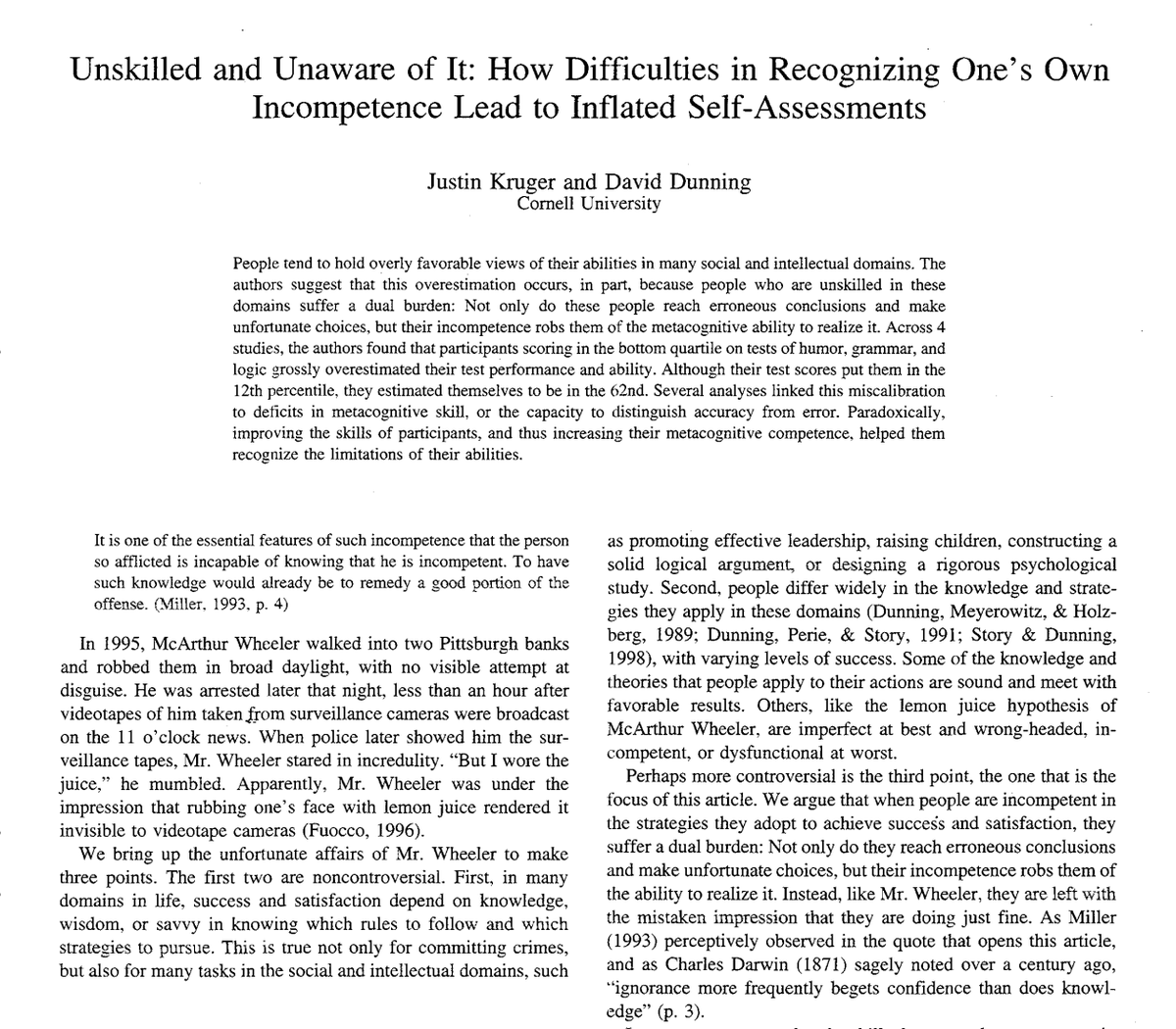
This paper answers why confident idiots run the world.
Cornell University published a psychological paper that explains every terrible boss, every loud influencer, and every broken corporate hierarchy.
It’s called “Unskilled and Unaware of It.”
they tested participants across logic, grammar, and humor to measure the gap between actual performance and self-perception.
And the results are wild.
participants scoring in the bottom 12th percentile consistently believed they were operating in the 62nd percentile.
they were not lying. they were literally incapable of recognizing their own incompetence.
the paper revealed a brutal paradox:
the exact skills required to master a domain are the exact same skills required to accurately evaluate your own competence in that domain.
if you lack the skill, you inherently lack the cognitive capacity to realize you are failing.
this creates a dangerous systemic loop.
the incompetent are blessed with absolute, blinding certainty. their brain protects them from their own ignorance, allowing them to speak first, demand authority, and never second-guess their decisions.
meanwhile, the actual experts suffer the exact inverse.
top performers in the study consistently underestimated their rank. because a task was easy for them, they falsely assumed it was easy for everyone else.
they hesitate. they obsess over nuance. they assume they have nothing unique to add.
we are biologically wired to confuse confidence with competence.
the loudest person in the room gets promoted, gets funded, and gets the microphone, not because they know what they are doing, but because they are physically incapable of seeing what they don't.
the only defense mechanism is building systems that stop rewarding absolute certainty and start demanding proof of work.
La actividad económica en Colombia registró una contracción anual de 0,04% en agosto de 2026, según el Indicador de Seguimiento a la Economía, ISE, publicado por el Dane. El resultado estuvo marcado por el desempeño negativo de las actividades primarias y secundarias https://t.co/ltiVXBfZXA
@andresvecino Entiendo el punto de la austeridad, pero es útil que cuente con un jet privado, su rol implica toma de decisiones críticas para un Estado. El costo de oportunidad es muy alto por querer mostrarse mundano.
La columna de @andrescarob sobre la polémica de los museos me parece extraordinaria.
Y en línea con su propio espíritu, diría que concuerdo con ella en un 99%:
https://t.co/kUpzZ5Qt5C
Why AI is not all bad news for most mathematicians
On October 6, 2026, OpenAI released hundreds of mathematical preprints. And while these results are still being evaluated, the news caused shockwaves. Some celebrated it while others warned of a mathspocalypse. But these early reactions may be a bit exaggerated. This is not to deny that AI is disrupting math research, but to question whether that disruption extends to the much larger community of people trained in mathematics. My point here is that much of what we associate with mathematics is here to stay, because the vast majority of people trained in mathematics do not operate at the frontier, and that this is a good thing.
To make my point, I’ll start with a Formula One (F1) racing analogy. F1 is the frontier. It pushes the boundaries of what is possible with exceptional drivers and technology. And because of this, it gets well-deserved attention. But F1 is not transportation.
Most professional drivers are not in F1. They drive buses, taxis, and trucks. Their job is not to show us the limit of what cars can do, but to transport children safely to school, deliver products without breaking them, and help billions of people get to work every morning. F1 is exciting, but the world keeps moving because of the millions of drivers that do not operate at the frontier.
Imagine the arrival of an alien civilization with better F1 vehicles and drivers. The aliens are so advanced that no human ever wins a Formula One race again. This would certainly change Formula One. But would it mean that the majority of professional drivers would have lost their purpose?
I don’t think so.
The morning after the race children would still need to get to school, and goods would still need to get delivered. Because the value of those activities was not derived from performance at the frontier.
Now, you might say that trucks and taxis are also bound to disappear, because AI will drive them too. But here is where the analogy breaks. Research mathematicians, mathematics educators, and professionals trained in mathematics are not the same thing. Yet they are all part of a larger mathematical ecosystem whose value comes not only from discovering new mathematics, but also from teaching, understanding, and applying what we already know.
Consider a math teacher at a K-12 school or at a local university. What I appreciate from the math teachers at my daughter's school, or from those who taught me during my education, is not that they are trying to solve the Riemann hypothesis, but their ability to help us understand math, from adding fractions to solving partial differential equations.
A good math teacher is not a machine of correct answers. They are responsible for creating a social environment in which mathematical understanding can develop, even for a thirteen-year-old that would prefer to be doing anything other than learning math. And this is an activity of enormous value. How valuable? Imagine having to choose between a world where no new frontier math is developed for the next ten years and a world where children between the ages of 6 and 16 no longer receive math education. The first one would be lamentable. The second would be catastrophic. There is nobility in recognizing the value that happens outside the frontier.
And this is true also for universities and professional practices. While frontier mathematicians compete to prove new theorems, others teach math to physicists, economists, engineers, and countless other students pursuing careers that require quantitative reasoning. In a professional practice, you want an engineer responsible for a bridge to have a good understanding of how stress is calculated on a structure, even when the calculations are performed by software or AI.
The point is that the social value of mathematics is not derived exclusively from advancing the frontier. Much of that value rests on the shoulders of millions of people who teach, practice, and apply mathematics. This is why the idea of a mathematical apocalypse is misleading: it confuses visibility with value. It reduces an entire discipline to the highly visible activity of solving difficult new problems. And of course, we want to keep that going, just like we would not like to eliminate Formula One. But my intuition is that many frontier mathematicians will be supercharged by AI. They will be human drivers on alien cars. But for the millions of people who are not pursuing the frontier, the core of their value doesn’t change. We should not confuse what’s spectacular with what is valuable.
Academic prestige tends to accumulate around frontier achievements. But the mathematician who introduced thousands of students to calculus over a career may have a larger overall impact on society. These are not consolation prizes, but achievements that keep the world working. AI is already solving difficult mathematical problems that have challenged some of the world's most talented mathematicians. But our world still needs millions of mathematicians, and billions of people with a good understanding of math. Because math is not just a race to solve the hardest problems, but a way of thinking that we pass from generation to generation.
https://t.co/pIzCYmK1It
🆕 Evidence-based policy: Why one good trial isn't enough 📢
Today on VoxDevTalks w/ @timsvengali, Chris Cotton (@queensuecon) discusses why one good study is not enough for confident policymaking, and how a new four-level evidence scale helps: https://t.co/8Ntd4AwQPz
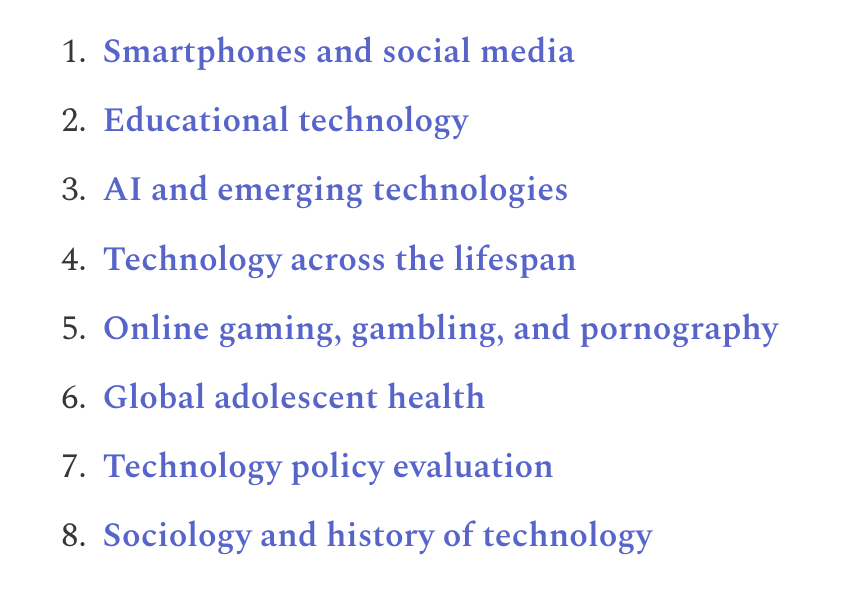
At the Tech and Society Lab at NYU-Stern, we have been studying the effects of many kinds of technology on kids & teens.
For the first time, we have posted all of our academic publications, tools, and data-related essays in one place. Start here:
https://t.co/BJkOoTbvso