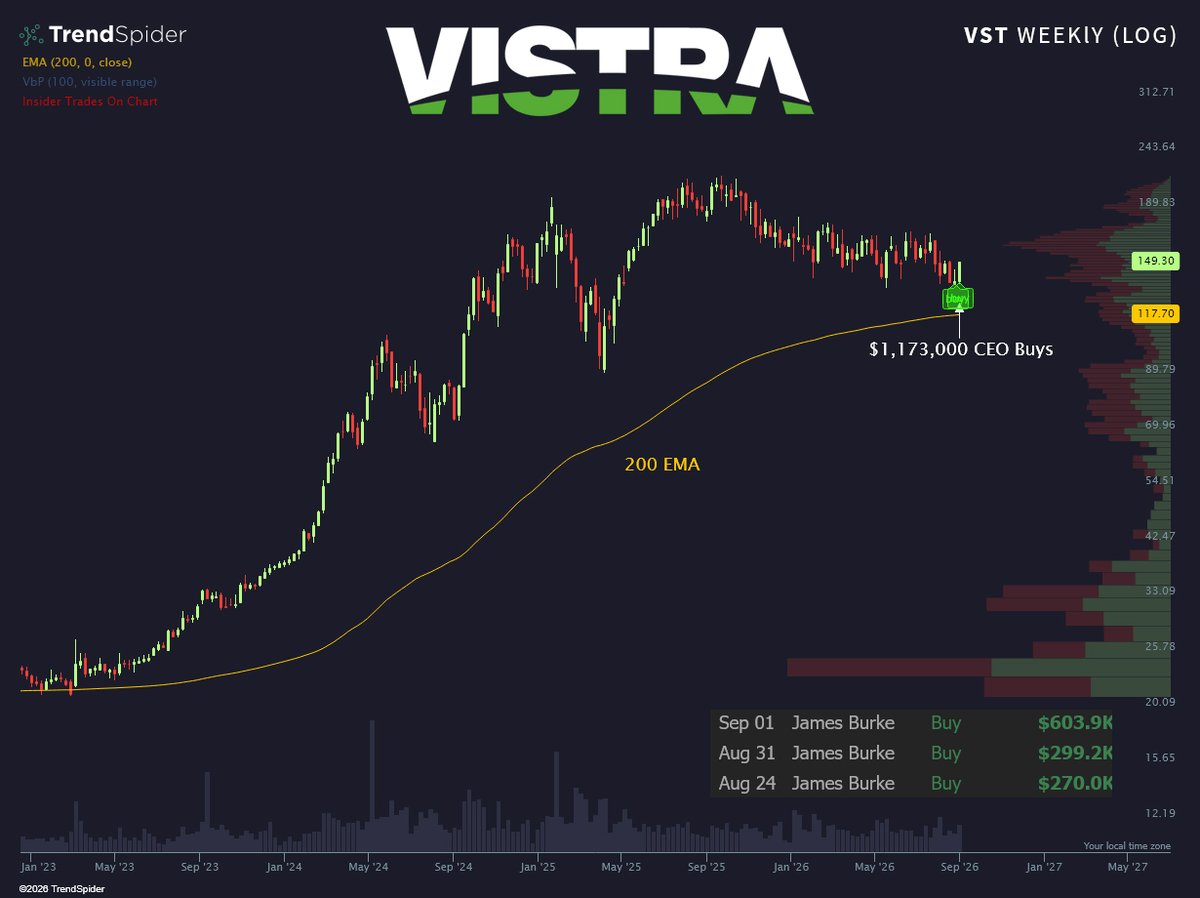
NANCY PELOSI ABSOLUTELY DOES NOT MISS
Her husband bought millions of dollars of Bloom Energy $BE deep ITM
Weeks later $BE is being added to the SP500.
Ripped 15% on the news.
And this is where it gets insane:
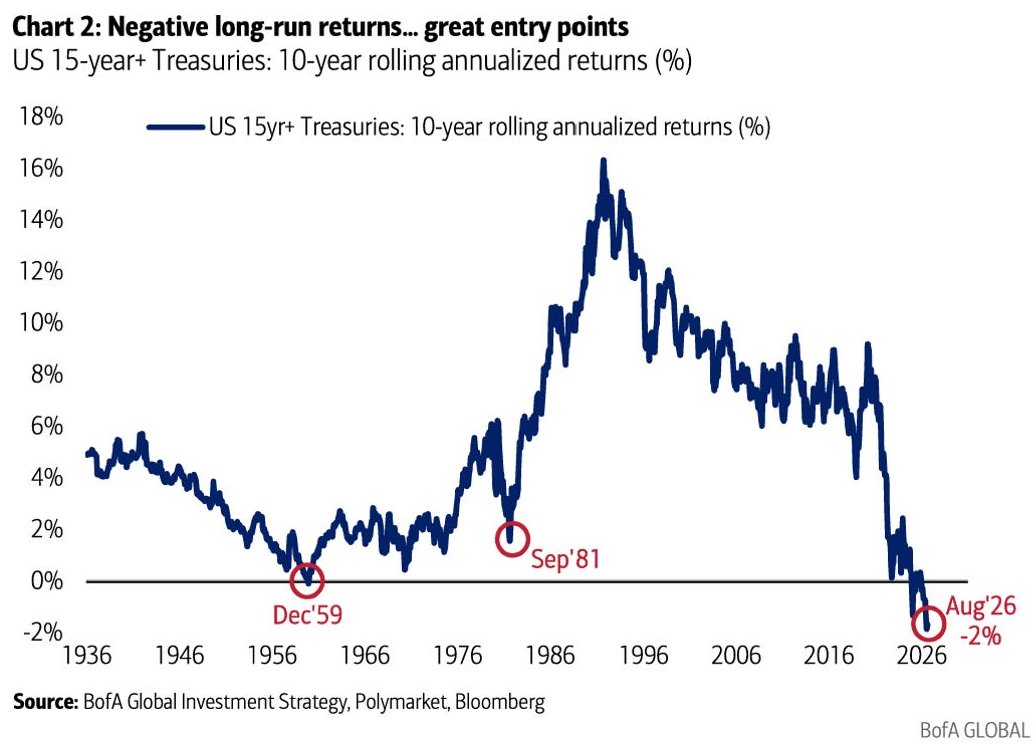
BofA's Hartnett notes the 10-year rolling return from 15+ year Treasuries is "-2% (worst of past 100 years)," but that "negative long-run returns" have proven "great entry points for stocks in 1939, 1974, 2009, commodities in 1933, 2018;"
He says while "US midterms [will not be a] 'regime change' election like Thatcher/Reagan ’80, BREXIT/Trump ’16, Fed hike, UST buybacks, rising risk midterms show voter priority [is] 'affordability' not lower taxes, faster AI data center expansion..."
That makes "Q4 yields [a] good contrarian play."
OIL
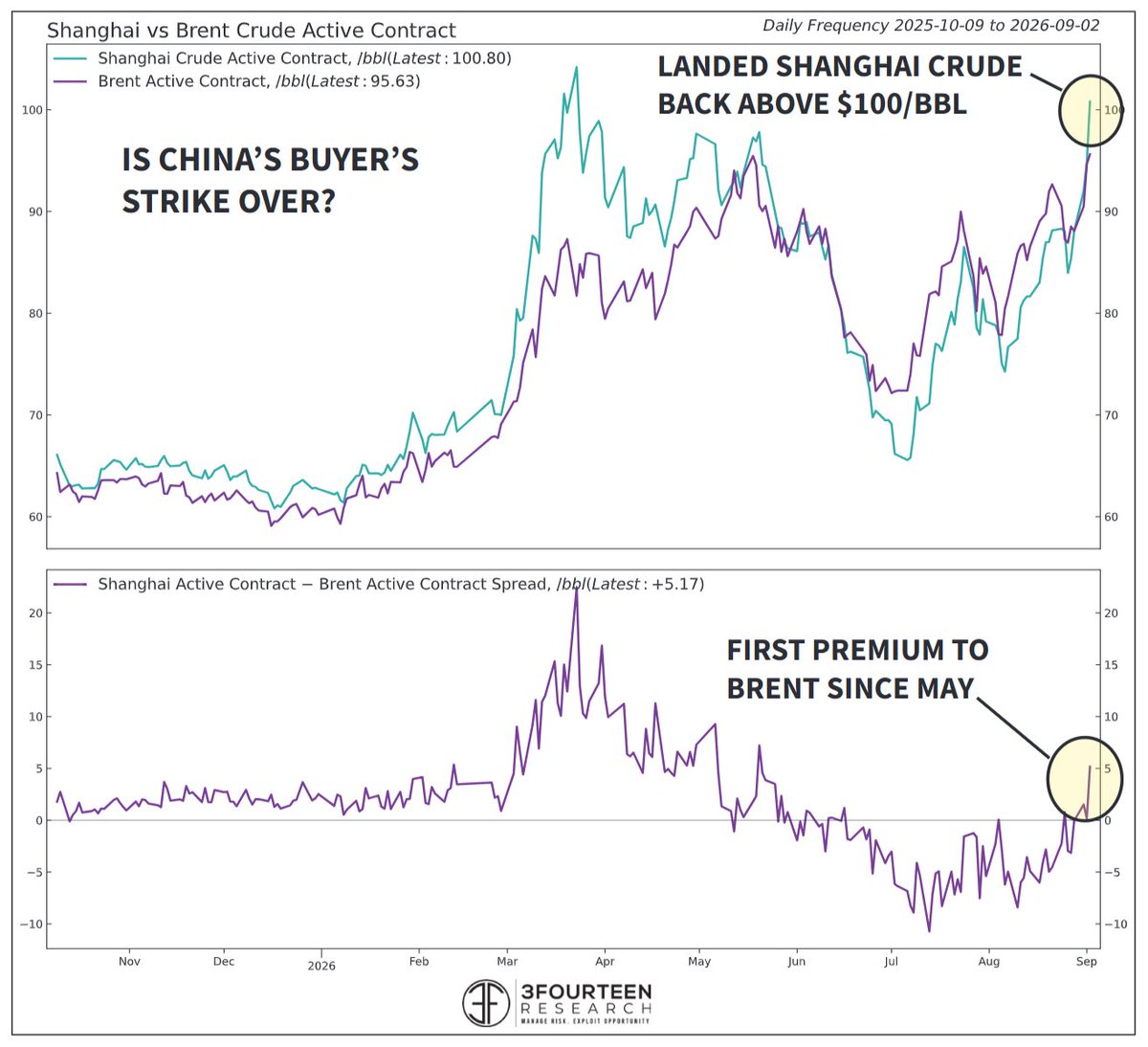
Shanghai crude futures above Brent Crude for the first time since May.
China's buyer strike has been the most important reason oil prices have remained subdued during the Iran War.
It seems China is buying again now...
Copper at Risk of Rare Supply Decline as Mine Setbacks Mount
A string of disappointing results is undermining expectations that global mine supply would post at least modest growth this year. International Copper Study Group data show output fell 1.1% in the first half, with major producers Codelco and Freeport-McMoRan Inc. posting double-digit declines. Morgan Stanley, which entered the year expecting mine supply to expand, now sees it little changed or slightly lower, raising the prospect of the first annual decline since 2017.
That would be a striking outcome — copper trading near record highs should encourage miners to maximize output. Deteriorating ore quality, accidents, project setbacks and extreme weather are frustrating those efforts, and fueling concerns about whether supply can keep pace with demand as electrification gathers pace over the coming years. (Bloomberg)
P.S. I wrote a substack post on this on June 1 (link in bio)
📖 PUBLICATION DAY
Today a book I've spent 2yrs working on is finally out.
I'll have more to say about it later on, but TRADE WORLD is a brand new story about the hidden underbelly of the modern world.
A sort of companion to Material World. But SO much more.
I hope you like it!
🟠Morgen beschließt das Kabinett den Entwurf von Finanzminister Lars Klingbeil (SPD) zum Einkommensteuerreformgesetz.
🟠Heute lässt Wirtschaftsministerin Katherina Reiche (CDU) per Brief durch einen Staatssekretär mitteilen, was sie davon hält:
➡️"Die aktuelle Bundesregierung wäre die erste Bundesregierung seit 2015, die keinen vollständigen Abbau der kalten Progression gesetzlich veranlasst. Ergebnis ist eine inflationsbedingte heimliche Steuererhöhung."
Bitte als Quelle verwenden: Machtwechsel-Podcast
Had the pleasure of joining @cvpayne at Fox this afternoon. Thanks for having me, Charles - always a big pleasure.
The consensus take now seems to be: “bad for risk assets, rate hikes coming.” after Jackson Hole.
I’m not so sure much changed on Friday.
Warsh wasn’t the productivity dove I had hoped for, and the market now treats a September hike as the base case. Apparently, everyone suddenly thinks the man who refuses to give forward guidance just forward-guided a hike… lol.
But run the language through a quant lens, and something important stands out.. He did NOT set a new hawkish peak. That was my main message.
Analysts collectively expect S&P 500 earnings to compound at ~24% annually for five years, roughly double their historical norm.
The current spike is higher than any prior point in the 40-year series, including the Dot Com peak of ~19% around 2000–2001 and the 2020/21 Meme Stock peak ~24%.
It's a sentiment indicator, not a forecast you should trust. Analysts are notoriously bad at five-year earnings projections, and the estimates tend to be most wrong precisely when they're most extreme. A 24% sustained growth rate for the entire index is historically very rare to actually deliver.
🚨 BREAKING NEWS! The engineer who created Claude Code from scratch just released a 28-minute video that's pure gold:
how to write prompts that actually deliver ridiculously good results.
I've seen $300 courses that don't even come close to what he explains in the first 10 minutes.
CLAUDE.md files, memory shortcuts, parallel sessions, and prompting patterns that almost no one uses...
All in one single video. Completely free. No fluff.
Whether you're a developer, just starting out, or already been using Claude for months: this changes the game for you starting today.
Save. Watch. Share.
Ed Zitron @edzitron went on The Compound and Friends @TheCompoundNews this week and Josh and Michael gave him 90 minutes to lay out the full AI bear case. I went through 37 of his claims with the filings open. By my count 19 are wrong or unfalsifiable, 12 are half right and 6 are fair. Here’s the breakdown.
Disclosure first. I’m long $NVDA $META $AMZN $GOOGL $ORCL $CRWV $AVGO $PLTR $AAPL $MSFT. I’m obviously talking my book and Ed would be the first to point that out which is exactly why every number below ties back to a filing or a company disclosure you can pull up yourself. Ed taped this on August 27th which was the day after NVIDIA reported its Q2 of fiscal 2027 so I’m using those numbers and the 10-Q that came with them.
I want to give Ed credit because he did the work on OpenAI’s audited financials and a lot of his numbers hold up. OpenAI lost $20.9 billion in 2025 on $13.07 billion of revenue. Oracle and CoreWeave are levered. Abilene is late. Private credit is the contagion channel nobody can size from the outside and margin debt hit a record in June. None of that is made up and I think about every one of those risks every day I’m in these names. My problem was never his numbers. It’s what he does with them and what he leaves out.
Back in 2023 nobody could tell Ed how much money AI actually made and the hyperscalers wouldn’t break out AI revenue. That was a fair complaint in November 2023. It isn’t one anymore. Microsoft disclosed in its 10-K that it booked $24.1 billion of revenue from OpenAI in fiscal 2026. Amazon said its AI business and its custom chip business each run above $25 billion a year and both are growing triple digits. Google Cloud grew 82% YoY to $24.8 billion. Anthropic told investors it’s at a $65 billion run rate with booked Q2 revenue above $11.5 billion. The question Ed built his whole newsletter around got answered. So the argument has quietly shifted to whether those numbers should count and that’s a much weaker hill to fight on.
His biggest claim is that the demand is illusory. He says OpenAI and Anthropic take up 90% of AI infrastructure, that the banks have about $440 billion of cloud revenue coming from two unprofitable startups that need ten times the demand they have today and that by his own estimate there’s only about $22 billion of real compute demand outside the labs.
Take the $22 billion first. Amazon says its AI business alone runs above $25 billion a year so one company’s disclosure is already bigger than Ed’s number for the entire industry. Microsoft said its commercial backlog grew 25% with OpenAI stripped out and that the entire $51 billion sequential increase came from customers outside the frontier labs. Add up the contracted backlogs at Microsoft, Oracle, Google, Amazon and CoreWeave and you get roughly $2.45 trillion. Some of that is lab commitments and I’m not pretending otherwise. But Microsoft already told you what its backlog does without OpenAI and Google says more than half of its backlog converts inside two years.
Now the $440 billion. Spread that over roughly three and a half years and it’s about $125 billion a year across all three clouds. The two labs already generate about $105 billion a year between them and compute is their biggest cost line. They don’t need ten times the demand they have today. They need to roughly double from here and keep paying their compute bills. Anthropic grew sevenfold in seven months and reported positive adjusted operating income in Q2. Two customers growing that fast is a concentration risk you have to manage. It isn’t evidence of a fraud.
Then there’s what the operators themselves said a month before Ed taped this on earnings calls where getting it wrong is a securities law problem. Amy Hood said Microsoft’s cloud revenue passed $214 billion in fiscal 2026 and nearly 90% of it came from customers outside the frontier model companies. Andy Jassy said the lion’s share of AWS capacity for 2027 is already reserved and even $220 billion of CapEx won’t cover the demand Amazon has in 2026. Sundar Pichai said existing cloud customers are running more than 50% above their commitments. Ed’s whole thesis is that these companies are building for two customers who can’t pay. All three of them told you the opposite on the record.
The segment numbers back them up. AWS went from $10.2 billion a quarter in Q1 2020 to $42.2 billion in Q2 2026. Growth accelerated for the fifth straight quarter to 36.7% and operating income was $16.6 billion at a 39.4% margin which is up 650 basis points YoY. Barclays (BCS) puts the two labs at 13% of AWS revenue this year so the other 87% of a $169 billion run rate business that just accelerated is everyone else. You don’t expand margins by 650 basis points serving two loss making customers at cost. Google Cloud did $2.8 billion in Q1 2020 and $24.8 billion in Q2 2026. Its growth rate went 32%, 34%, 48%, 63% and 82% over the past five quarters and operating income more than tripled to $8.8 billion at a 35.6% margin. Ed called Alphabet just another LLM company. A profitable AI business growing 82% on its own custom silicon with no OpenAI check behind it is the thing Ed keeps saying can’t exist and it’s sitting right there in the segment table.
Ed says Microsoft made $34.33 billion on AI in fiscal 2026 and $24.1 billion of that is OpenAI so selling AI to everyone else is a single digit billion dollar business set against $260 billion of CapEx. His word for it was disaster. Microsoft never reported $34.33 billion of AI revenue. That’s a Bloomberg estimate. The $24.1 billion is real but it includes the revenue sharing payments OpenAI makes to Microsoft and not just Azure consumption. The $260 billion is cumulative CapEx going back to early 2022 by Ed’s own count. What he left out is that Azure passed $100 billion in annual revenue and grew 43% in the June quarter which was the fastest since 2022. Even if you assume every dollar of the $24.1 billion is Azure, OpenAI is still under a quarter of it. Microsoft 365 Copilot went from 15 million paid seats in December to over 30 million in June. Commercial remaining performance obligations hit $678 billion which is up 84% YoY and still up 25% with OpenAI taken out. Microsoft earned $133.7 billion of net income and says it stays free cash flow positive in fiscal 2027 on $175 billion of CapEx. If that’s a disaster I’d like to see what Ed calls a good year.
Ed says 16% of Nvidia’s quarter was one customer and five customers make up 70% of their accounts. The 10-Q says one direct customer was 16% of revenue. A year ago two direct customers were 23% and 16% so the top of the list actually got less concentrated. The 70% has nothing to do with revenue. It’s the share of accounts receivable held by five direct customers as of July 26th. He blended two different disclosures on air. Nvidia’s direct customers are clouds and those clouds have millions of customers standing behind them.
Then GitHub Copilot. Ed says it let people burn $5,000 of tokens for $40 a month, moved to token billing on June 1st and now the business is dead. Nadella said on the July call that GitHub Copilot has 50 million users and revenue accelerated more than 60% quarter over quarter after the billing change. Ed can’t have it both ways on this one. Twelve minutes later he’s complaining that AI companies subsidize tokens and let people burn thousands of dollars of compute for $200 a month. When Microsoft stops subsidizing he calls it a rug pull. You have to pick one. He also says nothing has gotten cheaper. GPT-4 quality cost $30 per million tokens in 2023 and you can get it for under 50 cents today. Coal got cheaper too and the world burned more of it.
On OpenAI being a liability that Microsoft has to consolidate. Microsoft owns 27% of OpenAI. At the $852 billion valuation from the last round that stake is worth about $230 billion on roughly $13 billion invested. If that’s a liability I’d take a few more of them. Receivables from OpenAI were $6 billion at June 30th against $24.1 billion of annual revenue. That’s ninety days of sales. Nobody is stapling IOUs to anything.
Ed says to hit fiscal 2028 consensus Nvidia needs three to five customers to find way more debt at higher rates while it just raised prices 17% and memory costs are skyrocketing. Nvidia guided fiscal 2028 growth of 70% this week and said out loud that the guide is supply constrained while customer forecasts point to growth doubling. A bubble that’s popping doesn’t have customers asking for more than the vendor can build. The price hikes are real and the driver is a supply squeeze in high bandwidth memory. Prices fall when demand disappears. They don’t go up double digits. The hyperscalers also aren’t funding any of this with junk debt. Alphabet and Amazon generated $185.7 billion and $161.4 billion of trailing operating cash flow and their bonds are AA rated.
Michael put up Nvidia’s trailing net income passing Apple’s and Ed asked how much of it was equity gains from Anthropic, OpenAI, CoreWeave and Nebius (NBIS). Fair question. Gains on equity securities were $7.8 billion and they sit below the operating line. Operating income was $63.7 billion which on its own was bigger than Nvidia’s entire revenue in the same quarter a year earlier. That’s cash and not a mark to market.
Then the part I’d replay in slow motion if I could. Ed said he was wrong in 2024 because he was naive and assumed the market wouldn’t spend hundreds of billions for no reason. Later in the show he said he’s stopped giving timelines altogether. So the thesis has been wrong for two years and the explanation is that everyone else is stupid. When your model fails for two years the scientific move is to update the model. Ed’s move was to extend the deadline.
Ed calls run rate the biggest scam of them all. Run rate is just the latest period’s revenue annualized and Bloomberg defined it exactly that way in the same article Ed was criticizing. But fine. Use the booked numbers. Anthropic disclosed Q2 revenue above $11.5 billion. That’s one quarter, it’s booked and it’s fourteen times the year ago quarter. His recurring revenue argument is backwards too. AWS is consumption revenue. Wall Street pays premium multiples for consumption businesses because usage that’s embedded in a workflow is stickier than a seat license somebody forgets to cancel. If you want contracted revenue Microsoft reports $678 billion of it, Google has $514 billion and Amazon has $496 billion. Those are signed contracts and not annualized months.
On the lenders being idiots. Ed cites a report that Blue Owl (OWL) agreed to invest in Stargate Abilene in ten minutes. The hosts pushed back on that in real time and I would have too. The Abilene financing was a $15 billion joint venture with a $7.1 billion construction loan led by JPMorgan (JPM). Banks with actual syndication desks did the underwriting. I’ll concede the schedule to him. Buildings three and four are months late. A construction project running late is a construction project running late. It isn’t a solvency event.
Ed says every AI startup loses money and when customers see the real cost of tokens they shrivel away. Airbnb (ABNB) is the cleanest counterexample I can think of and it happened two weeks ago. Brian Chesky said the company will spend a lot more on AI tokens this year than it forecast because the ROI is there. Support cost per booking fell 16% YoY with the AI assistant resolving 45% of the issues it starts. Anthropic’s run rate went up after it moved enterprise customers to per token pricing which is the exact event Ed says should have collapsed demand. Ramp’s spend data says 43.5% of US businesses paid for Anthropic products in July, up from 9% in May of last year. If the real cost of tokens were driving people away the adoption curve would be bending the other way.
Ed cites a blog post arguing most AI integrations fail and executives adopt out of fear. I’ll believe the Census Bureau over a blog post as its May 2026 survey indicated that 19.8% of US businesses use AI in a business function. It also said that 37% of firms with 250 or more employees use AI in a business function and 43% of American workers reported that they use generative AI for work. Microsoft sold 10 million Copilot seats in a single quarter and it’s hard to believe that ten million seats would be sold if AI integrations were failing. Flip the Census number around and 80% of US businesses still haven’t adopted AI in any function. I don’t read that as a failed rollout. I read it as runway.
Ed says Microsoft, Google, Meta and Amazon are all slowing and the only companies growing are the ones getting checks from the labs. Google Cloud grew 82%. Azure grew 43%. AWS grew 37%. Meta grew 28% with no lab money at all. He said Meta didn’t grow like gangbusters and the Q3 guide proves the slowdown is here. Meta’s Q2 revenue was $60.8 billion which was up 28% YoY after 33% in Q1. Ad impressions grew 14% and price per ad grew 12%. The Q3 guide of $61 to $64 billion against $51.2 billion a year earlier works out to 19% to 25% growth. So the slowdown Ed is describing is a company growing more than 20% on a $250 billion revenue base. Meta’s cloud didn’t grow like Microsoft’s because Meta doesn’t sell cloud. It’s an ad company and a 12% higher price per ad is what AI ranking looks like when it shows up in the numbers.
Ed says OpenAI’s actual numbers are bad. They are and I’m not going to pretend otherwise. But OpenAI lost $2.37 for every dollar of revenue in 2024, $1.60 in 2025 and $1.22 in Q1 2026. The losses are shrinking as a share of sales while revenue triples. OpenAI is the weakest link in the entire AI trade and I’d say that on any stream. The difference between me and Ed is that I think the IPO is the test and he thinks the test can’t be passed.
Now the claim Ed comes back to over and over for the whole interview. OpenAI and Anthropic are unprofitable startups that need to constantly raise money, they can’t pay for this out of cash flow and it all comes down to when the money runs out. Every word of that assumes these two are financed the way CoreWeave or Oracle are financed. Borrow, burn and default when the coupon comes due. They aren’t. Neither OpenAI nor Anthropic has issued a bond. Neither has a term loan. The Information reviewed OpenAI’s financials as of March 31st and reported zero debt. OpenAI’s only bank facility is a $4.7 billion revolver that was undrawn when the March round closed. Anthropic has a $2.5 billion revolver and is arranging a bigger one ahead of the IPO which is the same thing SpaceX (SPCX) did before it listed.
What they have instead is equity. Roughly $180 billion raised by OpenAI and roughly $130 billion by Anthropic and all of it came from investors who bought shares. Equity has no maturity date and no interest payment. Nobody at OpenAI wires a coupon to SoftBank (SFTBY) every quarter. Every one of those rounds was also raised with the stated purpose of spending it. The investors funded the burn on purpose because the burn is what buys the growth. So the question Ed keeps asking about when revenue recaptures the spending is the wrong question for an equity funded company. Anthropic’s Series E investors paid a $61.5 billion valuation in March of last year. The Series H in May was $65 billion at a $965 billion valuation. That’s more than fifteen times in fourteen months. OpenAI went from $157 billion in October 2024 to $852 billion in March. Those are the people Ed says are about to stop writing checks.
The debt does exist. It just sits somewhere else. SoftBank borrowed against its own balance sheet to fund its OpenAI checks and its lenders have recourse to SoftBank and not to OpenAI. Oracle, CoreWeave, Crusoe and the Blue Owl joint ventures borrowed to build the buildings. That’s landlord risk backed by signed leases with the labs which is Ed’s private credit point and I’ve already conceded it. OpenAI’s $665 billion of compute commitments are contracts to buy capacity over five to ten years. That isn’t borrowed money. Amazon’s stake in Anthropic is worth more than every dollar Anthropic has committed to spend at AWS over the next decade.
Every hypergrowth company you’ve ever owned was built with other people’s money while it lost money. Amazon sold junk bonds in 1998 and 1999. Tesla (TSLA) sold junk bonds in 2017. Uber (UBER) sold junk bonds in 2018. OpenAI and Anthropic haven’t sold one. They’re running the version with less leverage than the last three generations of tech winners and Ed is describing it as the most fragile capital structure he’s ever seen. Both labs have filed confidentially. Anthropic is targeting a Nasdaq listing in October and OpenAI’s CFO told staff it will be public in 2027. Ed’s version of this story ends with the labs failing to raise. The actual story so far is the two biggest private rounds in history and it looks like they’re about to be followed by the two biggest IPOs in history.
Ed says Anthropic is rushing to go public before it has to show Q3 books because token maxing is over and Fable 5 petered out at 11% market share according to Ramp. Anthropic’s run rate went from $47 billion in mid May to $65 billion at the end of July. That’s $18 billion of annualized revenue added in ten weeks during the exact window Ed says customers hit a ceiling. The 11% also isn’t market share. Ramp says Fable 5 is 6% of the tokens businesses buy from Anthropic and 11.4% of the dollars. The most expensive model takes a modest share of Anthropic’s own mix while Sonnet and Opus carry the volume.
He also got the Meta and Anthropic story backwards. The reported deal is Anthropic leasing about $10 billion of compute from Meta over two years with Anthropic paying Meta monthly. Meta is the landlord in that arrangement and not the customer. Ed spent ten minutes saying Meta has nothing to show for its CapEx. The Anthropic talks are Meta showing you the return on that CapEx.
Now the four horsemen. Horseman one is CoreWeave failing to raise debt. CoreWeave raised $13.5 billion of gross debt in Q2 alone including more than $10 billion of unsecured notes and converts, its first Eurobond and a $1 billion check from Jane Street. Backlog is about $104 billion against full year revenue guidance of $12.4 to $13.2 billion. Ed’s cost of debt point stands and I own the stock so I watch it closely. The 2031 notes yield around 11.5% and net interest expense was $640 million in the quarter. That’s the price of growing 112% with somebody else’s money.
Horseman two is a hyperscaler bond deal that barely gets covered. Ed says Amazon’s last deal was only 1.6 times oversubscribed. Peak demand on the $25 billion July deal was $62 billion which is 2.5 times covered. The book shrank to $41 billion because the banks tightened the spread once they saw the demand and a thin book doesn’t let you do that. Amazon’s March deal drew $126 billion of orders for a $37 billion issue and Alphabet’s $32 billion February deal was four to five times covered. A functioning market prices more supply a few basis points wider. A closed one doesn’t price at all.
Horseman three is Oracle. Ed says the ratings agencies don’t have the stones to downgrade it. S&P Global (SPGI) cut Oracle to BBB minus on July 9th and named OpenAI as a key credit risk. That happened seven weeks before he said it. Oracle’s CDS hit a record 198 basis points and the stock is down about 65% from the peak. I’m long Oracle and I added through the July selloff so I’ll be straight with you about the risk. Fiscal 2027 CapEx is up to $95 billion, free cash flow was negative $23.7 billion last year and there’s $20 billion of equity coming. It’s a levered bet on a $638 billion backlog where OpenAI is about half of it. I know that and I’m underwriting it on purpose. Ed conceded Oracle is the one company he’s certain would get bailed out. I’d rather own the company the biggest bear in the world thinks is too important to fail than short it.
Horseman four is a major AI startup going insolvent and his example is Perplexity which he says has faded. Perplexity’s annualized revenue went from under $250 million at the start of the year to more than $750 million by August. It tripled in eight months. Nvidia backed it in three prior rounds and is discussing a new one above $30 billion. If that’s the startup whose death is supposed to signal the apocalypse then the apocalypse is a long way off.
Michael asked where the mania is when Nvidia trades at 18 times forward earnings and Meta trades at 16. Ed’s answer was that the mania isn’t in the equity market and it’s in data center construction instead. Sit with that for a second. The biggest AI bear in the world just agreed those aren’t bubble multiples. Cisco (CSCO) peaked at more than 130 times forward earnings in March 2000 and in the ten fiscal years after the bubble popped Cisco earned roughly $50 billion in total. Nvidia earned more than that last quarter and trades at a market multiple. A market that sends Oracle down 65% while it rewards Alphabet on the same CapEx news isn’t a mania. Manias don’t discriminate like that.
Josh asked the best question of the whole show. What would make Ed change his mind? His answer was that even profitability at OpenAI and Anthropic in 2028 wouldn’t do it. I don’t know how to call that a thesis. A thesis has some condition under which it fails. He also said he has no money in the market. A bear with no position, no timeline and no way to be proven wrong can never be wrong. That’s a comfortable place for him to sit and a useless one for you.
Ed’s point that AWS took from 2003 to 2015 and $29.7 billion of inflation adjusted CapEx to turn its first profit is right. The lesson is just the opposite of the one he draws from it. AWS is now a $169 billion run rate business with a 39% operating margin and a $496 billion backlog. That might be the best return on CapEx in the history of the S&P 500. Jassy said the margins and returns in AI are tracking what AWS saw in core cloud at the same stage and I don’t have a reason to doubt him yet.
The strongest part of Ed’s case is private credit and I’m not going to wave it away. Private credit, insurance balance sheets and pension money are funding data center developers and neoclouds at rates that assume the tenants pay for a decade. If a tenant walks there’s no Google search business sitting behind that debt. Two things keep it from being 2008. The tenants on the biggest leases are Microsoft, Amazon, Google, Meta and Oracle. The hyperscalers fund the majority of their CapEx from operating cash flow and investment grade bonds. The risk sits with the developers and the single tenant projects. Oracle is the one big balance sheet where that risk is concentrated and I own it knowing that. The right takeaway isn’t to sell Nvidia. It’s to know which companies are the tenants and which are the landlords and to never confuse an 11% CoreWeave coupon with a 4.5% Amazon coupon.
On retail leverage Ed is just right. FINRA margin debt hit a record $1.5 trillion in June and it’s still up about 39% YoY even after falling to $1.42 trillion in July. I respect that number. It’s a market risk though and not an AI thesis. Leverage tells you the next drawdown is going to be violent. It doesn’t tell you whether Azure grows 45% next quarter.
So where does that leave us. Ed is right that OpenAI loses a lot of money, that Oracle and CoreWeave are levered, that memory costs are rising, that construction runs late and that retail is over leveraged. He’s wrong that the demand is illusory, wrong that Microsoft can’t sell AI to anyone but OpenAI, wrong on the direction of the Meta and Anthropic deal, wrong that the agencies won’t downgrade, wrong that nobody can make this profitable and wrong about what Nvidia’s 10-Q actually says about receivables and prepayments. Most of all he’s unfalsifiable. He was wrong in 2024, he was wrong in 2025 and his response was to stop making predictions and keep the thesis anyway.
The full video will be dropping tomorrow on my responses to Ed's 37 claims and even though he has blocked me he is still welcome to come on @basispointpod with @amitisinvesting and Myself.
هناك عجز في مادة الديزل حول العالم ومخزوناتها منخفضة. أسعار الديزل في الولايات المتحدة الأعلى في التاريخ. أحد الأسباب الأساسية الآن ليس هرمز ولا باب المندب، وإنما ضرب أوكرانيا للمصافي والموانئ الروسية التي أوقفت صادرات روسيا من الديزل من جهة، وخفضت كمية النفط المتوسط اللازم لإنتاج الديزل من روسيا وكازاخستان.
ومع هذا لم ينبس الرئيس ترمب ببنت شفة! بل على العكس، هاجم شركات النفط الاميركية التي لاعلاقة لها بالموضوع.
S&P 500 implied 1-month correlations remain in the single-digits.
Correlations have never been this low exiting a Q2 reporting season.
Of note, correlations keep moving lower in the AI age.
A few fresh Warsh thoughts here..
1) In July, Warsh kind of hinted that we were waiting for a new inflation measure. He took that off the table (for now) by being strict about the PCE. That was probably to satisfy the committee, and that is what the market takes as hawkish. Warsh famously doesn’t give forward guidance, but if he did, he would have just signalled a September hike. (From Dario Perkins, my friend at TS Lombard.) I have to agree, even if I think we may be overreading it. The best guess is still that Warsh is trying to buy himself time until the committees / task forces are done.
2) The one part of the Trump mandate that he is very explicit about delivering on is trying to communicate that the market should trade everything BUT the Fed. Not sure it will be an easy task, but he is at least trying every single time. Trump has been very vocal about that as well: good data should be good news for equities, rather than “good data = rate hikes = sell everything.”
3) He didn’t really deliver the productivity speech I had hoped for, but I still hold on to the view that he has that whole mindset installed in him. So if we get a hike in September or October, I think it is to satisfy the “groupthink” at the Fed now, to be able to deliver on the productivity side later, once he has some committee’s word for it. That is also what a blue chip CEO does: pay McKinsey to deliver a predecided conclusion, so he can use that “external input” as the reason to make a new strategy.
4) Warsh just made life worse for Bessent. One could argue that being hawkish brings long bond yields down, so it is not crystal clear that he makes it worse. But from a liquidity standpoint, Bessent needs to buy back more next week at the first opportunity. Would be fun if Bessent bought, say, 10bn worth of long bonds (he has stated at least 4bn), and I actually think he will do it. The TGA has plenty of firepower for that.
5) I am not giving up on the short USD trade that I otherwise timed very well in early July and until now. But Warsh didn’t make that trade’s life easier. He handed the specs long USD a lifeboat here. And bottom line is that I didn’t get my preview of this speech particularly right, but we are talking about forecasting a human with a very mixed incentive scheme. Not easy here.




![neilsethinew's tweet photo. BofA's Hartnett notes the 10-year rolling return from 15+ year Treasuries is "-2% (worst of past 100 years)," but that "negative long-run returns" have proven "great entry points for stocks in 1939, 1974, 2009, commodities in 1933, 2018;"
He says while "US midterms [will not be a] 'regime change' election like Thatcher/Reagan ’80, BREXIT/Trump ’16, Fed hike, UST buybacks, rising risk midterms show voter priority [is] 'affordability' not lower taxes, faster AI data center expansion..."
That makes "Q4 yields [a] good contrarian play."](https://pbs.twimg.com/media/HRbMHJMbsAA7gZl.jpg)