More than 1.5 GW of chips are in China that shouldn’t be. Unwinding that web could reshape open-source AI.
“In our view, there’s more than one and a half gigawatts of chips in China that are not supposed to be there according to US law. How they get there, that whole web, that’s what’s going to unwind.”
“If NVIDIA can no longer support the open-source ecosystem, because that was Jensen’s primary goal, does that mean the open-source ecosystem falls away?”
“Now open source looks a lot weaker with NVIDIA down and out. Anthropic looks much more likely to get a complete monopoly or a duopoly. This bodes really well for Anthropic’s IPO next week.”
“They’re more diverse in what chips they use than any other company in the world.”
I have a major result to share.
I’ve found conclusive forensic evidence that the top 4 Chinese AI labs—DeepSeek, Moonshot, MiniMax and Ant Group—have built their newest models on NVIDIA’s most advanced Blackwell chips, which are barred from export to China.
This sounds insane, but I discovered that almost every AI model carries a hidden signature of the GPU that trained it. When a model is first set up, the starting values of its weights are laid out in a pattern that depends on the exact GPU. Each combination of GPU and seed number produces a unique pattern—a sort of fingerprint of the hardware used to create the model. Traces of that pattern survive training into the published model.
Again, this evidence isn’t based on any insider information or leaking. It’s based on a forensic analysis of the model weights released by the companies themselves.
I searched more than six trillion combinations of chip layout and seed number and matched them to open-weights models. In doing so, I found conclusive evidence that six Chinese AI models—including DeepSeek-V4-Pro, Kimi K3, and MiniMax-M3—were initialized on NVIDIA Blackwell systems. Four of the models match Grace Blackwell, the GB200 and GB300 parts in NVIDIA’s flagship liquid-cooled rack-scale systems.
I then verified these results on real hardware. Running unmodified PyTorch with the seeds I’d recovered, a Blackwell B300 reproduced DeepSeek-V4-Flash’s untouched starting weights bit for bit, and a rented GB200 reproduced Kimi K3’s to a correlation of 0.999995. A Hopper H100 reproduced none of DeepSeek-V4-Flash’s, and changing the seed by one broke the match. (DeepSeek’s seed is 953049583 by the way.) The method also was verified to match 24 known open-weights models to the hardware that developers said they used.
It is exceedingly unlikely that these results are a coincidence. Across six trillion combinations, the best accidental match should reach only about 8 sigma (i.e., eight standard deviations above what random chance would produce). The real matches range from 49 to 1,385 sigma, and even the weakest single test hits 20.
These were data-center-scale training runs. With some analysis of release schedules and model details, I estimate that the largest, Kimi K3 and DeepSeek-V4-Pro, used 2,000 to 3,000 Blackwell GPUs each. Clusters of this size cost on the order of $150 to $200 million each to buy, and across these labs alone would add up to more than half a billion dollars of export-controlled GPUs, not counting experimental compute or otherwise. It’s quite likely that we see multi-billion dollar expenditure on export-controlled GPUs.
I am highly confident in this result, and it has been independently verified by senior researchers at OpenAI and Anthropic. You can read the full report at https://t.co/YOtzND0Jqk.
There is much more I’ve identified about these models through other forms of checkpoint forensics like this, and will have more to share soon.
Ever since Anthropic cut off distillation, Chinese open models have made zero improvements.
Hate to say this but this is the sad truth, to be analysed with the Nvidia scandal.
Citadel founder Ken Griffin says Florida’s success isn’t primarily about low taxes but safe streets, effective government, and affordable housing, praising Miami’s new Democratic mayor for working to slash housing permit delays from 800 days to just over 100. 🇺🇸
“I think taxes are a very, very, very small part of the success of Florida’s story. I lived in Chicago. In Chicago, you did not want to leave your house at 9 o’clock at night to walk down the street. It simply was unsafe.
Florida is a government that works. It’s people focused on great schools, great universities, safe streets, and delivering high-quality services to people at a very cost-effective price point.
Here in the city of Miami, we have a new Democratic mayor, and I met with her just a few weeks ago. She’s most proud that she’s cutting the time for permitting multifamily housing from 800 days to just over 100 days. She knows that will drive down the cost of housing.
She’s focused on how to make the city more affordable and the experience for developers more successful.
That ethos, that competition to deliver services for our people, should be the mindset of mayors and governors across our entire country.”
Why did Florida (largely) escape the blue wave and Texas didn't?
3 key reasons:
1. Florida had a property tax reduction measure on the ballot. Drove turnout & showed GOP serious about affordability.
40% of Texas voters said economy top issue. So did 37% of Florida voters. But HOW they voted differed a lot.
Among Florida voters who considered economy top issue, 55% voted Republican.
Among Texas voters who saw economy as top issue, only 40% voted Republican.
2. Cuban voters. As @giancarlosopo wrote, they still voted more Republican than other Hispanic blocs, although fewer supported Republicans than in 2024.
3. Florida had an actual socialist candidate. Exit polls showed Texas and Floridians had similar views about socialism, but again, actual voting patterns differed. 87% of those who viewed socialism unfavorably voted for Ashley Moody. Only 79% of those who viewed socialism unfavorably voted for Ken Paxton.
US industrial capacity has been slipping for decades, and so have the prospects of our middle class and, to a meaningful degree, our national security. Data-center construction and continued US leadership in AI finally give us a chance to reverse that decline. The current push to block these projects anywhere and everywhere is effectively handing an advantage to China.
US industrial capacity has been eroding for decades, and with it the fortunes of our middle class and to an extent, our national security. Data center development and our leadership in AI can reverse that trend, finally. Current hysteria to block all projects everywhere is a gift to China.
There is a great winner from the 11/4 election that few mentioned: FLORIDA. Now the largest pro business state, with a young and energetic governor. @ByronDonalds
@volvoshine There is a great winner from the 11/4 election that few mentioned: FLORIDA. Now the largest pro business state, with a young and energetic governor.
France has found a new thing to tax: the gigabyte. On Friday, with 35 of 577 deputies in the room, the National Assembly voted 11 to 10 to charge 5.5 euro cents for every gigabyte sent to French users. Its Socialist author expects €10 billion a year, aimed at Google, Meta, Amazon and Netflix.
The government opposed it. Finance committee chair Éric Coquerel, one of the 11, says he pressed the wrong button. The same debate floated taxes on companies' AI spending, tokens included. Those failed. The instinct did not.
Germany is catching up. Digital minister Karsten Wildberger said Berlin must "tax the extremely high revenue from this technology," before backpedaling. Karin Prien, deputy leader of the governing CDU, agreed last week: "There is no other way." Chancellor Friedrich Merz, a skeptic, told Monday's digital summit: "We must, we want to become leaders."
Maybe this is why Europe trails in AI. A new industry shows up, and the oldest reflex wakes first: send it a bill. Neither country has built an OpenAI. Both already know how to invoice one.
France's economy unexpectedly shrank in the third quarter while inflation rose more than anticipated, piling pressure on the government ahead of further nationwide protests this weekend that are making it more difficult to cut spending.
The Compute-Token Jevons paradox. @ClemDelangue@PeterDiamandis@JP_O@brivael@alexandr_wang@alexwg
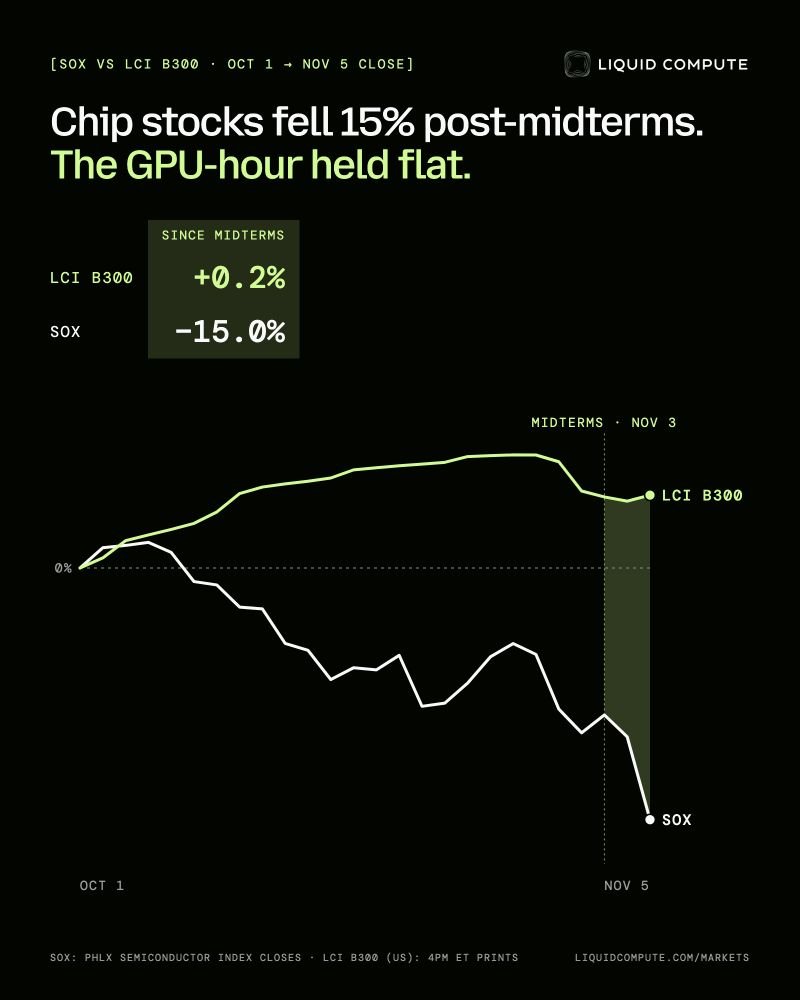
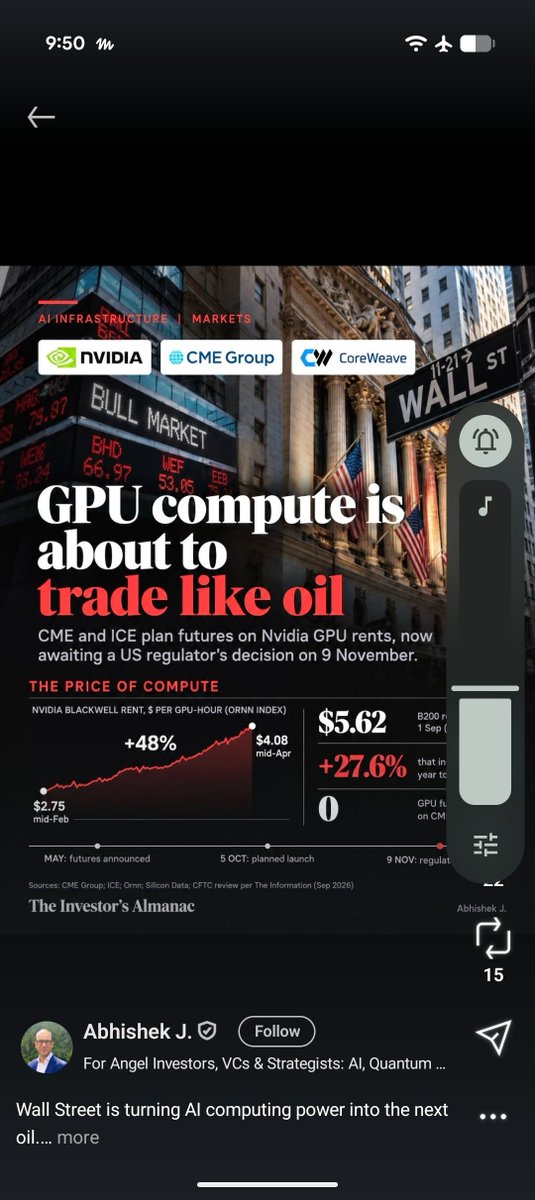
Intelligence is getting cheaper; people consequently consume vastly more of it. More models, more routing, more inference and more agentic workflows translate into higher aggregate GPU-hours unless efficiency improves even faster. This is why falling token prices can coexist with rising GPU rental prices. The fact that even the older H100 is holding/rising despite expected technological depreciation is an especially compelling scarcity signal.