2 ways of looking at "cave fill" area. (decision points). 1) initial support, 2) partial test into, or 3) full cave fill.... stay tuned...same bat channel....
This is what a 3 bar triangle looks like on a market profile chart off silver. When the market moves out of overlapping value areas like this, that is what leads to a more powerful move.
Charts charts and more charts
I do NOT NOT believe that charts predict price. Never have believed this
Here are the values of charts:
1. Show the path of least resistance
2. Show likely level of support/resistance
3. Periodically provide tell on highly asymmetric R:r trades
This strategy can make 5–10% returns in a few weeks…
WITHOUT predicting tops.
WITHOUT chasing breakouts.
WITHOUT staring at the screen all day.
BY SELLING NAKED PUTS.
Here’s how pros use it (save this post, you'll need it) 👇
Market Wizard Linda Raschke’s 12 Technical Trading Rules:
1. Buy the first pullback after a new high. Sell the first rally after a new low.
2. Afternoon strength or weakness should have follow through the next day.
3. The best trading reversals occur in the morning, not the afternoon.
4. The larger the market gaps, the greater the odds of continuation and a trend.
5. The way the market trades around the previous day’s high or low is a good indicator of the market’s technical strength or weakness.
6. The previous day’s high and low are two very important “pivot” points, for this was the definitive point where buyers or sellers came in the day before. Look for the market to either test and reverse off these points, or push through and show signs of continuation.
7. The last hour often tells the truth about how strong a trend truly is. “Smart” money shows their hand in the last hour, continuing to mark positions in their favor. As long as a market is having consecutive strong closes, look for up-trend to continue. The up trend is most likely to end when there is a morning rally first, followed by a weak close.
8. High volume on the close implies continuity the next morning in the direction of the last half-hour. In a strongly trending market, look for resumption of the trend in the last hour.
9. The first hour’s range establishes the framework for the rest of the trading day.
10. A greater percentage of the day’s range occurs in the first hour then was the case in the past, and thus it has become increasingly important to trade aggressively if there are early signs of a strong trend for the day.
11. There are four basic principles of price behavior which have held up over time. Confidence that a type of price action is a true principle is what allows a trader to develop a systematic approach.
I DON’T UNDERSTAND WHY PEOPLE DON’T USE GROK FOR STOCKS.
Most traders are looking at charts from 6 months ago.
Grok analyzes real-time sentiment on X to predict future.
Here are 20 prompts to find the next 10x stock:
OK - not going to mention this stuff anymore...but pays to make note of these areas ahead of time...(Damon will of course show how he looks at this stuff and trades it...)
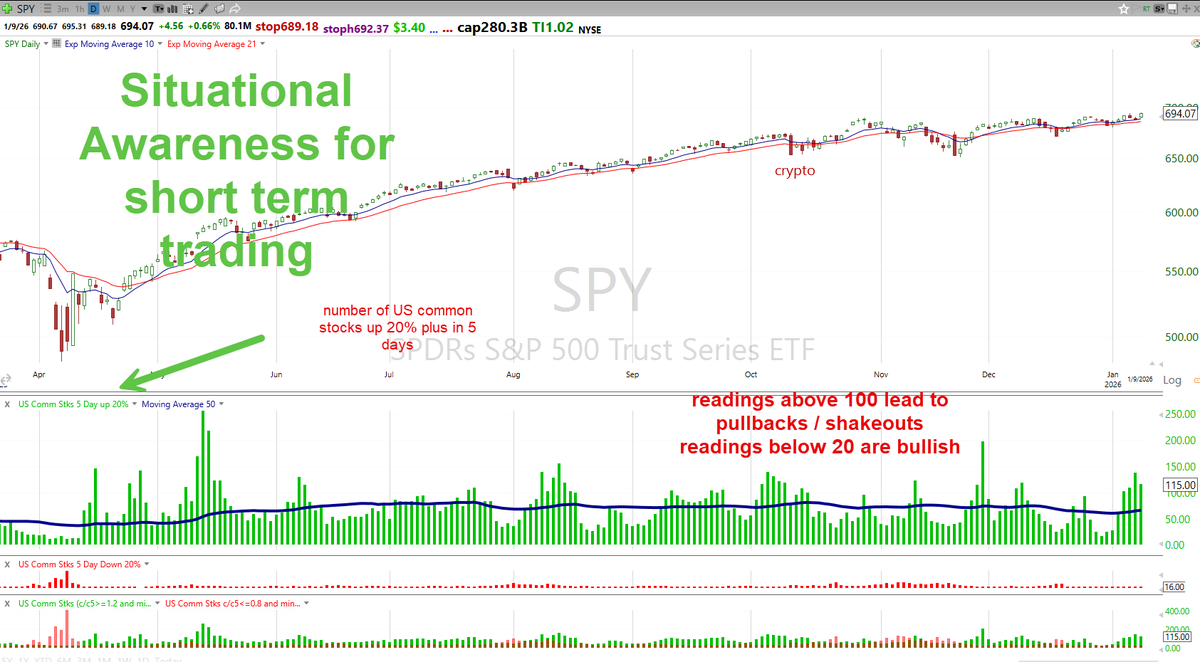
For short-term swing trading, it is best when markets are weak.
Increasingly, I use the 20% study more than the Market Monitor to decide when to be aggressive and when to be cautious. Low readings are bullish; readings above 100 signal a minor pullback.
This is the kind of setup hedge funds pray retail doesn’t notice.
$MSTR just fell 63%… and it’s finally hitting a level where it usually bottom-bounces 70–80% of the time.
I’m NOT long yet! The monthly BX still needs to increase but this is the most discounted zone on the chart.
Full breakdown in the video. 👇
Challenge question
If you have traded seriously for more than three years but have yet to gain the traction you desire, let me challenge you.
I am assuming that what separates you from success is not the lack of knowledge about the markets or about trading styles.
You know what you need to do to achieve success.
Your challenge is overcoming self sabotage.
So, here is the question.
What will it take -- think about it -- for you to settle all your internal struggles to begin doing consistently what you know is needed to achieve success?
Qullamaggie on What Institutional Buying Looks Like
“Oh APPS at new highs. This is awesome; you can just draw a line here. It’s been building higher lows the whole year. Look at this; this is what the institutional buying looks like. They just want to get in.
Very fast growing small cap software stock with a pretty decent valuation. This is not at nosebleed levels, like a lot of the software stocks are right now.”
Qullamaggie on You Have To Study So Much You Don’t Hesitate
“For those who haven’t been here the whole stream, I’m gonna upload the stream on YouTube and you need to watch it because I go through setups. I go through specific setups, like what to buy.
Then you need to do your own research. You need to learn these patterns. You need to do it; there are no shortcuts. If you want to make millions and even tens of millions, you need to learn this . You need to memorize these chart patterns, and you can’t hesitate once you see it. You know, like you can’t hesitate; you have to attack it. That’s where you need to be at.”
If the stock you were going to buy looked good on the open, it is probably cheaper now.
We need to wait for support. This has been a pretty steady decline.
Let's wait to see how much of the gap fills. $SPY
What stocks are you looking at today?
Given the past few months this probably indicates we gap up tomorrow.
Massive tariffs announced, rumors of Fed Chair resigning, political riffs, Iran closing air space….throw in an invasion of Taiwan and I’m sure we’ll hit an all-time high.
Normally I’d say we’re in for a huge rug pull here, but the market is in full “Simple Jack” mode at the moment, so unless I see $SPY confirming below $620, I doubt it.
Many traders rush into trades as soon as the bell rings, they want to trade and they want to do it NOW.
Sometimes it's better to be right than to be early.
Here Are 7 Reasons You Should NOT Trade the Open 🧵
#DayTrading#TradingPsychology#PriceAction
In my humble opinion it's not the tight stops but rather position sizing.
We have been in a chop fest for about 3 weeks. You should have been trading small to avoid getting chopped to pieces.
Tight stops that are near "danger points" are not the problem.
$spy $qqq $iwm