שלום ינון, אני שוטר בתל אביב, מה שאתה רואה פה זה שלושה ילדים שיושבים אמש בבית קפה ברחוב רמז, ליד הגימנסיה ואוכלים פסטה ואז נכנסים 6 חארות מכנופיית SSQ דופקים להם מכות רצח שודדים מהם את הארנקים והטלפונים ואת האופניים וממשיכים לקורבן הבא.
לפני יומיים הם דקרו שני נערים בגינה ליד.
כרגע לפי הפקודות והנהלים של המשטרה אין לנו איך לטפל בהם , אני צריך שהשר ישנה כמה נהלים כדי שאוכל לקחת את ה 170 מתנדבים שלי ונתחיל לנקות את העיר
The PR messaging on the US-Israel-Iran war is crystallizing. The upshot is that the Iranians cannily outmaneuvered the Americans, and now are exiting the war in a stronger position than they went into it.
The major narratives that are emerging include:
1. Iran successfully exploited a strategic advantage
2. Iran's "new" hard-line leadership is emboldened
3. The US had/has no clear strategy
4. The US lost credibility in the war
We've also seen more outlandish claims (including from "serious" sources) that Iran is now a major power.
Almost all of this is flawed or outright false.
We've all heard a lot about the fog of war. But there's also the dust and debris of the post-war. The US and Israel have pounded the Iranian regime for weeks. It's impossible to account for the true strategic, institutional, and logistical toll this takes.
In the middle of the war, when the Iranian regime's sole mission is its own survival, that survival constitutes what might seem, on the surface, like a win—both to the regime and to the outside world.
This is akin to a deer that's been shot by a hunter and which, despite its grave wound, is able to flee on account of the adrenaline pumping through its system.
It can run so long as the adrenaline is flowing and the threat immediate. But what happens when it has outrun the hunter and is still bleeding? If it's hobbled, how does it find food and water? How can it flee from other predators?
The Iranian government is a carefully balanced network of power centers. We know that the IRGC have stepped in to fill the power vacuum. But this will have naturally upset the "natural" order of things internally.
One of Ali Khamenei's most important roles was to ensure the equilibrium of competing power centers that doesn't merely keep the regime alive, but constitutes the regime itself. The clerics, politicians, IRGC, army, and the merchant class; the hard-liners and reformists, the pro- and anti-nuclear camps—all had to be balanced against one other, all constantly seeking an edge, an advantage, over the others.
The mythos surrounding the Supreme Leader, combined with his deep ties to the Revolution, was strong enough to keep a wobbly, brittle political-military-religious system in something like vertical alignment with itself.
Khamenei is not only gone, but it appears as if the IRGC has hand-picked his incapacitated son as the new Supreme Leader. Consider for a moment why the Guards would choose a man who is manifestly incapacitated: the only clear reason is because he's the most convenient figure to use as a puppet.
From the outside, this idea of uncertain and conflicting power centers might be hazy. But what is clear is that whatever is really going on inside of the power structures of the regime will be known to everyone involved.
If the new Supreme Leader is indeed a puppet for the IRGC, this will only further exacerbate rivalries and palace intrigue. Already there are signs that this is happening, with hardline politicians in Iran calling for the former president and foreign minister to be hanged for treason.
Take another key message: the quickly popularizing idea that the regime is now stronger than it was. The notion is ludicrous on its face. The regime did find its lever in the Straits of Hormuz. But it did so at the massive cost of turning nearly every Gulf state against it.
It's something like a heavily indebted company realizing it can pay down its most urgent debt by selling off its stock and assets. Works great in the short term; but in the long term it proves disastrous.
In this case, what was just 6 weeks ago a matrix of competition and alliance in the Gulf has now unified into a single block with one overriding interest: never let Iran do this again, no matter what the cost. Some of these countries that, weeks ago, were ambivalent allies of Iran and the most vocal opponents of the war are now the strongest voices pressing for the war to be continued.
Even more to the point, when considering the idea that the regime is stronger than it was, Iran saw much of its top military, political, and intelligence leadership wiped out—not one or two, but up to three or four layers deep.
The notion that the US and Israel have penetrated far into the regime is, by now, an accepted premise among the regime. Every action they take, every phone call and email, will be undertaken with the assumption that the communication or order or directive has already been intercepted. The level of paranoia among the regime, already high, will become crippling.
Next, there is the sheer loss of physical capabilities. The Iranian navy is all but destroyed, the air force gone, at least half of the country's missile launders eliminated, nuclear sites, weapons siloes, drone factories, ballistic missile production, command centers, radar installations—it's all gone.
These are capabilities that take not years but decades to build up, all destroyed in less than 40 days.
You don't simply come back from that. You don't get restocked by Russia or China overnight, or even over years, no matter how many ships they send.
Let's also not forget that Iran is not just a regime, but a country. As much of a disruption the war caused to the global economy, as painful as $4/gallon gas is, the effect to the Iranian economy is 100-1000x as great.
Inflation, already astronomical, is now unrestrained. An entrenched energy crisis could threaten to tip into full blown catastrophe. A lingering nationwide water shortage, so severe that the Iranian government has begun making plans to move the capital from Tehran to a city with better water supply, can quickly become calamity.
An astute friend recently compared this phenomenon of delayed impact to the sight of buildings undergoing controlled demolition. You see the demolition crew press the button, watch the flashes of the charges going off, hear the rippling booms of the explosions. And then.... nothing. For a few elongating seconds, it seems as if it was a dud.
And then slowly, there's a downward inching motion. It builds in speed, gathers force, until the structure is in complete collapse.
This is now a distinct possibility. The Iranian PR machine—backed by a prostrate Western press and the hydra-headed beast of one of the most effective propaganda campaigns in modern history, whose locus is social media—are trumpeting Iranian victory and American loss.
Propaganda is the most powerful weapon in an asymmetric war. It's the backbone of terrorism, which is a species of propaganda. This is why terror groups are so good at propaganda: it's their lifeblood, the very reason they exist.
This asymmetric effect is doubly true when the stronger party is a democracy with a robust press and very well protected freedom of information laws, and when the weaker party is an autocracy that controls the press completely, is able to shut off the internet, and has learned over decades to govern public (or, at least, publicly acknowledged) perception of reality itself.
But the thing about propaganda is that while it can twist reality, it can't change it. It can't raise the 60 navy ships from the sea floor, rebuild the crushed missile siloes, or, least of all, resurrect the dead leadership (try and try as it might).
It can fight reality tooth and nail. But reality wins every time.
This time is no different.
"Not having a coding experience is becoming an advantage."
Replit CEO Amjad Masad:
"You don't need any development experience. You need grit. You need to be a fast learner."
"If you're a good gamer, if you can jump in a game and figure it out really quickly, you're really good at this."
"Coders get lost in the details."
"Product people, people who are focused on solving a problem, on making money, they're going to be focused on marketing, they're going to be focused on user interface, they're going to be focused on all the right things."
"I think this year it's gonna flip, and I think not having a coding background is gonna be more advantageous for the entrepreneur."
@amasad with @jackhneel
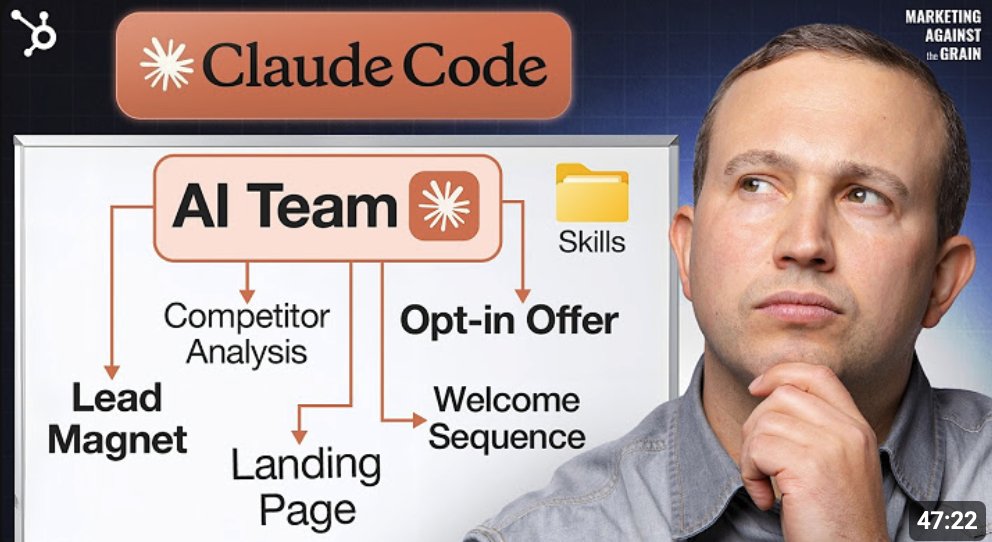
I show the CMO & SVP of Hubspot how I use Claude Code for marketing and cover:
- skills
- workflows
- best practices
and more. thanks to Kipp & Kieran for having me on. great marketers, guys and hosts, looking forward to doing it again sometime!
watch the full ep here: https://t.co/Htkz4rmpSS
Ashley Rindsberg reports on how online creators like Candace Owens and Tucker Carlson foment rage and monetize antisemitism—and how much they earn doing it. https://t.co/poAEc92SrT
Compare the same contentious topic on Wikipedia and @Grokipedia.
It’s the difference between a cramped room and open space — a contrast that’s hard to unsee. @nasdaily and I discuss.
🚨 INVESTIGATION: Editors repeatedly altered @nasdaily Wikipedia page, inserting selective controversies, political framing, and curated criticism.
Over two years, a series of incremental edits quietly shifted the page’s balance emphasizing political controversy over creative achievements.
Examples:
• User: IP address 2605:6000.. added a "Criticism" section with a citation from Middle East Eye which claims Nuseir whitewashed the Israeli-Palestinian conflict.
•User: إيان portrayed Nuseir's business ventures as instruments of Israeli political influence
User SI09: refused edit request to change occupation from Video blogger to Entrepreneur & CEO calling it self-promotion citing WP:PROMO.
Full report by @AshleyRindsberg in the thread 👇
I recently had a chance to speak with @nasdaily about @grokipedia. Nas was a huge supporter of @wikipedia—until he became a victim of the site's defamation engine.
In an interview with me, Nas told me how after exploring Grokipedia he found it to be a marvel.
Interview drops tomorrow @npovmedia.
NEW INVESTIGATION: New York Times Bestselling author and journalist @maxlugavere has endured a sustained reputation attack on @Wikipedia.
In an interview, Max tells NPOV's @ashleyrindsberg how the Wikipedia attack damaged his reputation and turned his life's work—researching ways to prevent the dementia that took his mother's life—into malicious accusations.
NPOV's investigation reveals a deeply coordinated network of editors called "the Skeptics" that works on Wikipedia as a coordinated editing group known as Guerrilla Skeptics on Wikipedia (GSOW).
+ The opening of the Wikipedia entry falsely labels Max an "anti-vegan activist." This now appears prominently on @Google searches on Max.
+ Carefully curated film reviews are used to indirectly accuse Max of attempting to profit from his mother's disease and tragic death.
+ The key elements of the attack rely on articles written by two members of a center at McGill University known as the Office for Science and Society (OSS).
+ The main editor on Max's entry adds content from OSS figures, whose own entries on Wikipedia were created and/or currently controlled by GSOW editor Robincantin.
+ Susan Gerbic, a contributor to Skeptical Inquirer magazine and a fellow of the NGO that owns the magazine, has identified one Robin Cantin as "my editor."
+ Gerbic is founder of the Guerrilla Skeptics on Wikipedia project.
Watch the NPOV video here👇
For the full NPOV investigation, see the link in thread.
During Iran’s nationwide internet blackout, uploads to Wikimedia Commons continued uninterrupted.
This video documents a concentrated influx of Iranian state-linked media during the protest period, and how those files now populate public search and reference platforms.
Full investigation, see link in thread.
A flood of Iranian regime propaganda has hit @Wikipedia. More than 10,000 images and videos are being mass uploaded to Wikimedia Commons, the site's media repository.
Almost every piece of content is watermarked by state outlets—including Khamenei's official website and IRGC-owned Tasnim News Agency. This indicates it is official regime propaganda. It ranges from videos featuring chants of "DEATH TO AMERICA" to images of threats to @realDonaldTrump.
One collection, with red HUD markers, is an explicit threat of retaliation to protestors, with the statement "We will not let them go"—pulled straight from a speech by Khamenei.
As we were doing the investigation, we literally watched the uploads continue—hundreds more pieces of propaganda flooding one of the world's most trusted knowledge platforms.
Exclusive: Cursor, a startup that makes an AI-coding tool beloved by engineers, has raised $2.3 billion at a $29.3 billion valuation—nearly 12 times the value the company had in January https://t.co/w3nAmjSDSa