THE MATH YOU NEED TO START UNDERSTANDING LLMS
THE FOUNDATION BEHIND MODERN AI MODELS
Large Language Models (LLMs) are powered by mathematics. Behind every prediction, embedding, and generated response is a combination of linear algebra, probability, calculus, and optimization. You do not need a PhD in mathematics to start learning LLMs, but understanding the core concepts gives you a major advantage.
LINEAR ALGEBRA — THE LANGUAGE OF LLMS
→ VECTORS
Vectors represent words, tokens, and embeddings inside neural networks.
→ MATRICES
Matrices store and transform large amounts of numerical data efficiently.
→ DOT PRODUCT
Used to measure similarity between embeddings and power attention mechanisms.
→ MATRIX MULTIPLICATION
Core operation behind neural network computations and transformer architectures.
→ EIGENVECTORS & DIMENSIONALITY
Help models compress and organize information in high-dimensional spaces.
PROBABILITY & STATISTICS — HOW MODELS PREDICT
→ PROBABILITY DISTRIBUTIONS
LLMs predict the probability of the next token in a sequence.
→ CONDITIONAL PROBABILITY
Used to estimate the likelihood of words based on previous context.
→ MEAN, VARIANCE & STANDARD DEVIATION
Important for normalization and understanding data distributions.
→ BAYESIAN THINKING
Helps explain uncertainty and prediction confidence in AI systems.
→ SOFTMAX FUNCTION
Converts model outputs into probabilities for token prediction.
CALCULUS — HOW MODELS LEARN
→ DERIVATIVES
Measure how changes in parameters affect model outputs.
→ GRADIENTS
Guide neural networks toward lower error during training.
→ CHAIN RULE
Critical for backpropagation across deep neural networks.
→ OPTIMIZATION FUNCTIONS
Used to minimize loss and improve prediction accuracy.
OPTIMIZATION — TRAINING LARGE MODELS
→ GRADIENT DESCENT
The foundation of neural network training.
→ LEARNING RATE
Controls how fast or slow a model updates weights.
→ LOSS FUNCTIONS
Measure how wrong the model’s predictions are.
→ REGULARIZATION
Helps prevent overfitting and improves generalization.
INFORMATION THEORY — UNDERSTANDING TOKENS
→ ENTROPY
Measures uncertainty in predictions.
→ CROSS-ENTROPY LOSS
Common loss function used in transformer-based models.
→ TOKENIZATION
Breaks text into smaller units for model processing.
THE MOST IMPORTANT CONCEPT FOR TRANSFORMERS
→ ATTENTION MECHANISM
Allows models to focus on relevant words in a sequence.
The attention mechanism heavily relies on matrix multiplication, vector similarity, and probability distributions.
WHY THIS MATH MATTERS
→ Helps you understand how transformers actually work
→ Makes debugging and fine-tuning easier
→ Improves your understanding of embeddings and token prediction
→ Gives you a strong foundation for AI engineering and research
BEST WAY TO LEARN THE MATH
→ Start with linear algebra basics
→ Learn probability before deep learning
→ Understand derivatives conceptually before advanced calculus
→ Practice with small neural network examples
→ Focus on intuition before equations
TOOLS THAT MAKE LEARNING EASIER
→ NumPy for matrix operations
→ PyTorch for tensor computations
→ Jupyter Notebook for experiments
→ Visualization tools for gradients and embeddings
FINAL THOUGHT
You do not need to master every mathematical field before building with LLMs. Start with the fundamentals, connect the concepts to real AI systems, and learn progressively as you build projects.
MASTER LLMS IN DEPTH
Grab the complete LLMs Handbook here:
https://t.co/ljEMt0UNUI
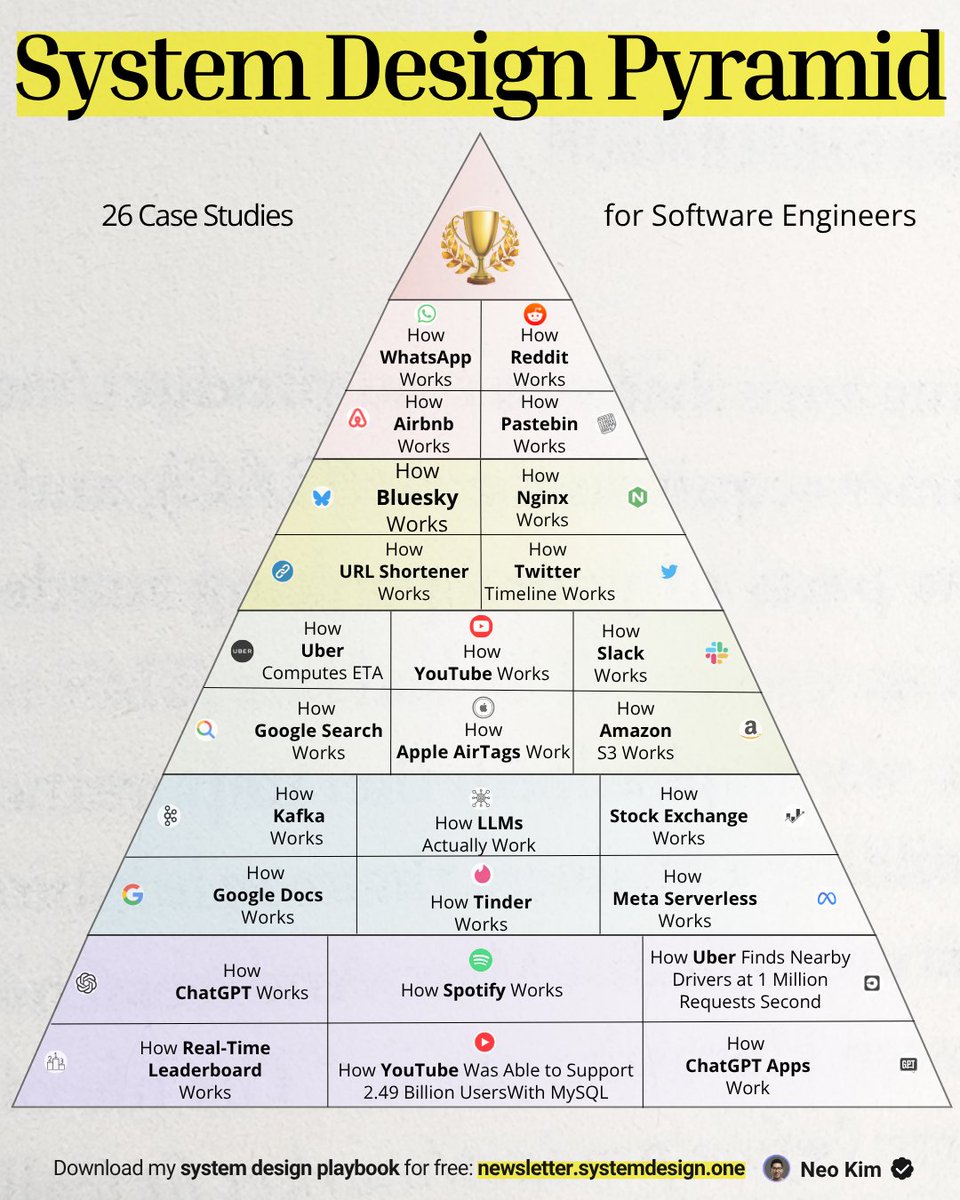
If you're serious about system design (in 2026), learn these 26 case studies:
1 How Stock Exchange Works:
↳ https://t.co/iFNSX9TM9O
2 How YouTube Works:
↳ https://t.co/kHk3g6jz6t
3 How Kafka Works:
↳ https://t.co/8rOy9KgCMo
4 How Google Docs Works:
↳ https://t.co/W57IkAjXpT
5 How URL Shortener Works:
↳ https://t.co/tGndgdhH0V
6 How WhatsApp Works:
↳ https://t.co/VScq8QwHMr
7 How Airbnb Works:
↳ https://t.co/Bi5SAjfv5S
8 How Spotify Works:
↳ https://t.co/BxrH3oHIFS
9 How Slack Works:
↳ https://t.co/eIo29uOQOJ
10 How Reddit Works:
↳ https://t.co/o6Pw2hhj3T
11 How Bluesky Works:
↳ https://t.co/2rLYlRlky0
12 How Tinder Works:
↳ https://t.co/4E1zfgfvlw
13 How Twitter Timeline Works:
↳ https://t.co/pF2RYmPaIG
14 How Uber Finds Nearby Drivers:
↳ https://t.co/kJ2t8dtmch
15 How Pastebin Works:
↳ https://t.co/8NSUNlYM7q
16 How Amazon S3 Works:
↳ https://t.co/iReWAEHwmj
17 How Do Apple AirTags Work:
↳ https://t.co/upWcgsXwKh
18 How LLMs Actually Work:
↳ https://t.co/5lCKxq2g4N
19 How Uber Computes ETA:
↳ https://t.co/hw1hYJqQmj
20 How Real Time Leaderboard Works:
↳ https://t.co/HEChNTOHWb
21 How ChatGPT Apps Work:
↳ https://t.co/BJTYYnAwO1
22 How Nginx Works:
↳ https://t.co/JTeQTJvyrf
23 How ChatGPT Works:
↳ https://t.co/TZYZ3iddYH
24 How Meta Serverless Works:
↳ https://t.co/NSt6jovxu5
25 How YouTube Was Able to Support 2.49 Billion Users With MySQL:
↳ https://t.co/4VDJ5cs6fL
26 How Google Search Works:
↳ https://t.co/jwOaC4bhnv
What else should make this list?
===
👋 PS - Want my System Design Playbook for FREE?
Join my newsletter with 200K+ software engineers now:
→ https://t.co/ByOFTtOihX
===
1 Save & RT to help other software engineers ace system design.
2 Follow @systemdesignone + turn on notifications.
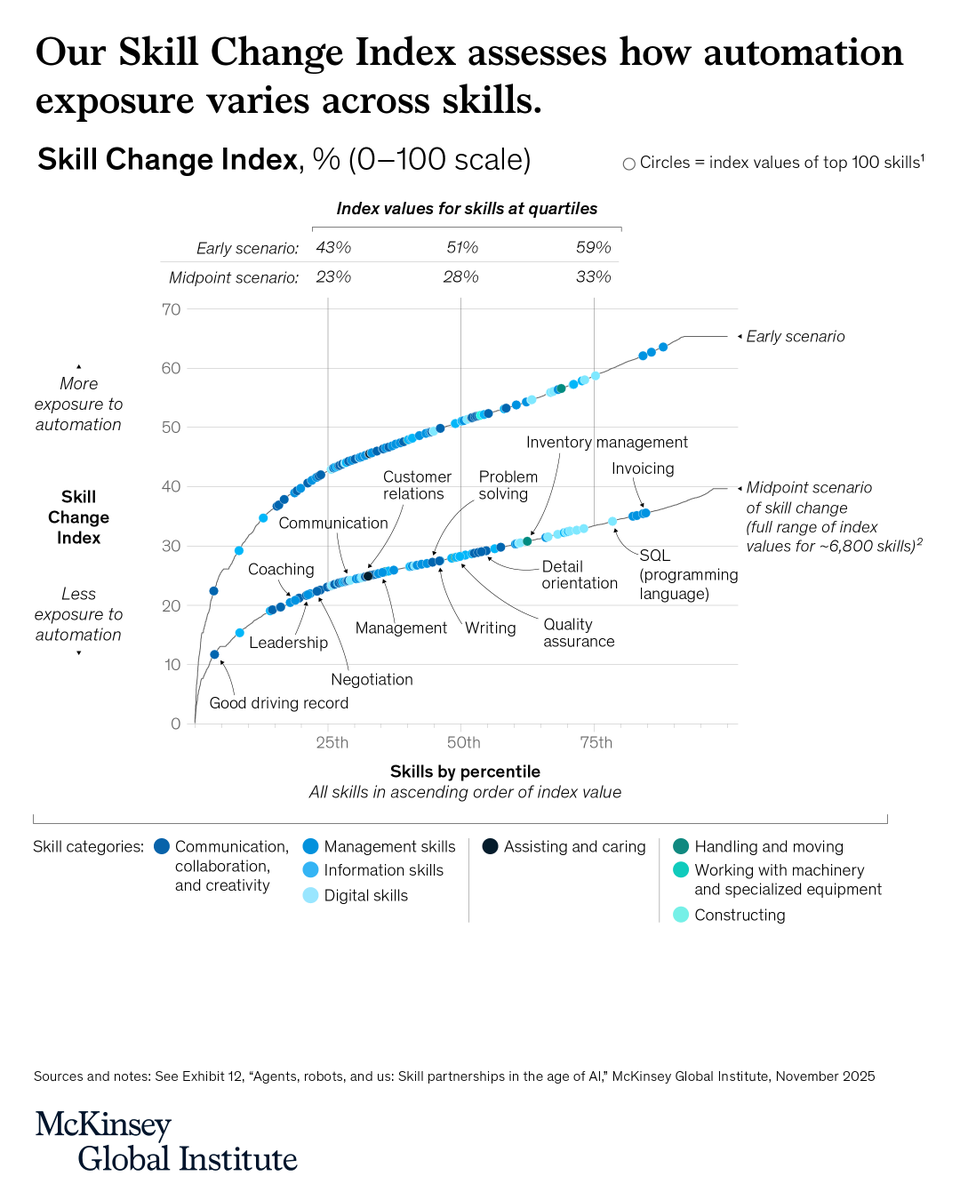
AI won’t make most human skills obsolete, but it will change how they’re used.
Negotiation, problem solving, and leadership will matter more than ever as people work alongside agents and robots.
Our new Skill Change Index shows which skills will be most, and least, exposed to automation in the next five years: https://t.co/fRXfHF1k56
#GenAI is here—and it’s poised to transform businesses across industries. But there are risks to consider, too.
Learn how companies can manage the risks of gen AI—starting with an honest conversation about what risks they are willing to take. https://t.co/pWNKhJyUac
“No one can teach you how to lead; you need to be willing and able to learn how to lead. Mostly we learn from our experiences and facing adversity. Stepping outside of the spaces where we feel safe — is a powerful teacher.” https://t.co/wP1BqqQmnt
In a study of 60 leaders, those who were most successful in overcoming resistance were the ones who diagnosed the root of a disagreement before trying to persuade. https://t.co/wA4ll3N7MG
The best way to build a successful career is to put in the work right now: Grow your skills, take on lateral responsibilities, and work at companies and with people who will build up your credibility. https://t.co/Hh8pTNWL6a







![ipfconline1's tweet photo. The 6 Stages for a Successful Digital Transformation [Infographic]
#DigitalTransformation #DigitalMarketing #Business https://t.co/tBbULBR21J](https://pbs.twimg.com/media/DCDAybaXYAESSsg.jpg)