Twenty ß characters in a Ruby app: nothing happens. Twenty-one: Ruby writes one byte past the end of a heap buffer. Ruby2Shell has been in Ruby since 2.4.0, and a default Rails app reaches it before login.
https://t.co/S0TrJmOaHu
If you are still using #PowerShell 5 exclusively it's time to reconsider and install PowerShell 7.
PowerShell 5 is officially deprecated.
https://t.co/cAgq2lm4TU
NEW CVSS 10.0 JUST DROPPED ON <the security industry as a whole>
Impact: The entire security industry as a whole is DOS'd and cannot function and is running on caffeine and 0 hours of sleep.
There is no patch.
This one is real bad.
🚨 Rapid Response: Six critical F5 BIG-IP flaws (CVSS 9.8) could lead to RCE. All are data plane issues, not the management interface.
2M+ web properties sit behind BIG-IP; not all are vulnerable. Fixes are out, no exploitation reported. https://t.co/xXE6csDgwY
🚨 New attack bypasses Windows Hello and BitLocker security, cracking PINs in hours instead of months
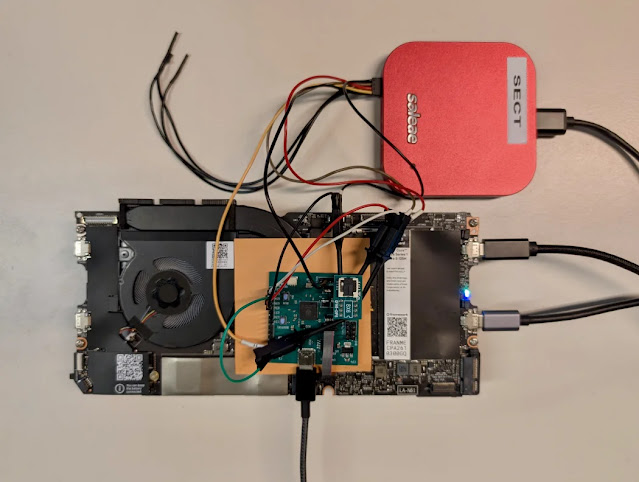
Security researchers at TU Berlin have demonstrated a hardware attack dubbed "Hello Again" that bypasses TPM lockout protections, allowing attackers with physical access to repeatedly guess Windows Hello and BitLocker PINs.
The attack manipulates security counters stored in motherboard flash memory, reducing the estimated worst-case time to crack a 4-digit Windows Hello PIN from 69 days to just 40 hours. A 6-digit BitLocker PIN could be cracked in approximately 20 days instead of 19 years.
The vulnerabilities affect certain AMD and Intel-based systems. AMD has acknowledged one flaw as CVE-2026-43613 and is preparing firmware updates.
Researchers recommend longer PINs to reduce the risk.
The European Commission just got hit by a major cyberattack, Politico reports. Here's what you need to know.
Politico Europe broke the story as an exclusive on Nov 19, 2026. It says the attack potentially compromised swaths of personal data. It was serious enough that the most senior Commission officials discussed the crisis at their weekly meeting.
The targets were internal systems, mainly HR and medical reimbursement services. These handle things like payslips, leave requests and medical claims. Reports say they were disrupted for more than 10 days. Commission spokesperson Thomas Regnier confirmed the institution was targeted.
The Commission believes it has contained most of the attack. But the full extent of the damage is still unclear, and it is investigating whether staff personal data was exposed.
One report says the hackers used ARTEX, a publicly available AI-powered tool built to find vulnerabilities in IT systems. Commentators have linked the rise in attacks to AI, and some call this a coordinated series of attacks. Nobody has said who is behind it.
Key numbers:
- 10+ days of disruption to HR and medical systems
- Politico exclusive published Nov 19, 2026
- 1 tool named so far: ARTEX, AI-powered and publicly available
The Commission says most of the attack is contained, while the scale of the data exposure and the attacker remain unknown.
@lordx64@hackerfantastic The use of AI tools like ARTEX in these attacks is a major shift. We actually went deeper on this here: https://t.co/po3vdslDEc
watchTowr Intel is tracking the latest PHP security release, which remediates a number of Remote Code Execution vulnerabilities, including CVE-2026-115560 and CVE-2026-126714.
Both are session-deserialization bugs via session upload progress, but require additional chains to reach RCE.
If you have a tickets for #BSidesLDN2026 and can no longer be there on the day, do the nice thing & transfer it to someone who can, like @DrAzureAD,
If you don’t know someone who want sit, cancel it & it will become available on Eventbrite straight away
https://t.co/pbOC8hRdeY
PHP2Shell, Java2Shell, Nginx2Shell… WHAT THE ACTUAL FUC# IS WRONG WITH YOU PEOPLE? These AI toys have driven you completely insane. GET A LIFE. GET MARRIED. TOUCH THE GRASS. SEE A THERAPIST. NOT EVERYTHING NEEDS A FUC#ING SHELL!
Pre-auth RCE in nginx is the bug every hacker dreams of finding. It almost never happens.
Today we’re disclosing nginx2root: five nginx vulnerabilities, and an exploit that takes an unauthenticated attacker all the way to root.
One of themhits the default config.
If you run nginx, patch now. Then read: https://t.co/rDQQAimLZP
CVE-2026-123007, CVE-2026-123634, CVE-2026-123633, CVE-2026-121810, CVE-2026-113425
To anyone concerned about ARTEX affecting their org:
We built a closed source agent swarm platform you can try for free, with guardrails, scoping, that you can deploy on any API, MCP, Portal, etc.
Hundreds of coordinated agents, acting like ARTEX, without malicious side effects.
Begging any MOTS, Security Engineers, AppSec, to really give it a shot.
You'll be extremely surprised at what you'll find, once hundreds of harnessed agents are given time, resources, and crazy compute power.
Honestly I’m tired of this AI discovered RCE bullshit.
It creates so much chaos inside of companies that have no idea how to deal with this.
Anyone that publishes an exploit that can’t be widely exploited and doesn’t disclose this - I’m down for total public shaming of the individuals and companies that push this narrative.
I’m not dismissing the criticality of latching on these - however it doesn’t require IR, all hands on deck, must patch tomorrow - which is probably why we see the mass outages we are experiencing.
It’s damaging our industry. We need to fight back on this and go after those that hype this up for ego and marketing.
POC || GTFO
Join me.
🇮🇹 BREAKING: ITALIAN POLICE IDENTIFY MAN BEHIND “MIKHAIL ANDROPOV” PSEUDONYM - BUT HE IS NOT THE BOMB THREAT SENDER
Italian cyber police, working with the FBI, have identified a man in Phoenix, Arizona, who uses the pseudonym “Mikhail Andropov”.
The name appeared in threatening emails sent to thousands of Italian schools on November 11, 12 and 16.
The man had contacted Italian authorities, reporting that his online identity was being misused.
IMPORTANT: According to ANSA, the FBI has ruled out his involvement in sending the mass bomb threats.
Investigators are still working to identify the actual perpetrators and establish possible links between the incidents.
So let's talk about ARTEX - No! Let's speak about Kafka and how you can use it to detect any cyber attacks, at data pipeline level. We have released open source Apache 2.0 DetectFlow and rolled a major update to it few weeks ago. So it does not matter what is the orchestrator behind the attack - you will see all steps of it, as long as data hits your Kafka streams. How does it work? A picture is worth a thousand words. Maybe a walkthrough video with Will LaForest that we did at launch is worth a bit more https://t.co/nWLKUJZz5t
And the source code with all time top quality premium Sigma rules, attack flows and higher order correlations is also here at GitHub
Flipper One Kickstarter campaign raised more than $11M in its first day 🤯https://t.co/Pg79jLemIZ
Thank you all for your trust and support. We'll do our very best to deliver on all our promises!