🚨BREAKING: Today, the Members of the European Parliament will vote on the AI Act. This is what happens next:
The AI Act is expected to officially become law by May or June, and its provisions will start taking effect in stages:
- 6 months later: countries will be required to ban prohibited AI systems
- 1 year later: rules for general-purpose AI systems will start applying
- 2 years later: the whole AI Act will be enforceable
Fines for non-compliance can be up to 35 million Euros or 7% of worldwide annual turnover.
If you are interested in AI regulation, you can't miss my live session with the inimitable @BertuzLuca, @JcMalgieri, and @RistoUuk discussing challenges, opportunities, and practical insights (link below).
So, the adtech/data industry complains that Google's "privacy sandbox" in Chrome doesn't offer them all the highly problematic profiling and targeting options based on excessive data sharing and misuse they used to exploit without any control for years.
https://t.co/pPBcVDC3wl
Big Tech companies avoid accountability by leaning on their policies and terms and conditions. But in reality, do they actually uphold the protections that should exist? #HealthScams#ScamShield#BigTechBigLies#ScamsForSale
The Korean DPA published its guide on AI and data protection. See https://t.co/4kXLeFuL5Q. “Pursuing a ‘zero-risk’ AI may not be practicable, but we still need to make efforts to achieve a ‘minimal risk’ to data privacy, from a pragmatic perspective.”
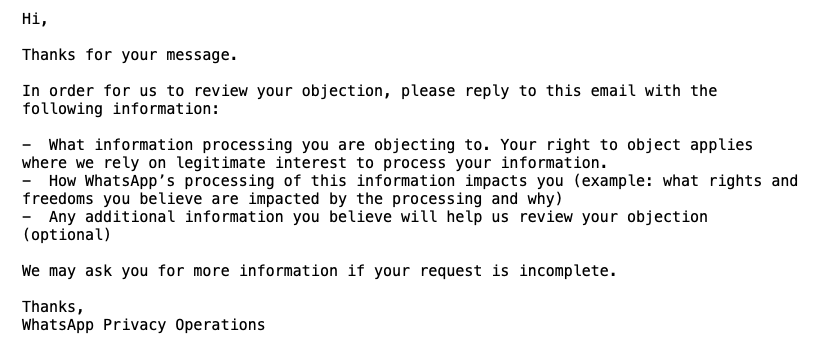
1/ WhatsApp says you can can object to their processing of your information for a range of purposes, but when you object they email & ask "How WhatsApp’s processing of this information impacts you : what rights and freedoms you believe are impacted by the processing and why).
How can you tell your email is part of a data breach?
1. Visit a reputable website that checks for data breaches, such as Have I Been Pwned (for personal email) or SpyCloud (company emails). These websites maintain a database of compromised email addresses from various breaches.
Worldcoin, a controversial Web3 app which promises to give Africans crypto for their identity via an eye scanner, has now fully launched in Kenya, East Africa and features a P2P exchange
but security and privacy concerns lurk
Read more ✅ https://t.co/tw7CRxjLGy ⬅️
Who are the mentioned local partners? What type of data is being shared with them? Are there any data protection agreements in place? Will these local partners be registering as data controllers/processors as well?
#Privacy pros, beware: #darkpatterns in privacy can also happen in the context of code implementation. It will ignore user choice, cause privacy harm, and breach data protection principles and rules. It happens often and not many privacy professionals are aware.
1/2
Absolutely mind blowing panel at #DPI23 showing how #blockchain technology, #NFT use cases & digital identity developments challenge head on concepts like data minimisation &
data localisation. We really need to start thinking very differently about how we regulate #privacy.
The U.K. government published the Data Protection and Digital Information (No.2) Bill which proposes to reform the U.K. GDPR.
@JoeGTJones has highlighted some of his key takeaways from the draft bill.
https://t.co/vK8aBCz0ni
What are some of the worst privacy takes/myths of all time? We’ll go first-
1. “If I have nothing to hide, then data protection and/or privacy are not relevant to me”
BREAKING: Following noyb litigation, @Meta
(Facebook and Instagram) has been prohibited from using personal data for advertisement.
The #GDPR decision signals a major blow to Meta's business model in Europe, as Meta faces a € 390 Mio fine.
https://t.co/yhmcVVlLth
Meta's business model declared illegal in the EU according to WSJ. Facebook, Instagram and WhatsApp can no longer run personalized ads without user consent
As reported by The Wall Street Journal, the EDPB has decided that Meta cannot force users to agree to personalized ads.