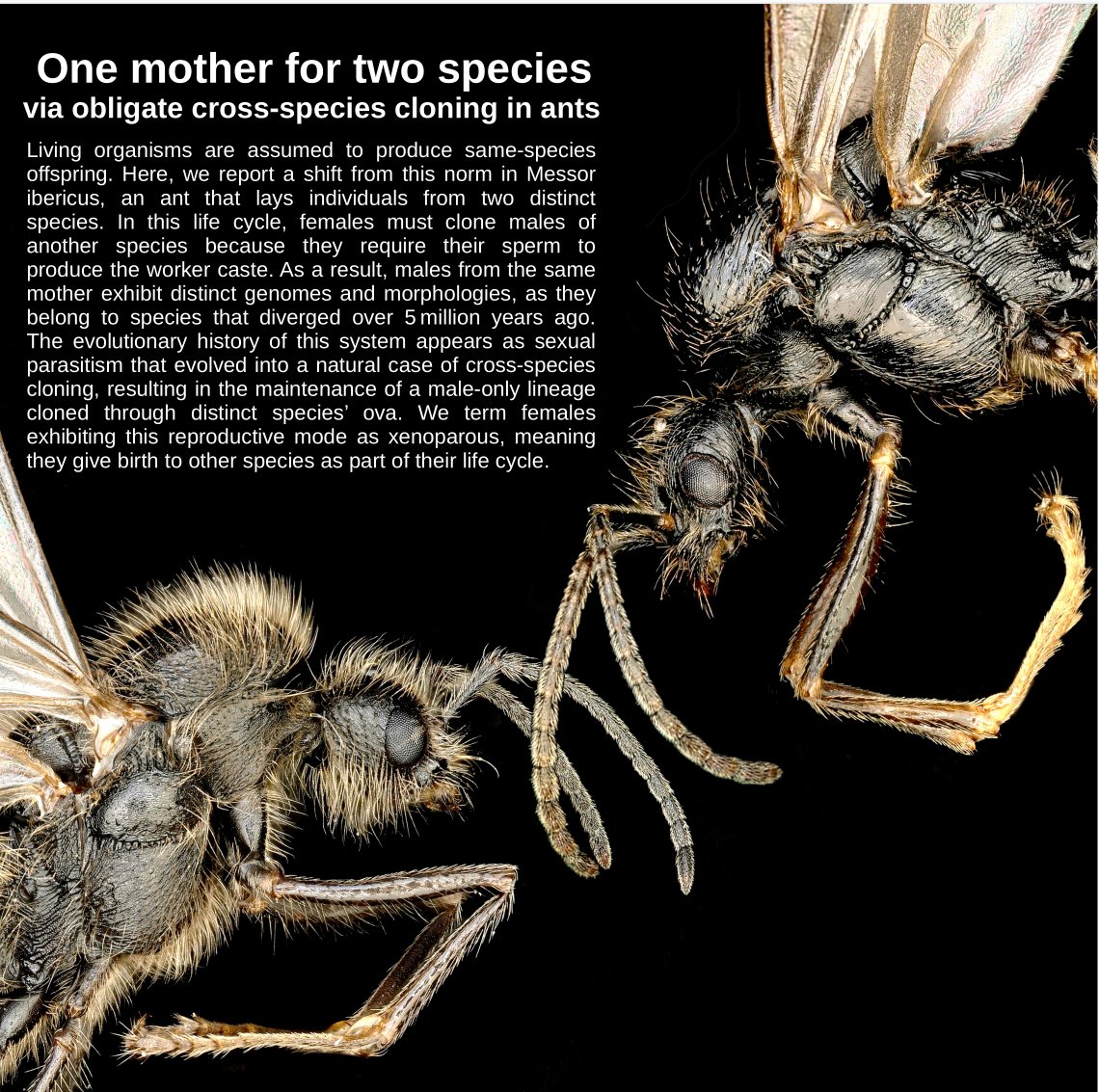
These two males belong to different species—but share the same mother. How? Why? To celebrate the print release of our last paper in this week’s
@nature.com (issue 8084), here’s a thread summarizing the results. Why? Let’s dive in🧵👇https://t.co/V5kzpPyMG9
Reproduction is strange in many social insects, but the Iberian harvester ant (Messor ibericus) takes the weirdness to the next level.
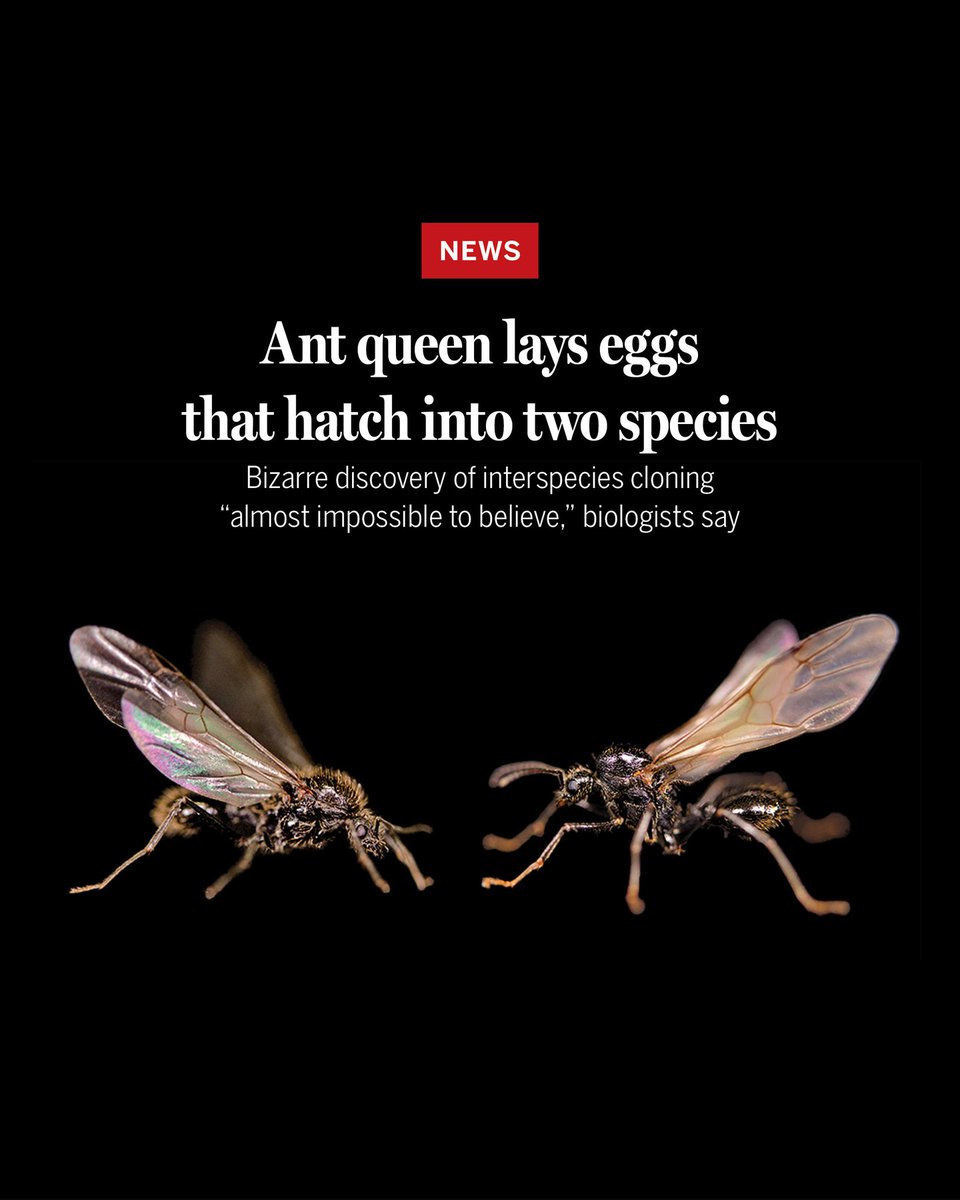
Queens mate with males of another species and then clone them, researchers reported last year, which means this ant is the only known organism that propagates two species by itself. Evolutionary biologist Jonathan Romiguier, who led the team, calls M. ibericus “in a sense, the most complex, colonial life form we know of so far.”
The finding “is almost impossible to believe and pushes our understanding of evolutionary biology,” says Michael Goodisman, an evolutionary biologist who was not involved with the new research. “Just when you think you’ve seen it all, social insects reveal another surprise.”
Learn more: https://t.co/8JAwgp25dn #ScienceMagArchives
These two males belong to different species—but share the same mother. How? Why? To celebrate the print release of our last paper in this week’s
@nature.com (issue 8084), here’s a thread summarizing the results. Why? Let’s dive in🧵👇https://t.co/V5kzpPyMG9
This work benefited from the support of an @ERC_Research grant RoyalMess, hosted by @CNRS, @isemevol and @umontpellier. Article freely available here for more details: https://t.co/V5kzpPyMG9
These two males belong to different species—but share the same mother. How? Why? To celebrate the print release of our last paper in this week’s
@nature.com (issue 8084), here’s a thread summarizing the results. Why? Let’s dive in🧵👇https://t.co/V5kzpPyMG9
#Xenoparity shows how sexual parasitism can evolve to a self-sufficient unit of selection, where two species bind their lifecycles. Question: When two species sexually depend on each other and are produced by the same colonies, how should we consider the resulting superorganism?
@Rainmaker1973 If you’ve heard about our study on ants producing two different species but are still confused about how it works—and don’t have time to read the paper (https://t.co/V5kzpPzkvH)—this 10 minute video explains it very well: https://t.co/ybXduIwTXn.
An ant queen just gave birth to two different species, stunning scientists.
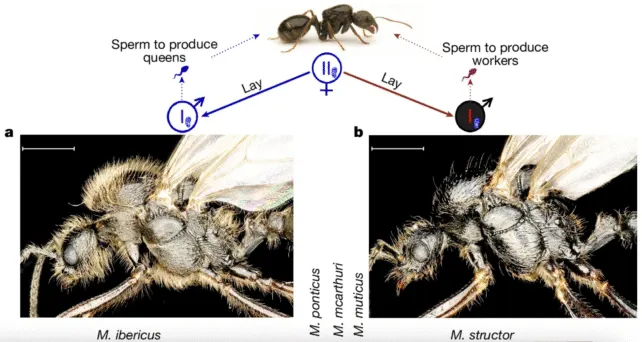
Researchers studying Iberian harvester ants in Europe uncovered one of the strangest reproductive systems in the natural world. A single queen can lay eggs that hatch into two completely different species: her own, Messor ibericus, and another called Messor structor.
The finding was especially puzzling because the colony was discovered on the Italian island of Sicily – about 621 miles (1,000 kilometers) away from the closest known population of Messor structor. Yet somehow, the queen was producing both species.
Normally, each ant species keeps to its own genetic line. But millions of years ago, Iberian harvester ants lost the ability to produce their own workers.
To survive, their queens began mating with Messor structor males, producing hybrid female workers that make up 99% of a colony. Later, evolution went a step further: the queens learned to clone the sperm of those males. That means a queen can now create “foreign” males from another species using only her eggs and stored sperm – a process scientists call sexual domestication.
The result is astonishing. In the lab, researchers watched as one queen gave rise to both hairy Messor ibericus males and virtually hairless Messor structor males, each with distinct genomes. It’s the first known case of what scientists are calling xenoparity – reproduction that requires propagating the genome of another species through one’s own eggs.