DeepSeek Upendings
#1: MIT License on the code repo and model weights
#2: Free consumer web and mobile app
#3: Low cost API (~2 cents on the OpenAI dollar)
#4: Frontier model training run for 5.6 million USD
#5: No API rate limits
@TOzgokmen@RobertRasmus2 Here’s a compilation of all the tweets in your thread to a single doc. See tweet to command @threadreaderapp before that to compile through your tweet which I responded to.
@UrbanKaoboy Notice the foundation upon which Klarna's success is built:
A use case that accommodates incorrect responses, providing the option for human intervention when meticulous prompt design and safety measures prove insufficient. 1/n
@UrbanKaoboy Given that hallucinations are an innate trait of large language models, any task that does not lend itself to the above framework cannot be automated away by AI. But then, most jobs comprise one or more tasks that lend themselves to the framework. 3/n
@KarlKrohn@shrink100@DGlaucomflecken Requiring insurance companies to pay the exact same reimbursement for each code in each market will kill this racket. Even better get rid of commercial insurance entirely.
Prof. Jordan explains why today's AI is nowhere near advanced enough to challenge humans except in low-level pattern recognition tasks, and, ML which underlies recent progress in AI, is an engineering field. Insightful!
https://t.co/8mABa2Y689
Not medical advice. Just an anecdote.
As a kid, I had severe asthma and allergies. Albuterol, preventalin, nebulizer, hospitalized a few times, the whole 9.
The thing that got me out of it? Despite doc recommendations, I started running cross-country in middle school.
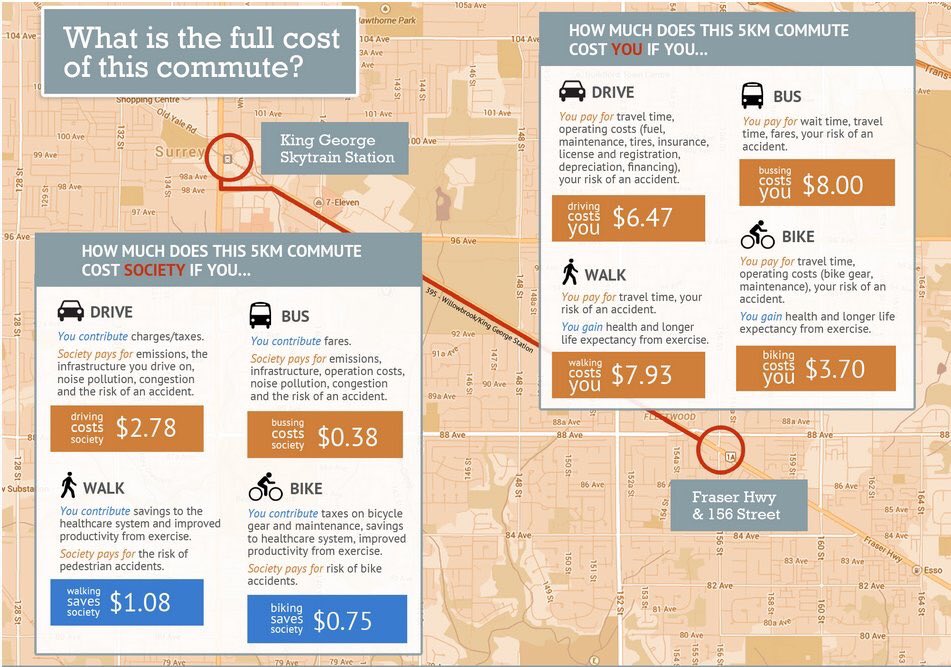
What’s the full cost of this 5 km #Vancouver commute?
Driving costs society $2.78.
Riding the bus costs society 38¢.
Biking saves society 75¢.
Walking saves society $1.08.
So who’s REALLY paying their way? #CityMakingMath Via @thediscourse HT @grescoe https://t.co/5UtEVbPe3v