In this first version, things are somewhat idealized -- fluxons travel perfectly ballistically, and (reversible) interactions are perfectly elastic. The simulation is (mostly) deterministic and 100% reliable, but there are a few (intended) failure modes which you may encounter!
The first simple version of this project -- an (educational) puzzle game that lets people learn and play around with the BARCS (Ballistic Asynchronous Reversible Computing in Superconductors) model of computation -- is now live at https://t.co/FMxiOXKojL. Give it a try!😃
I started programming around age 11, first at summer camps and then using a little TRS-80 Color Computer I had bought for myself using saved-up birthday and Christmas money.
But I got bored with coding by midway through grad school — it just wasn’t even challenging enough any more, and my friends and I had already won the world programming championships as undergrads back in ‘91 (ACM ICPC). Grinding away as a software engineer at some faceless mega-corporation held zero appeal for me.
That (together with a repetitive stress injury, thanks to Emacs and an old mushy Sparcstation keyboard) helped motivate me to focus more intensively on my research career and finish my PhD. If the field you spent the last 15 years becoming a top expert in no longer even feels challenging for you, then just try something harder, amirite?
That’s when I switched fields from CS/AI to the physics of computation, and began my 30-year journey into reversible computing research, which has been an endless source of challenges. Perfecting this technology is a never-ending quest; in reality, of course you can approach but never quite get to 100% efficiency. And even just doing well enough at it to crush SOTA conventional CMOS digital tech is already a magnificently difficult problem, as von Neumann might say.
But my point is, for those CS people and programmers who are going through an existential crisis right now because AI has made the focus of all of their previous cognitive effort seem so downright easy that it’s no longer interesting — welcome to where I was 30 years ago.
The solution, of course, is to do what I did — TRY SOMETHING HARDER. Programming is too easy, but you now have a certifiable genius-level AI at your fingertips, what can you do with that? What grand civilizational challenges are you now suddenly equipped to tackle? Instead of just moping around 😩 because you can no longer pay the rent by being a code monkey, THINK BIGGER. Today, no problem is too hard for a motivated, smart person to tackle. Just grab an AI, or a well-orchestrated agent swarm, pick a hard problem in any field, and go out there and conquer the world! 🦾😤✌🏼
AI is a wonderful enabler, and it’s never too late to reinvent yourself. So, go get em! 😁✌🏼
In ecology, one finds that the most stable ecosystems are always the most diverse ones, with many competing species.
Civilization works in the same way. Many powers, of many sizes. The notion of one world government was never really going to fly — it’s too prone to becoming corrupted (single points of failure and all that), so whenever one power starts getting too big for its britches, it meets resistance from others. So we have a multipolar world, and that’s probably for the best.
One sees this play out in crypto as well; it’s not healthy for the Bitcoin ecosystem for any one mining pool to have a majority of hashing power, so there are always at least a few large players.
I think the same will always hold true in AI as well. No one lab is going to outstrip all the others and become a singleton ASI. Everyone can see that this wouldn’t be a good thing for the world. (Absolute power corrupts absolutely, you know.) There will always be smaller labs, open source and so on.
So yeah, no one power is going to eat the lightcone; even if the big AI labs collude with each other, they will face resistance to any kind of play for total world dominance. The world does have other significant powers, and tech isn’t the entire pie, not by a long shot.
Haha it's kind of funny how the phrasing here almost makes it sound like I lead all of @SandiaLabs -- to be clear, obviously I don't, and I'm not currently even at Sandia right now, but on entrepreneurial leave at @VaireHQ anyway. 😊
A former student reminds me that in my research group back at UF, we were already writing papers envisioning automated agents everywhere about a quarter-century before AI agents were cool 😎
Cooling on Earth may or may not be more efficient. The cost of energy on Earth is increasing, while the cost of energy in space is decreasing, due to the cost of launch dropping orders of magnitude via Starship and solar being abundant and 6-9x more efficient in space. The energy crossover point is the key. The point of this analysis was to convey that radiation isnt the showstopper, it is a line-item, and not a physics blocker, as many assume.
Debunking the Cooling Constraint for Space Data Centers ❄️🛰️
We tackled one of the most persistent objections to orbital compute: “How do you cool data centers in space?”
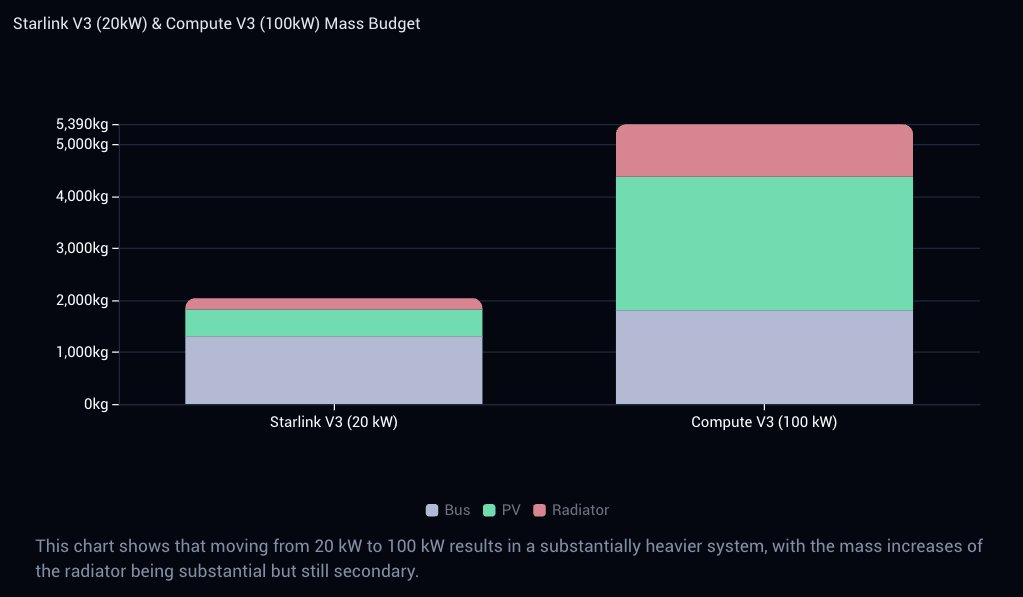
Using first-principles and Starlink V3 scaling (20kW > 100kW) as a reference, we show the cooling problem is widely misunderstood.
Key takeaways…
🌡️ Operating temperature is the dominant lever: small increases in radiator temperature drive large reductions in required area and mass.
📐 As Starlink-class platforms scale from communications-optimised @ 20 kW to compute-optimised @ 100 kW, solar dominates planform area growth; radiators remain a small, single-digit % of footprint. Theres a reason the @starcloud_ 5GW concept is dominated by a massive solar array, not a massive radiator.
⚖️ Mass is a more substantial trade. Even then, radiator mass stays secondary to solar arrays. At 100kw, radiators are only 10-20% of mass. Though, pushing toward lighter radiators materially increases system cost due to more advanced materials and designs.
🛠️ Radiator outcomes are an architectural choice: kg/m² and operating temperature swing mass and cost by multiples for the same thermal job.
🔫 It's time to retire cooling as a primary objection of orbital data centers. If you can launch the power, you can launch the cooling.
Full analysis and model here ���
https://t.co/7Jqfq1gedl
@ENERGY Genesis Mission tackling AI-powered science -> Platforms like C4E can complement this by optimizing energy use, integrating renewables, and making AI data centers more efficient and sustainable, powering discovery responsibly.
Researchers at Aalto University just made AI run on pure light.
No GPUs. No electrons. Just photons doing tensor math at 186,000 miles per second. Published in Nature Photonics on November 14th, this breakthrough could push AI into a completely new era by 2028.
The method is called single-shot tensor computing. They encode data directly into light waves (amplitude and phase), then let physics handle the calculations as light travels through the system. One pass. All operations happen simultaneously.
Your GPU processes calculations sequentially: step one, step two, step three. This optical system processes everything at once. Like inspecting 1,000 packages simultaneously instead of checking them one by one.
The math powering ChatGPT, image recognition, and every AI model relies on tensor operations. Aalto’s team figured out how to do these operations entirely with light. Multiple wavelengths handle even more complex, higher-order tensors.
Zero active control needed during computation. The light just travels and computes passively. No electronic switching. No intervention. The physics does the work automatically.
Energy consumption drops to near zero. No heat generation. No massive cooling systems. No server farms burning 2% of global electricity. Just light moving through optical pathways doing what it does naturally.
Dr. Yufeng Zhang estimates 3-5 years to real-world integration. That puts photonic AI chips in actual products by 2028-2030. Every ChatGPT query currently burns enough power to run your house for 30 minutes. This tech could cut that to basically nothing.
Professor Zhipei Sun says the method works on almost any optical platform. The computational framework integrates directly onto photonic chips. This isn’t theoretical anymore. This is the hardware revolution that makes trillion-parameter models actually sustainable.
🌞 The International Solar Alliance at #COP30 | Belem, Brazil
As the world unites in Belem from 10–21 November for @Cop30noBrasil, the ISA Solar Hub Pavilion will shine as a space where collaboration meets innovation, and bold ideas turn into real-world impact.
From catalysing the clean energy transition and building climate-resilient cities, to advancing solar for sustainable agriculture, our sessions will explore how solar energy is driving resilience, prosperity, and climate action across continents. 🌍
Join us at The ISA Solar Hub Pavilion and witness how the power of the sun is shaping a cleaner, brighter, and more equitable future for all.
🤝 Follow along for live updates, expert perspectives, and inspiring stories of #ClimateAction from Belem.
@GRIHACouncil | @IWMI_
#Cop30noBrasil #SolarForAll #SolarHub #CleanEnergy #VoicesForSolar #ClimateActionNow #OneSunOneWorldOneGrid #AmbitionToAction #SolarPower
Just a reminder that the sun shines, the wind blows, the water flows, and the Earth creates heat every day
206 days in 2025 so far with WindWaterSolar exceeding 100% of demand for part of the day, averaging 3.9 among all 298 days
And fossil gas is down 37.4% in 2 y
New Deepseek model drastically reduces resource usage by converting text and documents into images — 'vision-text compression' uses up to 20 times fewer tokens https://t.co/piP06DjTCW