Retinol has been the default "collagen stimulator" for 40+ years — but its mechanism relies on forcing micro-injury and inflammation to trigger cellular turnover.
You’re essentially irritating your skin into renewing itself.
GHK-Cu research points to a completely different route: a naturally occurring copper-binding peptide studied for activating collagen synthesis and tissue-remodeling pathways without that irritation cascade.
Same downstream interest. Completely different upstream mechanism.
Here is why that structural difference matters:
Retinol (Tretinoin/Vitamin A): Accelerates cell turnover through controlled micro-damage, which often triggers peeling, redness, and temporary barrier breakdown before the benefits kick in.
GHK-Cu (Copper Tripeptide-1): Functions as a biological signal, directly instructing skin cells to increase collagen/elastin production and upregulate repair genes—no structural damage required.
Instead of burning down the house to rebuild it, signal peptides simply hire a better construction crew.
If you want the anti-aging signaling without the barrier destruction, copper peptides are quietly becoming the most compelling alternative in modern skin biology.
For research use only. Not for human consumption. This is not medical advice.
Note: Not legal advice — given current FDA enforcement intensity, recommend a compliance/counsel pass before publishing.
Everyone quotes 28.3% for retatrutide. The numbers further down the same press releases tell a more complicated story.
(New to the TRIUMPH trials? We explained what they are in a separate post, linked in the first reply.)
Five findings from the Phase 3 program that rarely make the headline:
The number drops in type 2 diabetes.
28.3% came from TRIUMPH-1, which excluded diabetes. In TRIUMPH-2 (1,152 adults with type 2 diabetes, 80 weeks), the highest-dose arm averaged −20.8%. Same molecule, different population.
A sensory signal showed up.
Dysesthesia, an altered or unpleasant skin sensation, was reported in 4.5% to 7.3% of retatrutide participants in TRIUMPH-2, vs 0.7% with placebo. In TRIUMPH-3 it was 6.4% vs 1.3%. Lilly described the events as generally mild to moderate, with most resolving during treatment. Why it happens hasn't been explained.
More participants stopped at the top dose.
Discontinuation due to adverse events reached 13.5% in the highest-dose arm of TRIUMPH-3, vs 4.8% with placebo.
The heart-outcome question is still open.
TRIUMPH-3 enrolled 1,949 adults with established cardiovascular disease. The hazard ratio for major cardiovascular events was 0.82, with a confidence interval of 0.55 to 1.22. That interval crosses 1, so it shows neither benefit nor harm. Risk markers did move: triglycerides −37%, hsCRP −51%.
None of it is peer-reviewed yet.
Every Phase 3 number above is topline data from company announcements. The full datasets come later.
Known: large average weight reductions across five Phase 3 trials. Claimed online: "proven better and safer than everything before it." No trial has shown that.
Retatrutide is investigational and not FDA-approved. Lilly has said it plans to file in Q1 2027.
Which number surprised you? Reply below.
For research use only. Not for human consumption. This is not medical advice.
Sources: Eli Lilly topline release, July 23, 2026 (TRIUMPH-2, NCT05929079; TRIUMPH-3, NCT05882045). Eli Lilly topline release, May 21, 2026 (TRIUMPH-1, NCT05929066).
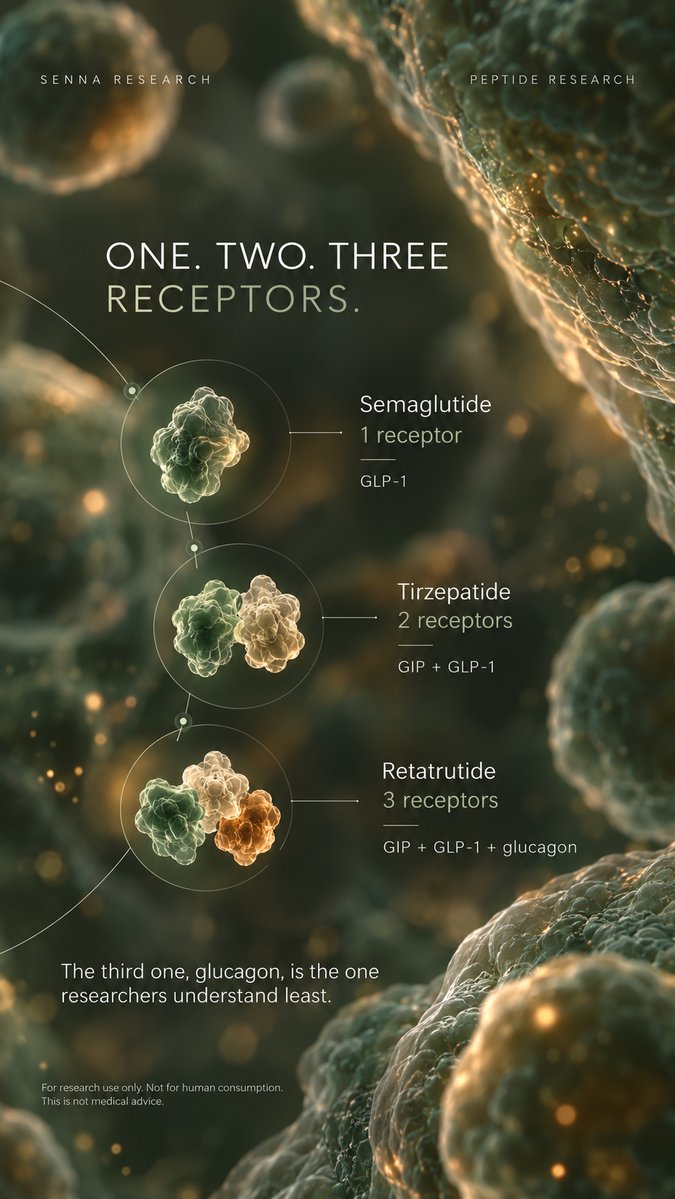
One receptor. Then two. Then three.
Semaglutide acts on GLP-1.
Tirzepatide acts on GLP-1 and GIP.
Retatrutide acts on GLP-1, GIP and glucagon.
More receptors is a design difference. Whether it's a better one is what the head-to-head trials are for.
Which receptor should we explain first? Reply 1, 2 or 3.
For research use only. Not for human consumption.
Retatrutide's 28.3% headline came from a trial that excluded diabetes.
In the trial that enrolled adults with type 2 diabetes, the same molecule averaged 20.8%.
Same peptide. Different population. Different number.
Save this before quoting either.
For research use only. Not for human consumption. This is not medical advice.
The semaglutide vs tirzepatide vs retatrutide chart is all over the timeline. It's built from three trials that never tested these compounds against each other.
Here's what each trial measured, and the one pair that has been compared head-to-head.
Semaglutide. One receptor: GLP-1.
STEP 1 (NEJM, 2021): 1,961 adults, 68 weeks. Mean body weight change of −14.9% vs −2.4% with placebo.
Tirzepatide. Two receptors: GIP and GLP-1.
SURMOUNT-1 (NEJM, 2022): 2,539 adults, 72 weeks. −20.9% in the highest-dose arm vs −3.1% with placebo.
Retatrutide. Three receptors: GIP, GLP-1 and glucagon.
TRIUMPH-1 (Phase 3 topline, May 2026): 2,339 adults, 80 weeks. −28.3% in the highest-dose arm.
(STEP, SURMOUNT and TRIUMPH are each compound's Phase 3 trial program. We explained what the TRIUMPH trials are in a separate post, linked in the first reply.)
One receptor, two, three. 15, 21, 28. It looks like a staircase, and that's the version that gets shared.
What the chart leaves out:
These are three separate trials. Different lengths, different participants, different years. Lining the results up is a collage, not a comparison.
The numbers aren't calculated the same way. The 28.3% estimates what happens when participants stay on treatment. The 14.9% and 20.9% count everyone, including those who stopped. Calculated the stay-on-treatment way, tirzepatide's SURMOUNT-1 figure is 22.5%.
Only one pair has gone head-to-head. SURMOUNT-5 (NEJM, 2025) ran tirzepatide against semaglutide in the same trial: −20.2% vs −13.7% at 72 weeks. Retatrutide has no completed head-to-head against either. TRIUMPH-5, against tirzepatide, is still running.
The third receptor is the least understood. Glucagon receptor activation raises energy expenditure in animal models. Whether that explains the larger number in people is a hypothesis, not a finding.
The bigger number came with more dropouts. In TRIUMPH-1, discontinuation due to adverse events rose with dose: 4.1%, 6.9% and 11.3%, vs 4.9% with placebo.
Two of these are FDA-approved medicines. Retatrutide is investigational. Its Phase 3 results so far are company topline data, not peer-reviewed papers, and Lilly has said it plans to file with the FDA in Q1 2027.
The staircase might hold up. TRIUMPH-5 is the trial that will actually test it.
Which of these trials should we break down next? Reply with the name.
For research use only. Not for human consumption. This is not medical advice.
Sources: Wilding et al., NEJM 2021 (STEP 1). Jastreboff et al., NEJM 2022 (SURMOUNT-1). Aronne et al., NEJM 2025 (SURMOUNT-5). Eli Lilly topline release, May 21, 2026 (TRIUMPH-1). https://t.co/rJ3OTthLsB NCT06662383 (TRIUMPH-5).
Semaglutide acts on one receptor. Tirzepatide on two. Retatrutide on three.
The third one, glucagon, is the one researchers understand least.
Comment if you want the mechanism breakdown.
For research use only. Not for human consumption. This is not medical advice.
@thegarybrecka Meal timing can influence sleep and metabolism, but the science is more nuanced than a strict 7 PM cutoff. Consistency matters more than the clock.
@hypertrophydad_ More frequent dosing doesn’t automatically mean better results. Retatrutide’s optimal dosing schedule and long-term effects still need clinical evidence.
@KleosOperator Optimization should never mean adding more compounds blindly. Understanding the evidence, risks, and long-term effects matters just as much as the potential benefits.
BPC-157 has no human trials." Not quite. It entered one. Then it went quiet.
Under the development code PL 14736, BPC-157 was taken into clinical testing for ulcerative colitis, delivered as an enema.
That's a clue to where its research actually started. BPC-157 is a 15-amino-acid fragment of a protein found in gastric juice, and most of its preclinical work is on the GI tract, not on tendons.
Known: decades of rat and cell-culture data across GI models, unusual stability in stomach acid, and angiogenesis and nitric-oxide signaling as proposed mechanisms.
Claimed: "heals leaky gut," "fixes IBD." None of that is established in humans.
Missing: complete published clinical results. The program never became an approved drug, and the human dataset people assume exists doesn't.
So the most interesting question about BPC-157 isn't "does it work." It's why a compound with this much preclinical research stalled at the exact point where human data would have settled it.
Theories welcome in the replies.
For research use only. Not for human consumption. This is not medical advice.
Sources: Sikiric et al., review literature on BPC 157 (PL 14736).
Collagen can't hold its shape without copper. Almost nobody talks about the enzyme that explains why.
Lysyl oxidase cross-links collagen and elastin fibers. It's what turns loose strands into a stable, load-bearing matrix. It's copper-dependent: without bioavailable copper, there's no cross-linking.
Two pieces of basic biochemistry that connect here: • Vitamin C is a required cofactor for the enzymes that stabilize collagen before cross-linking. That's why scurvy breaks down connective tissue. • Zinc and copper compete for absorption, and long-term high-dose zinc is a documented cause of copper deficiency.
That's the context GHK-Cu research sits in. GHK is a tripeptide with an unusually high affinity for copper. One hypothesis in the literature is that part of its activity comes from carrying copper to the tissue where copper-dependent repair enzymes work.
It's a hypothesis, not a settled mechanism. But it helps explain why this peptide keeps showing up in collagen research when most don't.
The full source list for every post we publish lives in the Senna Research Discord. Link in bio.
For research use only. Not for human consumption. This is not medical advice.
You hit 30 and suddenly skincare isn't just for aesthetics anymore. It's preventative maintenance. 💀
GHK-Cu is one of the more interesting peptides being investigated in skin biology.
It's a naturally occurring copper-binding peptide that researchers have studied for its potential role in collagen synthesis, tissue remodeling, and wound repair.
Why does that matter?
As we age, collagen production and skin repair processes change, contributing to wrinkles, reduced elasticity, and slower recovery.
Preclinical research suggests GHK-Cu may influence some of these pathways, while small human studies of topical formulations have explored its cosmetic potential. There's still a lot to learn, especially about long-term effects and different delivery methods.
@Bulkpeptide Great point. Tracking report dates and revisions is essential for traceability. Keeping a clear record of superseded versions alongside the current lot report helps maintain transparency and accountability.
99% pure" is the most repeated number in this market, and the least understood.
On a COA, purity usually comes from HPLC. It tells you what percentage of the detected signal is a single peak. It doesn't tell you what that peak is.
A sample can read 99% on HPLC and still be the wrong sequence, a truncated version, or the right molecule in the wrong amount.
A COA worth trusting shows three separate results:
Purity (HPLC): how much of the sample is one compound
Identity (mass spec): whether that compound has the molecular weight it should
Quantity: whether a 10mg vial actually holds about 10mg
Then check the boring details: a named third-party lab you can look up, a lot number that matches the vial, and results that vary from batch to batch. A COA that never changes isn't testing anything.
Every Senna Research batch COA is published by lot number. Link in bio. Compare it against the vendor you're using now.
For research use only. Not for human consumption. This is not medical advice.
@Nithya_Shrii Facts! Just look how much running exploded in the past 5 years. Now everyone and their mom is signing up for marathons! Whether it was the run clubs, content creators, or Wiz Khalifa, somehow they made running in circles look appealing.
The Professor woke up and chose violence.
Calling BPC-157 overrated in front of Pep is CRAZY work.
BPC-157 vs. GHK-Cu — which peptide has the more interesting research behind it?