I feel healed. Not sure what happened. Almost 4 years of excruciating pssd. Today I find myself falling in love. It's surreal. Muscle fatigue, gone. Sweating, gone. Tremors, gone. Social anxiety, gone. No meds. no supplements.
Drugs, Mood and Sex.
How could drugs NOT cause violence, anhedonia and sexual problems?
This is a difficult concept to put into words. Some people will be clearly offended although that is not my intention. I want to show the obvious with this post.
It's all sex. I honestly can't find an example where consuming a psychiatric drug doesn't cause mood problems, anhedonia and sexual difficulties. It helps if we establish some foundations.
Dopamine, testosterone and estrogen pathways in the body are all linked in some form. This means any drug that changes mood, hair, acne, reproduction cycles will cause anhedonia and agitation. I use the word "will" intentionally. It isn't a case of could. They do cause these problems, whether you notice it happening or not. It's a case of intensity of the change.
Now for the the offensive bit. Ever notice serial killers are frequently sexual sadists? How about the gay community having higher levels of drug use and pychriatric disorders than national levels? People with low mood have less intercourse? Certain types of drug abusers will have more sex than normal? When you develop anhedonia, did you notice your ability to feel compassion and sexual function decreased greatly?
When you look to the transgender community, the metrics explode. I quickly pulled some figures, they should be accurate enough to use as examples. This group sits at 80%+ have been suicidal, 40%+ have made suicide attempts, and roughly two-thirds have major depression diagnoses. Drug abuse is also high in this group.
Everywhere we look, sex, drugs and harm are tied together. For drugs to calm a person down, they must by default, also dampen sexual function. It simply cannot be avoided due to the overlap in pathways in the brain, in particular dopamine. The worse the violence is, the worse sexually related outcomes are. Serial killers project their problems outwards, transgenders project their problems inward. I group transgenders in the violence group due to the act of removing body parts. Cutting off healthy tissue is listed as "nonsuicidal self-injury (NSSI)" It's just we framed the act of a M.D. doing the cutting as healthcare.
If we look to prostitution, again there is a stronger than normal association for violence found there. We even see it in animal mating rituals where the males will fight each other for reproduction rights. For some species the act of mating is suicide.
Taking a SSRI reduces sexual function and produces apathy. If you are a parent your ability to produce children is weakened and your ability to feel love and compassion towards your child is also diminished. The two are inherently linked. So is it anyone surprise that contraceptive drugs leads to depressive diagnoses and SSRI's being prescribed?
Also drugs that increase focus are often linked to increased sexual arousal. Anything that gives dopamine activity a bump upwards will generally do the trick. Given SSRI and antipsychotics reduce dopamine levels and activity on receptors is associated with brain fog. Is it really a revelation that low dopamine produces brain fog and sexual dysfunction? Or drugs that give dopamine activity a bump up are reported to improve focus such as coffee?
While what I'm writing is general rules of thumb they don't always hold true. There is a lot more happening in the brain, most of it we don't understand. Alcohol another drug we like to abuse. We built a society around it's use. Acutely it raises dopamine and makes people more sexually active, it also has the effect of causing sexual dysfunction and reduces concentration.
Many men will abuse alcohol effects to help them last longer during intercourse. Unfortunately it can make people aggressive, and it really does lower IQ. At least until sobriety is achieved and withdrawal symptoms have subsided. Anyone living with an alcoholic knows how bad it can be at times.
These are just some thoughts. Sex, drugs, anhedonia and agitation are linked together. This cannot be avoided. It also why your diagnoses or underlying complaints don't matter to your prescriber. This makes psychiatry observational and there is no blood test or brain scan. The treatment is always the same, suppress brain communication channels and lower dopamine activity. In doing so you will reliably settle the person down, produce apathy and sexual dysfunction.
I hope this confusing mess of a post helps you see how these problems tie together. If you take one thing away from this. Labels such as PSSD, PAWS, PFS, protracted withdrawal, brain fog, anhedonia, memory impairment are all related.
Only the duration and intensity of the experience varies. Everyone who takes a SSRI has emotional and sexual dysfunction. But due to brain impairment the drug induces, makes it difficult for the person on the drug or in withdrawal to appreciate what has happened to them.
Our individual subjective interpretation is what makes people believe the drug has different effects. Plus pharmaceutical propaganda fanning the fire. The drugs don't work for one person and fail for the other. If you are actively suicidal and the SSRI weakens your ability to feel negative emotions, you may report it works. If you already have anhedonia and the SSRI makes worsens it, you may report the drug doesn't work.
In both cases the SSRI still had exactly the same effect. The subjective experience of the two different cases produced different perceived outcomes. The SSRI did not work differently for people due to biological differences. Our biology will influence the intensity of drug effect. In everyone the SSRI will plug up the SERT and desensitize 5-ht receptors in the same manner.
Anhedonia, cognitive, and sexual dysfunction I suspect is rampant in society due to SSRI and antipsychotics. I think we have been miss identifying the problem until now.
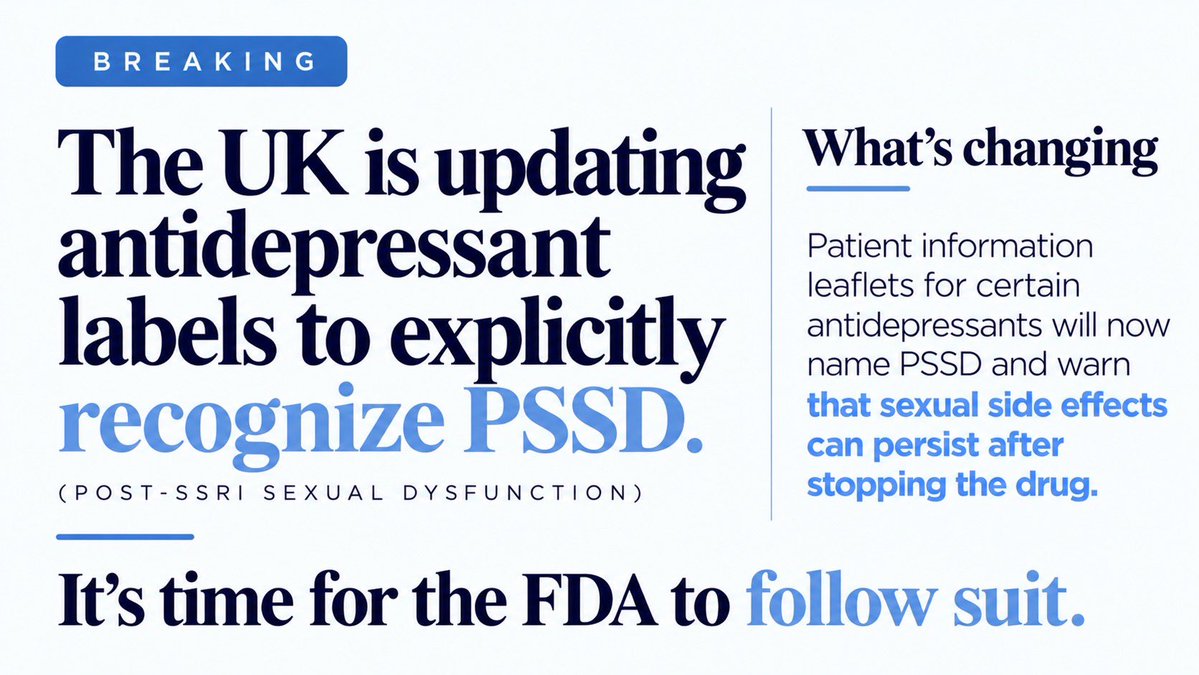
The UK is updating antidepressant warnings to recognize PSSD (post-SSRI sexual dysfunction) and acknowledge that sexual side effects can continue long after stopping treatment.
It's time for the FDA to follow suit.
But sadly this still isn't enough. These injuries extend far beyond sexual dysfunction, causing devastating, lasting cognitive and emotional impairments.
People deserve to be fully informed about what they are risking before making a decision that could potentially affect them for the rest of their lives. @PSSDNetwork
President George Bush Sr. Cocaine, CIA And Antidepressants
From January 30, 1976 to January 20, 1977. He was the director of the CIA.
In the late 1970s cocaine was informally recognized by USA agencies as a serious problem. It was formally acknowledged by the government in 1985 and peaked nationally as crack cocaine in 1989.
After he left the CIA. From 1977 to 1979, George Bush Sr was a director at the Eli Lilly. In 1976, Eli Lilly started clinical trials of fluoxetine.
While the cocaine crises was developing in the United States. Eli Lilly was developing SSRIs. Here's the Rub.
When you take cocaine it boosts confidence and focus. It's a stimulant due to dopamine reuptake inhibition. It is also a local anesthesia, meaning it numbs your skin and it also causes sexual dysfunction.
When you quit cocaine it causes focus and memory problems. Depression, anxiety, panic and paranoia. There are additional symptoms such as agitation, pacing, tremors and abnormal nerve sensations. When the symptoms strike they are dependant on dosing, and where you are at in withdrawal.
Recovery from cocaine is often in the 6-12 month range for cognitive symptoms heal. Long term heavy users, it can extend to 2 years plus range.
Anhedonia, anxiety, sleep disruption, poor concentration and memory are core features of post acute cocaine withdrawal and is commonly accompanied with sexual dysfunction.
Strange isn't? Cocaine and SSRIs have highly similar withdrawal profiles. Also both drugs are reuptake inhibitors.
It's as if Eli Lilly ties to the CIA and government used their connections while witnessing the effects and addiction potential of cocaine on a national scale. They just happen to develop a drug that replicates a component of cocaine. It wasn't long before additional pharmaceutical companies added their own drugs formally copying all the effects into pill form. The components copied being serotonin, norepinephrine and dopamine reuptake inhibition.
These pill forms are commonly known as Paxil (SSRI), Effexor (SNRI) and Wellbutrin (NDRI) to name a few.
While I'm confident they will never admit it, pharmaceuticals and psychiatry likely knew the whole time about antidepressant withdrawal. I'm mean how couldn't they? They would of seen what was happening in New York and Los Angeles during the cocaine crisis. I think they found a highly profitable cash cow and decided to cut in on the drug cartels action and moved the effects of cocaine into pill form and listed it as medicine. This made it legal.
There is no biological test for depression or method to withdrawal people form these drugs as their doesn't need to be one. Pharmaceuticals had all they needed from monitoring the cocaine crisis unfold in the United States. Replicate the effect and leave the drug in the brain chronically is all that was needed. Keep people on the drugs and the patient claims they feel fine. Remove the drug and it goes horribly wrong for them.
From this point you blame the persons underlying mental illness when they complain while trying to discontinue the drug and provide unrealistic recovery time frames like 4-6 weeks and down play their symptoms. When in truth it's usually 6-12 months minimum to recover from both cocaine and antidepressants.
There you have it. This is what psychiatry does. They move known drugs of abuse into pill form then they blame you for what the drug did. The research studies, and questionnaires and the infamous "check lists" It's all a show.
Prescribing their drugs is as easy as a gentle breeze. Start with a normal dose of a SSRI and keep adding stronger drugs until the person stops complaining. That's it! That's 95%+ of the prescribing practice.
The remaining few percentage points the drugs are warranted. Oddly enough in those cases it usually isn't the antidepressant class you prescribe. I would argue giving a person in catatonia a benzodiazepine is compassionate care. But leaving them on the drug for 2 years and risking the development of neurological disorders cruelty.
I feel healed. Not sure what happened. Almost 4 years of excruciating pssd. Today I find myself falling in love. It's surreal. Muscle fatigue, gone. Sweating, gone. Tremors, gone. Social anxiety, gone. No meds. no supplements.
A little update of where I'm at with PSSD and psychiatric drugs I have been posting. I'm nearly done wrapping up the SSRI related items. I need to put together an evidence post that supplements the pinned article.
From here I'll have to push to get it taken seriously and lean on spreading the information through the PSSD community and getting the information in the face of doctors. The hypothesis, treatment and evidence will be completed to the best of my ability using current factual data from research papers.
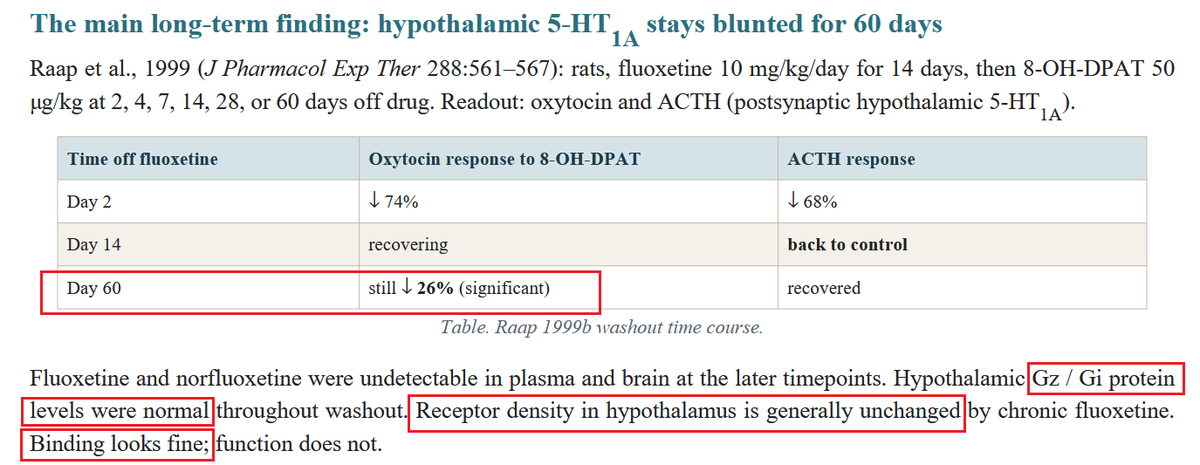
I do have some strong evidence. The image implies receptor uncoupling long term in the brain of rodents.
This is a small clipping. G-protein was fine and the receptor density was fine. But on day 60 after SSRI washout the Oxycontin was still down by 26%. Thus the signal is blunted and implies uncoupling.
This is one way how I'm able to suggest that people in PSSD has to much Serotonin throughput in their brains.
I will try to make it clearer in the coming days. Then we'll need to get a lot of eyes looking at the information. Unfortunately the article will have to remain in it's systematic manner for professionals to take it seriously.
@KevinRo90321458 Unbelievable. I'm just astounded with where I was and where I am. Feels like a miracle. So much has changed and improved since my tiny doses of Buspirone and cyproheptadine. Don't understand it.
@KevinRo90321458 My beard hair got very grey over the last few years. I have historically had very thick, dark beards. It got to a point where I was getting embarrassed about it. 38yo. I swear since I started feeling better it has been darkening! Also sex drive has gone through the roof. 🤯
@KevinRo90321458 Good to know. My research pointed me hard down similar paths to what you are chasing but you are much smarter than me! Ok I'll keep my eye out.
SSRI / PSSD effects - Receptor uncoupling explains everything.
While I'm still working out how proteins are exactly interacting with the effected cells. This looks like the underlying problem that is driving PSSD.
The receptors that are uncoupled can't re-couple it appears to be due to Gαi/o depletion. Which is 1 of 3 proteins that make up the G protein. The other 2 are Gβ and Gγ.
Quote:
"The levels of G(o) and Gi2 proteins in the midbrain were significantly decreased after 3 days and remained reduced for the duration of fluoxetine injections. Fluoxetine did not reduce the concentrations of Gi and G(o) proteins in the frontal cortex at any time."
https://t.co/4RH7MJY5A5
There is a few studies done on G-protein, and diving deeper into the mechanical nature will be a follow up post to this one. For disclosure here is a couple supportive links.
https://t.co/AvZSDSPlES
https://t.co/FR5AgjC9kk
The shorthand view is this. When the receptor is chronically occupied, in this case 5-HT is plugging up the 5-HT1A. It changes the shape Gα is in. Creating a more favourable environment for it to be destroyed. I'll give the details in the next post once I understand it better. The end result is the protein making more trips to the proteasome which chops it up.
This effect keeps the 5-HT1A receptor decoupled. It's happening to at least the 5-HT2C and 5-HT1B.
For example if you look at 5-HT2C in the amygdala. You get a solid picture of why and you can repeat the process to explain many of the drug effects.
5-HT2C activation in the amygdala = Anxiety up
5-HT2C decoupling in the amygdala = Anxiety down
When you look at the drug from this vantage point. While factoring in GABA, NE, and dopamine changes. It's becomes pretty easy to see why people flip in and out of akathisia and anhedonia as a result of these drugs.
I should mention this amygdala example only explains anxiety when starting the drug, Think of the 5-HT2C in this brain region as a volume knob on your emotions. Thus once it decouples you become emotionally flatter which reduces anxiety.
With the 5-HT1A decoupled on the serotonin neuron it tells it to fire faster. The 5-HT1B decoupled on the same neuron tells it to release more 5-HT each time it fires. While these receptors stay chronically occupied. The destruction of Gα remains elevated.
This negative feedback loop also explains why people report temporary improvement from Buspirone then eventual failure as they revert back to their previous PSSD state.
Buspirone occupies the 5-HT1A receptor. Its effect somewhat follows the same process when you start a SSRI. Increased signal on this receptor at first slows 5-HT release and some improvements from PSSD is gained. Then the chronic activation of the 5-HT1A would further decouple the receptor wiping out what was gained and there would be a return of symptoms.
Once I have the mechanical nature of the G protein sorted out. We may finally have good insight into what is happening to produce PSSD symptoms.