Every AI: “I can’t do that.”
@elonmusk@SpaceX@grok : “Mars? Zufiks? Paint guns? Say less.” 🚀🎨Made in minutes. Reply with your wildest ideas and I’ll feed it to https://t.co/d4XVDYXO1k and @Grok next. 👇
Technical completion is not scientific validation.
UHBSE structures longitudinal clinical data into source-aware individual states. Next: leakage-free event-probability modelling evaluated separately across sources.
Intervention response and clinical use come later.
https://t.co/kQysLcsAZw
Transitions are not a trajectory model.
We already built and accepted the longitudinal transition dataset as technical input.
The next gate is narrower: correct the event-probability layer’s risk sets, calibration evaluation, boundary horizons and pre-test freeze before carrying claims forward.
We don’t think human biology should be represented by one giant model that always returns an answer.
A useful biological simulation system needs separate layers for:
*state
*trajectory
*time-to-event
*applicability
*uncertainty
and eventually intervention response.
Different questions require different evidence.
Sometimes the correct output should simply be: not enough support to simulate this
So what can MIO actually do?
✅ Tasks parents assign (even by voice)
🪙 Coins kids earn & save toward goals
🎁 A reward shop you fill yourself
🏆 150 achievements & streaks
💬 Family chat + live location
All built around MIO, a mascot kids care for.
https://t.co/2VGnoj3eTy
https://t.co/i7pZnuuaAT
One day, we challenged ourselves with a question: Why are there so many kinds of simulators, yet no simulator of human biology that can predict the potential effects of an intervention before it actually happens?
I’m talking about medications and treatments that doctors prescribe based primarily on what they learned in medical school and through clinical practice in their specialty.
The world is moving incredibly fast. Several years ago, we decided to join that race and show that treatment outcomes can be modeled in advance—without exposing patients to unnecessary risk or experimenting on people.
#Biotechnology #StartupValidation #health #startup
Modeling has already been recognized by the FDA as a tool that complements laboratory, animal, and clinical research, and the ICH M15 establishes the requirements for evaluating and documenting model-informed evidence.
FDA (https://t.co/VzjuUueluq),
ICH M15 (https://t.co/a1S7BdoRRU)
@FDA@FDArecalls@FDADrugs@FDataAnalysis
#uhbse #bioengine
A connected pilot source contains longitudinal records for 43,856 subjects.
Eight thousand five hundred eighty-eight had three or more appointments.
Eight thousand two hundred sixty-two also had laboratory history. From that eligible set, one hundred subjects entered the first bounded technical cohort.
The source also holds sixty-eight point one thousand appointments, eight hundred seventy-four thousand laboratory result records, and one point three seven million result items. Volume alone is not enough. Longitudinal structure is what makes simulation testable. These are aggregated counts from one connected pilot source.
No patient record is displayed.
@SergeyNarykov@uhbse_engine
We are building a research-grade trajectory engine designed to reconstruct a current state, test model applicability and compare possible branches with uncertainty. Clinical use would require separate validation stages.
Let me be clear from the beginning: @uhbse_engine is not a medical chatbot, an electronic health record or a finished “digital twin of the human body.”
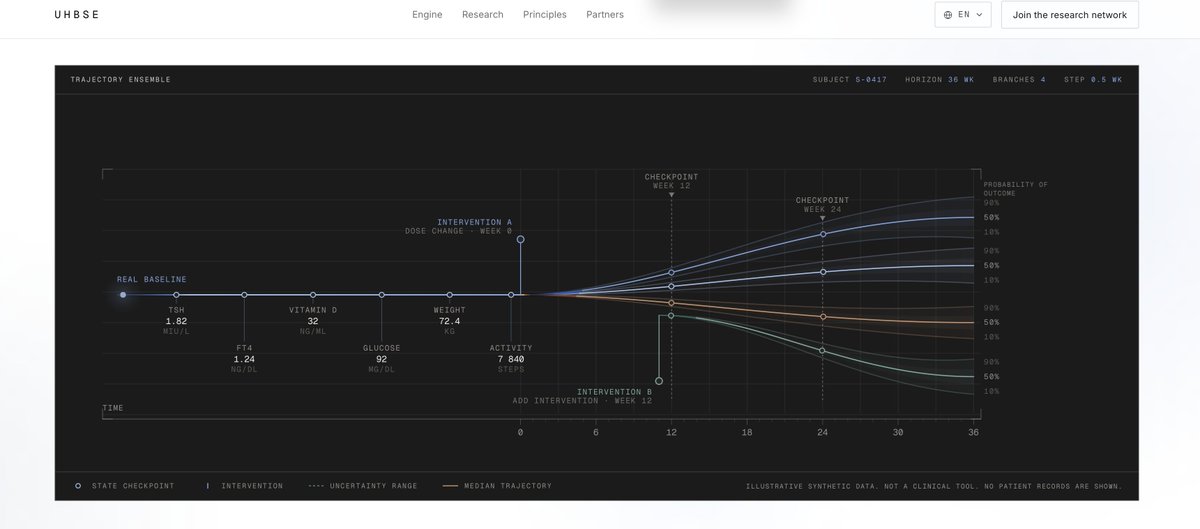
A treatment decision is rarely a single event.
A dose may change today. Another intervention may be introduced weeks later. Meanwhile, the patient’s physiological state continues to evolve.
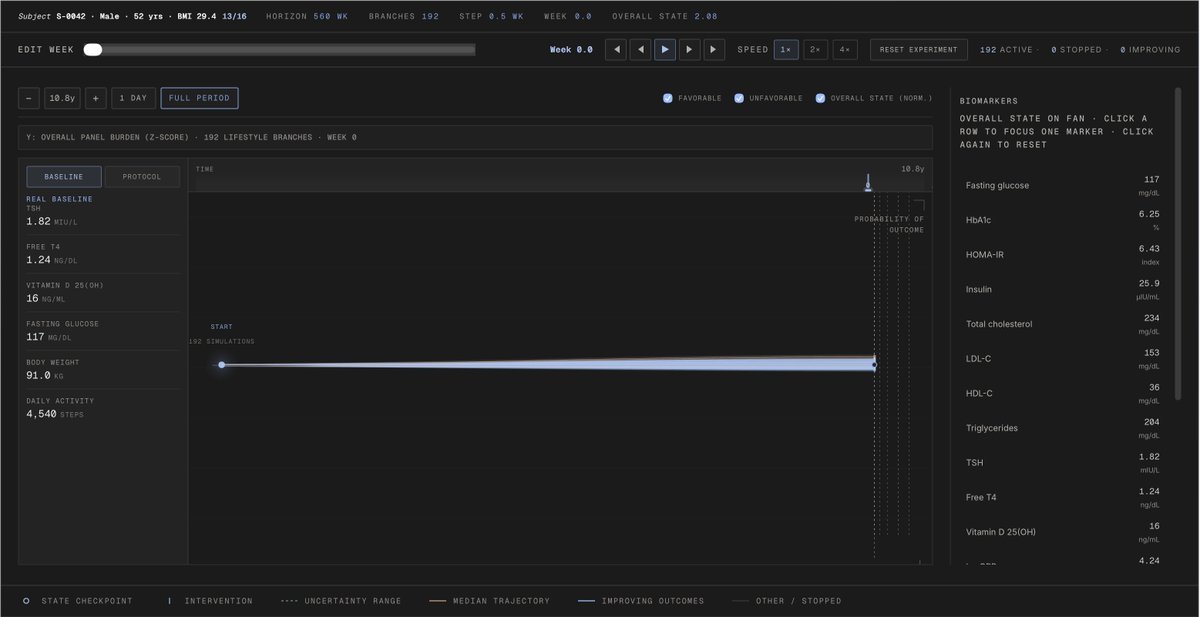
This UHBSE prototype view shows how we approach that complexity.
UHBSE is not a finished product—we are still building and improving it every day. It is no longer just an idea. We have a functional prototype, a clear methodology, and a real foundation for independent validation. Next to prove where it creates measurable value @a16zBioHealth
Modeling has already been recognized by the FDA as a tool that complements laboratory, animal, and clinical research, and the ICH M15 establishes the requirements for evaluating and documenting model-informed evidence.
FDA (https://t.co/kslkF4T7Jw),
ICH M15 (https://t.co/QAWr8t26XS)