@ALikhodedov@GringoInvesting The worst thing with Chernobyl scale event is that government will try to hide everything, and no one will be responsible.
Bad analysis spreads fast.
“Global food prices are rising because of:
* Surging energy costs (fair)
* Freight costs (wrong - higher freight is bearish)
* Disrupted grain flows through the Strait of Hormuz (wrong again - the Gulf is an importer, so disruption should be bearish)
* Disrupted fertilizer flows (OK)
So two out of four points are wrong - and fintwit still runs around with its hair on fire shouting that wheat should double next week…
#oatt #sizovreport
I would go for Brent - I think, provided that Trump continues his "excursion" for another 2-3 weeks and the Strait does not open until May or later, this will pretty much guarantee high prices for a year and pretty high at least for another one.
He, like the market clearly does not understand that simply by increasing the stock draw he already creates the problem -which won't resolve immediately or even in a few months after SOH starts operating normally.
In these circumstances administration will be very tempted to declare national emergency and restrict crude and/or product exports .....
Are #wheat importers getting a bit nervous? Egypt (#1 global wheat importer) has just raised internal procurement prices to boost strategic reserves.
[As noted in recent weeks, if I were a wheat importer, I would be thinking about hedging / locking prices for 2H 2026 and possibly beyond.]
-----
Reuters: Egypt raises local wheat procurement price amid a push to shore up reserves. Egypt increased its procurement price to 2,500 EGP per ardeb (150 kg) for the current harvest, up from a previous range of 2,250���2,350 depending on quality.
Authorities target 5 MMT of local wheat this year. Last year, purchases reached 3.9 MMT vs a 4–5 MMT target.
#commodities #foodsecurity #egypt #oatt #sizovreport
It’s truly astounding how much of a delusion the rates desk folks are living in. I get it. Hope is a fine thing, and inertia is something that never fades easily.
You guys were completely wrecked this quarter, and since you’ve been spouting nonsense like "nothing will happen," I understand your desperate scramble to hijack the next narrative.
Yes, demand destruction is real. However that destruction is never linear. Supply and demand are never perfectly proportional to each other. It’s not as if one breaks and the other immediately recalibrates to settle into an equilibrium.
They react by saying, "Rising oil prices? Won't that eventually dampen consumption and demand, leading to a recession?" and then they bet on falling rates or try to dump cyclicals.
Consequently, on Friday some participants played out a scenario of pushing prices up, counting their chickens before they hatched by thinking, "High oil → economic burden → the Fed will get spooked and cut rates three times, right?"
And those trapped in long duration have started blabbing with renewed hope. It’s a total comedy where reality and market expectations are completely out of sync. They aren't accounting for the lag at all.
In contrast, the Fed will hold the line and won't cut rates until inflation is firmly under control and demand has completely broken.
When the market starts getting too far ahead of itself, it creates a paradox that actually undermines the very conditions for a rate cut—yet they aren't even considering that. It’s pure cognitive dissonance.
They compare this to 2022, but: 1) In 2022, the actual supply loss of crude was negligible, whereas now it exceeds 10mb/d; 2) Oil demand, in particular, has a very high share of inelastic demand; 3) Even if demand destruction follows, there is a lag of at least several months before finding an equilibrium.
Please, wake up. It’s true that the fancy rhetoric of finance governing the real world has been very effective until now. However, this time, the aftershocks of the real world are transitioning into finance—do you still not see the difference?
You will all regret this bitterly soon. You still don't realize how dangerous the idea is to skip over all the time-consuming processes just to front-run a distant future outcome.
#oott $tlt
OIL SUPPLY LOSS
It seems that many people without oil background simply do not understand the size of supply gap we are staring at.
One thing that (some) generalists do not get is that opex commodities are very different from paper assets. Equity of a company, that is not making money can trade on loftly expectations for years, but with opex commodities like oil or gas you can hit the constraints of either storage (as in 2020) or inelastic demand and reality will punch you in the face.
So let us do some numbers.
By the end of March we will lose 200mb of crude production and some condensate/NGLs (say, 30).
After that each week we will be losing 85mb of crude production and 15 of condensate/NGLs - 100mb in total. This is assuming redirections work better than they are now (5mbd across Yanbu and Fujairah) and Iranian barrels continue coming at the same pace.
I am a relative optimist wrt current situation and always assumed, similar to @Rory_Johnston that this will be resolved one way or another, because the consequences of Hormuz being blocked for a long time (3mo+) are catastrophic. I do not know how - maybe EM countries will make arrangements with Iran or maybe Iran would scale down the threats, does not matter.
Let us assume the meeting in Islamabad at the end of the week indeed happens. I do not see why Iran would immediately agree and reopen the Strait - it is clearly to their benefit to drag their feet (more leverage, higher price). And even if Ghalibaf is indeed a Delcy Rodriguez type of character (as some are suggesting) he is not in a weak position and does not need to surrender immediately. I imagine they could continue "productive talks", let 1-2 tankers through here and there, but delay the full resolution.
So I assume negotiations won't end immediately and anything resembling normal flow through the Strait won't resume immediately. Say it takes another 3 weeks. I do not see Gulf producers resuming production before it is clear that the Strait is open. Argus said that restart would mostly be quick, but probably not everywhere (although they do expect full production recovery - similar to 2022). So we are probably - at best - looking at end of April for resumption of normal flow. Better scenarios are not impossible, but seem quite unlikely.
So it is easy to see how we lose 500-600mb of production in what is far from the worst case scenario.
This will hit mostly OECD inventory, which was not high to begin with (last year surplus went mostly to China or oil on water, which is being consumed now).
Then, unless Iran completely surrenders control over the Strait it is likely that there still will be some disruptions. Also I imagine risk premium will be high (at the end we just saw the biggest calamity in history of oil & gas markets). Countries would probably need to increase SPRs - e.g. I do not see how India will be comfortable with virtually no SPR.
And I did not even mention the nontrivial transportation mess we are in or the "flow" problem (it is not just inventory, but the fact that we cannot get the inventory we have - such as SPRs fast enough).
Supply response outside of OPEC would be neglible in the first few months.
All that could easily guarantee high prices for quite some time.
Then there is LNG - where Qatar restart will take months, not to mention damage to 17% of their capacity ....
And fertilisers ....
That is why all commodity specialists from permabulls to permabearish IEA are raising alarms.
There is a ton of landlocked CA imports + first call on Venny… and if the difference between WTI and ex -US grades is huge I am sure refineries will blend in light sweet or maybe even run on it - even though it is not efficient. All the arguments about crude quality are valid, but not when LS is massively cheaper
Collapsing liquidity in refined product futures cud have major implications. Asian jet traded $225/bbl - possibly the highest price ever paid for oily product. If refineries start stopping out on short hedges because of margin calls and can't sell futures, then who will?
#OOTT
We’re all bogged down in the daily grind, but my buddy @PauloMacro just dropped a solid reminder of the 2022 analog.
On the day of the Russia invasion, the S&P 500 gapped down but somehow finished up +1.5%, retested those lows, and then rallied into the end of the quarter. Only then did it absolutely crater through mid-2022.
and Oil spiked ~$8/bbl from $92 to $100, but gave it all back to close flat. The very next day, it was trading at $90—lower than the night before the invasion. Then, just 6 days later, it touched $130.
The big difference here? Russia was exporting 4-5 mb/d back then with zero actual supply loss; they actually pushed more crude onto the water throughout 2022.
Meanwhile the Middle East exports ~15 mb/d through Hormuz, and right now, flows have basically stopped. And unlike Russia, there’s no floating storage to act as a buffer.
That’s the whole story. We should probably stop getting so bogged down in the daily noise and focus on what's actually going down in the real world.
History doesn't have to repeat the 2022 playbook, but it’s definitely something to chew on.
#oott #com
I just got back from Tel Aviv. My thanks to those who worried about me and to the officials who helped with my return flight.
A few thoughts:
1) The Strait of Hormuz is experiencing a bottleneck, but it won’t be 100% physically blocked. As many of you know, that is an extremely difficult task.
The best move for Iran is to push the risk to the extreme so that tankers avoid it on their own. Remember, the Strait of Hormuz is a lifeline for Iran as well.
Even so, charterers are pressuring shipowners. Considering the current freight rates, some tankers willing to take the risk will turn off their AIS and dash through the Strait at full speed during the night.
It looks like some small vessels have already passed through. Most tankers Aframax or larger still seem to be hesitating for now.
2) I had a chance to talk with some Egyptians while passing through Cairo, and they were worried about the US strategic goals and exit strategy.
I assumed the top US officials had a macro plan, but after watching Hegseth’s speech yesterday, I have serious doubts. No clear exit strategy is visible at all.
He kept up the aggressive rhetoric to defend himself and the admin, but it only made me feel more strongly that they are actually panicking.
3) With South Korea’s gas inventories hitting a 5-year low, KOGAS—whose Qatar contract has gone up in smoke—is reportedly starting to lose its mind. Current gas stocks are extremely low.
As KOGAS, the world’s largest single gas buyer, falls into a panic, massive chaos is expected in the global LNG market.
4) Russia is also having issues. According to a dark fleet operator in Dubai, one of his ships is currently in Novorossiysk, Russia, where the terminal has been closed for five days following a Ukrainian drone attack. This is adding further pressure to an already unstable market.
5) I know there are various speculations about Iran's current missile inventory.
However, according to local South Korean media reports, the US is considering moving South Korea's Patriot and THAAD batteries to the Middle East.
This is highly significant because the THAAD system was deployed in Korea back in 2016 despite extreme public opposition and serious diplomatic friction with China.
It is a tool so vital for deterring China in the Far East that it was worth taking those risks. China reacted fiercely because they knew the AN/TPY-2 radar of the THAAD system could monitor their ICBMs.
The fact that they are considering moving such a precious strategic asset, deployed through such a process, to the Middle East speaks volumes.
Iran has to consider a long-term war; do you really think they would throw away all of their most precious strategic assets in just a few days? That is preposterous.
It is worth reminding ourselves that air defense missiles are several to dozens of times more expensive than attack missiles and are consumed at an incredibly fast rate.
Until just a few days ago, we saw countless concerns about the US manufacturing crisis and the procurement of weapons and warships.
Yet suddenly, many ppl are speaking as if air defense missiles are infinite while Iran’s attack missiles have run dry.
The intelligence and bombing capabilities of Israel and the US are impressive, but they can't perform miracles. If they really had everything under control, where did the enriched uranium inventory go?
Iran’s ballistic missiles are very cheap and easy to manufacture. Worrying about the air defense missile inventories of the US, Israel, and the Gulf nations should come first.
6) The Iranians will feel they have been deceived; do you really believe they will readily come to the table?
The same ppl who were shouting that peace would come last week are once again saying that negotiations are imminent. I hope they feel at least a modicum of shame.
#oott #iran
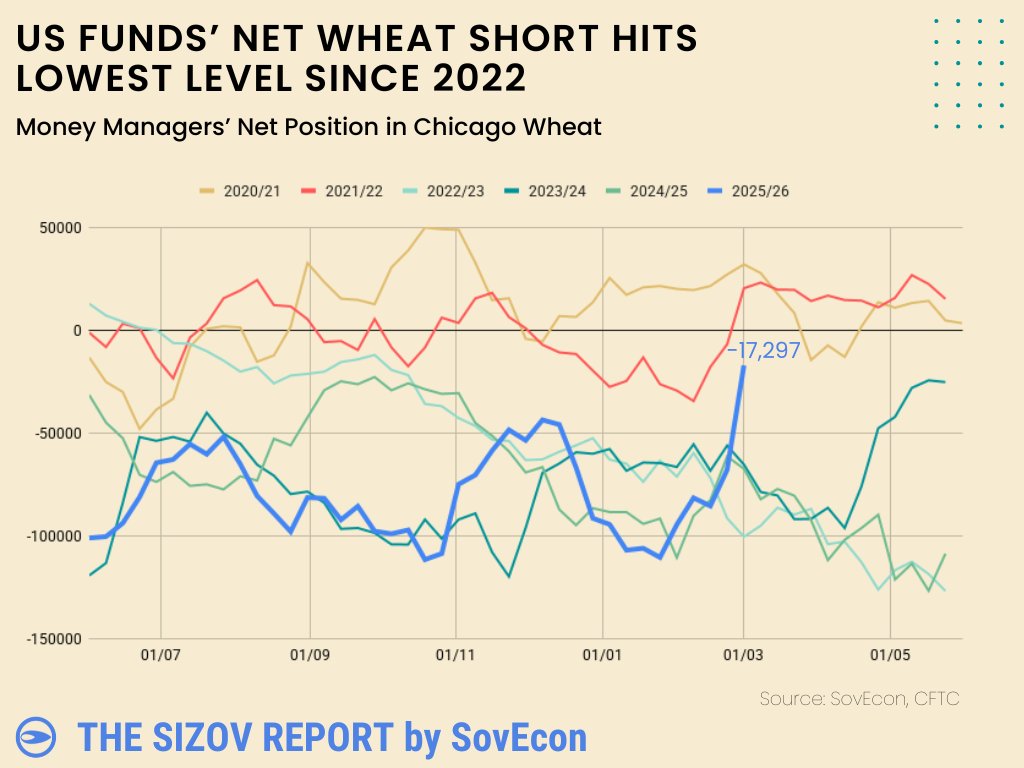
Funds have effectively erased their 2022–26 #wheat short.
+51K contracts last week — the 4th largest weekly purchase on record (largest since Jan 2018).
Net positioning has shifted to long.
Yet gross shorts remain above 200K contracts.
The headline says “long.”
The structure says something more nuanced.
#oatt #sizovreport
Oman’s Maritime Security Center reported that the Marshall Islands-flagged product tanker MKD Fium was struck by a drone boat in the Gulf of Oman, about 50 nautical miles north of Muscat
Qatar is indeed captive to the Strait of Hormuz and accounts for 18% of global LNG supply (82 out of 440mt), making it the world’s 2nd-largest exporter after the U.S.
But I doubt its cargoes will be disrupted for more than a few days, given Doha’s alignment with Tehran and the mutual economic interest in keeping flows moving.
Current shipping disruptions are largely self-sanctioning active owner decisions rather than physically enforce, and mainly a function of sharply higher insurance premiums.
The often-cited but highly unlikely full sea-mine scenario would be a structural game changer. However, targeted missile or drone strikes on a small number of tankers are sufficient to chill traffic, and are cheaper & more discriminatory than blanket mining.
After all, the National Guards control the regional energy infrastructure and heavily rely on export revenues to China, which creates a powerful incentive to avoid prolonged, systemic risk which achieves nothing strategically but assures their own domestic oil assets become U.S. and Israeli military target.
Strait of Hormuz disruption risk for LNG is best considered a nothing burger within an oversupplied sector.
Will TTF/JKM spike on Monday? Perhaps a dead cat bounce for a few days until cooler minds prevail over the headlines traders.
Here is the current location of the Palau-flagged tanker SKYLIGHT (IMO: 9330020), which is reported to have been hit.
It’s currently presumed to be grounded off the coast of Khasab, Oman (26.288021 / 56.266388). The vessel is at 0 knots and in ballast. Also interesting that there are zero tankers currently transiting the Strait.
Except for the Iranian tanker SINOPA (IMO: 9172038), which started moving on the 27th after idling at the entrance of the Strait from the Gulf of Oman side, there are currently no Aframax or larger tankers confirmed to be passing through the Strait of Hormuz.
#oott #iran



![sizov_andre's tweet photo. Are #wheat importers getting a bit nervous? Egypt (#1 global wheat importer) has just raised internal procurement prices to boost strategic reserves.
[As noted in recent weeks, if I were a wheat importer, I would be thinking about hedging / locking prices for 2H 2026 and possibly beyond.]
-----
Reuters: Egypt raises local wheat procurement price amid a push to shore up reserves. Egypt increased its procurement price to 2,500 EGP per ardeb (150 kg) for the current harvest, up from a previous range of 2,250���2,350 depending on quality.
Authorities target 5 MMT of local wheat this year. Last year, purchases reached 3.9 MMT vs a 4–5 MMT target.
#commodities #foodsecurity #egypt #oatt #sizovreport](https://pbs.twimg.com/media/HE6KBoIboAAwSev.png)