🚨🎙️ Jürgen Klopp on criticism of Thomas Tuchel:
“People always speak after the game like coaching is easy — like you just choose ‘attack’ or ‘defend’ and that’s it. It doesn’t work like this. Football is much more complex.
I see the criticism of Tuchel for trying to defend the 1–0 against Argentina, but let me tell you something — if he didn’t do that, if he kept pushing forward and they conceded, the same people would be here saying, ‘Why didn’t he control the game? Why didn’t he defend the lead?’ In knockout football, whatever decision you make, someone will criticize you.
I’m not saying every decision is perfect, but you have to understand the logic behind it. Managing a game at that stage is never simple.
And then… there’s another reality. This Argentina team, the belief, the mentality — sometimes it feels like something special is with them in these moments.
And when you have Lionel Messi… what can you do? He’s 39, and still the best player in the world. You think you’ve controlled him, you think you’ve done everything right — and then he makes the difference. Two assists, two decisive actions, and the game is gone.
So yes, you can talk tactics, you can talk decisions… but sometimes, you also have to accept that greatness decides matches. And if you don’t understand that, you don’t really understand football.”
Charles Bukowski shocked the world in 1987.
He finally became famous for writing about modern American life that included extreme violence & s*x acts.
I spent the last 5 years digesting it all...
And these are the 14 things I can't stop thinking about:
If you enjoyed this thread and would like to join the mission of promoting western civilization, kindly repost the first post (linked below) and consider following: @thinkingwest
https://t.co/8JrBBfoAwY
Її було вбито НКВД, а тіло викинуто з вагону, під час етапу до Казахстану...
Ця дівчинка — Людмила Старицька-Черняхівська, донька драматурга Михайла Старицького та Софії Лисенко (сестри композитора Миколи Лисенка). Майбутня письменниця, науковиця і громадська діячка, яку НКВД все
триста сторінок. Свою , Марина довела , на двадцяти трьох сторінках і зробила це вражаюче елегантно.
А ще , вона — друга в світі жінка із філдсівською премією за всю історію її існування.
9. A footnote on the G7 oil price cap. The cap is recognition of the fact that Russia's current account surplus needs to be cut. But - thanks to Greek shipping oligarchs - the cap was set at $60 and wasn't binding. A mistake that can be fixed now by lowering the cap...
8. It's not too late. First, the West needs to end its focus on financial sanctions. Second, we need to start talking about hard trade-offs that are needed to confront c/a surplus countries. We need to stop giving them cash, which means we need to stop buying their stuff...
7. Had we done a hard energy embargo on Russia, this would have come at a cost to the West, but Russia would have gone into financial crisis, making the war harder for Putin to fight. An embargo would have also scared other potentially hostile current account surplus countries.
6. Number one lesson from Russia is that our infatuation with financial sanctions must end. They don't work on c/a surplus countries, unless we sanction all banks, in which case we're just doing a trade embargo. We need to be doing trade embargos instead of financial sanctions...
5. We could have avoided this, but it would have required sanctioning ALL Russian banks. That's the same as a trade embargo, since Putin no longer gets paid and stops exporting. This shows what's needed to hurt c/a surplus countries: a trade embargo! Not financial sanctions...
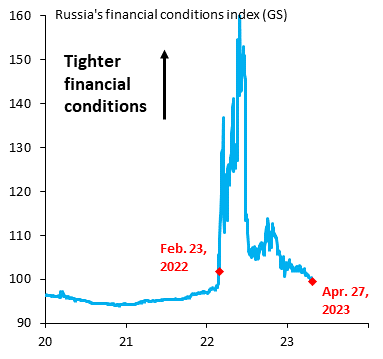
4. So our financial sanctions did not prevent Putin getting all his cash in return for energy exports. All this cash just got routed through different banks than before. As a result, financial conditions in Russia eased back to pre-war levels, a big plus for Russia's war economy.
3. Russia shows how our financial sanctions failed. We sanctioned some banks, including the central bank (red), but not all. This meant that all the cash from Russia's current account surplus got routed through non-sanctioned Russian banks (blue). Putin still got all his cash...
2. Root problem is an infatuation with financial sanctions. These can be effective when used on current account deficit countries - Turkey in 2018 is an example - but they don't work on current account surplus countries. This is a key point that cannot be emphasized enough.
Evaluation of our sanctions policy
1. Only 2 questions matter. First, have our sanctions meaningfully curtailed Russia's ability to wage war? Second, are our sanctions a deterrent to countries that may wage war in the future? Unfortunately, the answer to both questions is: "No!"