B2B MASTERCLASS ON CLOSING DEALS.
Reading and APPLYING this will literally change your life, I guarantee results.
TRIPLE BOOKMARK THIS:
-------------------
Loss Aversion is king, the best closers are lawyers - they build a case with evidence, create large gaps and then show price In a way that saves money instead of spending it to upside.
People do not buy because the future is better. They buy when staying the same is more expensive than changing.
It’s helping the prospect accurately feel the cost of the gap between:
Where they are now and Where they said they want to be
So you're $50K deal could either be looked at as a $50K price tag or the opportunity to dodge $90K in losses.
-------------------
1. The foundational study:
Prospect Theory
The anchor paper is Kahneman & Tversky’s 1979 Prospect Theory paper in Econometrica.
This is the root of loss aversion. The key idea is that people evaluate outcomes relative to a reference point, not in absolute terms, and the value function is steeper for losses than gains.
losing something usually hits harder than gaining the same thing feels good.
Sales-call translation:
Most reps sell the upside.
“Here’s how much better things could be.”
But the prospect is often emotionally anchored to avoiding downside.
Better discovery helps them see:
“What is the current path already costing you?”
Ask:
“Where are you trying to get this quarter?”
Then:
“What happens if nothing materially changes between now and then?”
Then:
“What does that cost you in pipeline, time, margin, team capacity, or opportunity?”
The key is that the prospect has to define the desired state first. Then you use their own stated goal as the reference point to begin creating a gap.
-------------------
2. Losses can shift risk appetite
Tversky & Kahneman’s 1981 Science paper on framing showed that people respond differently to equivalent outcomes depending on whether they are framed as gains or losses.
In the famous framing experiments, people became more risk-seeking when choices were framed around avoiding losses, even when the math was equivalent.
Sales-call translation:
A prospect who seems “risk averse” about buying is often not risk averse in general.
They are risk averse about the wrong risk.
They see buying as risky.
They do not yet see inaction as risky.
So the job is not to pressure them.
The job is to rebalance the risk frame.
Call tool: Risk reversal question
Ask:
“I get why changing vendors/processes/systems feels risky. What I’m trying to understand is, what’s the risk of keeping this exactly as-is for another 90 days?”
Then shut up.
You’re not creating risk.
You’re surfacing the risk already sitting inside the status quo.
-------------------
3. Status quo bias: people overvalue staying put
Samuelson & Zeckhauser’s work on status quo bias showed that people disproportionately prefer existing options, even when switching could be better. Their work connects strongly to loss aversion because change forces people to give up something familiar, and that “giving up” can feel like a loss.
Sales-call translation:
In B2B, the biggest competitor is usually not another vendor.
It’s the current way of doing things.
The prospect may hate the current situation, but it is familiar. Familiar pain often beats unfamiliar improvement.
Call tool: Status quo inventory
Ask:
“What are you currently doing to solve this?”
Then:
“What parts of that are working?”
Then:
“What parts are clearly not working anymore?”
Then:
“What have you already accepted as ‘normal’ that probably shouldn’t be normal?”
That last question is powerful because it makes the invisible cost visible.
-------------------
4. Endowment effect: people value what they already have
Kahneman, Knetsch, and Thaler’s 1990 Journal of Political Economy experiments showed the endowment effect: people often demand more to give up something they own than they would be willing to pay to acquire it. In the classic experiments, randomly assigned owners of mugs valued them more than non-owners did.
Sales-call translation:
Prospects are emotionally attached to their current stack, team habits, workflows, vendor relationships, and internal narratives.
Even when the current setup is underperforming, it still feels like “theirs.”
So attacking their current way of doing things usually creates resistance.
Better move:
Respect the current system first.
Then expose where it no longer matches the goal.
Call tool: Respect then contrast
Say:
“Candidly, it makes sense why you built it this way. It probably worked for the stage you were in.”
Then ask:
“Is the same system still strong enough for where you’re trying to go next?”
This lowers defensiveness.
You’re not calling their baby ugly.
You’re showing that the old system may not fit the new ambition.
-------------------
5. Goals become reference points
Heath, Larrick, and Wu’s 1999 paper “Goals as Reference Points” argues that goals inherit the properties of prospect theory: once a goal is set, falling short can feel like a loss, not just a missed gain.
This is one of the most useful studies for sales.
Because it means the prospect’s own goal can become the emotional anchor.
Not your pitch.
Not your ROI calculator.
Their stated goal.
Sales-call translation:
Do not start with pain.
Start with the goal.
Then make the gap concrete.
Call tool: Goal-gap ladder
Ask:
“Where are you trying to be by the end of the quarter?”
Then:
“Where are you right now?”
Then:
“What’s the gap?”
Then:
“What needs to change for that gap to close?”
Then:
“What happens if nothing changes?”
This is the cleanest way to create tension without being pushy.
The prospect builds the gap themselves.
-------------------
6. Stake size matters less than you think, but the effect size is debated
You do not need to tell every prospect they’re “leaving millions on the table.”
The sharper move is to make the loss specific, believable, and connected to something they already care about.
Bad:
“You’re leaving millions on the table.”
Better:
“You said the team needs 40 qualified meetings per month. Right now, you’re getting 14. So the real gap is 26 qualified meetings every month. What does that shortfall do to the sales target?”
That’s a different conversation.
Now the prospect is not reacting to hype.
They are looking at the gap.
Target: 40 meetings.
Reality: 14 meetings.
Gap: 26 meetings.
Now the cost of inaction becomes concrete.
This is where most reps lose the deal.
They try to make the problem bigger with adjectives.
“Massive”
“Expensive”
“Urgent”
“Critical”
But adjectives do not close sophisticated buyers.
Math does.
Specificity does.
The prospect’s own words do.
The smallest undeniable cost of inaction is usually more persuasive than the biggest exaggerated one.
-------------------
7. Framing matters, but not all frames work the same way
Framing is not one thing. (Not talking about B2C Bro Framing)
A prospect can look at the same decision through multiple frames:
1. Risk
2. Goal
3. Cost
4. Identity
5. Timing
This is why sales calls go flat when reps only have one frame.
They keep saying the same thing in different words.
“You’ll get more pipeline.”
“You’ll grow faster.”
“You’ll save time.”
“You’ll improve efficiency.”
The prospect already gets the upside.
They just do not feel enough contrast yet.
A stronger closer knows how to rotate the frame without sounding repetitive.
Risk frame:
“What’s riskier right now - changing the system, or keeping the current one for another 90 days?”
Goal frame:
“You said the target is X. Current pace gets you Y. So what has to change?”
Cost frame:
“What does the current process cost in missed revenue, wasted labor, delayed execution, or lost focus?”
Identity frame:
“Is this the kind of operating system that matches where the company is trying to go?”
Timing frame:
“Is this a now problem, or a later problem?”
Each frame pulls the prospect into a different angle of the same truth.
The goal is not to trap them.
The goal is to help them see the decision clearly.
Because most buyers are not comparing solution vs no solution.
They are comparing the discomfort of change against the invisible cost of staying the same.
Your job is to make the invisible cost visible.
-------------------
8. Loss-framed messaging is not always more persuasive
This part matters.
Loss aversion is powerful, but it is not a universal persuasion button.
Some research on message framing shows gain-framed messages can outperform loss-framed messages in certain contexts.
Meaning:
You cannot make the entire sales conversation negative.
If every part of the call is about pain, risk, cost, and loss, the buyer can start feeling cornered.
That creates resistance.
The best sales calls use both sides.
Gain creates desire.
Loss creates urgency.
The future pulls them forward.
The cost of inaction pushes them out of the current state.
The structure looks like this:
- Desired future
- Current reality
- Cost of staying there
- Path to close the gap
- Confidence in the next step
That is the order.
1. Start with what they want
2. Then clarify where they are
3. Then make the gap impossible to ignore
4. Then position the solution as the path to close it
5. Then make the next step feel obvious
Most reps either oversell the dream or overplay the pain.
Both are weak.
Only selling the dream makes the offer feel nice-to-have.
Only selling the pain makes the call feel manipulative.
The close happens in the gap between the two.
-------------------
9. Boundaries of loss aversion: not everything “given up” feels like a loss
Novemsky and Kahneman’s 2005 Journal of Marketing Research paper explored the boundaries of loss aversion.
One useful point:
Not every exchange feels like a loss.
Money spent in a normal purchase does not always trigger the same feeling of loss if the buyer sees the exchange as intended, justified, and economically rational.
This is huge for pricing.
Buyers do not only resist price because “money is a loss.”
They resist price when the value exchange is unclear.
A $50K price tag feels expensive when it is floating by itself.
A $50K price tag feels different when it is attached to preventing a $90K loss, fixing a revenue gap, replacing wasted labor, or accelerating a target the company already cares about.
Price resistance is not a pricing Issue.
It is a gap Issue.
The buyer does not yet believe the gap is expensive enough.
Or they do not believe the solution closes enough of the gap.
So instead of defending price, tie price back to the economics of the problem.
Use language like:
“My question now is whether this problem is expensive enough to solve now. Based on what you said, the gap is costing you X. If that’s accurate, then the budget only makes sense if we believe we can use it to close enough of that gap to justify it.”
That is clean.
No pressure.
No discounting.
No fake scarcity.
Just math.
The buyer should not feel like they are being pushed into spending money.
They should feel like they are deciding whether the current loss is worth avoiding.
That is the difference.
-------------------
The Loss Aversion Gap Framework
This is the full framework.
Use it on discovery calls, strategy calls, closing calls, proposal reviews, and objection handling.
-------------------
Step 1: Establish the reference point
Loss aversion needs a reference point.
Without a reference point, there is no gap.
Without a gap, there is no urgency.
Questions:
“What are you trying to get done this quarter?”
“What number are you responsible for?”
“What does a successful 90 days look like?”
The prospect has to tell you what matters.
Not because it gives you a fake reason to pitch.
Because their own goal becomes the anchor for the entire conversation.
-------------------
Step 2: Establish current reality
Once the goal is clear, you need the truth.
Not the polished version.
The real version.
Questions:
“Where are you today?”
“What are you currently doing to get there?”
“What’s the current pace?”
“What’s working?”
“What’s not working?”
Most prospects feel vague pain.
Vague pain does not close.
Concrete distance closes.
The job is to turn:
“We need better pipeline”
into:
“We need 40 qualified meetings per month, we’re getting 14, and the current system has not moved in 6 months.”
Now there is a real gap.
-------------------
Step 3: Calculate the gap
This is where the call gets serious.
Questions:
“So if the target is X and current reality is Y, the gap is Z, right?”
“What would need to change to close that?”
“What have you tried already?”
“Why hasn’t that closed the gap yet?”
This step matters because the gap stops being your opinion.
It becomes their math.
Their target.
Their reality.
Their words.
Their shortfall.
That is why it lands.
You are not convincing them of a problem.
You are helping them organize what they already admitted.
-------------------
Step 4: Make inaction visible
This is where most reps are too soft.
They identify the gap, then immediately pitch.
Wrong move.
Before you pitch, make the cost of the gap visible.
Questions:
“What happens if this stays the same for another quarter?”
“What does that affect downstream?”
“What does that cost the team?”
“What does that cost you personally?”
“What becomes harder if this waits?”
This reframes the decision.
The buyer stops comparing:
Buy vs don’t buy.
And starts comparing:
Change vs keep paying the cost of the current path.
That is the real close.
Because in B2B, the prospect is rarely choosing between spending and saving.
They are choosing between one cost and another.
The cost of action.
Or the cost of inaction.
-------------------
Step 5: Reframe change as loss prevention
Once the gap is clear, the offer should not be positioned as shiny upside.
It should be positioned as the path to protect the outcome they already care about.
Language:
“Based on what you told me, the real issue is not just getting more upside. It’s preventing this gap from compounding.”
Or:
“The current path seems expensive. Not because it’s broken everywhere, but because it doesn’t look strong enough for the target you’re trying to hit.”
A $50K offer is expensive when it is judged as a standalone cost.
It becomes rational when it is measured against the cost of the unresolved gap.
That is how strong closers sell.
They do not beg for belief.
They build a case.
They establish the desired outcome.
They expose current reality.
They calculate the gap.
They make inaction visible.
Then they position the solution as the cleanest path to stop the loss.
That is why the best closers are closer to lawyers than hype men.
They do not just “pitch.”
They build the case so well that the decision becomes obvious.
Not because the prospect was pressured.
Because the cost of staying the same finally became clear.
-------------------
I created a Claude Code skill that takes your call transcripts and coaches with building your Loss Aversion angles.
Like + Comment "SALE" and I'll dm you the GitHub Repo.
(must be following to DM you)
New 2PT just dropped
Two Piece Tuesday is a series where I break down two quality 1099 remote sales roles from the past week
One for an experienced rep and one for a beginner
I show you how I go about performing due diligence after helping over 500 reps land these roles
I also sneakily sometimes share a link to apply to them
I've included a link to the two below in the replies, you don't want to miss this one
How to get someone who doesn't take action to do so on a sales call
1. Ask implication questions
Project poor practices over timeline and present opportunity cost of doing nothing
2. Tie opportunity cost back to their "why" (wife, kids, etc.)
Little problem is now big problem
One day in 2017 young ambitious Dylan stumbled across dropshipping and online money
Nearly 10 years later, safe to say we figured it out a little bit
Photo from my wedding
All these dudes I either met through helping them get remote sales jobs, meeting them through the industry, or they run their own online businesses
Just lobbed up a bit of a reflective IG post on this
Linked below, check it out
We talked on IG for 2 years before he joined TSSC
That whole time he was in D2D roofing sales (like me)
Working brutal hours in the FL sun
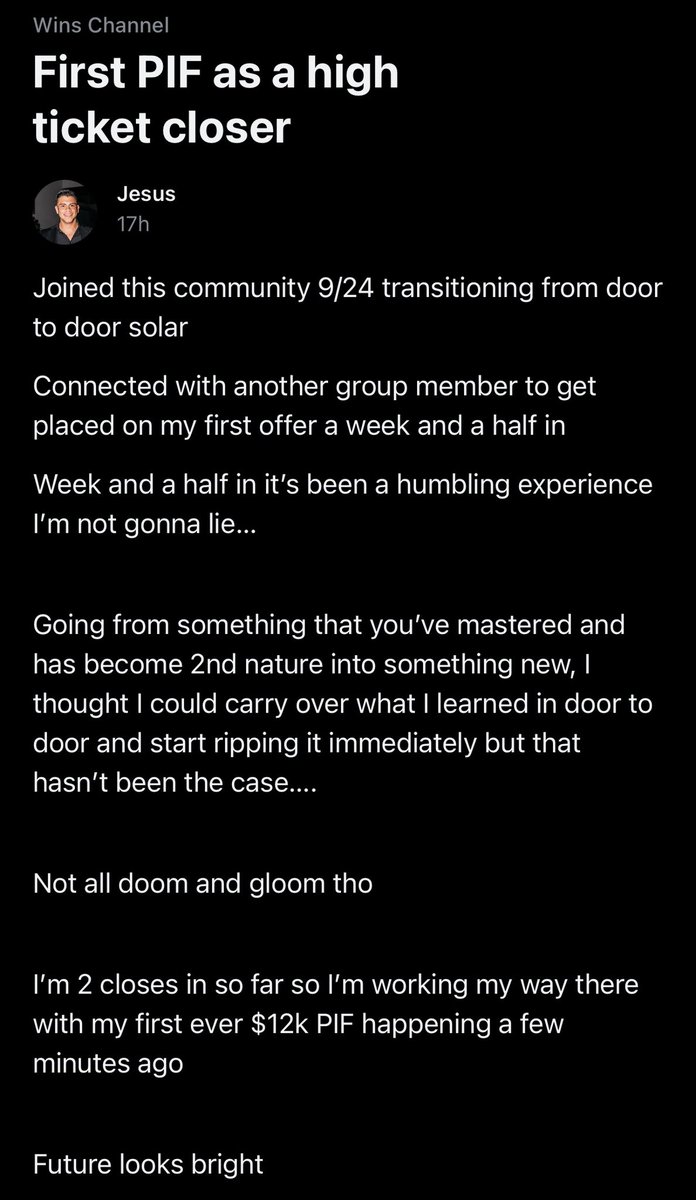
Last month he did $35,000 as a remote closer taking inbound sales calls
Hand delivered trophy for the milestone at our Tampa area meet-up this weekend
Feels good
Now hiring: Remote closer
Must have closed over $1m in kool aid pickle webinar leads in the last year
Legit $10k/mo opportunity if you’re hungry
No beginners
DM me for the link to apply