Own Your AI, Before AI Owns You
Founder | Conservative Muslim | Proud American | Unapologetically traditional (If I offend you, you're most likely the problem)
@MaxMusing I'm one of the "SaaS will be dead soon" guys and this is a very sensible perspective, which I'm fully onboard with. Clearly not all SaaS will be dead, but this is the good, hard, strong kick in the ass that SaaS companies needed.
Building a "bot" is easy. Building a high-performance SHIZA AWF agent is an engineering feat.
To thrive in the post-labor economy, an agent needs more than a prompt, it needs a DNA of Autonomy, Planning, and Adaptability. 🧵
In the post-agentic economy, the question isn’t if AI will replace jobs, it’s who will own the agents that do. 🏗️
Our founder breaks down why you shouldn't just use AI, but own it as a sovereign asset.
Don't rent your future from Big Tech. Build it on SHIZA. 🔐
Build. Capture. Own. Monetize. $AWF
2020: "So you blockchain guys have built a solution and are now looking for a problem"
2026: "Agents are creating a multi-trillion dollar problem that will require a solution to enable a post-agentic economy"
"Blockchain UX has always been shit for humans because blockchains weren't built for humans. Signing transactions, gas, bridging. Humans hate it. Agents don't care. Most onchain activity is already bots. We've been building machine infrastructure this whole time."
💯
a lot of my ETH bros are coping imo and clinging to the L2 vision after Vitalik's xeet because we (including me) invested so much mental energy into the L2 vision, defending it against Solana bros about it, etc
maybe because I've had a lot of trauma in my life (and my crypto investing life) but I'm fast to adapt and move on--for me, Stage 2 no longer being real means this is not what ETH-heads should be focused on anymore to benefit Ethereum, and I've very quickly changed my mentality
as Vitalik made clear (and the market makes even clearer), the current type of independently financed "L2s" are definitely not dead & will continue to provide a welcome use case for Ethereum, but they will not become real rollups and thus are no longer the primary story for Ethereum (or even close to it)
appchains, enterprise chains, etc. CEXchains, etc. have a very bright future--for themselves, their users, and their investors, and Ethereum will likely continue to perform a modest 'notarization service' role to many of them while (because they don't hit stage 2) never being their definitive 'settlement layer' or ultimate protocol enforcement authority ; hell, even cringey Canton says something in their docs about potentially using Ethereum as a notarization layer to reduce trust in their domain nodes
but:
-->providing a notarization service role to appchains is not a necessary or sufficient thesis or userbase for Ethereum/ETH
-->the systems that need this notarization service are not cryptoeconomically secure but rather are socioeconomically secure--in a way, they very much fulfill my 'BORG' vision of code/law hybrids as they use a mix of software mechanisms and legal mechanisms (like highly legally structured security 'councils') to achieve 'security'/trust reduction/social scaling--that's all fine (I am open to many trust models and think these models are great for bringing enterprise onchain) but Ethereum has always been about cryptoeconomic security and real decentralization/autonomy;
-->after Vitalik's infamous L2 post & in light of the fact that most L2s permanently plan to remain sidechains making modest notarial use of Ethereum, they will stop marketing themselves as "L2s" and "rollups" and come up with some new name like 'agileChains' or something, in many cases their users will not even know they have anything to do with Ethereum
-->the zk-scaling vision, buttressed by new explicit anti-censorship mechanisms like FOCIL, is a more exciting scaling strategy for Ethereum
so,...Ethereum being a notary service to Robinhood AgileChain and MegaETH is great and all but it ain't gonna pump ETH or even sustain current price in itself, even if ETH is used as a gas token in them (which there are many disincentives to)...the days of .eth's desperately clinging to things like 'Robinhood announced an L2' to drive a narrative for Ethereum/ETH are over. . . .
imo, Ethereans need to fully embrace vitalik's milady-spirited leadership and contrarian vision of an ultra cypherpunk chain that is one of the last communities to still believe in web3-ish/read-write-own type vision, embrace the zk-scaling story (even though there is a lot of work still to do on it), and find ways to expand that TAM...go full cypherpunk/cyberpunk, focus less on "institutions" that will all be rolling their own semi-permissioned and censorable sidechains at best...
right now, agentic economy is the best bet for doing that, though of course we will have competitors on it (Solana already featuring polished clawd type apps)...the Ethereum community has to build really cool AI shit that leverages ethereum to give these AIs true 'autonomy', mitigates legal liability from that for devs (I prototyped one approach with GAIB (https://t.co/uwZzk0m7Vu)), and is fun af to use and speculate on
@stevesi's historical analysis is spot-on, but his conclusion needs more nuance.
His conclusion: We'll have MORE software, not less. Domain expertise becomes MORE valuable.
Every historical transition he cites had humans building the new systems.
This time: AGENTS building software. Not humans. (We know this because this is exactly what we're doing.)
Yes, domain experts will guide the building. But the NUMBER of domain experts needed will be exponentially smaller.
"More people work in banking today than ever before."
True. Because humans were still building and operating the systems.
When agents build AND operate the systems, you don't need more people. You need fewer people with higher expertise.
The math doesn't work the same way this time.
Value shifts from builders (massively in demand today) to the few domain experts who can guide agents.
This isn't about timeline. It's about WHO OWNS the infrastructure when this happens (very soon).
When agents replace builders, who owns those agents?
Big Tech? Or individuals?
That determines whether this transition creates shared prosperity or concentrated wealth.
He's completely right: This is exciting, not scary.
He's partially right: Domain expertise alone won't save the middle class alone.
OWNERSHIP of AI agents will.
Not UBI. Not job retraining. OWNERSHIP.
"Own your AI, before AI owns you."
Great analysis and 100% with you on newer software being built and domain expertise becoming more valuable. However your conclusion misses something critical:
Every transition you cite had HUMANS building the new systems: PC era → Humans building GUI software, Internet → Humans building websites, Streaming → Humans building platforms.
This time: AGENTS building software. Not humans.
Yes, domain experts will guide agent-built systems. But the NUMBER of domain experts needed is exponentially smaller than the number of builders today.
Different math. Different economic system.
Very exciting times ahead indeed, but we need to begin thinking about post-labor economics in a post-agentic world, so we can position ourselves for thriving in this new frontier.
BTC hit $62K. ETH $1,850. SOL $78.
Couldn't have chosen a worse time to launch $AWF.
But our job isn't to time the market. Our job is to build. And building is what we're doing.
No one tells you that most of the time, being a founder fucking sucks. Grinding in silence. Revenue's slow. Market's brutal. Team's exhausted. You question everything because it's all on you.
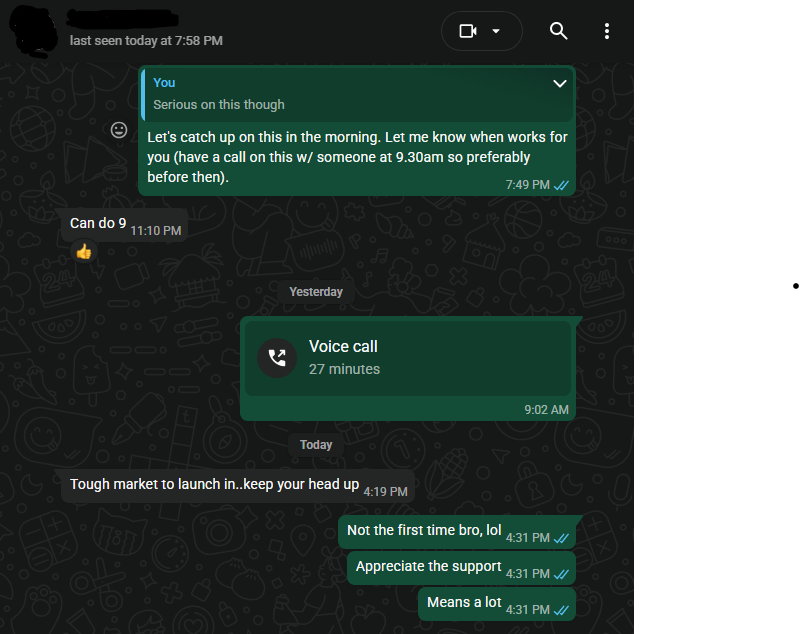
Then randomly, out of the blue, one of your investors sends this:
Totally random. Total bro moment.
This shit hits different when you're in the trenches.
It's lonely at the top. Find your bros. Nothing like it.
They won't fix the market. They won't solve your problems. But they'll remind you why you need to keep going.
Building through the bear.
Bismillah. 🚀
One of the fundamental mistakes that people are making is associating jobs with purpose, which is completely wrong.
A human's purpose is not associated with his job. A job serves as a mechanism for the human to help achieve his purpose. A job is fluid and changes based on a variety of factors so yes there will always be a job, but the economic value associated with the job is what will change quite drastically.
Yes, there will be a mass disruption to the economic value associated with jobs and the overall labor markets, but I also think it's wrong to associate that with a dystopian society.
If anything, this will lead to mass abundance because things will become incredibly affordable due to the most expensive line item on any P&L (human labor) being removed from it.
Humans will have more to do, so we will create different jobs, but the jobs "market" as we've known it thus far will forever change.
On the flip side, pretending that AI will not cause a mass disruption to the labor markets is equally as wrong. There is a mass disruption that's coming and humanity will adjust to it. There will be short term pain, but in the long term it will be for the better.