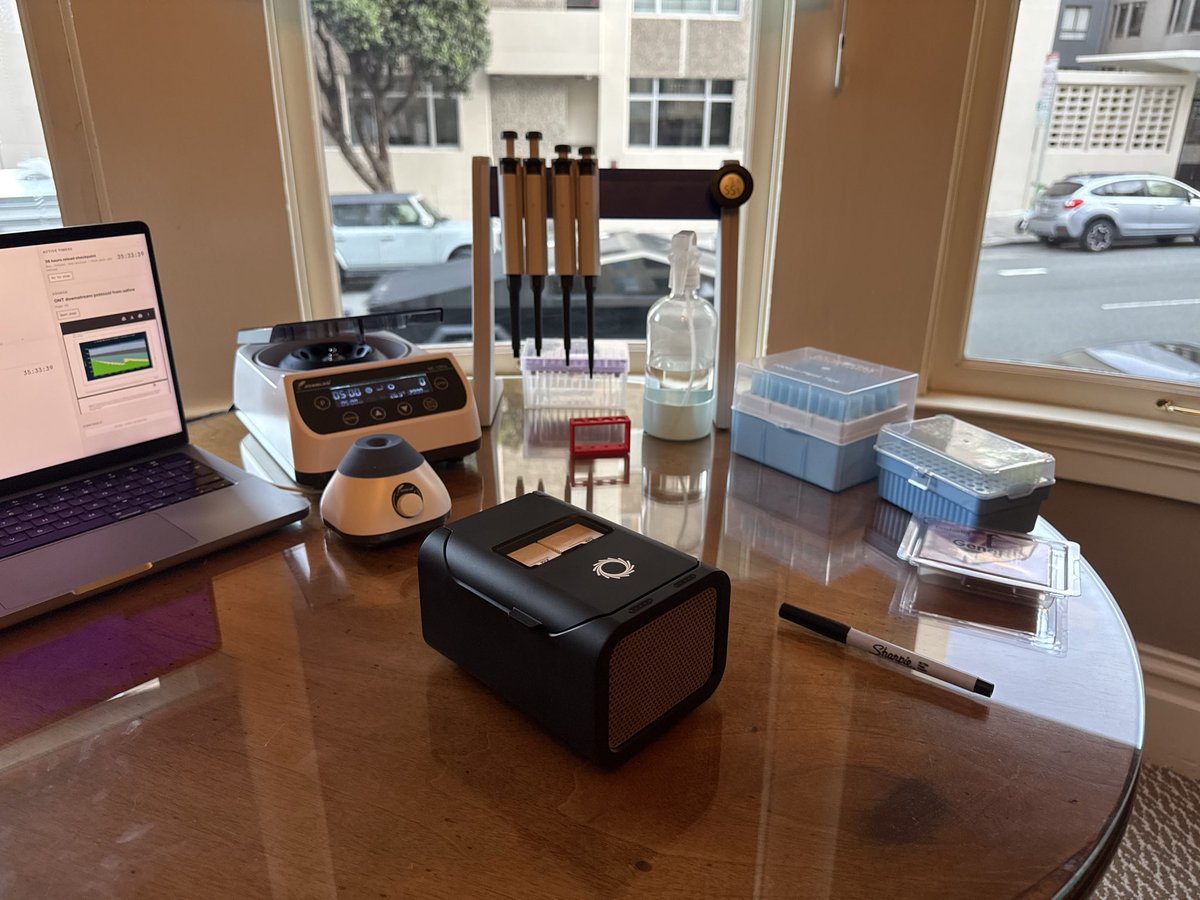
I just sequenced a human genome to 30× coverage entirely at home.
As far as I know, this is the first time this has been done.
I didn’t step foot in a lab once. Every step - from saliva collection, to running the sequencer - took place in a single room with a dining table + kitchenette.
Six weeks ago, I had never done wet lab biology before.
I used an Oxford Nanopore P2 Solo - the only commercially available sequencing device portable enough to do 30x human genome sequencing at home.
Biggest takeaway - I could build something that combined software, hardware, and molecular biology far faster than I thought was possible.
I can name >100 specific instances where AI helped me solve a technical problem that would previously have blocked me because I lacked access to a domain expert.
For example: how do I save my sequencing run when my DNA extraction yield is 4x lower than I need it to be, and I have this limited set of reagents to hand?
To make this work, I had to navigate multiple disciplines:
- writing software to monitor sequencing runs and orchestrate remote GPU infra for basecalling
- learning + executing 5 hour long molecular biology protocols
- building a hardware device to quantify DNA concentration
Apologies for the hyperbole, but I feel super lucky to be living in 2026.
A few weeks ago I decided to sequence a human genome to 30x at home.
Then I actually did it. And I did it really quickly.
I lost my dog because we could not build her next mRNA cancer vaccine fast enough
Today we are announcing a $4M seed led by @foundersfund to change that.
My dog Rosie was given months to live. Chemo and immunotherapy failed
I used chatgpt + computational genomics to design a personalised mRNA cancer vaccine for her tumour. Several of her tumours shrank
Today we launch Gamgee (YC S26): personalised mRNA cancer vaccines for dogs
New Huang lab publication at Nature. Our newly developed technique: transient Pore Analyte Looping (tPAL) now achieves “chop and measure” nanopore sequencing of peptide, in an amino acid by amino acid manner. https://t.co/YMUPMckpnx
Big news today. Science's PRIMA visual prosthesis, our retinal implant for macular degeneration, has received its CE mark, which means marketing approval in Europe. This is a huge milestone to begin to have a device like this commercially available to regular patients. 1/
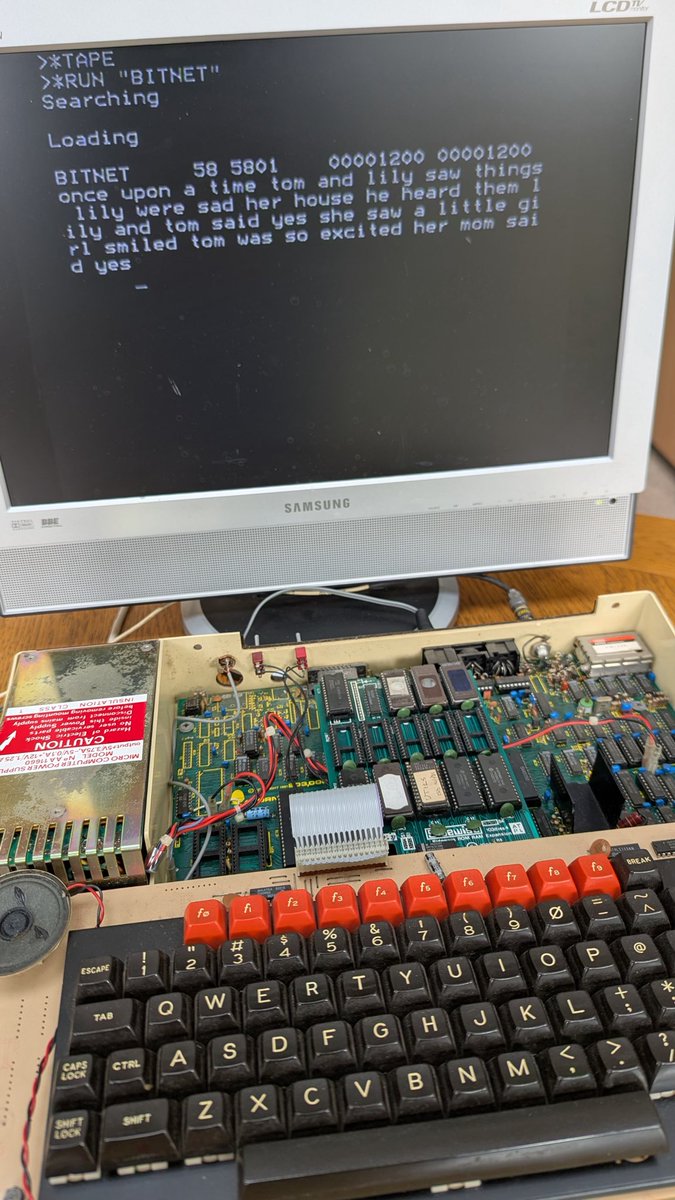
I built a 50k parameter language model to run on an 8-bit 6502 processor from 1975. It learnt to spell words and construct basic grammar!
The model is build on a Mamba backbone (attention’s KV cache not fit in 32KB of memory) with a character-level tokenizer.
The MOS-6502 doesn’t have a ‘multiply’ instruction - only 8-bit integer addition. I therefore used ternary weights to reduce matrix multiplication to a series of add/subtracts operations.
Technical write-up here: https://t.co/xbDzoMZtnm
Source code: https://t.co/Dyv2ejhhst
I built a 50k parameter language model to run on an 8-bit 6502 processor from 1975. It learnt to spell words and construct basic grammar!
The model is build on a Mamba backbone (attention’s KV cache not fit in 32KB of memory) with a character-level tokenizer.
The MOS-6502 doesn’t have a ‘multiply’ instruction - only 8-bit integer addition. I therefore used ternary weights to reduce matrix multiplication to a series of add/subtracts operations.
Technical write-up here: https://t.co/xbDzoMZtnm
Source code: https://t.co/Dyv2ejhhst
This is crazy useful. I’ve found Chinese tech news to be inaccessible to westerners.
For example, many leading Chinese tech distribute content on WeChat through the “Official Accounts” feed.
I have a web scraping cron job and translation pipeline so I can aggregate this info into a single feed
i have now sequenced my own DNA 5x at home and learned so much about myself
i wrote out the protocol here so anyone can follow it and talk to their DNA: https://t.co/T2koamoKtz
a lot of people helped with this, they are all mentioned below
Automated liquid handlers for biology are much older than I thought. A rough timeline:
- The 96-well plate is invented in 1951 by a Hungarian physician, Gyula Takátsy, who physically drilled each well out of a plate of Lucite, a type of acrylic.
- John Sever made the first "modern-looking" 96-well plate by punching it directly out of a sheet of plastic.
- The first automated liquid-handling device was released in 1967 (!!!). It was called the Autotiter, and was developed by a man named Tom Astle. I found a few sentences on Astle's company:
"Tomtec has succeeded since 1967 by working with its clients to help solve their liquid handling needs. From 1967 to 1981, the Company had essentially one employee, Tom Astle. From 1967 to 1971, the Company operated as Astec, Inc. In 1971 the Company's name was changed to Tomtec, and incorporated. Tom Astle has been the President and CEO since that time. In 1967, Tomtec developed the Autotiter. This automated what were then the manual microtiter techniques. The primary market was serology and virology. The original instruments were an essential element of Smith Kline's rubella vaccine program." (Photos of the original patent filing below.)
- In 1986, Beckman gets into the microplate automation space. They release the Biomek 1000 and mark it as a "fast and accurate...robotic workstation" that sits on a scientist's bench, "takes over tedious manual tasks and integrates the work of four different instruments." I found these details in a Beckman ad, which was published in a 1987 issue of the "Journal of Automatic Chemistry." Photos below.
The Beckman device looks fully modern; it could even connect to an IBM computer so scientists could program new methods on it. I couldn't find a launch price, but the device was similar to the Zymark Zymate, and that device cost about $35,000 when it released in the 1980s, which would be equivalent to hundreds of thousands of dollars today.
The pMHC binding with an antibody is so crazy to me. If the binding is general across patient MHCs, you can basically target cancer driver mutations with antibodies (which Revolution meds showed was effective towards pancreatic cancer). Step change, congrats to @nablabio team!
@Sephirsloth I was taken by a brilliant synthetic biologist to this quaint cafe today.
Funny thing. I must have missed the ‘dishonest hordes’. Where were they sitting?
I’m in Shenzen.
It’s clear China has implemented a much more effective capitalist system than the US.
And Chinese consumers are the main beneficiaries. Far more choice of cheaper, quality products: electric cars, smartphones etc.
And these are not just copycat products.
Even industrial design here feels like an evolution of what I’ve seen in the US. I wouldn’t be surprised if the next iPhone looks similar to a current model of phone made by Honor or Huawei.
A more accurate description of the US economic system might be “capitalism with American characteristics”
@LeroyLeroi001@Jansen0781 This is empirical. Walk down any street in Shenzen and look at the variety of premium Chinese brand EVs being driven.
These cars aren’t exported: they don’t exist in the US.