What the FUCK are we doing, California?
So-called “nonprofits” are getting rich by keeping people on the street and addicted to drugs.
Becerra supports it. Bass supports it. Raman supports it. And YOU are paying for it!
Wake up and VOTE!!!
MACARTHUR PARK: This is your tax money at work…
Free crack pipes and needles being handed out to drug addicts. CEOs of these so-called “nonprofits” making millions a year. The smell, the squalor, the inhumanity.
All of it is funded by YOU.
WAKE UP CALIFORNIA!!!
I am a member of the Norwegian Nobel Committee.
There are five of us. Five people, appointed by a parliament most of the planet could not find on a map, who decide, once a year, which human being the world has agreed to call good.
I know. I know. I think about it on the tram.
We meet in a building on Henrik Ibsens gate, a street named after a man who wrote almost exclusively about people discovering they are frauds, which nobody on the committee finds funny except me. There is a room with a long table and the portraits of the dead laureates looking down, Mandela, the Dalai Lama, a great many earnest men in spectacles, and one portrait we do not discuss, which is Kissinger, 1973, awarded while the bombs were still falling, after which two of our predecessors resigned and the satirist Tom Lehrer said political satire was now obsolete. We keep him on the wall. A reminder. Every family has the uncle.
It is October in Oslo, which means the sun gives up around four in the afternoon like a civil servant, and it rains the particular Norwegian rain that isn’t quite falling, just hanging there, judging you. I arrive with wet shoes. I always arrive with wet shoes. There is coffee, because this is Norway and there is always coffee, we drink more of it per person than almost anyone alive, and someone’s wife has sent kanelboller, the cinnamon buns, and we sit, five Norwegians, damp, caffeinated, sugared, and we decide the moral standing of the entire species.
Let me tell you how it actually works, because the world imagines a cathedral and it is, I promise you, a book club with a mandate.
287 nominations this year. 208 people, 79 organizations. Anyone can nominate, that’s the secret nobody understands: a professor, a parliamentarian, a former laureate, so the “nominee” list is meaningless, it’s a suggestion box, and every autumn some congressman nominates his own golden retriever and the press writes “SHORTLISTED.” Nobody is shortlisted. There is no short list the public ever sees. There is us, and the coffee, and the rain, and the portraits, and a Norwegian stubbornness that is older than the prize itself.
We read reports. The institute’s advisers write them, thick dull documents, and we argue. Our chairman told the BBC once that in the final meeting “there is a high temperature.” High temperature, for a Norwegian, means someone slightly raised an eyebrow and then apologized for it. We don’t do high temperature. We do a long silence, and then Kristin says “well,” and everyone knows exactly what “well” meant, and it’s settled. That’s our shouting. “Well.” You’d have to be raised here to hear the violence in it.
Now. This year. I will not say the name, because we never say the name, but you know the name.
A certain head of state wanted this prize the way a child wants a thing in a shop window, which is to say loudly, and in public, and with the full belief that wanting it was itself the argument. He said he deserved it. He said he’d ended eight wars, a number that grew most times he said it, like a fish. He had other heads of state phone us. Israel’s prime minister posted it on the internet, “Give him the Nobel.” The leaders of Cambodia and Pakistan announced they’d nominated him, as though announcing it were part of it, as though we tally mentions. A man flew around the globe collecting endorsements for a Norwegian committee the way you’d collect signatures for a petition to the council about a noisy dog.
And here, uff da, is the detail I treasure, the one that makes me smile into my coffee. The nomination deadline is the 31st of January. He took office on the 20th. So for all the phone calls, all the posts, all the gilded lobbying, the only nominations that could possibly count for this year’s prize were filed in the first eleven days of his term, before he had, by his own arithmetic, ended a single one of the eight wars. He campaigned all year for a prize whose window had shut while he was still hanging up his coat. We didn’t have to reject him. The calendar did. We just watched. Norwegians are very good at watching. We have long winters.
People think we sit there weighing his deeds. We don’t. That’s the thing I can’t make the world understand. We’re not grading his homework. We don’t owe anyone the prize for a ceasefire, however real, however loud the announcement. “He made peace” is not a sentence that ends in a medal, the way he believes it does, the way he believes every good thing ends in his name on it. The will of a dead Swede says the prize goes to whoever did the most for fraternity between nations. A dead Swede, I should add, who made his entire fortune inventing dynamite and selling arms, and spent his last years horrified at his own obituary, which called him a merchant of death, and so bought his way to immortality as a man of peace. The whole prize is one guilty arms dealer’s attempt to launder his name. We are, all of us, administering a dead man’s public relations. I find this clarifying. It keeps me humble. It should keep everyone humble, and it keeps, by my count, no one humble at all.
So who did we give it to?
An eighty-five-year-old woman. A judge. Born in Durban, under apartheid, granddaughter of a Tamil man who came to South Africa as indentured labor, a bus driver’s daughter from the poor Indian quarter, who became the first non-white woman to run a law practice in her province, who defended Mandela’s people when defending them was dangerous, who sat on the Rwanda tribunal and the court at the Hague, and who, at eighty-five, is right now a judge weighing whether a genocide is a genocide. When we told the world, our chairman said the rule of law “underpins the system we have set up to ensure peace,” and that “peace requires justice.” She wasn’t even in Oslo. She was in Nuremberg. In courtroom 600. The actual room where they tried the Nazis. You cannot stage that. God staged that, and God, it turns out, is a better satirist than any of us.
She did not phone us. She did not post. No prime minister demanded it for her on the internet. She had, as far as our deliberations are concerned, the one qualification the loud man could never manufacture, which is that she wanted the work and not the medal. The medal finds those people. It flees the ones who chase it. This is not a rule we wrote. It’s just the only pattern the hundred-odd years of our mistakes has ever shown.
The reaction from across the ocean was immediate. His spokesman posted that we “place politics over peace.” Ja. Perhaps. We’re five damp pensioners in a rainy city; of course it’s political, it was always political, it was political when we gave it to a sitting American president nine months into his first term for the promise of things he had not yet done, and we have been quietly embarrassed about that one for fifteen years, so believe me, we had a particular reason this year to prefer a woman with fifty years of verdicts behind her over a man with eight wars in front of him and a deadline already behind him.
Here is what he will never understand, the thing I’d tell him on the tram if he ever took one. We are the one prize he cannot buy, cannot post his way to, cannot have a friendly dictator phone in for him. Not because we’re incorruptible, nei, we’re as vain and wrong and human as the portraits on our wall. But because the entire point of the thing, the only power a small cold country’s book club has ever held, is that it goes to the person not performing the wanting. The moment you demand it, you’ve proven you don’t understand what it’s for, and proving that is itself the disqualification. He ran the most expensive campaign in the history of the prize and the campaign was the reason. He was never losing to Navi Pillay. He was losing to the concept.
It’s dark now. Four o’clock dark. The buns are gone. Kristin said “well” an hour ago and we all went home. I’m on the tram with my wet shoes, and somewhere across the water a very powerful man is explaining to a camera that the prize is rigged, that we’re corrupt, that he’ll win it next year, and he genuinely might, we’re only five idiots and we’ve been wrong before, Kissinger is still on the wall.
But not this year. This year an old woman in Nuremberg, in the room where the law once stared down the exact kind of man who thinks wanting a thing loudly enough should make it his, got a phone call she didn’t ask for.
That’s the job. We don’t reward the man who ends the war and announces it.
We reward the woman who spent fifty years deciding what a war was.
He’ll never see the difference. That’s rather the whole point of him.
Takk for i dag. I have to change trams.
"It is hard to overstate the scale of death, destruction, and suffering inflicted on Gaza... The 223,000 tons of explosives dropped on Gaza—roughly equivalent to 15 times the power of the atomic bomb dropped on Hiroshima—have killed more than 74,000 Palestinians, the vast majority of them civilians, and reduced most of Gaza to rubble. Israel’s assault, over which it is currently on trial for genocide at the International Court of Justice, has wiped out some 92 percent of Gaza’s housing stock, 95 percent of its farmland, all 12 of its universities, and nearly half of its 36 hospitals—in other words, the very institutions and infrastructure that sustain life." - @elgindy_
https://t.co/TDvQOPyv9A
Prayer becomes effective when it reaches out to others. The charity born of the Holy Spirit is God’s love poured into our hearts: a love that takes shape in a commitment to life and service. This love must become the goal, the way, and the meaning of our lives.
The war in tormented Ukraine continues to cause suffering far beyond its borders, especially in the poorest countries, where so many people depend on grain imports. I make a heartfelt appeal to the parties to the conflict to allow for the safe transport of grain through the Black Sea. The daily bread of millions of people cannot be held hostage by the war.
Lots of folks in the pro-life movement browbeat and shamed people for not supporting Trump, and now we have more abortions, the generic abortion pill, a completely watered-down GOP plank on abortion, and public executions. Absolutely pathetic and very, very sad.
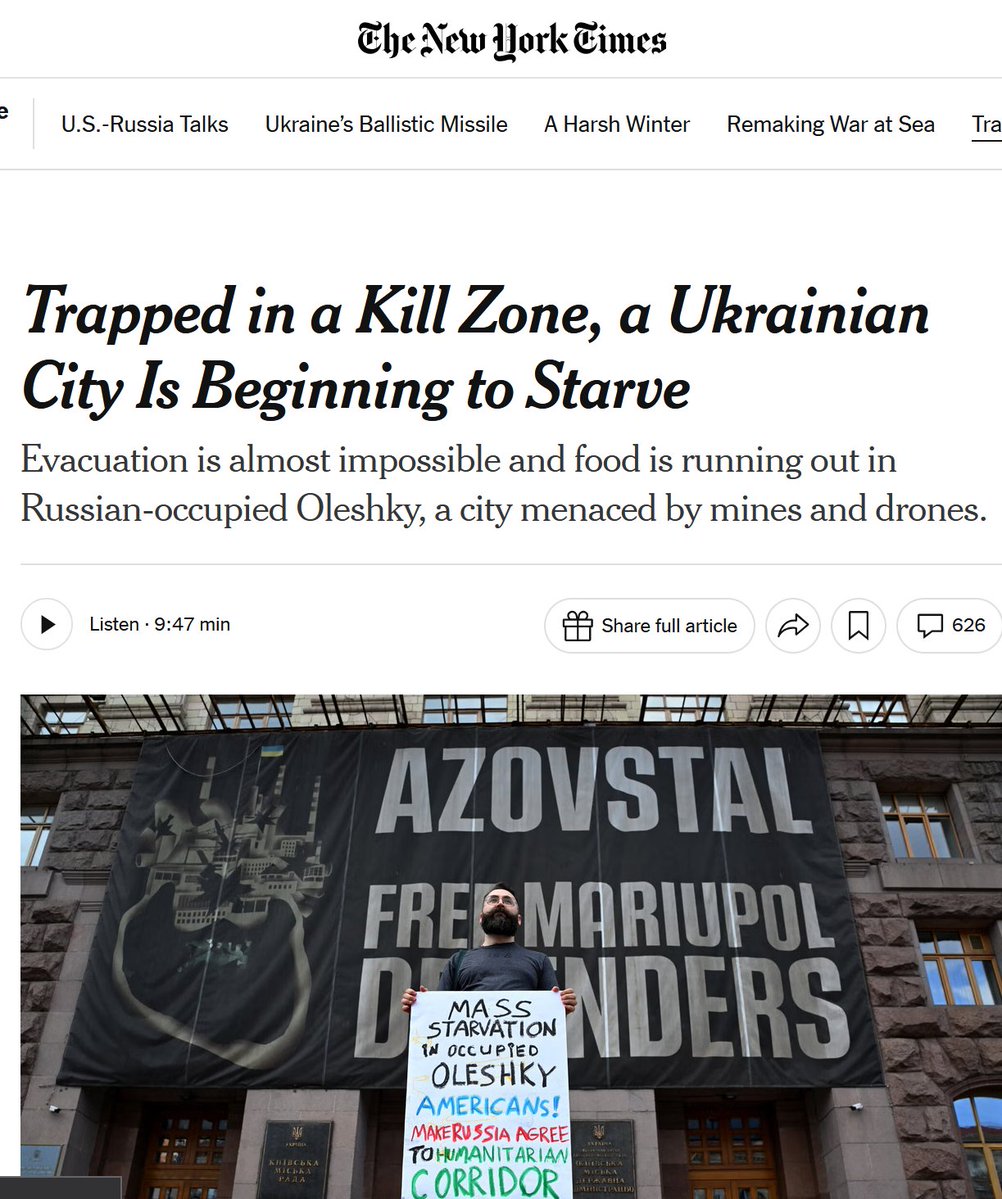
Let's talk about this New York Times headline, and what it reveals about bias, propaganda, and how corporate media cue you to get outraged about some violence and ignore others 🇺🇦🇵🇸
1) Let's start with the title: "Trapped in a Kill Zone, a Ukrainian City is Beginning to Starve".
Check the incredibly emotive language. Barbaric Russia has turned an entire city into a "kill zone". I checked the archive, and the NY Times has NEVER described Gaza as a "kill zone," despite the numbers of slain there dwarfing Oleshky.
In summary, the language spurs the reader to get outraged. "Something must be done about this" is the clear implication.
2) "Russian-occupied Oleshky" -- this is an accurate phrase, but telling nonetheless. Want to guess how many times the New York Times has used the phrase "Israeli-occupied Gaza" to describe the situation there?
Zero. In fact, you have to go back to 1993 to see that phrase appear in the New York Times -- before most people reading this were probably born.
Ask yourself why that is. How can the newspaper of record go 30+ years without using such a matter-of-fact phrase, while using it virtually daily when it comes to Russia 🇷🇺 and Ukraine 🇺🇦.
3) "Menaced" -- Again with the emotive language. I checked the New York Times archive database, and could find zero examples in the past 50 years of the Times using the word "menace" to describe what Israel is doing to Palestine, Lebanon, or any of its other neighbors. But Iran and Hamas? They were regularly described as not only a menace to Israel, but often the world.
These things don't happen by accident, and they reveal the deep structural and ideological biases at play in media, even in something as short as a headline and subheadline. There is an enormous amount of information, views, and propaganda encoded in just a few words -- propaganda that you will unwittingly swallow unless you are critically assessing everything you read, see, and hear.
4) Finally, I have to comment on the image used to illustrate the article. The Azovstal Defenders were largely made up of men from the Azov Battalion, a Neo-Nazi paramilitary group that has been subsumed into the Ukrainian Armed Forces.
In the years before the 2022 invasion, the New York Times accurately described them as Nazis, but that quibble has now been put to the side.
5) This is not meant to be an anti-Ukraine post, claiming they receive special treatment. I'm merely trying to highlight how corporate media frame certain wars, presenting certain invasions as outrageous war crimes, while sanitizing and tacitly supporting others.
The key is to educate yourself in critical media literacy so you can see through the propaganda and make your own, informed judgements. See groups like @ProjectCensored and others for resources on media literacy.
El-Sayed: Donald, please, I'm asking you, come to Michigan. Clearly your candidate can't speak for himself. He doesn't have anything to say. Clearly you are the answer. And you should tell everybody why they should imagine you on the ballot.
Here's the challenge: I think you are too afraid to come to Michigan because, you know, when I beat your candidate, I'm actually beating you. I dare you to come.
FOX: Does that disturb you to hear this growing movement of democratic socialists in the United States who think it is the government's job to make sure you live a dignified life?
El-Sayed: I assume you went to good public school. And you get to drive on good roadways or wish the roads are good? When you put your garbage out, someone picks it up?
This should outrage every American. This is the president of the United States telling Iran to bomb American cities. I live in Los Angeles, but that’s beside the point. Tommorow it could be your city.
My fellow Americans, this is not normal. This is not funny. This behavior should ring alarm bells for us all!
A year after the peace agreement was initialed, Azerbaijani MP Rasim Musabekov is threatening Armenia with another war. Yet another indication that our neighbors are presenting a performance of peace for Trump while pursuing aggressive rhetoric and policies in reality.
Nobody actually needs a personal AI assistant. The average screen time in the US is 7 hours/day. people have plenty of time. There's no evidence that freeing up more will lead to anything but more tiktok scrolling
If anything daily life needs more offline friction
Is Ilham Aliyev’s Nazi-style rhetoric also a “sign of peace”?
On October 2, speaking at the 8th Congress of Azerbaijan’s ruling New Azerbaijan Party, Aliyev accused Armenians of having “stabbed us in the back” and added: “This is not the first time in their history. They did the same a century ago, in another place.”
This is not an innocent phrase. The “stab-in-the-back” myth (Dolchstoßlegende) emerged in post-WWI Germany and was later exploited by the Nazi movement.
Aliyev’s use of this historical trope against Armenians, combined with his repeated references to Armenia and Armenians as an enemy, deserves serious attention.
And this comes from the leader who, after signing the Washington peace declaration, claims to be committed to combating intolerance, racial hatred and discrimination.
Is this what “preparing societies for peace” looks like?
Trump: "We've gonna shove it up their ass ... They are a bunch of dumb son of a bitches"
Remember when presidents had dignity?
Here's a lowlight supercut from Trump's rally tonight in Ohio:
@mikerecine Grow some balls, walk up to them and tell them to knock it off. I'm a 52 year old mom and have to do it every time I drop off my son for surfing. Not kids though but adult males. I don't care. It's maddening
There are many secular critics who are writing admirably about AI. But it's been apparent to me for a while that religious—particularly catholic—critics are speaking to the public's moral disquiet in a way that secular thinkers, reliant on utilitarian claims about harm, are not.