Decoding AI x on-chain, agent economies, and where smart money rotates next. Tracking RWA tokenization, real yield, and DeFi protocols built to survive BM.
Everyone in crypto says “we’re early”, but for networking + memory we’re actually late — blockchains still pretend disks are RAM and gossip is good enough. Optimum is the upgrade pack: MIT‑incubated team shipping a chain‑agnostic memory layer that starts as faster data propagation (mumP2P) and grows into decentralized RAM (DeRAM) for any L1/L2 that wants it. On the private testnet they’re already pushing blocks/blobs around Ethereum with way lower latency and less redundant storage by using Muriel Médard’s Random Linear Network Coding — the same class of tech that’s been battle‑tested in 5G and satellites.
What’s next on the roadmap? After Ethereum mainnet integration, Flexnodes roll out as the atoms of the network: independent operators who contribute bandwidth and low‑latency placement to accelerate how block data moves, and later how state is read/written via DeRAM. Instead of paying nodes just for showing up (stake, uptime), Optimum’s upcoming token is designed to reward useful work — more equations, more variants, better propagation, better memory access — so value flows to the machines that actually make chains feel fast. If that model sticks, you won’t just pick a rollup for cheap gas, you’ll pick the ones that quietly sit on top of a memory layer like Optimum, because once users get used to “RAM‑speed onchain UX”, there’s no going back to loading screens disguised as decentralization.
@get_optimum@MurielMedard@kentlinyy@blockchainjeff
#Optimum #Flexnodes #DeRAM #Web3Infra #RLNC #Ethereum #Scalability #Onchain #Crypto #Nodes
Im assembling a team...
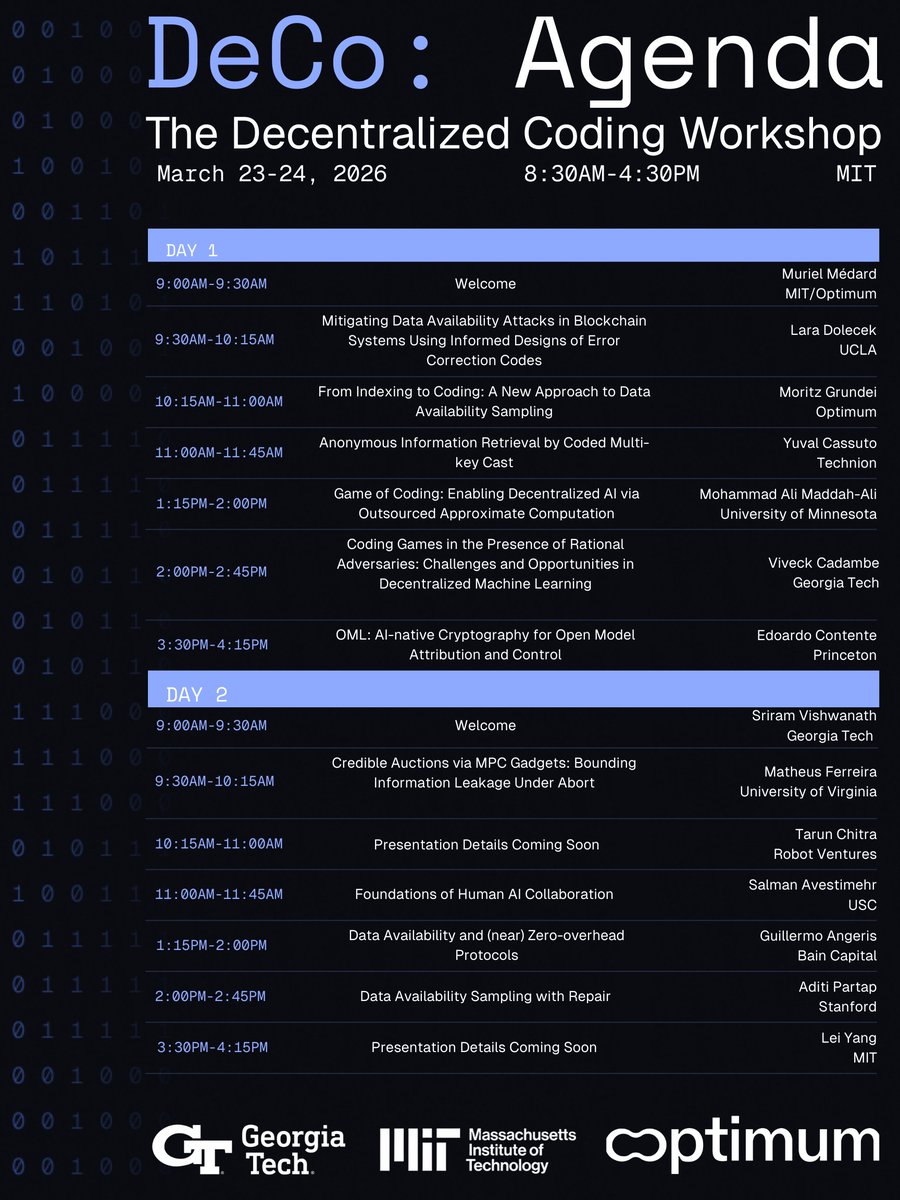
March 23-24 we're hosting DeCo at MIT-- featuring the top researchers, builders, and investors who are working on decentralized coding.
The goal: Find out how we can apply decentralized coding to solve blockchain's biggest problems.
If you want to know whether an infra project is serious, don’t look at the logo — look at who’s willing to plug it into production. Optimum didn’t start with a meme launchpad; it started by wiring itself straight into Ethereum’s spine. Seven of the biggest validators and node operators — Kiln, https://t.co/2DLuM05Aro, Everstake, Blockdaemon, InfStones, Luganodes, Ebunker — are already running OptimumP2P in a private testnet, together representing ~15% of all staked ETH. These are the folks whose business is uptime and slashing‑avoidance; if they’re experimenting with a new p2p layer, it’s not for the vibes.
Why do they care? Because OptimumP2P is literally free performance on the thing that matters most to them: propagation speed and reliability. A/B tests show up to 10x lower latency under load, stable performance with message sizes where Gossipsub starts dropping packets, and zero message loss in stress scenarios — all through a simple sidecar API that keeps existing libp2p + consensus untouched. For operators like Luganodes, that means faster block and attestation gossip, better MEV capture, fewer reorgs and missed duties — basically squeezing more yield and safety out of the same hardware.
This is also why infra players are publicly cheering it on. Luganodes calls Optimum “a decentralized high‑performance memory layer” and is already live in the OptimumP2P testnet; https://t.co/2DLuM05Aro is literally posting “fast validators, faster Ethereum” when talking about the partnership. And in the background you have outfits like Blockdaemon evaluating native support, while Ethereum media frames Optimum as “the missing memory layer” rather than yet another alt‑L1.
Put simply: Optimum’s go‑to‑market isn’t “convince degen CT first, infra later”. It’s the opposite. They went straight to the people who run the core network, gave them a way to speed it up without rewriting everything, and let the latency numbers do the marketing. If those operators keep liking what they see, every L1/L2 that wants their services will quietly inherit Optimum by default — not because of airdrops, but because no one wants to be the chain that stayed on dial‑up while everyone else upgraded their backbone.
@get_optimum@MurielMedard@kentlinyy@blockchainjeff
#Optimum #OptimumP2P #Validators #Kiln #P2Porg #Everstake #Blockdaemon #Luganodes #Web3Infra #Ethereum
Zodl is redefining what a truly private crypto wallet looks like. Built by the original creators of Zcash, it combines deep cryptography expertise with a clean, intuitive mobile UX that actually feels like a modern fintech app, not a science project.
With shielded ZEC at its core, @zodl_app keeps your transaction details hidden on‑chain and extends that protection at the wallet level, so your financial footprint stays yours. On top of that, Zodl Crosspay lets you pay in shielded ZEC while your counterparty receives the asset they actually want – BTC, a stablecoin, and more – without exposing your identity or full history on public blockchains.
The wallet ships with built‑in, non‑custodial swaps powered by NEAR Intents, giving you a CEX‑like experience for moving in and out of ZEC, but with no accounts, no KYC, and reduced bridge risk. You stay in control of your keys at all times – there’s no sovereignty without privacy, and Zodl is built around exactly that principle.
For anyone who cares about serious privacy, cross‑chain liquidity, and self‑custody in one place, Zodl is quickly becoming the flagship way to use Zcash in the real world. #zodl #privatepay #zec
Optimum isn’t backed by “some fund + a mascot logo”, it’s basically a who’s who of serious infra money + founders who ship things that don’t go to zero in a week. Seed round: $11M led by 1kx, with a swarm of infra‑native funds like Mapleblock, Blockdaemon, Robot Ventures, LongHash, Animoca Ventures, GSR, Spartan, CMS, Big Brain, Oak Grove, NGC, CMT, SNZ, Triton and others — the exact folks who usually sit on cap tables of base layers, rollups and core tooling, not memecoins. Go one step earlier and the angel round reads like CT’s Avengers cameo list: Polychain’s CTO, DeFiance Capital’s founder, Bitget’s CEO, co‑founders of Wormhole and Polygon, managing partner at Jump Crypto, plus names like Zaki Manian, Brecht Devos, Richard Ma, Ben Fisch, Rand Hindi and more.
In plain English: the people who run today’s infra — bridges, exchanges, rollups, clients, security shops — are betting that tomorrow’s bottleneck is memory + networking, and Optimum is their chosen horse. You don’t need to understand RLNC to read that signal: when this many infra‑maxis pile into a “decentralized memory layer”, they’re not farming airdrops — they’re telling you where they think the next critical chokepoint (and value accrual) in the stack will live.
@get_optimum@MurielMedard@kentlinyy@blockchainjeff
#Optimum #Investors #Web3Infra #1kx #Polychain #DeFiance #Animoca #JumpCrypto #Scalability #Onchain