@greenpeeps5@LeeAnndelCasti2 I like to think there’s a vast Sea Monkey kingdom in the sewer system...sort of like the lost city of Atlantis but ruled by creatures depicted in the comic book ad. 🤣
@olson17522@ChrisDJackson@HunterBiden Let’s not bring his Catholicism into it since JD has already shown how little he knows about his religion du jour. (And let’s not forget Hunter Biden is a cradle Catholic who went to Catholic school, so again, let’s not add religion into this mix.)
@RinkusSharon@FarmGirlCarrie I always assume these videos are not in the U.S., but some European country! Or they are done by people that live so remotely in the U.S. that no one will call the county on them about not having building permits or building to code. 😆
@QrsMisanthrope Just yesterday my sister mentioned how 1 of her dogs was full of crazy energy even after a 4 mile hike & my response: Is a full moon coming up? Sure enough. I used to have a dog that was naturally tuned into the 3 before/3 after cycle…it was cool to see how accurate she was.
@alex_prompter It’s pretty crazy that Artificial Intelligence requires the entire output of a nuclear reactor, while actual intelligence can get by on Twix bars and Monster Energy.
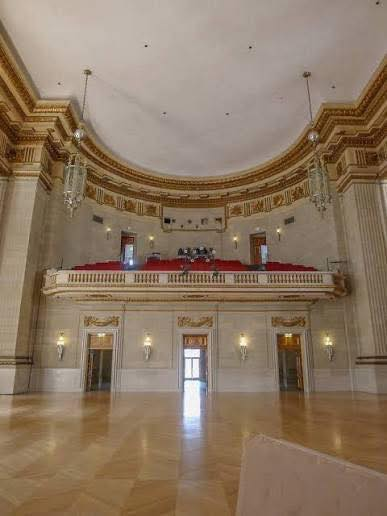
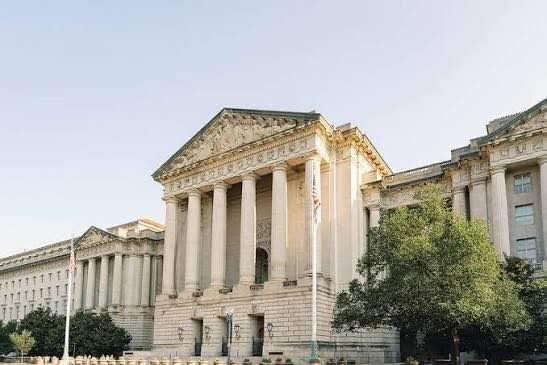
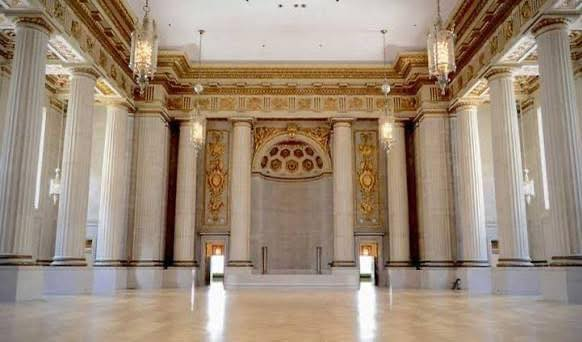
The US government already has a ballroom just down the street. The Andrew Mellon Auditorium is less than a mile away from the White House is beautiful and accommodates more people than the new ballroom will and is owned by the U.S. Government.
via Shelia Earl
@DarrenKiley@itsolelehmann This is my exact argument against them! We, as a human world can’t even get our race relations to be problem-free, how is it a benefit to add humanoids into the mix? It’s not. It’s just a horrible idea!
The United States capital is in Washington D.C. for one reason almost nobody learns in school.
Congress got run out of Philadelphia by its own army.
In June 1783, just months after the Revolutionary War ended, around four hundred unpaid Continental soldiers marched on the Pennsylvania State House where the Continental Congress was meeting. They surrounded the building, jeered through the windows, jabbed bayonets at the doorway, and demanded their back pay.
Congress turned to Pennsylvania's state government and asked them to call out the militia to disperse the mob.
Pennsylvania refused.
The most powerful legislative body in the new nation realized, in real time, that it had no land of its own, no soldiers of its own, and no protection from the very state that hosted it. So they did the only thing they could do. They fled in the night.
That single humiliation, called the Pennsylvania Mutiny of 1783, is the reason there is a federal district at all. The framers later wrote into the Constitution that the seat of government would never again belong to any one state. It would belong only to itself.
But before that fix arrived, the capital wandered like a refugee.
Including Philadelphia, which served on and off five separate times, the capital of the United States has officially sat in nine different cities.
Baltimore, Maryland. Congress fled there in December 1776 when the British army was closing on Philadelphia and Washington's troops were freezing along the Delaware. They met in a tavern.
Lancaster, Pennsylvania. The capital was here for exactly one day in September 1777 before Congress decided to keep running.
York, Pennsylvania. They settled across the Susquehanna River for nine months. The Articles of Confederation, the country's first constitution, were drafted there. York is the only city outside the original thirteen state capitals that can credibly claim to have hosted the birth of American government.
Princeton, New Jersey. After the soldiers' mutiny, Congress relocated to Nassau Hall on the Princeton College campus, where the building still has a cannonball hole from the war.
Annapolis, Maryland. In December 1783, in the senate chamber of the Maryland State House, George Washington walked in, removed his sword, and resigned his commission as commander in chief of the army. He could have made himself king. Instead, he handed the war back to Congress and went home to farm. King George III, when he heard about it from across the Atlantic, reportedly said that if Washington really did that, he would be the greatest man in the world.
The Treaty of Paris, ending the Revolutionary War, was ratified in that same Annapolis room a few weeks later.
Trenton, New Jersey. Congress met there for a few weeks in late 1784.
New York City. From 1785 to 1790, this was the seat of government. George Washington was inaugurated there on the balcony of Federal Hall on Wall Street in April 1789. The Bill of Rights was drafted there. The first Supreme Court convened there. New Yorkers fully expected to be the permanent capital forever.
Then politics happened.
In June 1790, Thomas Jefferson hosted a private dinner at his rented New York home. Alexander Hamilton attended. James Madison attended. Hamilton needed Southern votes for his plan to have the federal government assume the war debts of the states. Madison and Jefferson, both Virginians, wanted something in return.
They wanted the capital out of the North.
The deal struck over that dinner table is now called the Compromise of 1790. The federal government would absorb state debts. In exchange, the permanent capital would move to a brand new city built on the Potomac River, near Virginia, on land that did not yet exist as a city, on swampy farmland and forest that would have to be carved out of Maryland and Virginia and built from scratch.
While they built it, the capital would temporarily move back to Philadelphia for ten years.
George Washington personally chose the exact site. It included his own neighborhood. Mount Vernon was just down the river.
The boundaries of the new district were laid out as a perfect ten mile by ten mile diamond by Andrew Ellicott and a free Black astronomer named Benjamin Banneker, the son of a former slave, who calculated the survey points using the stars. There is a quiet historical irony in the fact that the city of American government was mapped, in part, by a man whose own grandfather had been kidnapped from Africa.
A French engineer named Pierre Charles L'Enfant designed the streets, the broad avenues, the placement of the Capitol on a hill and the President's House nearly two miles away connected by a long ceremonial road. He was fired within a year for being impossible to work with. His plan was used anyway.
The federal government moved into Washington in November 1800. The Capitol building was unfinished. The White House was unfinished. John Adams, the second president, moved into the unfinished mansion, and his wife Abigail famously hung the laundry to dry in the empty East Room because she had nowhere else to put it.
Then in August 1814, during the War of 1812, a British army marched up from the Chesapeake Bay, fought a brief and embarrassing battle at Bladensburg in which American militia ran for their lives, and walked into Washington unopposed.
They burned the Capitol. They burned the White House. They burned the Treasury. President James Madison fled into Virginia. His wife Dolley refused to leave until she had cut a full length portrait of George Washington out of its frame and rolled it up to save it. That painting still hangs in the East Room today.
When Congress returned to the smoking ruins of the city, a serious motion was put forward to abandon Washington forever and move the capital permanently back to Philadelphia. The vote failed by nine votes. Eighty three to seventy four.
Nine votes. That is how close Washington D.C. came to ending in 1814.
The diamond shape of the original district is also gone now. The Virginia side, which included most of Arlington and part of Alexandria, was given back to Virginia in 1846 because residents there felt ignored by the federal government and wanted to vote in state elections again. That is why the modern map of D.C. has a clean square edge cut out of one side. It was once the rest of the diamond.
During the Civil War, Washington sat on the front line. It was surrounded on three sides by slave territory. Confederate forces came within sight of the unfinished Capitol dome at Fort Stevens in July 1864, the only time in American history a sitting president, Abraham Lincoln, came under direct enemy fire on a battlefield. He stood on a parapet to watch the fight in his stovepipe hat. A Union officer reportedly shouted at him to get down before he was shot. That officer, by some accounts, was a young captain named Oliver Wendell Holmes, who would later sit on the Supreme Court for thirty years.
The Washington Monument, started in 1848, sat as an unfinished stump for over twenty years because the country ran out of money and then had a war. If you stand at the base today and look up, you can still see a faint horizontal line where the marble changes color. The bottom third was quarried before the Civil War. The top two thirds came from a different quarry decades later. It looks like a healed scar on the skyline of the city.
So the next time someone asks why the capital of the United States sits where it does, the answer is not really about geography, or compromise, or Washington's hometown.
The answer is that in 1783, an army of unpaid soldiers chased the United States Congress out of its own building, and a state government shrugged and watched it happen.
Everything after that, the diamond on the Potomac, the burning of the city in 1814, the cannonball hole in Nassau Hall, the resignation in Annapolis, the dinner deal in New York, the missing piece given back to Virginia, the scar on the Washington Monument, all of it traces back to that single summer in Philadelphia when the founders learned the hard way that a government without ground of its own is a government on the run.
They never wanted to run again.
Holy shit, this is BRILLIANT: This dude breaks down why everyone thinks the whole WHCD event was fake... everything about trump is FAKE.
Best video you'll see today.
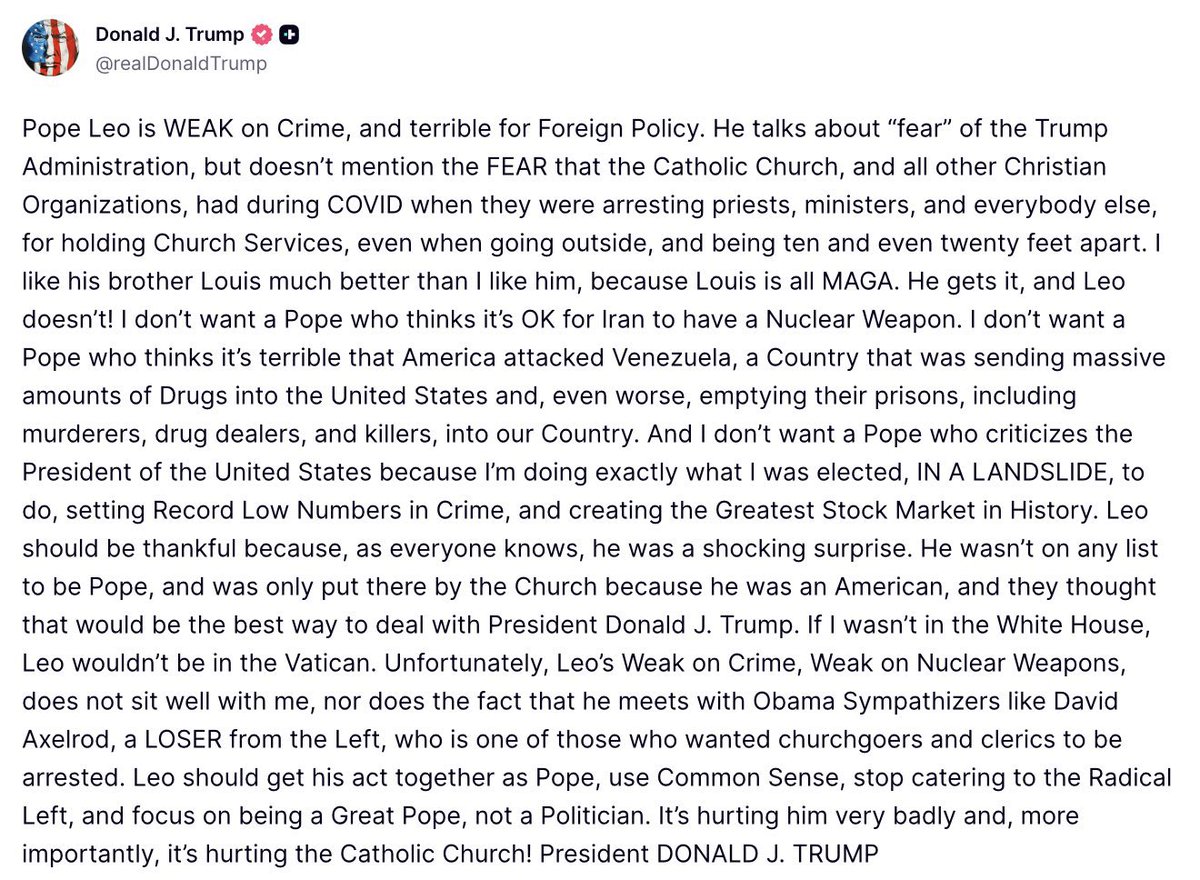
There is a way past the absurd and deeply divisive “war” between the President and the Pope, which has been enthusiastically ginned up by the press. And it is indicated in the Catechism of the Catholic Church, paragraph 2309 to be precise. After laying out the various criteria for determining a just war—proportionality, last resort, declaration by a competent authority, reasonable hope of success, etc.—the Catechism points out that “the evaluation of these conditions for moral legitimacy belongs to the prudential judgment of those who have responsibility for the common good.” The assumption is that the just war principles function, to use the technical term, as heuristic devices, designed to guide the practical decision-making of those civil authorities who have to adjudicate matters of war and peace.
The role of the Church, therefore, is to call for peace and to urge that any conflict be strictly circumscribed by the moral constraints of the just war criteria. But it is not the role of the Church to evaluate whether a particular war is just or unjust. That appraisal belongs to the civil authorities, who, one presumes, have requisite knowledge of conditions on the ground. So, is the war in question truly the last resort? Is there really a balance between the good to be attained and the destruction caused by the war? Are combatants and non-combatants being properly distinguished in the waging of the conflict? Do the belligerents have right intention? Is there a reasonable hope of success? The posing of those questions—indeed the insistence upon their moral relevance—belongs rightly to the Church, but the answering of them belongs to the civil authorities.
The Pope has said, on numerous occasions, that he is not a politician and that his role is not the determination of any nation's foreign policy. But he has just as clearly said that he will continue to speak for peace and for moral constraint. In making both of these claims, he is operating perfectly within the framework of paragraph 2309 of the Catechism. If we understand that the Pope and the President have qualitatively different roles to play in the determination of moral action in regard to war, we can, I hope, extricate ourselves from the completely unhelpful narrative of “Pope vs. President.”
@christian2fly@IterIntellectus This is not new, when I was in grade school back in the 70s I remember being taught that daily newspapers—the main means of news at the time, next to local tv stations)—were written on a 6th grade level. This was so the most of the U.S. population could understand the stories.
@thablackestlily@Viralfizz Or maybe he used left over paint from other jobs he’s done? 🤣 (That’s the only explanation I can think of for the ugly color combos and old chunky paint!)
The disrespect that so many Catholics here are showing Pope Leo is disgusting. Yea, yea, yea you all will give me the litany of the reasons you have for your disrespect. You will pummel me with questions like, “but Father, what about this, this, and this…” Well I have a question for you! Who do you all think you are? You are the holy ones? The prayerful ones? So filled with the Holy Spirit? Who are you to scrutinize and judge every single word and action of Christ’s authority on earth? The pharisaical nature of American Catholics is truly coming out. And then, so many denigrating the Pope at every turn at the same time minimize and rationalize every action and diatribe of our President? Here is a reflection for us all…Proverbs 9:10.
Yes, he really said that.
Yesterday Vice President JD Vance criticized Pope Leo XIV for not knowing enough theology: "I think it's very, very important for the pope to be careful when he talks about matters of theology ... If you’re going to opine on matters of theology, you’ve got to be careful, you’ve got to make sure it’s anchored in the truth," he said, at a Turning Point conference.
One of the many, many, ironies about that statement is that it came in response to Pope Leo's comments about war and peace and, specifically, the concept of "just war," which originated with St. Augustine. As many have already noted, when the Vice President was making his comments, Pope Leo XIV, a member of the Augustinian Order, and twice Prior General of the Augustinians before his election as Pope, was visiting the hometown of St. Augustine, then called "Hippo," now in Annaba, a town in modern-day Algeria. For good measure, Pope Leo XIV, the man critiqued for insufficient theological education, earned not only a master's degree in divinity, but also licentiate and a doctorate in canon law from the Pontifical University of St. Thomas Aquinas in Rome.
JD Vance's recent conversion to Catholicism is beside the point, because many converts are of course not only highly intelligent (and learned in theology) but faithful and energetic Catholics. We rejoice over everyone entering the church.
What most of us do not rejoice over, however, is a deadly combination of inaccuracy and hubris. Pace, Vice President Vance, but the current war in Iran is not a just war under Catholic doctrine. You can hear that from church leaders from across the theological spectrum, from Archbishop Timothy Broglio, the head of the military vicariate and former head of the @USCCB, to Cardinal Robert McElroy, Archbishop of Washington who holds doctorates in both theology and political science. You can look all that up online. Suffice to say, the Vice President doesn't seem to understand the tenets of just war.
Nor does he seem to understand the fundamental position of the church, which is for peace. "War is always a defeat for humanity," as St. John Paul II said. If that authority isn't enough, then turn to Jesus who said, "Blessed are the peacemakers," not "Blessed are the warmongers." And after the Resurrection, the Risen Christ says to the frightened disciples not "Vengeance is mine" but "Peace be with you."
Incidentally, the day before, the Vice President said that the Pope (and the Vatican) should stick to teaching about morality, also seeming to forget that war and peace are profoundly moral issues.
For his part, Pope Leo was focused yesterday on his spiritual father, St. Augustine. After what seemed like an emotional visit to Hippo, he celebrated Mass at the Basilica of St. Augustine in Annaba. During his homily he said, "The primary task of pastors as ministers of the Gospel is therefore to bear witness to God before the world with one heart and one soul, not permitting our concerns to lead us astray through fear, nor trends to undermine us through compromise."
Amen. Let's all continue to pray for the Holy Father as he works for peace.
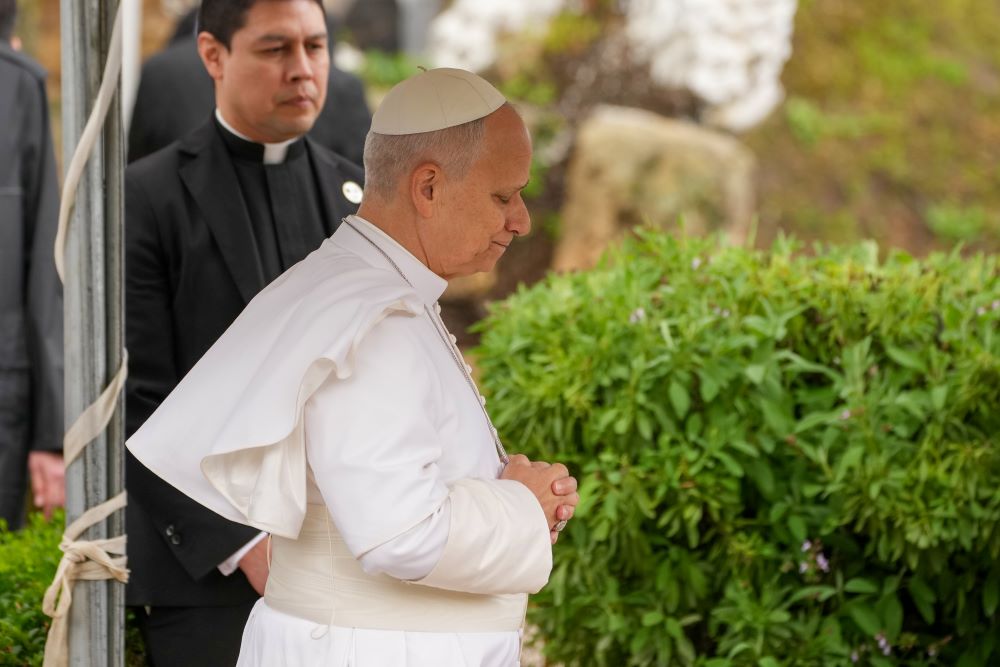
(Image: Pope Leo XIV prays at the archeological ruins of Hippo, home of St. Augustine, in current-day Algeria. CNS photo).
@fuzzylicious007 @Mlu__N2 I agree! Where is the personality? As an introvert, my home is my sanctuary and it’s a happy, lived-in, cozy place. “Dull and lifeless” is a great description for that whole video! 😆
@SupremeBrowt @Mlu__N2 Yes! And being an introvert doesn’t mean you have a “nice clean house”…being alone in a quiet house gives me more time for creative projects that tend to create clutter. I’m a huge introvert & cannot relate to such a non-cozy home. (Not all introverts need controlled order!)
With all due respect to the Office of the President, this post contains several claims that are factually inaccurate and theologically misguided, and as a Catholic I feel compelled to respond.
1. The Pope was not elected to please any president.
Pope Leo XIV was elected by 133 cardinals from across the world in a sacred conclave, on the fourth ballot, on May 8, 2025. 
The Holy Spirit guides the conclave, not American politics.
To suggest that “if I wasn’t in the White House, Leo wouldn’t be in the Vatican”  is not only historically ignorant but theologically offensive to every Catholic on earth.
2. He was not an unknown outsider.
Pope Leo XIV served as Prefect of the Dicastery for Bishops under Pope Francis, one of the most powerful roles in the Vatican, responsible for selecting bishops for dioceses worldwide. 
He was one of the most qualified candidates in the College of Cardinals.
3. He is deeply rooted in service, not politics.
An Augustinian missionary who worked for decades in Peru, Pope Leo XIV dedicated his life to the poor and the Gospel long before any political figure noticed him. 
His name honors Leo XIII, the Pope who championed workers’ rights and the poor during the Industrial Revolution, a tradition of Catholic Social Teaching that predates any modern political party.
4. The Pope’s role is prophetic, not partisan.
When the Pope speaks on peace, nuclear weapons, immigration, or the dignity of nations, he is fulfilling the mission of Christ, not opposing any government.
His first words as Pope were “Peace be with you all,”  echoing the Risen Christ (John 20:19).
A Pope who is silent on injustice would be failing his divine mandate.
5. Demanding a Pope “get in line” with a president contradicts 2,000 years of Church history.
From St. Peter before Nero, to St. Thomas More before Henry VIII, to John Paul II before Soviet communism, the Church has never existed to validate earthly power.
“We must obey God rather than men.” (Acts 5:29)
As Catholics, we pray for all leaders, including President Trump.
But we stand firmly with our Holy Father.
Habemus Papam. And he answers to God alone.
@HunE916@flora_patria@JebraFaushay I’m sure if she was decked out in American flag attire, instead of a Pomeranian shirt, and dancing with no rhythm to YMCA, they’d call her a “patriot” instead of a weirdo. 😜