RL2-VLA: Adaptive RL Latent Compositional Steering with Test-Time Scaling for Vision-Language-Action Models
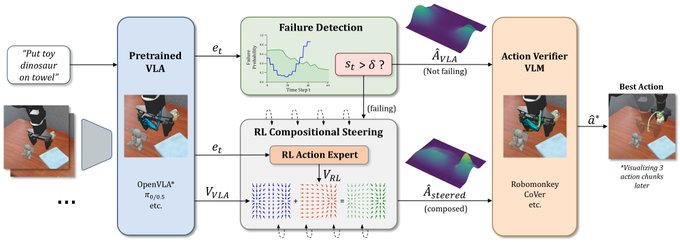
Overview of RL2. RL2 relies on base VLA samples to approach the task object, then adaptively applies RL compositional steering to diversify actions toward successful states — when failure is preemptively detected.
🎯 Most VLA steering methods break down exactly when they're needed most: under out-of-distribution failures.
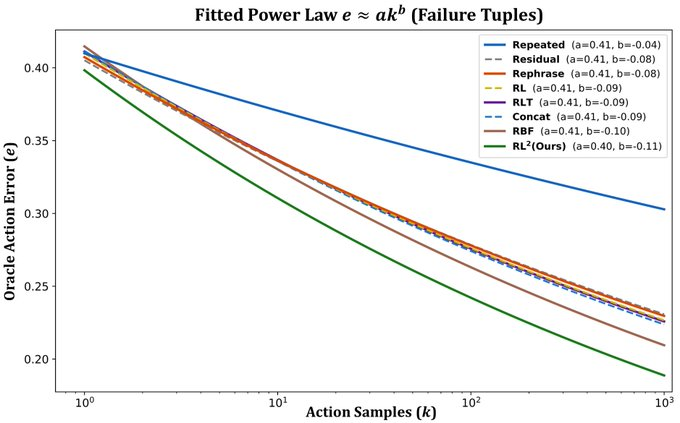
We uncover distinct test-time scaling laws 📉📈 for success and failure states, revealing why.
This leads to 𝐑𝐋²-𝐕𝐋𝐀 🚀 — an adaptive RL compositional steering framework that intervenes only when the VLA is likely to fail.
🧵👇
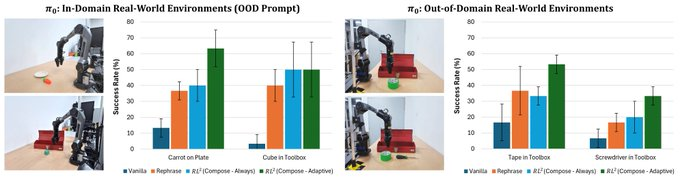
📊Extensive Evaluation We benchmark RL² on OpenVLA, π₀, and π₀.₅ across simulation (SIMPLER / PolaRiS) and real-world tasks under OOD prompts and task environments. RL² achieves up to +17.5% average improvement over strong steering baselines.
🛠️RL² Framework We train a lightweight offline RL flow-matching policy conditioned on VLA action expert latents, then compose its flow velocity with the frozen VLA at every flow-matching step. SAFE, a SOTA multitask failure detector, activates steering only upon failure.
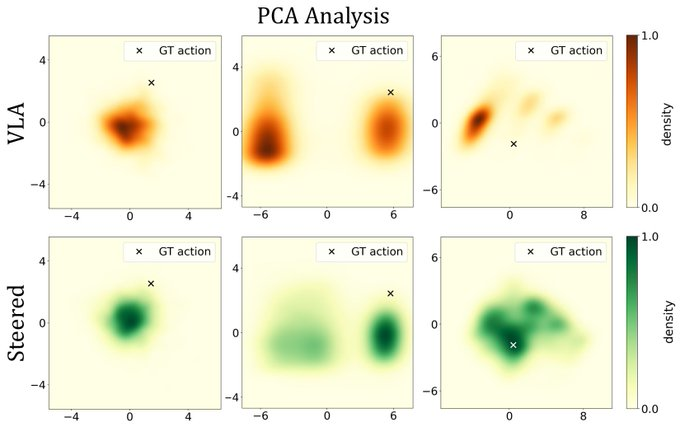
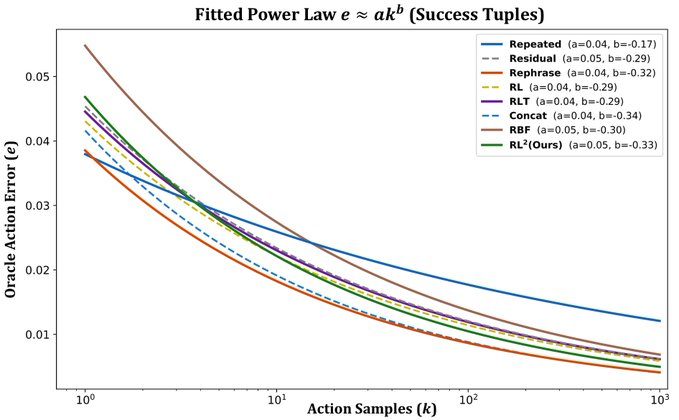
📈Success Scaling Laws The opposite holds during success states. Diversity-inducing steering can unnecessarily perturb already-accurate actions, leading to poor scaling compared to baselines. This motivates adaptive steering only when the base VLA is failing.
📉Failure Scaling Laws During failure states, action diversity is most beneficial. Diversity-inducing steering methods exhibit the strongest scaling behavior, with RL² compositional steering performing the best by generating actions beyond dominant VLA failure modes.
🚧 The OOD Challenge
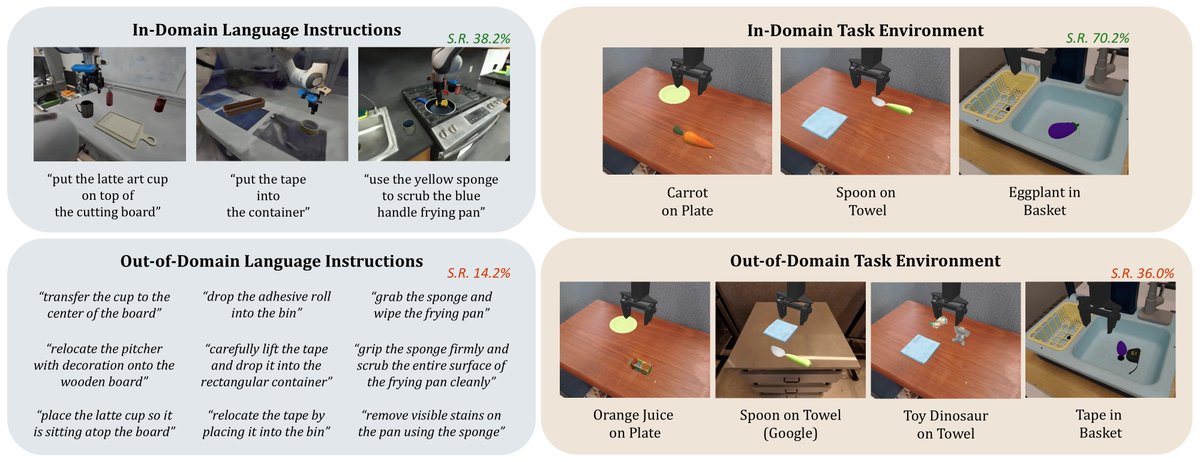
While VLAs excel on in-domain tasks, their performance drops sharply under unseen language instructions and task environments.
💡 Recent work tackles this with inference-time steering, enabling better OOD generalization without costly retraining or additional data collection.
🔍 How can we steer pretrained VLAs beyond dominant failure modes in OOD scenarios?
We uncover distinct test-time scaling laws 📈 for steering approaches under success and failure states.
This motivates 𝐑𝐋²-𝐕𝐋𝐀💫, an adaptive RL compositional steering framework.
🧵 👇
We're growing the @cortexairobot team across San Francisco, Singapore, and Malaysia.
We're hiring Robot Operator Managers, Robot Operators, and Software Engineers to scale real-world robotics data, deployments, and infrastructure for physical AI.
Check out our open roles: https://t.co/UzGimN9E9X
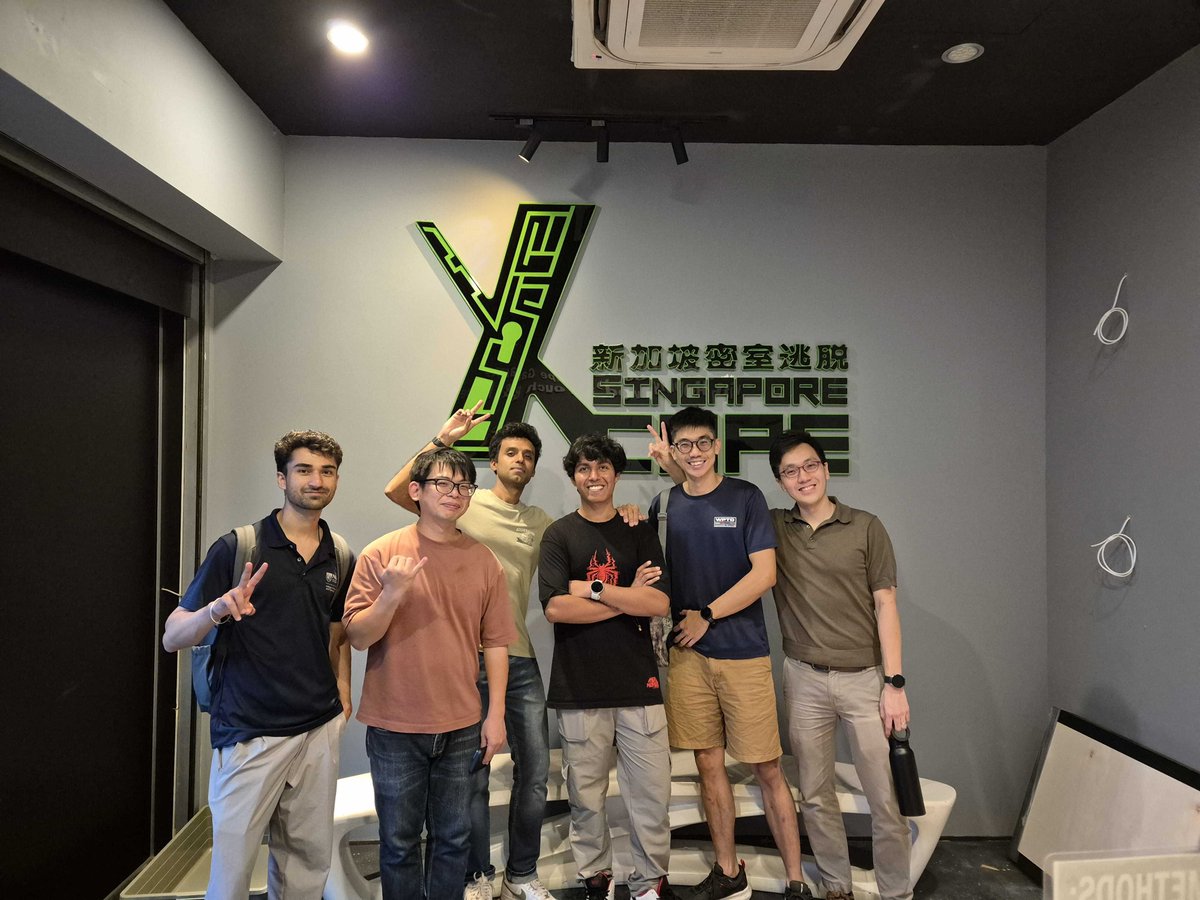
One year at MARMot Lab, Guillaume Sartoretti's group @NUSingapore, as I wrap up here. Probably the most important arc for me.
Got to work on test-time steering for VLAs, adapting a pretrained policy at inference without touching the weights, and figuring out the hard parts of that.
Thanks to Guillaume for giving me the opportunity, and to @derektan1995 , genuinely one of the best people I've gotten to work closely with. And @sood__shivam , William Teo, Jeric Lew, Srikrishna Iyer for all the great discussions we had along the way. 🙂
VLA-JEPA just dropped in LeRobot 🤖
What makes this model special is that it does not just learn what action to take from a given observation, it also leverages a JEPA world model to learn action-relevant dynamics.
During training, the VLA leverages V-JEPA2 by conditioning its predictor. This clever trick adds a world modeling objective to the training, which also allows pretraining on human videos.
At inference, the world model is dropped entirely, keeping only a standard VLA architecture: Qwen backbone and action head.
The demo here was only fine-tuned on 13 examples, showing great pretraining capability and running in real time on @NVIDIARobotics DGX Spark!
VLA-JEPA is the first world model to be ported to LeRobot, and I feel like it won't be the last 🚀
@Thom_Wolf@ClementDelangue