🔍 How can we steer pretrained VLAs beyond dominant failure modes in OOD scenarios?
We uncover distinct test-time scaling laws 📈 for steering approaches under success and failure states.
This motivates 𝐑𝐋²-𝐕𝐋𝐀💫, an adaptive RL compositional steering framework.
🧵 👇
🔍 How can we steer pretrained VLAs beyond dominant failure modes in OOD scenarios?
We uncover distinct test-time scaling laws 📈 for steering approaches under success and failure states.
This motivates 𝐑𝐋²-𝐕𝐋𝐀💫, an adaptive RL compositional steering framework.
🧵 👇
📊(6) Extensive Evaluation
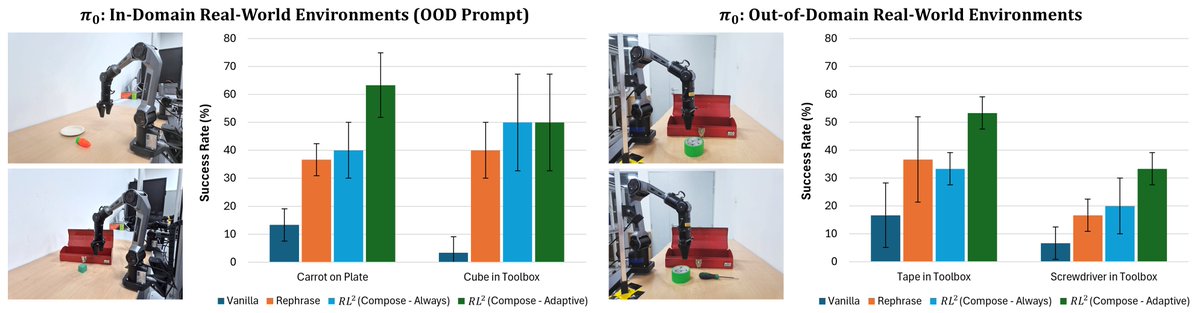
We benchmark RL² on OpenVLA, π₀, and π₀.₅ across simulation (SIMPLER / PolaRiS) and real-world tasks under OOD prompts and task environments.
RL² achieves up to +17.5% average improvement over strong steering baselines.
🦾(8) Action Distribution Visualization
PCA reveals that RL² shifts the VLA action distribution closer to the ground-truth action during failure states.
🛠️(5) RL² Framework
We train a lightweight offline RL flow-matching policy conditioned on VLA action expert latents, then compose its flow velocity with the frozen VLA at every flow-matching step.
SAFE, a SOTA multitask failure detector, activates steering only upon failure.
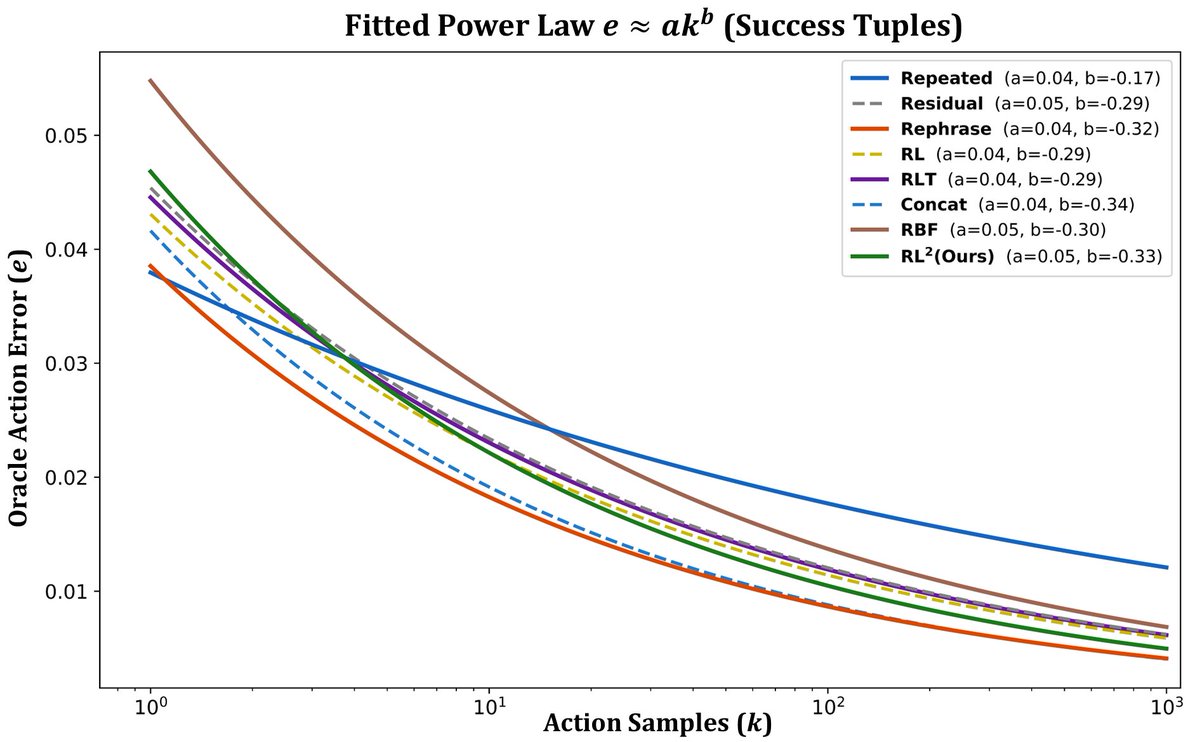
📈(4) Success Scaling Laws
The opposite holds during success states.
Diversity-inducing steering can unnecessarily perturb already-accurate actions, leading to poor scaling compared to baselines. This motivates adaptive steering only when the base VLA is failing.
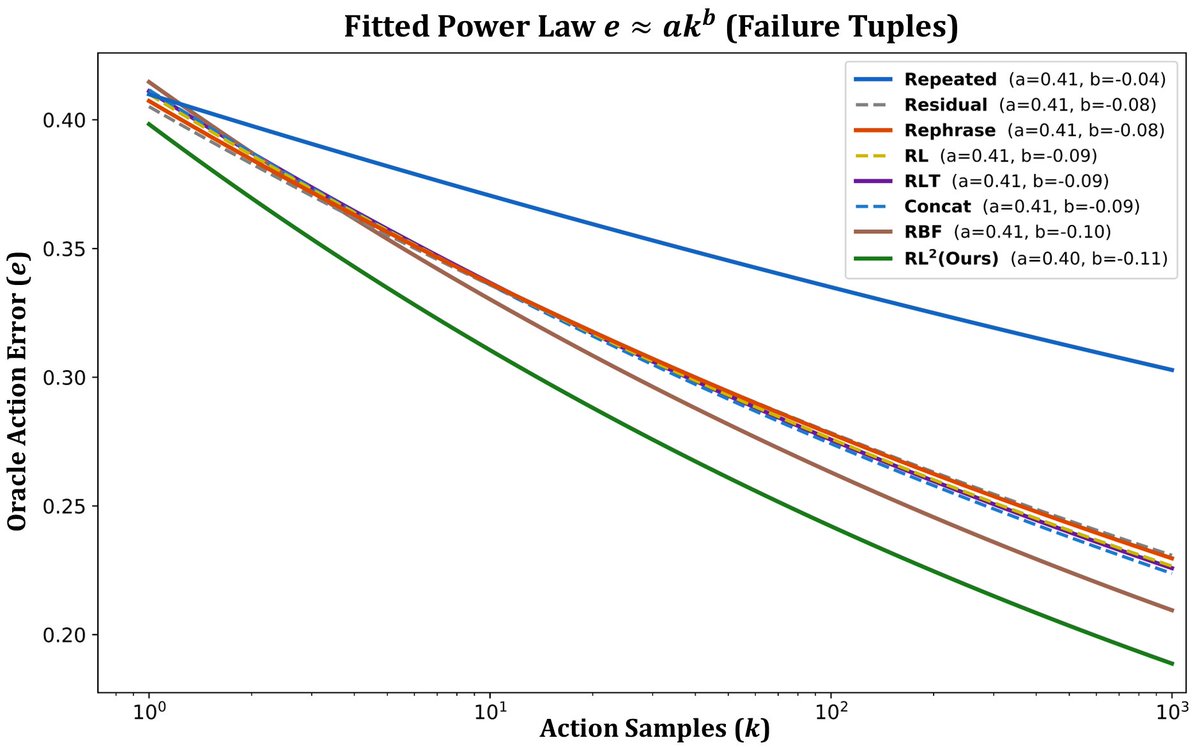
📉(3) Failure Scaling Laws
During failure states, action diversity is most beneficial.
Diversity-inducing steering methods exhibit the strongest scaling behavior, with RL² compositional steering performing the best by generating actions beyond dominant VLA failure modes.
🚧(2) The OOD Challenge
VLAs excel on in-domain tasks, but performance drops sharply under unseen language instructions and task environments.
Recent works tackle this through inference-time steering, improving OOD generalization without costly retraining or data collection.
📖(1) Check out more visualizations on our website. We also made it easy for you to try our code:
🌐 Website: https://t.co/aRZBAmFXIY
📄 Paper: https://t.co/pHvC6RQmqX
💻 Code: https://t.co/gSiHvPdsSJ
📍I'm excited to be at Seoul for #CORL2025 with my co-authors for our spotlight presentation on Search-TTA this coming Monday! 🇰🇷
🔊 Multimodality: emergent alignment to unseen input modalities
🛩️ Online Adaptation: refine poor VLM predictions
🦁 AVS-Bench: internet-scale data
🙏 Special thanks to my supervisors Prof Florian Shkurti and Prof Guillaume Sartoretti, who made the research visit to Toronto possible and for their solid guidance. Also to my co-authors and friends from NUS, Toronto, and ST Engineering who made this journey so enjoyable!
💻 Framework Flexibility:
We design Search-TTA to be flexible to different input modalities, planners, and environments. Applications include multimodal object detection, environmental monitoring, household search etc. Customize our code for your use case:
https://t.co/Npkv3LUvRm