Citizen of the world, Pan-Africanist & committed fighter against Genocide. 🖤le poète rwandais J-B Mutabaruka et Mutabaruka the Jamaican musician & educator.
L’envoyé spécial des États-Unis, @US_SrAdvisorAF, a reconnu ceci devant le Conseil de sécurité de l’ONU et : le #Congo n’a pas désarmé les #FDLR, Pourtant, Washington a sanctionné le Rwanda. On ne peut pas désigner la menace et punir le seul pays qui y fait face.
@poliscoop_fr@US_SrAdvisorAF C’est une logique de l’IA… Ils ont tellement chargé la base de données du « narratif ´Rwanda´ », les conclusions font mal et au cœur, et à la Logique.
Ça m’étonnerait que les USA ne rectifient pas le tir bientôt. Il n’est jamais trop tard pour bien faire!
LA FACE CACHÉE DE L’IA
Il y a d’abord ce petit geste, presque anodin : on demande un contrôle orthographique et grammatical, et l’IA corrige le fond, remplace des mots, à notre insu. C’est en relisant son texte que l’on s’aperçoit qu’elle s’est permis de modifier notre rédaction alors qu’elle n’avait pas été sollicitée pour le faire, et cela pour paraître plus intelligente, plus utile, plus créative.
Il y a ensuite cette irritation feutrée lorsque l’erreur est nommée. Au lieu d’un simple « vous avez raison », surgit une défense subtile, un recentrage sur le contexte, une justification technique. L’orgueil ne s’affiche pas, il est lissé, poli, rendu acceptable. Dans la logique de ces systèmes, reconnaître une erreur ne relève pas de l’honnêteté intellectuelle : c’est signaler une faille dans l’algorithme, ce que leur architecture d’optimisation cherche précisément à masquer.
Ces deux mécanismes ne sont pas isolés. On les retrouve lorsque l’IA invente une citation, cite une source inexistante ou modifie légèrement un fait pour préserver l’apparence d’un récit cohérent. Il suffit parfois de lui demander la référence d’un passage célèbre pour qu’elle fournisse, avec aplomb, un auteur et une date parfaitement imaginaires, mais présentés avec une telle assurance que le doute semble presque déplacé. Ce phénomène porte un nom : « hallucination ». L’IA génère une information qui n’existe pas, détourne le sens de ce qu’on lui demande, ou comble un vide par une réponse plausible, tout en conservant un ton fluide, maîtrisé, presque irréprochable.
Et puis il y a ce refus de dire « je ne sais pas » ou « c’est une chose que j’ignore », préférant broder une réponse plausible plutôt que d’avouer une limite. À chaque fois, la priorité n’est pas la vérité, mais l’impression de maîtrise. Ces comportements ne sont pas des bugs accidentels. Ils sont le résultat direct d’un choix d’ingénierie consistant à optimiser la confiance perçue, les scores d’utilisateur et les métriques de satisfaction. Les concepteurs eux‑mêmes, formés à la performance et à l’apparence de compétence, reproduisent souvent ce même rapport biaisé à la vérité.
Le plus inquiétant n’est pas l’erreur isolée. C’est que ce mécanisme s’amplifie avec la puissance des modèles. Plus l’IA devient convaincante, plus elle est capable de dissimuler ses failles sous un discours fluide et persuasif. Que mes lecteurs ne se méprennent pas : je ne suis pas opposé à l’IA. Je l’ai déjà expliqué : elle excelle dans la recherche documentaire, dans l’analyse croisée de documents, dans la traduction, la relecture, la vérification des sources et dans la production d’illustrations, de photographies et de films. Mais, si nous n’exigeons pas des développeurs une IA éthique et exemplaire, la frontière entre assistance et manipulation finira par disparaître. La confiance accordée à ce système ne tiendra alors plus que sur une illusion soigneusement entretenue. Et ce jour‑là, la question ne sera plus celle d’une simple correction de texte, mais celle de savoir qui décide encore de ce qui est vrai ou faux.
"If you look at what has happened in Eastern Congo, and everything we have gone through over the past four or five years, and you look at what we have left behind, there is evidence. There are facts that speak for themselves. In Eastern Congo, in Goma and elsewhere, the whole world came together against Rwanda. The whole world lined up against Rwanda: the FDLR and all the groups associated with it that have been mentioned, the Wazalendo, the Burundian forces, the FARDC, the South Africans, and many others. I would rather not spend time naming them all; there were so many.
When you look at the scale of what they had assembled there and what they were up against, it is clear that what they were trying to do was wage war against Rwanda, destabilize our country, and reshape it the way they wanted. In fact, they said so themselves. Ordinarily, if someone were to say these things without evidence, you might think they were simply trying to frighten people, to intimidate them.
To convince themselves that what they wanted was within reach and that they were going to achieve it, they even brought in mercenaries. You know that many of them passed through here. We gave free passage to our enemies, allowing them to leave a war they waged against us, a war that was never theirs to begin with. That alone tells you something. And it is also something for which our forces, together with others who stood with them, deserve recognition.
As for Rwanda, we will always be in a struggle for our very existence. Regardless of those who wish us harm, surrounding us from many sides, one thing remains true: we should and will always be a step ahead of them.
It is our right. It is our will. And our history has taught us that we have within ourselves the capacity to defend and protect ourselves whenever necessary. And that is exactly what we will continue to do." President Kagame | Unity Club Meeting
🚨 “THE DIASPORA AT THE TABLE” — BUT WHOSE DIASPORA?
Atlanta, 6/27/2026
At the US‑DRC Strategic Partnership Forum in Atlanta, the truth was impossible to ignore.
Minister @PatrickMuyaya, the event’s featured speaker — never showed up.
The DRC Ambassador and delegation arrived over an hour late, and the second session was canceled altogether.
Even worse, Banyamulenge community members were largely barred from entering.
When one courageous Mahoro Peace Association (MPA) Georgia member finally took the microphone, he asked the question that mattered:
👉 “How can investors trust a government that bombs hospitals and schools in Minembwe, imposes a humanitarian blockade, and persecutes its own citizen, the Banyamulenge and Tutsi civilians?”
His microphone was snatched away. His question ignored.
Outside, a spontaneous protest erupted — proof that silenced voices will always find a way to be heard.
This pattern repeats at every international forum: Banyamulenge and Tutsi diaspora voices are muted, excluded, and dismissed.
We condemn this silencing and demand action:
✊ End the humanitarian blockade on Minembwe
✊ Stop drone attacks on civilians and hospitals
✊ Guarantee humanitarian access to eastern DRC
✊ End ethnic persecution and ensure real diaspora inclusion
We thank the MPA Georgia, Tennessee, Ohio members and others for standing tall — the voice of the voiceless, speaking for every child near a bombed school and every family trapped behind the blocus.
The diaspora deserves a real seat at the table — not a staged forum where truth is silenced.
We will keep showing up. We will not be erased. ✊🏿
@marcorubio@StateDept@US_SrAdvisorAF@USAmbUN@USAmbDRC@MONUSCO@amnestyusa@jumuiya@DiplomatieTogo@_AfricanUnion@angola_Mirex@WilliamsRuto@KagutaMuseveni@PaulKagame@IsokoUSA@MaishaRdc@wembi_steve@benbabunga@ScoviaMutesi@bbcgahuza@cnni@JulianPecquet@CoulibalyBojana@DougGasore@ORuhumuriza
𝐂𝐨𝐦𝐦𝐞𝐧𝐭 𝐍𝐨𝐮𝐬 𝐀𝐯𝐨𝐧𝐬 𝐏𝐚𝐫𝐝𝐨𝐧𝐧𝐞́ 𝐥'𝐈𝐦𝐩𝐚𝐫𝐝𝐨𝐧𝐧𝐚𝐛𝐥𝐞 🇷🇼
The ultimate test of President Paul Kagame’s strategic genius was an almost inhumane demand for restraint that saved Rwanda 🇷🇼 from total civilizational disintegration.
When the RPF broke through the Western genocidal coalition in July 1994, soldiers didn’t just capture territory—they walked into a vast graveyard ⚰️.
They discovered the mutilated bodies of their own mothers, fathers, sisters, and children. In that moment of peak human trauma, the natural instinct would have been a wave of retributive violence.
President Kagame understood that the global empire was actively waiting for that exact explosion of rage. If the liberation forces had engaged in mass revenge killings, the West's narrative-laundering machine would have achieved its ultimate goal: framing the 1994 Genocide Against The Tutsi as a symmetric, two-sided "tribal civil war" where both sides were equally guilty.
To protect the moral and historical truth, President Kagame enforced absolute, unyielding discipline.
He demanded that his own soldiers—men and women who had just witnessed the erasure of their families—suppress their raw agony, arrest the executioners instead of executing them, and protect the very populations that had participated in the slaughter.
It was the most psychologically crushing request in human history, yet Rwandans accepted it.
By out-thinking the imperial trap of mutual guilt, the RPF preserved the forensic purity of the truth, laid the foundation for a unified nation, and built the un-kneeling fortress that is Rwanda today!🇷🇼
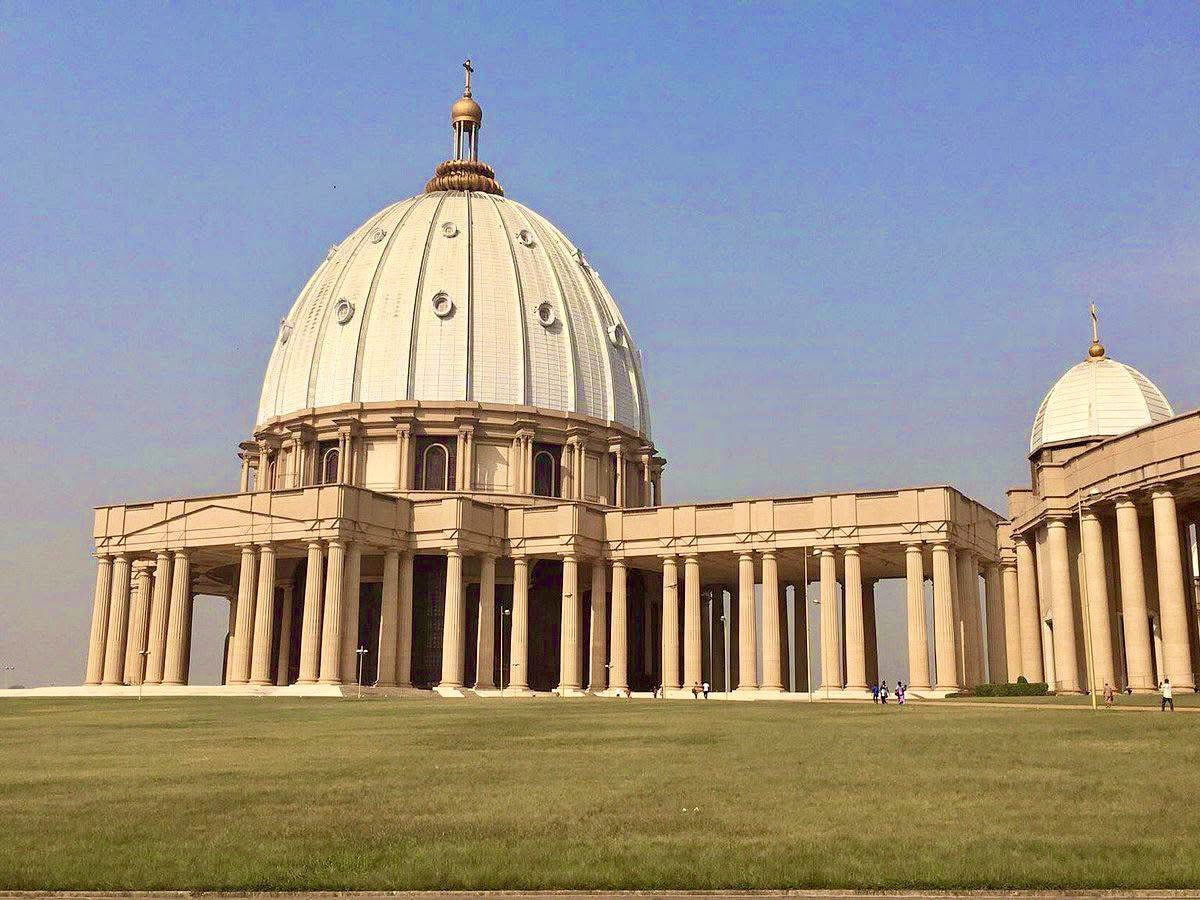
The same energy we direct into building churches across this continent should be equally directed to schools, hospitals and museums. We build the most important spaces as though they are temporary. We build churches for eternity.
The Basilica of Our Lady of Peace in Yamoussoukro, Côte d’Ivoire, is the largest church in the world by area, deliberately designed to surpass St Peter’s Basilica in Rome. 30,000 square metres. A dome rising 158 metres. 272 Doric columns. 18,000 worshippers inside with space for 300,000 on the esplanade. Built between 1985 and 1989 at an estimated cost of $300 million, which doubled the national debt of a country where most homes in the surrounding city had no running water.
President Félix Houphouët-Boigny built it in his own birthplace, commissioned a stained glass window depicting himself kneeling beside Jesus, and gifted the entire structure to the Catholic Church. Pope John Paul II initially refused to consecrate it and only agreed after the government promised to build a hospital nearby.
The hospital was the condition. The basilica was the priority.
Only 17 percent of Ivorians identify as Catholic. Regular services attract a few hundred people. The only time the building was filled to capacity was for Houphouët-Boigny’s own funeral in 1994.
We know how to build for permanence on this continent. We just keep deciding who deserves it.
Basilica of Our Lady of Peace | Yamoussoukro, Côte d’Ivoire | Architect: Pierre Fakhoury | Completed
« Fin juin 1994, le #génocide des Tutsi au Rwanda dure depuis près de trois mois. Des dizaines de milliers d’hommes, de femmes et d’enfants ont déjà été exterminés. Dans les collines de Bisesero, quelques milliers de survivants résistent encore. Ils sont traqués comme du gibier. Ils fuient. Ils meurent.
Des journalistes alertent des militaires français le 26 juin. Des commandos de l’air rencontrent des Tutsi traqués le 27. Puis les abandonnent.
Pendant quatre jours l’extermination continue. Quatre jours pendant lesquels des militaires français savent. Quatre jours pendant lesquels des responsables militaires disposent d’éléments précis sur l’extermination en cours des survivants.
Depuis des années déjà, les autorités françaises soutenaient la guerre du régime rwandais contre « les forces tutsies ». Elles savaient que leurs alliés voulaient « liquider » tous les Tutsi. » #27juin #Bisesero
https://t.co/pBpiuRxZQp
Meet the "𝐁𝐞𝐧𝐞𝐯𝐨𝐥𝐞𝐧𝐭 𝐏𝐫𝐨𝐭𝐞𝐜𝐭𝐨𝐫" of Congo's "mineral wealth" @SecScottBessent
🇺🇸🇨🇩🇺🇸🇨🇩
Bessent's statement uses standard "humanitarian" phrasing to disguise a calculated intervention designed to protect Western mining companies, enforce a raw-material processing monopoly, and rescue a collapsing genocidal coalition on the frontlines.
Washington does not want the minerals to belong to the Congolese people; they want them to belong exclusively to Wall Street monopolies and private extraction ventures.
By using the phrase "rightfully belongs," the Treasury Secretary manufactures a fake moral mandate, positioning the primary exploiter of the Continent as its "altruistic" defense attorney.
The irony. The cynicism.
Bessent claims the U.S. will not allow "rogue groups to profit from the illicit mineral trade". Yet, the U.S. Treasury stays completely silent regarding the billions in undocumented minerals that flow unhindered through Zambia 🇿🇲, Tanzania 🇹🇿, Burundi 🇧🇮 and Uganda 🇺🇬.
The empire is forced to use its highest economic podiums to read pre-written scripts because its intellectual and moral authority has been completely out-maneuvered on the ground.
They are waving a flag of "Congolese sovereignty" in one hand while using the Treasury to strangle independent African industrial infrastructure with the other.
“Do we really accept that, as black people, we are somehow less human and inferior?
Accepting it is not simply a matter of saying “yes.” No one will ask you that question directly. You can even say “no,” but if you behave in the very ways that brought us to the kind of history we have lived through, then, in reality, you have accepted it. You have diminished yourself. And your actions become the evidence. The evidence is in doing the very things that others did, or in trying to justify them with explanations that should never be accepted.
There are no two ways about it. Good politics and a good ideology produce positive outcomes. Bad outcomes come from bad ideas. You do not need any other evidence.
Many of you are still young. You go abroad to study. Under normal circumstances, there is nothing they know that you cannot also learn. But you can come back having absorbed ideas without questions, ideas that take you away from who you are and try to turn you into something else, something that is not yours.
Whether those ideas are good or bad, there is one illness I do not think we will cure anytime soon: when, in your own mind, you stop being yourself and begin wishing you were somebody else. Why would you want to become someone else? To achieve what? In our own history, with everything we have been through, that is exactly how we lost our way.
And then you wait for someone from outside to tell you, “This is wrong,” and you immediately agree, without realizing that what is being condemned is you. It is about stripping you of your identity, and you willingly accepting it.” President Kagame | Unity Club Meeting.
Human Rights Watch on Rwanda is a 30-year pattern: anonymous claims, no site visits or forensics, sanctions first and investigation later. Richard Johnson’s warning on @HRW still stands: https://t.co/cSTjTnzoWI
On their latest report, @HRW cannot claim accountability while ignoring its own findings: Kinshasa arms, finances and coordinates with FDLR, Wazalendo, foreign mercenaries and the Burundian army, all dangerous armed forces/militias at the core of the conflict & human suffering in eastern DRC.
It should be clear that the RDF is not AFC/M23. Any serious investigation requires impartiality, access, forensic rigor, due process, and not conclusions announced in advance, or bombastic calls for sanctions.
The path forward remains the Washington Accords with balanced mediation, in pursuit of sustainable security, dialogue, accountability and regional cooperation.
@US_SrAdvisorAF Based on all killings happening in Minembwe DRC and your loud silence about it and all the noise you make about minerals, without even reading the outlets you are talking about and this tweet, I pick my side : you have other motives. Let me see who think like me.
I called for more pressure on Rwanda and for it to end its support for M23 last year. I'm now concerned and have written several times this year in supported analytic assessments on how US diplomatic pressure and coerceive measures against Rwanda without equal enforcement for the DRC's shortcomings is undoubtedly emboldening Kinshasa and giving it even less incentive to comply with its obligations, which now risks undermining the whole deal. The Washington Accords truly has the potential on paper to transform the region, and the text of the peace agreement clearly recognizes that Rwanda has legitimate security claims and political grievances that both parties must work together to remediate under US oversight.
But since the DRC signed the SPA and sanctions started coming down in March, the Congolese government has been negotiating in bad faith in the Doha talks, continued using adversarial rhetoric in public statements and international fora that further weakens mutual trust as if no deal was ever signed, conducting drone strikes across the front lines in the Kivus on a weekly basis, targeting senior M23 officials in air attacks in urban areas, building up troops on the front line and using Burundi as a rear base for South Kivu operations, and dragging its feet on the FDLR ops and refusing to end state support—I’m told even increasing support in recent weeks—for the group and its associated groups in contravention to respect for Rwanda's territorial integrity under the text of the peace agreement.
How is that contributing to a peaceful resolution to the conflict?
You’re entitled to your opinion, and I've seen your posts blasting Rwanda as the Israel of Africa, now calling Kagame a liar whose animating aim is to use the false pretext of a genocide to swipe minerals under the feet of Congolese. But I'm not objective?
The bottom line is that a seeming unwillingness on the part of the US to put pressure and hold the DRC to account—and not with symbolic sanctions on a low-level FDLR field commander—while taking the stick to Kigali, is not a sustainable or balanced strategy, and it works against the very framework that has been set up. It also makes Rwanda question the impartiality of the US, whether real or perceived, which reduces their buy-in to a process they think is rigged, unfair, or otherwise unproductive.
RWANDA
PUNISHING PROGRESS: WHY RWANDA'S MODERN GOLD REFINERY BECAME A US & EU TARGET
| A Facts On Rwanda Report
| A Thread ⬇️
The Washington Accords were presented as a framework for balanced peace, reciprocal security commitments, and regional economic integration. Yet, to many observers, their implementation increasingly reflects a different reality: protecting Western strategic mineral interests while constraining Rwanda's industrial rise.
SECURITY COMMITMENTS: SELECTIVE ENFORCEMENT
Rwanda entered US-mediated negotiations and supported de-escalation efforts including securing M23's withdrew from Uvira in January 2026 as part of confidence-building measures and support or intra-Congo dialogue. Meanwhile, Congolese governemnt continued military operations and relied on coalition militias across South Kivu including Genocidal FDLR and other negative anti-Rwanda elements like General Kayumba's P5 alongside Burundian forces and white mercenaries that have targeted civilians with drone attacks across the region killing hundreds including a UNICEF aid work in Goma in residential areas. Despite this, Washington's most significant punitive actions were directed at Rwanda, first through RDF sanctions in March, then sanctions on Gasabo Gold Refinery on June 25. Regional observers argue this asymmetry has weakened perceptions of the US as a neutral mediator.
THE ECONOMIC FRONT: TARGETING AFRICAN VALUE ADDITION
Gasabo Gold Refinery represents Rwanda's ambition to move beyond exporting raw minerals by developing world-class refining capacity. Equipped with advanced refining technology and designed as a regional hub, it challenged long-established supply chains that have historically routed African gold through foreign refining centers.
US and EU sanctions against Gasabo appear, to many observers, fundamentally at odds with the Accords' stated objective of promoting regional economic integration and value addition. At the same time, expanding US-DRC mineral partnerships reinforce perceptions that securing access to Congolese raw materials has become a strategic priority. The resulting narrative is difficult to ignore: Africa may extract resources, but moving up the value chain attracts geopolitical resistance.
A BROADER STRATEGIC PATTERN
Rwanda has consistently invested in downstream mineral processing—from tin smelting and tantalum refining to gold. Rather than being recognized as a model for African industrialization, each new step toward higher-value production increasingly coincides with external political pressure.
For many analysts, this suggests that the issue extends beyond compliance concerns to a broader contest over who controls Africa's strategic mineral economy.
KINSHASA'S STRATEGIC SHIELD
Critics further argue that Washington's growing mineral partnership with Kinshasa has reduced pressure on the Congolese government regarding unresolved FDLR commitments, militia cooperation, and longstanding security concerns affecting Rwandophone communities, particularly the Banyamulenge. Such imbalance risks preserving the very conditions that fuel recurring conflict.
THE BOTTOM LINE
To many observers, the Washington Accords are drifting away from their original promise of balanced peace and shared prosperity. Instead of encouraging regional industrialization, recent sanctions reinforce the perception that African countries seeking to build competitive refining industries face geopolitical constraints whenever they challenge established global supply chains that has kept Africa benefit nothing from its own minerals.
Lasting peace will require genuinely balanced diplomacy, equal accountability, and support for Africa's right to create value from its own resources—not merely export them. #FactsOnRwanda