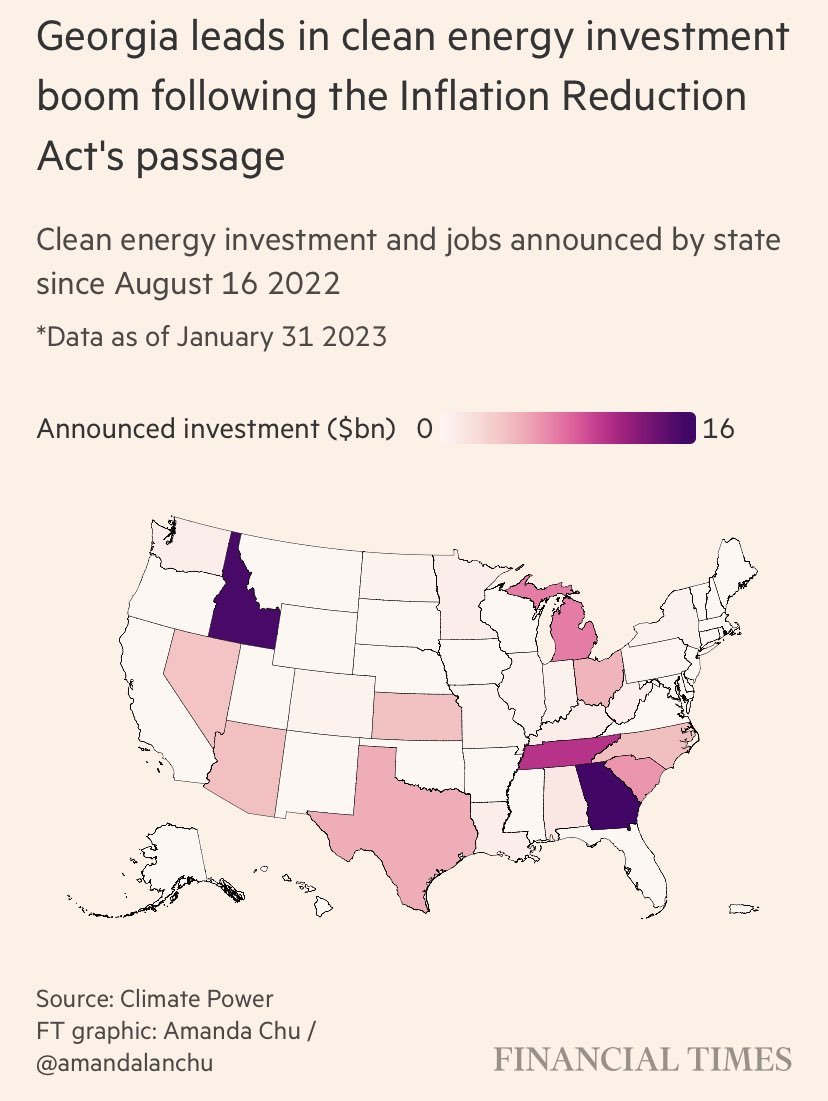
Many debates around alt energy stocks in the context of 2024 US elections. Interestingly, alt energy performed well during a Republican presidency, coinciding with US withdrawal from the Paris Agmt in 2019! Democratic presidency on the other hand doesn't look all that great.
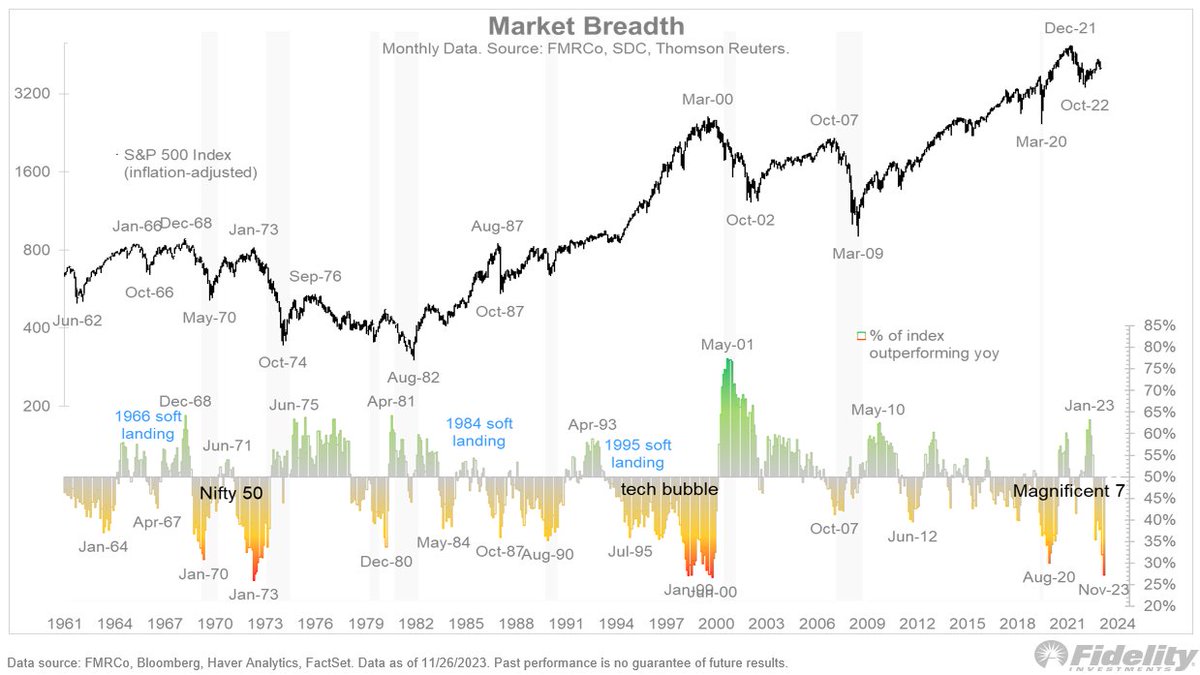
The theme of this year's stock market has been narrow leadership by mega caps. That's what happened in the early 1970s, when investors only trusted blue chips, and in the late '90s, when high-flying tech stocks ran amok, creating the dot-com bubble. The chart shows the inflation-adjusted S&P 500 at the top and, in the bottom panel, the percentage of stocks that outperformed the index over a rolling 12-month period.
In both the early '70s and late '90s, the tape only broadened during recession, which seems counter-intuitive. Perhaps the lesson is this: When leadership gets so lopsided (as it was then and is now), the tide can turn under any circumstances, bullish or bearish. If we get that long-awaited recession in 2024, it could happen in a broadening tape. Few investors will have that on their bingo card for 2024.
41% of French population is in favour of a proposal to limit everyone to 4 flights in their entire life.
59% of 18-24 year-olds agree.
2 return flights. Not per year: per life.
https://t.co/3HctPDkUb2
Look, Na-ion doesn't work.
OK, it works, but only at lab-scale.
Fine, it's commercialised, but it's still 5+ years away.
Sure, it's here, but it's not suitable for EVs.
Fine, it can go into EVs, but only in China.
Fine, *small amounts* will be sold in the west. (<--we are here)
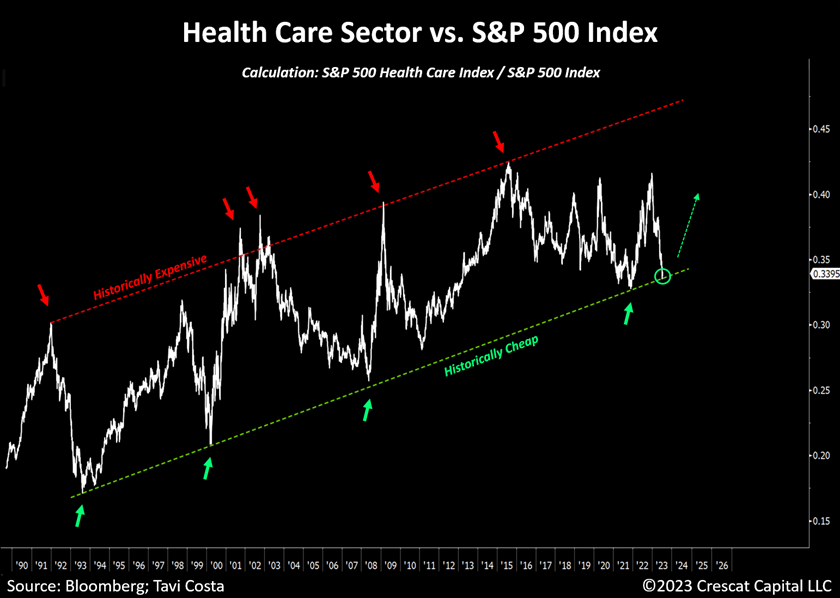
The relative performance of the healthcare sector versus the S&P 500 has been in a 30-year upward channel.
At market peaks, these stocks often reach attractive valuations and then excel in performance during economic crises.
While the spotlight has been on historically expensive mega-cap technology companies fueled by AI developments, the healthcare sector is poised to be among the primary beneficiaries of such technological advancements.
The case for the Biotechnology industry is arguably even more compelling.
Since 2015, these companies have drastically underperformed the S&P 500 and Nasdaq indices.
The Nasdaq Biotechnology index, which includes larger and established businesses, currently has a price-to-sales multiple of approximately 5.5 times, down from nearly 13 times back then.
In 2000, a ten year old schoolboy asked Warren Buffett if he was worried about the internet hurting his portfolio companies. The following year, after the internet bubble had begun to pop, he asked Warren if his views on the internet had changed.
15+ years later, in 2017, the schoolboy, now 27 years old and a professional internet investor at his ~20th consecutive Berkshire Hathaway annual meeting, updated his question and asked Warren about the implications of AI on his portfolio.
After hearing Warren's response and reflecting on it, as well as thinking about where his competitive advantages lay and the future he foresaw, he decided to focus on climate and sustainability. And today, he leads sustainability research for Counterpoint Global (home of the great teacher @mjmauboussin), and the subject of this weekend's letter:
Letter #102: Tom Kamei (2023)
This weekend's letter was an essay by written by Tom Kamei, adapted from a talk he gave at Notre Dame. In this letter, Tom discusses the shift from tangible to intangible investments, compares the sustainability wave to the digital wave, sustainability going mainstream, millennials as catalysts, sustainability through a prism, the convergence of profits and purpose, flaws in existing frameworks, measuring externalities, and much more.
Tom is an investor for Counterpoint Global and leads the Sustainability Research integration strategy for the US based funds managed by the team. He was a Fellow at The Aspen Institute in 2015 where he developed a proprietary process to quantify executive compensation alignment. Prior to his current role, Thomas worked with Counterpoint Global for two years as an intern. Previously, he was a research intern at Kleiner Perkins Caufield & Byers where he analyzed late stage private technology businesses for the Green Technology Growth Fund. Thomas received a B.S. in architectural studies from the University of Southern California.
Tom is also one of the most interesting investors out there—he’s an architect by training, a value investor by principle, a tech analyst by practice, and a sustainability researcher by purpose. If you’re wondering how that’s possible, so did I.
The answer is quite simple: He’s been going to the Berkshire Hathaway Annual Meeting every year since 1997, had the pleasure of asking Warren and Charlie several questions (pasted below), and taken their answers seriously.
TK Berkshire Questions:
2000: My name is Thomas Kamei. I am 10 years old and I go to Bacich School in Kentfield, California. I have been a shareholder for two years. This is my third annual meeting. Here’s my question: I know you won’t invest in technology companies, but are you afraid that the internet will hurt some of the companies that you do invest in, such as The Washington Post or Wells Fargo? Thank you. (Morning Session, Question 5.)
2001: Good morning. My name is Thomas Kamei. I am 11 years old and from Kentfield, California. This is my fourth annual meeting. Last year, I asked how the internet might affect some of your holdings. Since a lot of the internet companies have gone out of business, how are — has your view of internet changed? (Morning Session, Question 15.)
2002: Mr. Buffett and Mr. Munger, my name is Thomas Kamei. I am 12 years old. I live in Kentfield, California. This is my fifth annual meeting. I know you lost a lot of money as a result of 9/11. But I would like to know how 9/11 changed your life and your investment strategy? (Morning Session, Question 18.)
2007: Good morning. I’m Thomas Kamei from San Francisco. I’m 17-years-old and this is my tenth consecutive annual meeting. Mr. Buffett and Mr. Munger, I’m curious about what you think is the best way to become a better investor. Should I get an MBA? Get more work experience? Read more Charlie Munger Almanacs or merely is it genetic and out of my hands? (Morning Session, Question 14.)
2017: Hi, Warren. This one’s a fun one. Thomas Kamei is here. He’s a 27-year-old shareholder from Kentfield, California. And I should preface this question by saying that he was here 17 years ago at 10 years old, asked you a question from the audience asking you if the internet might hurt some of Berkshire’s investments. At the time, you said you wanted to see how things would play out. He’s now updated the question. “What do you think about the implications of artificial intelligence on Berkshire’s businesses, beyond autonomous driving and GEICO, which you’ve talked about already? In your conversations with Bill Gates, have you thought through which other businesses will be most impacted? “And do you think Berkshire’s current businesses will have a significantly — will have significantly more or less employees a decade from now as a function of artificial intelligence?”(Afternoon Session, Question 13.)
Two decades after asking Warren and Charlie about the internet, and after one decade as an internet analyst, Tom is now focused on sustainability research and investing. He has total conviction that the for-profit mechanism is a powerful lever to unleash humanity’s ingenuity and can help solve society’s most intractable issues while creating trillions of equity value along the way.
I hope you enjoy this essay as much as I did!
[Full Essay in Bio]
Very important research:
Despite the fact that the combined market capitalization of the top 10 companies in the S&P 500 constitutes an unprecedented 31.7% of the index, their earnings contribution has been drastically declining and now stands at only 21.5%.
The dominance of megacaps in leadership is overwhelmingly unsustainable and cannot be justified by their current fundamentals.
H/t @ChrisPavese and @jessefelder
"This is regulatory arbitrage. What you're doing is getting the IRA to pay you to capture the carbon, and then you're sneaking off to Europe, emitting it and helping someone avoid a carbon price. Let's be absolutely clear, the CO2 is ending up in the air." https://t.co/P7AQ2xKhyE
“Omg all these electric cars will break the grid where’s all the energy going to come from?!?!?!”
Believe it or not, National Grid have thought about this very carefully. And yes, they are also aware that sometimes it isn’t sunny/windy 😂
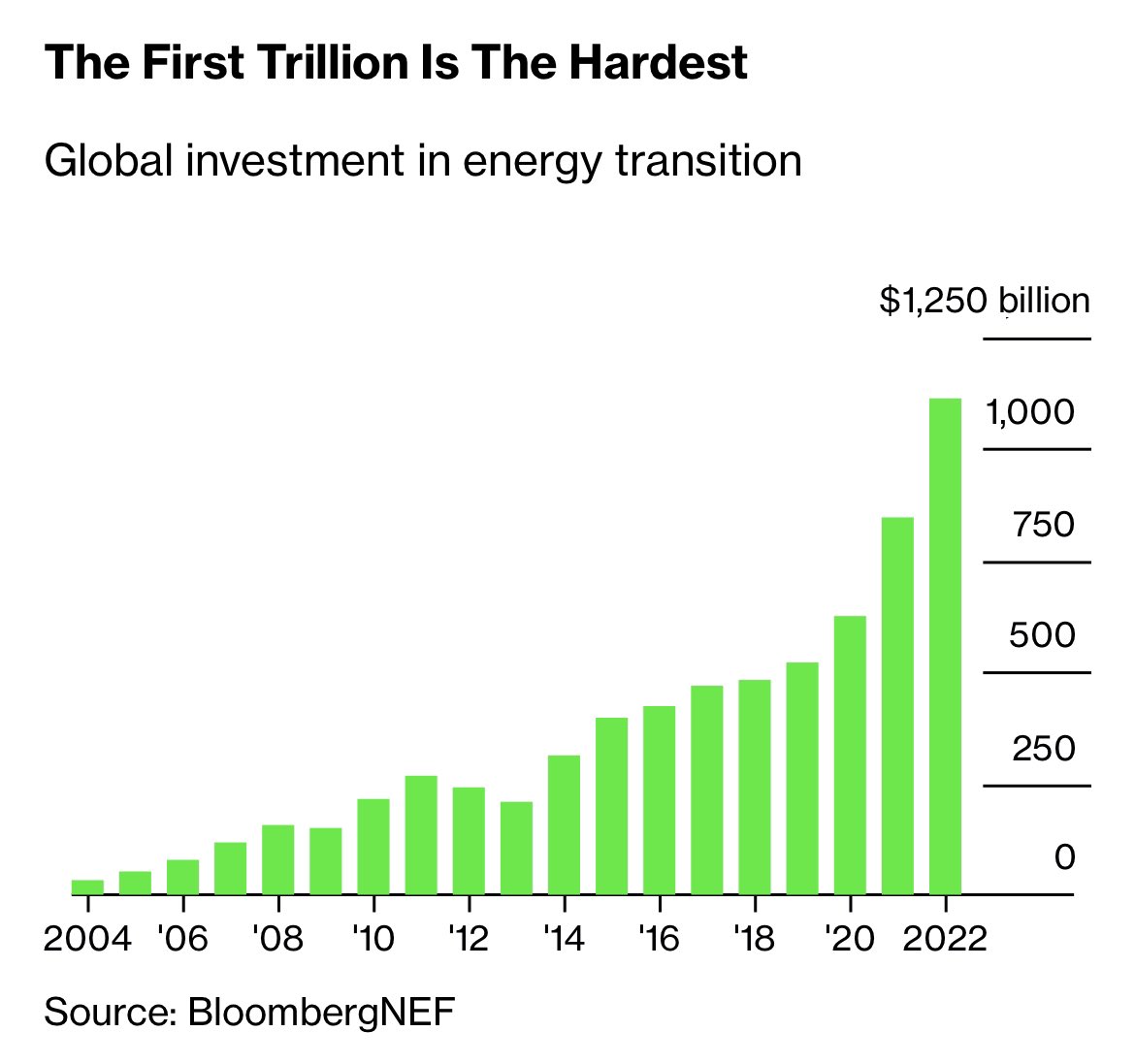
It took 8 years to reach the first $1 trillion in energy transition.
Less 4 years to reach the next trillion.
Less than 1 more year to reach the latest trillion.
1 dollar out of every 6 invested over the last 18 years flowed in 2022.
https://t.co/sAwIJ3xIZU
It is amazing how many people think that climate scientists are lying for money, while paying no attention to the trillions of dollars of revenue in the fossil fuel industry.
If scientists simply wanted to lie, they could be much better paid by the other side.
BREAKING: Heat pump market in Finland grew by 50% in 2022.
1.5m heat pumps have now been installed in a country with just 2.7m households.
https://t.co/nHXXDusF6m
1/5
Yesterday we @IEA published the 2023 Energy Technology Perspectives, led by my brilliant colleague @TimurGuel
This year's edition focused on clean technology supply chains.
Here are my three favourite charts


![kevg1412's tweet photo. In 2000, a ten year old schoolboy asked Warren Buffett if he was worried about the internet hurting his portfolio companies. The following year, after the internet bubble had begun to pop, he asked Warren if his views on the internet had changed.
15+ years later, in 2017, the schoolboy, now 27 years old and a professional internet investor at his ~20th consecutive Berkshire Hathaway annual meeting, updated his question and asked Warren about the implications of AI on his portfolio.
After hearing Warren's response and reflecting on it, as well as thinking about where his competitive advantages lay and the future he foresaw, he decided to focus on climate and sustainability. And today, he leads sustainability research for Counterpoint Global (home of the great teacher @mjmauboussin), and the subject of this weekend's letter:
Letter #102: Tom Kamei (2023)
This weekend's letter was an essay by written by Tom Kamei, adapted from a talk he gave at Notre Dame. In this letter, Tom discusses the shift from tangible to intangible investments, compares the sustainability wave to the digital wave, sustainability going mainstream, millennials as catalysts, sustainability through a prism, the convergence of profits and purpose, flaws in existing frameworks, measuring externalities, and much more.
Tom is an investor for Counterpoint Global and leads the Sustainability Research integration strategy for the US based funds managed by the team. He was a Fellow at The Aspen Institute in 2015 where he developed a proprietary process to quantify executive compensation alignment. Prior to his current role, Thomas worked with Counterpoint Global for two years as an intern. Previously, he was a research intern at Kleiner Perkins Caufield & Byers where he analyzed late stage private technology businesses for the Green Technology Growth Fund. Thomas received a B.S. in architectural studies from the University of Southern California.
Tom is also one of the most interesting investors out there—he’s an architect by training, a value investor by principle, a tech analyst by practice, and a sustainability researcher by purpose. If you’re wondering how that’s possible, so did I.
The answer is quite simple: He’s been going to the Berkshire Hathaway Annual Meeting every year since 1997, had the pleasure of asking Warren and Charlie several questions (pasted below), and taken their answers seriously.
TK Berkshire Questions:
2000: My name is Thomas Kamei. I am 10 years old and I go to Bacich School in Kentfield, California. I have been a shareholder for two years. This is my third annual meeting. Here’s my question: I know you won’t invest in technology companies, but are you afraid that the internet will hurt some of the companies that you do invest in, such as The Washington Post or Wells Fargo? Thank you. (Morning Session, Question 5.)
2001: Good morning. My name is Thomas Kamei. I am 11 years old and from Kentfield, California. This is my fourth annual meeting. Last year, I asked how the internet might affect some of your holdings. Since a lot of the internet companies have gone out of business, how are — has your view of internet changed? (Morning Session, Question 15.)
2002: Mr. Buffett and Mr. Munger, my name is Thomas Kamei. I am 12 years old. I live in Kentfield, California. This is my fifth annual meeting. I know you lost a lot of money as a result of 9/11. But I would like to know how 9/11 changed your life and your investment strategy? (Morning Session, Question 18.)
2007: Good morning. I’m Thomas Kamei from San Francisco. I’m 17-years-old and this is my tenth consecutive annual meeting. Mr. Buffett and Mr. Munger, I’m curious about what you think is the best way to become a better investor. Should I get an MBA? Get more work experience? Read more Charlie Munger Almanacs or merely is it genetic and out of my hands? (Morning Session, Question 14.)
2017: Hi, Warren. This one’s a fun one. Thomas Kamei is here. He’s a 27-year-old shareholder from Kentfield, California. And I should preface this question by saying that he was here 17 years ago at 10 years old, asked you a question from the audience asking you if the internet might hurt some of Berkshire’s investments. At the time, you said you wanted to see how things would play out. He’s now updated the question. “What do you think about the implications of artificial intelligence on Berkshire’s businesses, beyond autonomous driving and GEICO, which you’ve talked about already? In your conversations with Bill Gates, have you thought through which other businesses will be most impacted? “And do you think Berkshire’s current businesses will have a significantly — will have significantly more or less employees a decade from now as a function of artificial intelligence?”(Afternoon Session, Question 13.)
Two decades after asking Warren and Charlie about the internet, and after one decade as an internet analyst, Tom is now focused on sustainability research and investing. He has total conviction that the for-profit mechanism is a powerful lever to unleash humanity’s ingenuity and can help solve society’s most intractable issues while creating trillions of equity value along the way.
I hope you enjoy this essay as much as I did!
[Full Essay in Bio]](https://pbs.twimg.com/media/F10WadhaUAAz63w.jpg)




![kevg1412's tweet photo. In 2000, a ten year old schoolboy asked Warren Buffett if he was worried about the internet hurting his portfolio companies. The following year, after the internet bubble had begun to pop, he asked Warren if his views on the internet had changed.
15+ years later, in 2017, the schoolboy, now 27 years old and a professional internet investor at his ~20th consecutive Berkshire Hathaway annual meeting, updated his question and asked Warren about the implications of AI on his portfolio.
After hearing Warren's response and reflecting on it, as well as thinking about where his competitive advantages lay and the future he foresaw, he decided to focus on climate and sustainability. And today, he leads sustainability research for Counterpoint Global (home of the great teacher @mjmauboussin), and the subject of this weekend's letter:
Letter #102: Tom Kamei (2023)
This weekend's letter was an essay by written by Tom Kamei, adapted from a talk he gave at Notre Dame. In this letter, Tom discusses the shift from tangible to intangible investments, compares the sustainability wave to the digital wave, sustainability going mainstream, millennials as catalysts, sustainability through a prism, the convergence of profits and purpose, flaws in existing frameworks, measuring externalities, and much more.
Tom is an investor for Counterpoint Global and leads the Sustainability Research integration strategy for the US based funds managed by the team. He was a Fellow at The Aspen Institute in 2015 where he developed a proprietary process to quantify executive compensation alignment. Prior to his current role, Thomas worked with Counterpoint Global for two years as an intern. Previously, he was a research intern at Kleiner Perkins Caufield & Byers where he analyzed late stage private technology businesses for the Green Technology Growth Fund. Thomas received a B.S. in architectural studies from the University of Southern California.
Tom is also one of the most interesting investors out there—he’s an architect by training, a value investor by principle, a tech analyst by practice, and a sustainability researcher by purpose. If you’re wondering how that’s possible, so did I.
The answer is quite simple: He’s been going to the Berkshire Hathaway Annual Meeting every year since 1997, had the pleasure of asking Warren and Charlie several questions (pasted below), and taken their answers seriously.
TK Berkshire Questions:
2000: My name is Thomas Kamei. I am 10 years old and I go to Bacich School in Kentfield, California. I have been a shareholder for two years. This is my third annual meeting. Here’s my question: I know you won’t invest in technology companies, but are you afraid that the internet will hurt some of the companies that you do invest in, such as The Washington Post or Wells Fargo? Thank you. (Morning Session, Question 5.)
2001: Good morning. My name is Thomas Kamei. I am 11 years old and from Kentfield, California. This is my fourth annual meeting. Last year, I asked how the internet might affect some of your holdings. Since a lot of the internet companies have gone out of business, how are — has your view of internet changed? (Morning Session, Question 15.)
2002: Mr. Buffett and Mr. Munger, my name is Thomas Kamei. I am 12 years old. I live in Kentfield, California. This is my fifth annual meeting. I know you lost a lot of money as a result of 9/11. But I would like to know how 9/11 changed your life and your investment strategy? (Morning Session, Question 18.)
2007: Good morning. I’m Thomas Kamei from San Francisco. I’m 17-years-old and this is my tenth consecutive annual meeting. Mr. Buffett and Mr. Munger, I’m curious about what you think is the best way to become a better investor. Should I get an MBA? Get more work experience? Read more Charlie Munger Almanacs or merely is it genetic and out of my hands? (Morning Session, Question 14.)
2017: Hi, Warren. This one’s a fun one. Thomas Kamei is here. He’s a 27-year-old shareholder from Kentfield, California. And I should preface this question by saying that he was here 17 years ago at 10 years old, asked you a question from the audience asking you if the internet might hurt some of Berkshire’s investments. At the time, you said you wanted to see how things would play out. He’s now updated the question. “What do you think about the implications of artificial intelligence on Berkshire’s businesses, beyond autonomous driving and GEICO, which you’ve talked about already? In your conversations with Bill Gates, have you thought through which other businesses will be most impacted? “And do you think Berkshire’s current businesses will have a significantly — will have significantly more or less employees a decade from now as a function of artificial intelligence?”(Afternoon Session, Question 13.)
Two decades after asking Warren and Charlie about the internet, and after one decade as an internet analyst, Tom is now focused on sustainability research and investing. He has total conviction that the for-profit mechanism is a powerful lever to unleash humanity’s ingenuity and can help solve society’s most intractable issues while creating trillions of equity value along the way.
I hope you enjoy this essay as much as I did!
[Full Essay in Bio]](https://pbs.twimg.com/media/F10W-f-aQAE5sgA.jpg)