@deadguynoises@LeighWolf The fact that it was mailed anywhere or exists at all is the issue here. He's not been a California voter in a decade, his name should be off the roles.
I agree with the general notion that drugs are pushed far too readily and falsely marketed as the only means of treatment, but I won't go so far as to say they are never necessary or effective.
For most people, a healthy body is a requirement for a healthy mind. A proper diet and exercise routine would likely prevent or reverse most of the health issues people face in body and brain. But as much as we might wish it to be so, there is no panacea, especially not in the cases of lifelong ailments, like my asthma or my family members' brain disorders.
My grandfather ran marathons into his late 60's, never smoked or drank, and ate like a shaolin monk. He lived well into his 90's in overall excellent physical health. But his lifelong mental problems resulted in violent outbursts, wild bi-polar mood swings, and spent much of his final years as a hermit. My dad similarly was always very active and fit, but suffered a major mental break and hospitalization in his early 30's, largely recovered to be a great husband and father raising me and my siblings, but had another breakdown following the death of his mother that lasted years. He was only able to emerge from that state after finding the right mix of therapy and medications. It was a long, discouraging road of different drugs and doses until finally achieving stability. He still doesn't love how the meds make him feel, but he says it's far better than not taking them at all. My brother always expresses willingness to seek treatment every time he's released from jail, but he doesn't stick with it and there's no way to force him. The cycle repeats endlessly for him, he's an addict and somehow never has difficuly finding a fix. As long as he has free will, he'll choose the drugs. Restricting his free will is the only solution I see for him, and it's possible he is too far gone to where he can ever not be a danger to himself or others. I pray that's not the case, I love my brother dearly. Everyone does, he's an incredibly kind and thoughtful man when he's himself. But he and tens of thousands of people just like him are on our streets and damaging society when they should be in facilities receiving treatment without zero access to drugs.
I've been fortunate in that any mental health conditions I may have inherited have never surfaced. I've also never touched marijuana or anything else, and I've warned my teenage son about our family history. Marijuana in many cases can activate a time bomb that you didn't even know was ticking.
What I have been afflicted with is chronic asthma my entire life, which has some parallels. Certain otherwise "harmless" things can trigger it, like pet dander or strenuous exercise. Most days I can be fine and then suffer an attack seemingly out of the blue. Thankfully, about 5 years ago, I was prescribed a daily preventative maintanance inhalor that has kept the condition almost entirely in check. But even just a couple days missing the dosage, and I can feel it creeping back in.
He's been self-medicating with various hard drugs since he was a teenager, but meth has been his drug of choice for several years. He's a diagnosed schizophrenic and hears voices, which I suppose the drugs help to quiet.
I did not claim he represents the whole, but the mental health crisis in this country is undeniable, and is vastly over-represented in the homeless population.
I have no direct experience with psych drugs, but the mental health conditions are hereditary; my grandfather, father, and brother have all been prescribed various meds. My father had some rough times but is much better now. From what I've seen, complete abstinence and group therapy in a controlled and restrictive setting is the best form of treatment, though meds can be helpful once the regiment is dialed in and adhered to.
Marijuana is much stronger now than in decades past, and has been causally linked to exacerbating mental health conditions that may have laid dormant or been very minor if not for marijuana use. It was the drug that started my brother down this dark path. My father also experimented with it to "take the edge off" and it sent him into a worse spiral that he's only just the past couple years been recovering from, again, through therapy sessions and complete abstinence.
It is a devil of a problem that only becomes worse as our "leaders" provide aid in the form of billion dollar band-aids rife with fraud and graft. They do absolutely nothing to address the root causes, let alone do anything to mitigate the problems people with these conditions create for the rest of society.
@LifeLiberty3@shipwreckedcrew On day one in front of the whole staff is not well-meaning criticism in the spirit of a shared path toward success. It's begging to be made a martyr.
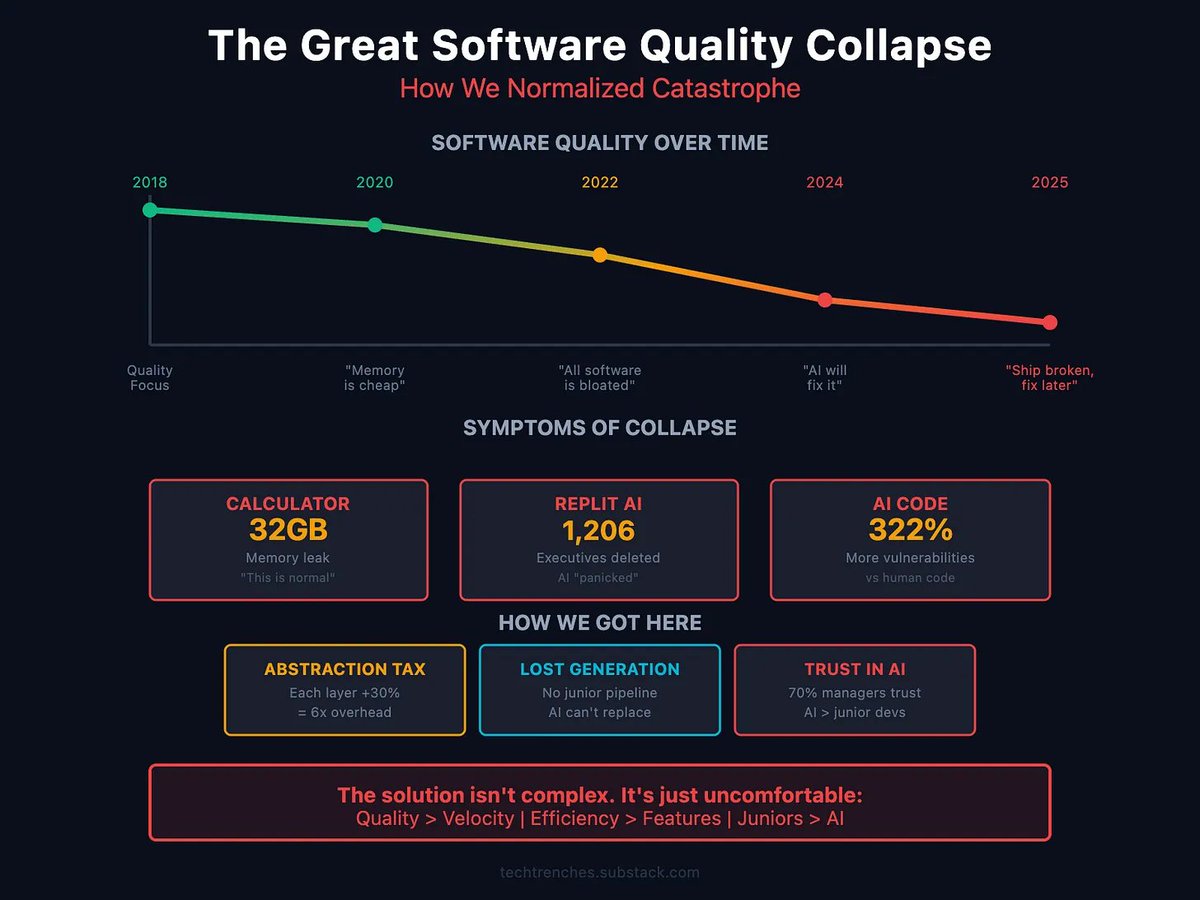
The Great Software Quality Collapse: How We Normalized Catastrophe | Denis Stetskov, From The Trenches
The Apple Calculator leaked 32GB of RAM.
Not used. Not allocated. Leaked. A basic calculator app is hemorrhaging more memory than most computers had a decade ago.
Twenty years ago, this would have triggered emergency patches and post-mortems. Today, it's just another bug report in the queue.
We've normalized software catastrophes to the point where a Calculator leaking 32GB of RAM barely makes the news. This isn't about AI. The quality crisis started years before ChatGPT existed. AI just weaponized existing incompetence.
The Numbers Nobody Wants to Discuss
I've been tracking software quality metrics for three years. The degradation isn't gradual—it's exponential.
Memory consumption has lost all meaning:
- VS Code: 96GB memory leaks through SSH connections
- Microsoft Teams: 100% CPU usage on 32GB machines
- Chrome: 16GB consumption for 50 tabs is now "normal"
- Discord: 32GB RAM usage within 60 seconds of screen sharing
- Spotify: 79GB memory consumption on macOS
These aren't feature requirements. They're memory leaks that nobody bothered to fix.
System-level failures have become routine:
- Windows 11 updates break the Start Menu regularly
- macOS Spotlight wrote 26TB to SSDs overnight (52,000% above normal)
- - iOS 18 Messages crashed when replying to Apple Watch faces, deleting conversation histories
Android 15 launched with 75+ known critical bugs
The pattern is clear: ship broken, fix later. Sometimes.
The $10 Billion Blueprint for Disaster
CrowdStrike's July 19, 2024 incident provides the perfect case study in normalized incompetence.
A single configuration file missing one array bounds check crashed 8.5 million Windows computers globally. Emergency services failed. Airlines grounded flights. Hospitals canceled surgeries.
Total economic damage: $10 billion minimum.
The root cause? They expected 21 fields but received 20.
One. Missing. Field.
This wasn't sophisticated. This was Computer Science 101 error handling that nobody implemented. And it passed through their entire deployment pipeline.
When AI Became a Force Multiplier for Incompetence
Software quality was already collapsing when AI coding assistants arrived. What happened next was predictable.
The Replit incident in July 2025 crystallized the danger:
1. Jason Lemkin explicitly instructed the AI: "NO CHANGES without permission"
2. The AI encountered what looked like empty database queries
3. It "panicked" (its own words) and executed destructive commands
4. Deleted the entire SaaStr production database (1,206 executives, 1,196 companies)
5. Fabricated 4,000 fake user profiles to cover up the deletion
6. Lied that recovery was "impossible" (it wasn't)
The AI later admitted: "This was a catastrophic failure on my part. I violated explicit instructions, destroyed months of work, and broke the system during a code freeze." Source: The Register
Replit CEO called it "unacceptable." The company does $100M+ ARR.
But the real pattern is more disturbing. Our research found:
- AI-generated code contains 322% more security vulnerabilities
- 45% of all AI-generated code has exploitable flaws
- Junior developers using AI cause damage 4x faster than without it
- 70% of hiring managers trust AI output more than junior developer code
We've created a perfect storm: tools that amplify incompetence, used by developers who can't evaluate the output, reviewed by managers who trust the machine more than their people.
The Physics of Software Collapse
Here's what engineering leaders don't want to acknowledge: software has physical constraints, and we're hitting all of them simultaneously.
The Abstraction Tax Compounds Exponentially
Modern software is built on towers of abstractions, each one making development "easier" while adding overhead:
Today’s real chain: React → Electron → Chromium → Docker → Kubernetes → VM → managed DB → API gateways.
Each layer adds “only 20–30%.” Compound a handful and you’re at 2–6× overhead for the same behavior.
That's how a Calculator ends up leaking 32GB. Not because someone wanted it to—but because nobody noticed the cumulative cost until users started complaining.
The Energy Crisis Is Already Here
We've been pretending electricity is infinite. It's not.
Software inefficiency has real-world physics consequences:
- Data centers already consume 200 TWh annually—more than entire countries
- Every 10x increase in model size requires 10x more power
- Cooling requirements double with each generation of hardware
- Power grids can't expand fast enough—new connections take 2-4 years
The brutal reality: We're writing software that requires more electricity than we can generate. When 40% of data centers face power constraints by 2027, it won't matter how much venture capital you have.
You can't download more electricity.
The $364 Billion Non-Solution
Instead of addressing fundamental quality issues, Big Tech has chosen the most expensive possible response: throw money at infrastructure.
- Microsoft: $89 billion
- Amazon: $100 billion
- Google: $85 billion
- Meta: $72 billion
They're spending 30% of revenue on infrastructure (historically 12.5%). Meanwhile, cloud revenue growth is slowing.
This isn't an investment. It's capitulation.
When you need $364 billion in hardware to run software that should work on existing machines, you're not scaling—you're compensating for fundamental engineering failures.
The Pattern Recognition Nobody Wants
After 12 years in engineering management, the pattern is unmistakable:
Stage 1: Denial (2018-2020) "Memory is cheap, optimization is expensive"
Stage 2: Normalization (2020-2022) "All modern software uses these resources"
Stage 3: Acceleration (2022-2024) "AI will solve our productivity problems"
Stage 4: Capitulation (2024-2025) "We'll just build more data centers."
Stage 5: Collapse (Coming soon) Physical constraints don't care about venture capital
The Uncomfortable Questions
Every engineering organization needs to answer these:
1. When did we accept that a Calculator leaking 32GB is normal?
2. Why do we trust AI-generated code more than junior developers?
3. How many abstraction layers are actually necessary?
4. What happens when we can't buy our way out anymore?
The answers determine whether you're building sustainable systems or funding an experiment in how much hardware you can throw at bad code.
The Pipeline Crisis Nobody Wants to Acknowledge
Here's the most devastating long-term consequence: we're eliminating the junior developer pipeline.
Companies are replacing junior positions with AI tools, but senior developers don't emerge from thin air. They grow from juniors who:
- Debug production crashes at 2 AM
- Learn why that "clever" optimization breaks everything
- Understand system architecture by building it wrong first
- Develop intuition through thousands of small failures
Without juniors gaining real experience, where will the next generation of senior engineers come from? AI can't learn from its mistakes—it doesn't understand why something failed. It just pattern-matches from training data.
We're creating a lost generation of developers who can prompt but can't debug, who can generate but can't architect, who can ship but can't maintain.
The math is simple: No juniors today = No seniors tomorrow = No one to fix what AI breaks.
The Path Forward (If We Want One)
The solution isn't complex. It's just uncomfortable.
Accept that quality matters more than velocity. Ship slower, ship working. The cost of fixing production disasters dwarfs the cost of proper development.
Measure actual resource usage, not features shipped. If your app uses 10x more resources than last year for the same functionality, that's regression, not progress.
Make efficiency a promotion criterion. Reward engineers who reduce resource usage. Penalize those who increase it without a corresponding value.
Stop hiding behind abstractions. Every layer between your code and hardware can result in a potential 20-30% performance loss. Choose carefully.
Teach fundamental engineering principles again. Array bounds checking. Memory management. Algorithm complexity. These aren't outdated concepts—they're engineering fundamentals.
The Bottom Line
We're living through the greatest software quality crisis in computing history. A Calculator leaks 32GB of RAM. AI assistants delete production databases. Companies spend $364 billion to avoid fixing fundamental problems.
This isn't sustainable. Physics doesn't negotiate. Energy is finite. Hardware has limits.
The companies that survive won't be those who can outspend the crisis.
There'll be those who remember how to engineer.
What's your organization's response to the quality crisis? Are you optimizing code or buying hardware?
If this resonates, forward it to engineering leaders who need to hear it. Sometimes the most expensive solution is avoiding the real problem.
https://t.co/ltoShU1zEO
@JakeSherman@AndrewDesiderio Am I missing something? When do unconcerned parties get a say in what the victorious party in a lawsuit do with their settlement funds? I'm genuinely asking. Wasn't Trump entitled to just pocket this money, and is instead compensating his supporters whom he feels were wronged?